Sarga 56
चित्रकूटगमनम् तथा पर्णशालाप्रवेशः (Arrival at Chitrakuta and Establishing the Leaf-Hut)
अयोध्याकाण्ड
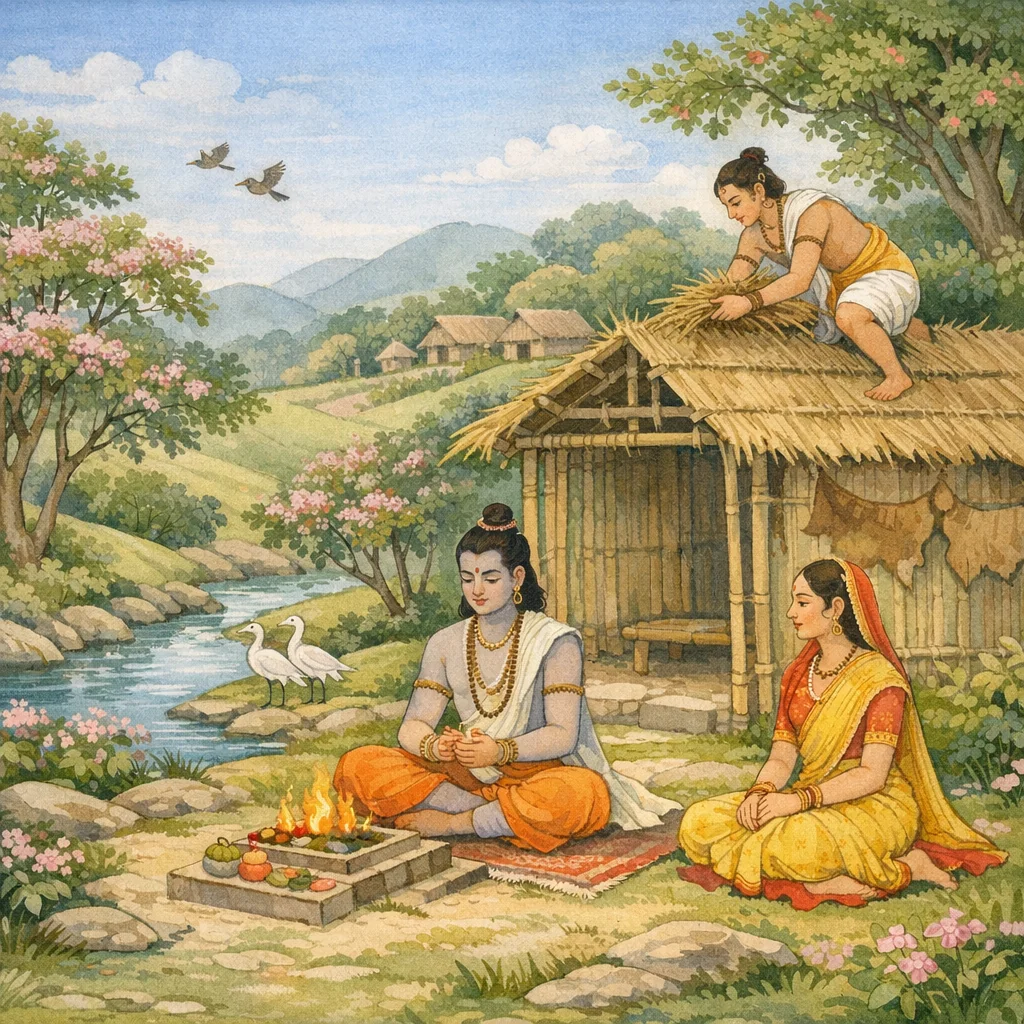
After the night passes, Rāma gently awakens Lakṣmaṇa and signals the time to proceed, framing the departure within attentiveness to the forest’s auspicious sounds. The party follows the route indicated by the sage (contextually, Bhāradvāja) toward Citrakūṭa, while Rāma draws Sītā’s attention to seasonal bloom and abundance—trees, honeycombs, birds, and elephants—presenting the landscape as both refuge and disciplined habitat. Reaching the mountain, Rāma evaluates it as suitable for residence because of water, roots, fruits, and the presence of great sages. They approach Vālmīki’s hermitage, offer respectful salutations, and are welcomed and seated. Rāma then directs Lakṣmaṇa to build a sturdy dwelling; once the leaf-hut is completed, Rāma prescribes vāstu-śamana rites (propitiation of the presiding household deity), including offerings of venison, mantra-recitation, bathing, and bali to multiple deities (Viśvadevas, Rudra, Viṣṇu). Rāma establishes altars and sacred fire-spots befitting a hermitage, propitiates beings with forest offerings, and the three enter the hut together, likened to gods entering Sudharmā, concluding with serene enjoyment in the rich woodland environment.
Shlokas
Verse 1
अथ रात्र्यां व्यतीतायामवसुप्तमनन्तरम्।प्रबोधयामास शनैर्लक्ष्मणं रघुनन्दनः।।।।
When the night had passed, Rāma—the delight of the Raghu line—gently awakened Lakṣmaṇa, who was sleeping.
Verse 2
सौमित्रे श्रुणु वन्यानां वल्गु व्याहरतां स्वनम्।सम्प्रतिष्ठामहे काल प्रस्थानस्य परन्तप।।।।
O Saumitri, listen to the sweet calls of the forest birds. O subduer of enemies—now is the time for us to set out.
Verse 3
स सुप्तस्समये भ्रात्रा लक्ष्मणः प्रतिबोधितः।जहौ निद्रां च तन्द्रीं च प्रसक्तं च पथि श्रमम्।।।।
Awakened at the proper time by his brother, Lakṣmaṇa cast off sleep and drowsiness, and also the travel-weariness that clung to him on the road.
Verse 4
तत उत्थाय ते सर्वे स्पृष्ट्वा नद्या श्शिवं जलम्।पन्थानमृषिणाऽदिष्टं चित्रकूटस्य तं ययुः।।।।
Then they all rose, touched the river’s auspicious water, and proceeded along the path to Citrakūṭa that had been indicated by the sage.
Verse 5
ततस्सम्प्रस्थितः काले रामस्सौमित्रिणा सह।सीतां कमलपत्राक्षीमिदं वचनमब्रवीत्।।।।
Then, setting out at the proper time with Saumitrī (Lakṣmaṇa), Rāma spoke these words to Sītā, whose eyes were like lotus petals.
Verse 6
आदिप्तानिव वैदेहि सर्वतः पुष्पितान्नगान्।स्वैः पुष्पैः किंशुकान् पश्य मालिनशिशिरात्यये।।।।
O Vaidehī, look at the kiṃśuka trees—blooming everywhere at winter’s end—appearing as though aflame, garlanded by their own flowers.
Verse 7
पश्य भल्लातकान् फुल्लान्नरै रनुपसेवितान्।फलपत्रैरवनता न्नूनं शक्ष्याम जीवितुम्।।।।
See these bhallātaka trees, in full bloom and yet unfrequented by people; bowed down with fruits and leaves—surely we shall be able to live here.
Verse 8
पश्य द्रोणप्रमाणानि लम्बमानानि लक्ष्मण।मधूनि मधुकारीभि स्सम्भृतानि नगे नगे।।।।
O Lakṣmaṇa, see—honeycombs as large as droṇa-measures, hanging down, stored up by bees on tree after tree.
Verse 9
एष क्रोशति नत्यूहस्तं शिखी प्रतिकूजति।रमणीये वनोद्देशे पुष्पसंस्तरसङ्कटे।।।।
Here the natyūha bird cries out, and the peacock answers it in call and countercall, in this lovely forest tract where the ground is thickly strewn with fallen flowers.
Verse 10
मातङ्गयूथानुसृतं पक्षिसंङ्घानुनादितम्।चित्रकूटमिमं पश्य प्रवृद्धशिखरं गिरिम्।।।।
Look at this mount Citrakūṭa, its peaks rising high—tracked by herds of elephants and resonant with the calls of flocks of birds.
Verse 11
समभूमितले रम्ये द्रुमैर्बहुभिरावृते।पुण्ये रंस्यामहे तात चित्रकूटस्य कानने।।।।
Dear brother, in this sacred forest of Citrakūṭa—lovely, level-grounded, and covered with many trees—let us dwell joyfully.
Verse 12
ततस्तौ पादचारेण गच्छन्तौ सह सीतया।रम्यमासेदतुश्शैलं चित्रकूटं मनोरमम्।।।।
Then the two of them, walking on foot with Sītā, reached the beautiful, delightful mountain of Citrakūṭa.
Verse 13
तन्तु पर्वतमासाद्य नानापक्षिगणायुतम्।बहुमूलफलं रम्यं सम्पन्नं सरसोदकम्।।।।
Reaching that mountain—thronged with many kinds of flocks of birds—rich in roots and fruits, lovely to behold, and well-supplied with clear, pleasant water, Rama spoke on.
Verse 14
मनोज्ञोऽयं गिरिस्सौम्य नानाद्रुमलतायुतः।बहुमूलफलो रम्य स्स्वाजीवः प्रतिभाति मे।।।।
O gentle one, this mountain is pleasing to the heart—filled with many kinds of trees and creepers, abundant in roots and fruits; it seems to me a wholesome place to live.
Verse 15
मुनयश्च महात्मानो वसन्त्यस्मि शिलोच्चये।अयं वासो भवेत्तावदत्र सौम्य रमेमहि।।।।
Great-hearted sages dwell upon this rocky height. Let this, for now, be our dwelling; here, O gentle one, let us live contentedly.
Verse 16
इति सीता च रामश्च लक्ष्मणश्च कृताञ्जलिः।अभिगम्याऽश्रमं सर्वे वाल्मीकि मभिवादयन्।।।।
Thus, Sita and Rama—and Lakshmana with palms joined—approached the hermitage; all of them paid reverence to sage Valmiki.
Verse 17
तान्महर्षि प्रमुदितः पूजयामास धर्मवित्।अस्यतामिति चोवाच स्वागन्तु निवेद्य च।।।।
Delighted, the great sage—knower of dharma—honored them, welcomed them, and said, “Be seated.”
Verse 18
ततोऽब्रवीन्महाबाहुर्लक्ष्मणं लक्ष्मणाग्रजः।सन्निवेद्य यथान्याय मात्मानमृषये प्रभुः।।।।
Then the mighty-armed one—the elder brother of Lakshmana—having duly introduced himself to the sage, spoke to Lakshmana.
Verse 19
लक्ष्मणाऽऽनय दारूणि दृढानि च वराणि च।कुरुष्वाऽवसथं सौम्य वासे मेऽभिरतं मनः।।।।
Lakshmana, bring strong and sound timbers. O gentle one, build a dwelling—my mind is set on staying here.
Verse 20
तस्य तद्वचनं श्रुत्वा सौमित्रिर्विविधान् द्रुमान्।आजहार तत श्चक्रे पर्णशालामरिन्दमः।।।।
Hearing his words, Saumitri—the subduer of enemies—brought various timbers, and then built a leaf-thatched hut.
Verse 21
तां निष्ठितां बद्धकटां दृष्ट्वा रामस्सुदर्शनाम्।शुश्रूषमाणमेकाग्रमिदं वचनमब्रवीत्।।।।
Seeing that well-made, handsome hut—firmly set and walled with bound mats—Rama spoke these words to Lakshmana, who stood attentive, waiting to serve.
Verse 22
ऐणेयं मांसमाहृत्य शालां यक्ष्यामहे वयम्।कर्तव्यं वास्तुशमनं सौमित्रे चिरजीविभिः।।।।
O Lakṣmaṇa, if we are to dwell here long, we must first propitiate the spirit presiding over this dwelling; therefore, we shall bring black-antelope venison and perform the proper offering for this hut.
Verse 23
मृगं हत्वाऽऽनय क्षिप्रं लक्ष्मणेह शुभेक्षण।कर्तव्य श्शास्त्रदृष्टो हि विधिर्धर्ममनुस्मर।।।।
O Lakṣmaṇa of auspicious gaze, kill an antelope and bring it here quickly; the rite taught by the śāstras must be performed—remember the path of dharma.
Verse 24
भ्रातुर्वचनमाज्ञाय लक्ष्मणः परवीरहा।चकार स यथोक्तं च तं राम पुनरब्रवीत्।।।।
Understanding his brother’s words, Lakṣmaṇa—slayer of the enemy’s champions—did exactly as instructed; then Rāma spoke to him again.
Verse 25
ऐणेयं श्रपयस्वैतच्छालां यक्ष्यामहे वयम्।त्वर सौम्य मुहूर्तोऽयं ध्रुवश्च दिवसोऽप्ययम्।।।।
Cook this black-antelope meat, O gentle one; we shall make the offering for this hut. Make haste—this hour is fixed, and this day too is appointed for the rite.
Verse 26
स लक्ष्मणः कृष्णमृगं मेध्यं हत्वा प्रतापवान्।अथ चिक्षेप सौमित्रिस्समिद्धे जातवेदसि।।।।
Then the powerful Lakṣmaṇa, son of Sumitrā, slew a pure black antelope fit for offering and cast it as an oblation into the well-kindled fire.
Verse 27
तन्तु पक्वं परिज्ञाय निष्टप्तं छिन्नशोणितम्।लक्ष्मण: पुरुषव्याघ्रमथ राघवमब्रवीत्।।।।
Seeing that it was fully cooked—well roasted and with its blood drained—Lakṣmaṇa then spoke to Rāghava, the tiger among men.
Verse 28
अयं सर्व: समस्ताग्ङ: श्रृत: कृष्णमृगो मया।देवतां देवसङ्काश यजस्व कुशलो ह्यसि।।।।
This black antelope, complete in all its limbs, has been well cooked by me. O you who shine like a god, offer it to the deity—you are skilled in the rite.
Verse 29
राम: स्नात्वा तु नियतो गुणवान् जप्यकोविदः।सङ्ग्रहेणाकरोत् स्रवार्न मन्त्रान् सत्रावसानिकान्।।।।
Rāma—virtuous, restrained, and skilled in the recitation of mantras—bathed, composed himself, and then succinctly uttered all the mantras proper to the rite’s completion.
Verse 30
इष्ट्वा देवगणान्सर्वान्विवेशाऽवसथं शुचिः।बभूव च मनोह्लादो रामस्यामिततेजसः।।।।
Having worshipped all the hosts of gods and thus become purified, Rāma entered the dwelling; and for that Rāma of immeasurable radiance, a deep gladness arose in his heart.
Verse 31
वैश्वदेवबलिं कृत्वा रौद्रं वैष्णव मेव च।वास्तुसंशमनीयानि मङ्गलानि प्रवर्तयन्।।।।जपं च न्यायत कृत्वा स्नात्वा नद्यां यथाविधि।पापसंशमनं राम श्चकार बलिमुत्तमम्।।।।
After offering the oblation to the Viśvedevas—along with offerings to Rudra and to Viṣṇu—Rāma set in motion the auspicious rites meant to pacify the Vāstu-deity of the dwelling.
Verse 32
वैश्वदेवबलिं कृत्वा रौद्रं वैष्णव मेव च।वास्तुसंशमनीयानि मङ्गलानि प्रवर्तयन्।।2.56.31।।जपं च न्यायत कृत्वा स्नात्वा नद्यां यथाविधि।पापसंशमनं राम श्चकार बलिमुत्तमम्।।2.56.32।।
And after performing japa in the proper, rule-bound manner, and bathing in the river as prescribed, Rāma made an excellent final offering intended for the calming and removal of sin.
Verse 33
वेदिस्थलविधानानि चैत्यान्यायतनानि च।आश्रमस्यानुरूपाणि स्थापयामास राघवः।।।।
Rāghava established, in a manner befitting a hermitage, the proper arrangements for altar-sites, places of worship, and sacred enclosures.
Verse 34
वन्यैर्माल्यैः फलैर्मूलैः पक्वैर्मांसैर्यथाविधि।अद्भिर्जपैश्च वेदोक्तैर्दर्भैश्च ससमित्कुशैः।।।।तौ तर्पयित्वा भूतानि राघवौ सह सीतया।तदा विविशतु श्शालां सुशुभां शुभलक्षणौ।।।।
Using forest garlands, fruits, roots, properly prepared meats, along with water, Veda-prescribed prayers, darbha grass, and fuel-sticks with kuśa grass—according to rule—
Verse 35
तां वृक्षपर्णच्छदनां मनोज्ञां यथाप्रदेशं सुकृतां निवाताम्।वासाय सर्वे विविशुस्समेतास्सभां यथा देवगणास्सुधर्माम्।।2.56.36।।
Having thus satisfied the beings (of the place), the two Rāghavas—together with Sītā—then entered the splendid hut, both marked by auspicious qualities.
Verse 36
तां वृक्षपर्णच्छदनां मनोज्ञां यथाप्रदेशं सुकृतां निवाताम्।वासाय सर्वे विविशुस्समेतास्सभां यथा देवगणास्सुधर्माम्।।।।
All of them, gathered together, entered that leaf-thatched hut to dwell there—charming, well made, set upon a fitting spot, and sheltered from wind—just as the hosts of gods enter the assembly-hall Sudharmā.
Verse 37
अनेकनानामृगपक्षिसङ्कुले विचित्रपत्रस्तबकैर्द्रुमैर्युते।वनोत्तमे व्यालमृगानुनादिते तदा विजह्रु स्सुसुखं जितेन्द्रियाः।।।।
Then, self-restrained and masters of their senses, they roamed with great ease in that excellent forest—crowded with many kinds of beasts and birds, rich with trees bearing variegated clusters of foliage, and resonant with the calls of wild creatures.
Verse 38
सुरम्यमासाद्य तु चित्रकूटं नदीं च तां माल्यवतीं सुतीर्थाम्।ननन्द हृष्टो मृगपक्षिजुष्टां जहौ च दुखं पुरविप्रवासात्।।।।
Having reached the exceedingly beautiful Citrakūṭa, and the river Mālyavatī with its fine fords, Rāma rejoiced, gladdened by a land frequented by beasts and birds, and he let go the sorrow born of exile from the city.
Frequently Asked Questions
The central action is the deliberate establishment of a lawful residence in exile: Rāma insists that even in the forest, habitation must be ritually and ethically ordered (vāstu-śamana and prescribed offerings), showing that dharma governs circumstance rather than being suspended by hardship.
The chapter teaches that serenity arises from right practice: attunement to nature’s auspicious signs, humility toward sages, and scripturally guided rites together transform exile from mere deprivation into a disciplined, meaningful mode of life.
Key landmarks include Mount Citrakūṭa and the Mālyavatī river, framed as sacred and resource-rich; culturally, the hermitage system (Vālmīki’s āśrama), leaf-hut architecture, and Vedic-style bali/mantra observances map the forest as a regulated sacred geography.