Sarga 49
एकोनपञ्चाशः सर्गः (Sarga 49): Rāma’s Night Journey Beyond Kosala and the Charioteer Address
अयोध्याकाण्ड
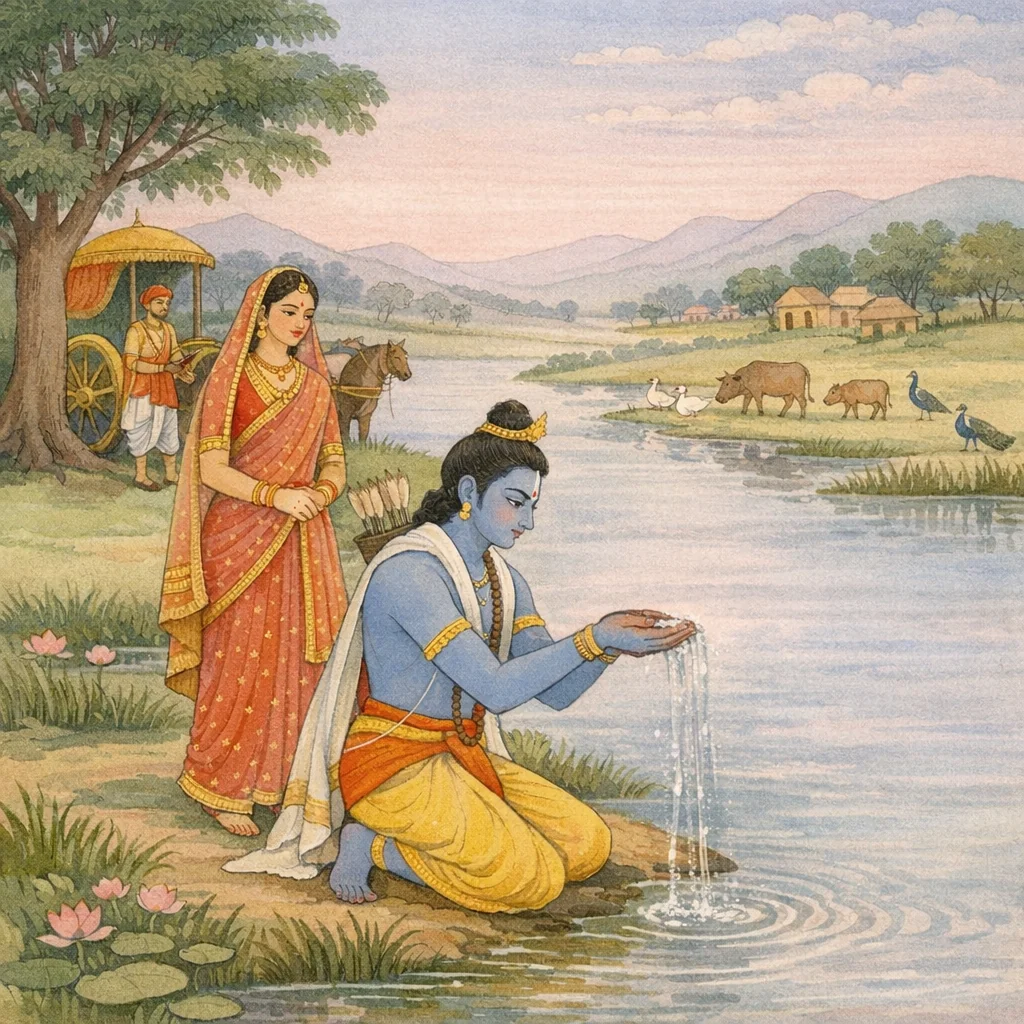
This sarga tracks Rāma’s rapid progress during the final portion of night as he recollects Daśaratha’s command, framing exile as a consciously maintained ethical vow rather than mere displacement. At dawn, after worshipping the auspicious morning sandhyā, he reaches and then crosses the frontiers of Kosala, while overhearing villagers’ critiques of Daśaratha’s passion-driven decision and Kaikeyī’s breach of decorum; these public voices supply an external moral audit of the royal household. The chapter then shifts into itinerary-detail: Rāma crosses the sacred river Vedāśruti and proceeds southward toward the quarter associated with Agastya; after extended travel he crosses the cool-watered Gomati (noted for marshy banks with grazing cattle) and then the Syandikā, resonant with peacocks and swans. Rāma shows Sītā vast tracts of land traditionally linked to Manu’s grant to Ikṣvāku, embedding political geography within dynastic memory. Repeatedly addressing the charioteer as “sūta,” Rāma speaks in a sweet, swan-like (haṃsamattasvara) tone, voicing longing for return to Sarayū’s blossoming groves and reflecting on hunting as a royal-sage pastime—pleasurable yet not his dominant desire—thus balancing kṣatriya culture with self-restraint.
Shlokas
Verse 1
रामोऽपि रात्रिशेषेण तेनैव महदन्तरम्।जगाम पुरुषव्याघ्रः पितुराज्ञामनुस्मरन्।।।।
Rāma too—tiger among men—traveled a great distance in the remaining hours of the night, keeping his father’s command continually in mind.
Verse 2
तथैव गच्छतस्तस्य व्यपायाद्रजनी शिवा।उपास्य शिवां सन्ध्यां विषयान्तं व्यगाहत।।।।
As he continued his journey in the same manner, the auspicious night came to an end. After performing worship at the auspicious morning twilight (sandhyā), he entered the frontier region of the country.
Verse 3
ग्रामान् विकृष्टसीमान्तान् पुष्पितानि वनानि च।पश्यन्नतिययौ शीघ्रं शनैरिव हयोत्तमैः।।।।शृण्वन् वचो मनुष्याणां ग्रामसंवासवासिनाम्।
He beheld villages with their outskirts freshly furrowed, and forests in bloom. Listening to the talk of people living amid the village settlements, he travelled swiftly on excellent horses—yet it felt to him as though he were moving slowly.
Verse 4
राजानं धिग्दशरथं कामस्य वशमागतम्।।।।हा नृशंसाद्य कैकेयी पापा पापानुबन्धिनी।तीक्ष्णा सम्भिन्नमर्यादा तीक्ष्णकर्मणि वर्तते।।।।या पुत्रमीदृशं राज्ञः प्रवासयति धार्मिकम्।वनवासे महाप्राज्ञं सानुक्रोशं जितेन्द्रियम्।।।।
“Shame on King Daśaratha, who has fallen under the sway of desire! Alas—today that ruthless Kaikeyī, sinful and bent on sin, has shattered all bounds of propriety and is set on a cruel deed: she is sending the king’s son—so righteous, so wise, compassionate, and self-restrained—away to live in the forest.”
Verse 5
राजानं धिग्दशरथं कामस्य वशमागतम्।।2.49.4।।हा नृशंसाद्य कैकेयी पापा पापानुबन्धिनी।तीक्ष्णा सम्भिन्नमर्यादा तीक्ष्णकर्मणि वर्तते।।2.49.5।।या पुत्रमीदृशं राज्ञः प्रवासयति धार्मिकम्।वनवासे महाप्राज्ञं सानुक्रोशं जितेन्द्रियम्।।2.49.6।।
“Alas—today that pitiless Kaikeyī, sinful and devoted to sin, has broken all bounds of decorum and is intent on a cruel deed.”
Verse 6
राजानं धिग्दशरथं कामस्य वशमागतम्।।2.49.4।।हा नृशंसाद्य कैकेयी पापा पापानुबन्धिनी।तीक्ष्णा सम्भिन्नमर्यादा तीक्ष्णकर्मणि वर्तते।।2.49.5।।या पुत्रमीदृशं राज्ञः प्रवासयति धार्मिकम्।वनवासे महाप्राज्ञं सानुक्रोशं जितेन्द्रियम्।।2.49.6।।
“She is the one who drives into exile the king’s son—such a man: righteous, profoundly wise, compassionate, and master of his senses—sending him to dwell in the forest.”
Verse 7
कथं नाम महाभागा सीता जनकनन्दिनी।सदा सुखेष्वभिरता दुःखान्यनुभविष्यति।।।।
“How indeed will Sītā—so fortunate, Janaka’s daughter, ever accustomed to comforts—come to endure hardships?”
Verse 8
अहो दशरथो राजा निस्नेहः स्वसुतं प्रियम्।प्रजानामनघं रामं परित्यक्तुमिहेच्छति।।।।
“Alas—King Daśaratha, bereft of affection, now wishes to abandon here his own beloved son, the sinless Rāma, who is dear to the people.”
Verse 9
एता वाचो मनुष्याणां ग्रामसंवासवासिनाम्।शृण्वन्नतिययौ वीरः कोसलान् कोसलेश्वरः।।।।
Hearing these words spoken by people dwelling in villages and hamlets, the valiant lord of Kosala crossed beyond the borders of Kosala.
Verse 10
ततो वेदश्रुतिं नाम शिववारिवहां नदीम्।उत्तीर्याभिमुखः प्रायादगस्त्याध्युषितां दिशम्।।।।
Thereafter, having crossed the river named Vedaśruti, bearer of auspicious waters, he proceeded facing toward the quarter where Agastya resided.
Verse 11
गत्वा तु सुचिरं कालं ततः शीतजलां नदीम्।गोमतीं गोयुतानूपामतरत्सागरङ्गमाम्।।।।
After travelling for a long time, he then crossed the cool-watered river Gomati—its marshy reaches rich with cattle—at the place where it runs onward to the sea.
Verse 12
गोमतीं चाप्यतिक्रम्य राघवः शीघ्रगैर्हयैः।मयूरहंसाभिरुतां ततार स्यन्दिकां नदीम्।।।।
And after crossing the Gomati, Rāghava, borne by swift horses, crossed the river Syandikā, resonant with the calls of peacocks and swans.
Verse 13
स महीं मनुना राज्ञा दत्तामिक्ष्वाकवे पुरा।स्फीतां राष्ट्रावृतां रामो वैदेहीमन्वदर्शयत्।।।।
Rama showed Vaidehī the prosperous land—encircled by kingdoms—which King Manu had formerly bestowed upon Ikṣvāku.
Verse 14
सूत इत्येव चाभाष्य सारथिं तमभीक्ष्णशः।हंसमत्तस्वरश्श्रीमानुवाच पुरुषर्षभः।।2.19.14।।
Saying only, “Charioteer,” he repeatedly addressed that driver; the illustrious best of men—whose voice was like that of an intoxicated swan—then spoke.
Verse 14
सूत इत्येव चाभाष्य सारथिं तमभीक्ष्णशः।हंसमत्तस्वरश्श्रीमानुवाच पुरुषर्षभः।।2.19.14।।
Saying only, “Charioteer,” he repeatedly addressed that driver; the illustrious best of men—whose voice was like that of an intoxicated swan—then spoke.
Verse 15
कदाऽहं पुनरागम्य सरय्वा पुष्पिते वने।मृगयां पर्यटिष्यामि मात्रा पित्रा च सङ्गतः।।।।
When shall I return again and, reunited with my mother and father, roam in the blossoming forest by the Sarayū, going on the hunt?
Verse 16
नात्यर्थमभिकाङ्क्षामि मृगयां सरयूवने।रतिर्ह्येषातुला लोके राजर्षिगणसम्मता।।।।
I do not greatly desire hunting in the Sarayū-side forest. Yet this sport is an incomparable pleasure in the world, approved among the company of royal sages.
Verse 17
राजर्षीणां हि लोकेऽस्मिन् रत्यर्थं मृगया वने।काले कृतां तां मनुजैर्घन्विनामभिकाङ्क्षिताम्।।।।
For in this world, hunting in the forest is undertaken by royal sages for pleasure, at proper times; it is a pursuit desired by bowmen and later adopted by other men as well.
Verse 18
स तमध्वानमैक्ष्वाकस्सूतं मधुरया गिरा।तं तमर्थमभिप्रेत्य ययौ वाक्यमुदीरयन्।।।।
Thus the Ikṣvāku prince, speaking in a sweet voice to the charioteer, continued along that road, giving utterance to the thoughts that rose in his mind.
Frequently Asked Questions
The pivotal action is Rāma’s continued, purposeful advance into exile while actively remembering his father’s command; the sarga juxtaposes this self-chosen fidelity with the villagers’ condemnation of courtly moral failure (Daśaratha’s passion and Kaikeyī’s boundary-breaking conduct).
The sarga teaches that disciplined dharma can coexist with human emotion: Rāma expresses longing for Sarayū and reflects on hunting as a royal pleasure, yet he regulates desire and keeps the ethical trajectory of exile intact.
Key landmarks include the Kosala frontier, morning sandhyā worship, and the rivers Vedāśruti, Gomati (cool waters, cattle-rich marsh banks), and Syandikā (echoing with peacocks and swans), alongside the southward orientation toward Agastya’s region and dynastic land-memory tied to Manu and Ikṣvāku.