Sarga 32
द्वात्रिंशस्सर्गः — Gifts to Suyajna and the Brahmins; Trijata’s Petition and Rama’s Charity
अयोध्याकाण्ड
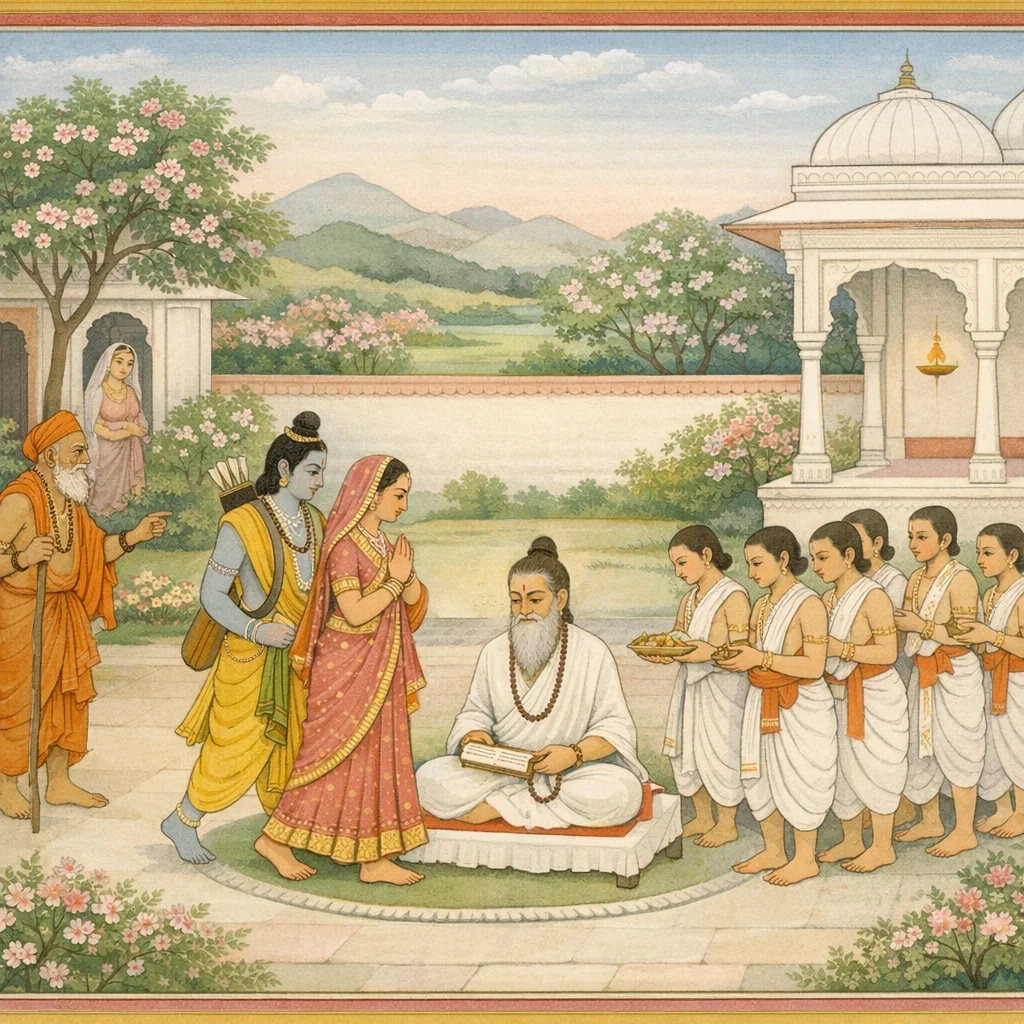
Sarga 32 maps Rama’s pre-exile redistribution of wealth as a ritualized enactment of dharma. Lakshmana, receiving Rama’s auspicious command, goes to the house of the Veda-versed brahmin Suyajna and invites him to Rama’s residence; Rama and Sita receive Suyajna with reverence and circumambulation, treating him like sacred fire. Sita’s ornaments and household valuables are formally offered to Suyajna’s household, and Rama adds major gifts (including elephants). Rama then instructs Lakshmana to honor eminent brahmins (Agastya and Kausika), Taittirīya teachers who attend on Kausalya, long-serving retainers such as the charioteer Chitraratha, and groups of Vedic students (Kaṭha–Kalāpa, mekhalin brahmacārins), specifying cows, carts filled with gems, bulls, garments, chariots, and attendants. Lakshmana distributes wealth ‘like Kubera.’ Rama further orders that the palaces remain guarded until his return and has the treasury brought out for dependents and the poor. The episode culminates in the destitute brahmin Trijata (Gārgya), whose wife urges him to seek aid; Rama playfully tests his vigor by asking him to throw his staff to delimit a gift of cows, then consoles him, clarifies that his wealth is meant for brahmins, and completes the charity so that no brahmin, servant, poor person, or beggar remains unsatisfied.
Shlokas
Verse 1
ततश्शासन माज्ञाय भ्रातु श्शुभतरं प्रियम्।गत्वा स प्रविवेशाशु सुयज्ञस्य निवेशनम्।।।।
Thereafter, understanding his brother’s welcome and most auspicious instruction, he went at once and entered Suyajña’s residence.
Verse 2
तं विप्रमग्न्यगारस्थं वन्दित्वा लक्ष्मणोऽब्रवीत्।सखेऽभ्यागच्छ पश्य त्वं वेश्म दुष्करकारिणः।।।।
Having bowed to that brahmin who was stationed in the fire-sanctuary, Lakṣmaṇa said: “Friend, come—behold the residence of Rāma, the doer of what is hard to accomplish.”
Verse 3
ततस्सन्ध्यामुपास्याशु गत्वा सौमित्रिणा सह।जुष्टं तत्प्राविशल्लक्ष्म्या रम्यं रामनिवेशनम्।।।।
Thereafter, having quickly performed the twilight worship, he went with Saumitri (Lakṣmaṇa) and entered that beautiful residence of Rāma, graced with prosperity.
Verse 4
तमागतं वेदविदं प्राञ्जलिस्सीतया सह।सुयज्ञमभिचक्राम राघवोऽग्निमिवार्चितम्।।।।
When Suyajña, learned in the Vedas, arrived, Rāghava (Rama), with Sītā and hands folded, honored him like sacred fire and circumambulated him.
Verse 5
जातरूपमयैर्मुख्यैरङ्गदैः कुण्डलैः शुभैः।सहेमसूत्रैर्मणिभिः केयूरैर्वलयैरपि।।।।अन्यैश्च रत्नैर्बहुभिः काकुत्स्थः प्रत्यपूजयत्।सुयज्ञं स तदोवाच रामस्सीता प्रचोदितः।।।।
With excellent golden ornaments—armlets, auspicious earrings, gem-studded pieces with golden chains, bracelets and bangles—and with many other jewels besides, Rāma of the Kakutstha line duly honored Suyajña. Then, urged by Sītā, Rāma spoke to him.
Verse 6
जातरूपमयैर्मुख्यैरङ्गदैः कुण्डलैः शुभैः।सहेमसूत्रैर्मणिभिः केयूरैर्वलयैरपि।।2.32.5।।अन्यैश्च रत्नैर्बहुभिः काकुत्स्थः प्रत्यपूजयत्।सुयज्ञं स तदोवाच रामस्सीता प्रचोदितः।।2.32.6।।
This verse is duplicated in the provided input as 2.32.6; its sense remains: Rāma honors Suyajña with fine golden ornaments and many jewels, and then—prompted by Sītā—addresses him.
Verse 7
हारं च हेमसूत्रं च भार्यायै सौम्य हारय।रशनां चाधुना सीता दातुमिच्छति ते सखे।।।।
“Dear friend, please take these for your wife: the necklace and the golden chain; and now Sītā also wishes to give you the girdle.”
Verse 8
अङ्गदानि विचित्राणि केयूराणि शुभानि च।प्रयच्छति सखे तुभ्यं भार्यायै गच्छती वनम्।।।।
As Sītā departs for the forest, she offers—O friend—wonderfully wrought and auspicious ornaments (armlets and bracelets) through you, to be given to your wife.
Verse 9
पर्यङ्कमग्य्रास्तरणं नानारत्नविभूषितम्।तमपीच्छति वैदेही प्रतिष्ठापयितुं त्वयि।।।।
Vaidehī (Sītā) also wishes that a couch—covered with an exquisite spread and adorned with many kinds of gems—be placed with you (i.e., entrusted to your keeping).
Verse 10
नाग श्शत्रुञ्जयो नाम मातुलोऽयं ददौ मम।तं ते गजसहस्रेण ददामि द्विजसत्तम।।।।
O best of brahmins, my maternal uncle gave me this elephant named Śatruñjaya; I now give it to you, together with a thousand elephants.
Verse 11
इत्युक्तस्स हि रामेण सुयज्ञः प्रतिगृहृयतत्।रामलक्ष्मणसीतानां प्रयुयोजाशिष श्शुभाः।।।।
Thus addressed by Rāma, Suyajña accepted the gift and bestowed auspicious blessings upon Rāma, Lakshmaṇa, and Sītā.
Verse 12
अथ भ्रातरमव्यग्रं प्रियं रामः प्रियंवदः।सौमित्रिं तमुवाचेदं ब्रह्मेव त्रिदशेश्वरम्।।।।
Then sweet-speaking Rāma, calm and unhurried, spoke these words to his beloved brother Saumitri—like Brahmā addressing the lord of the gods.
Verse 13
अगस्त्यं कौशिकं चैव तावुभौ ब्राह्मणोत्तमौ।अर्चयाहूय सौमित्रे रत्नैस्सस्यमिवाम्बुभिः।।।।
“O Saumitrī (Lakṣmaṇa), invite Agastya and Kauśika—those two foremost brahmins—and honor them, pouring out precious gifts as rainwater nourishes standing crops.”
Verse 14
तर्पयस्व महाबाहो गोसहस्रैश्च मानद।सुवर्णै रजतैश्चैव मणिभिश्च महाधनैः।।।।
“Satisfy them, O mighty-armed one, bestower of honor—by gifts of a thousand cows, and also by gold, silver, and precious gems of great value.”
Verse 15
कौसल्यां च य आशीर्भिर्भक्तः पर्युपतिष्ठति।आचार्यस्तैत्तिरीयाणामभिरूपश्च वेदवित्।।।।तस्य यानं च दासीश्च सौमित्रे सम्प्रदापय।कौशेयानि च वस्त्राणि यावत्तुष्यति स द्विजः।।।।
“And the devoted brahmin who attends upon Kausalyā with blessings—an ācārya of the Taittirīya tradition, pleasing in manner and learned in the Veda—give him, O Saumitrī, a conveyance and maidservants, and silk garments, until that twice-born is fully satisfied.”
Verse 16
कौसल्यां च य आशीर्भिर्भक्तः पर्युपतिष्ठति।आचार्यस्तैत्तिरीयाणामभिरूपश्च वेदवित्।।2.32.15।।तस्य यानं च दासीश्च सौमित्रे सम्प्रदापय।कौशेयानि च वस्त्राणि यावत्तुष्यति स द्विजः।।2.32.16।।
“And the devoted brahmin who attends upon Kausalyā with blessings—an ācārya of the Taittirīya tradition, pleasing in manner and learned in the Veda—give him, O Saumitrī, a conveyance and maidservants, and silk garments, until that twice-born is fully satisfied.”
Verse 17
सूतश्चित्ररथश्चार्य सचिवस्सुचिरोषितः।तोषयैनं महार्हैश्च रत्नैर्वस्त्रैर्धनैस्तथा।।।।पशुकाभिश्च सर्वाभिर्गवां दशशतेन च।
“And Cित्ररथ, the charioteer—an honorable counselor who has long dwelt in our service—gratify him with priceless jewels, garments, and wealth, and with all kinds of livestock, including a thousand cows.”
Verse 18
ये चेमे कठकालापा बहवो दण्डमाणवाः।।।।नित्यस्वाध्यायशीलत्वान्नान्यत्कुर्वन्ति किञ्चन।अलसा स्वादुकामाश्च महतां चापि सम्मताः।।।।तेषामशीतियानानि रत्नपूर्णानि दापय।शालिवाहसहस्रं च द्वे शते भद्रकां स्तथा।।।।व्यञ्जनार्थं च सौमित्रे गोसहस्रमुपाकुरु।
“And these many staff-bearing brahmacārins, versed in the Kāṭhaka and Kālāpa traditions—because they are devoted to daily Vedic study, they do no other work. Though inactive otherwise and fond of rich foods, they are honored even by the great. For them, arrange eighty carts filled with jewels; a thousand bullocks fit for carrying grain; two hundred fine oxen as well; and, O Saumitrī, provide a thousand cows for the preparation of food.”
Verse 19
ये चेमे कठकालापा बहवो दण्डमाणवाः।।2.32.18।।नित्यस्वाध्यायशीलत्वान्नान्यत्कुर्वन्ति किञ्चन।अलसा स्वादुकामाश्च महतां चापि सम्मताः।।2.32.19।।तेषामशीतियानानि रत्नपूर्णानि दापय।शालिवाहसहस्रं च द्वे शते भद्रकां स्तथा।।2.32.20।।व्यञ्जनार्थं च सौमित्रे गोसहस्रमुपाकुरु।
“A great multitude of mekhalā-wearing brahmacārins attend upon Kausalyā; to each of them, O Saumitrī, grant a thousand (as a gift).”
Verse 20
ये चेमे कठकालापा बहवो दण्डमाणवाः।।2.32.18।।नित्यस्वाध्यायशीलत्वान्नान्यत्कुर्वन्ति किञ्चन।अलसा स्वादुकामाश्च महतां चापि सम्मताः।।2.32.19।।तेषामशीतियानानि रत्नपूर्णानि दापय।शालिवाहसहस्रं च द्वे शते भद्रकां स्तथा।।2.32.20।।व्यञ्जनार्थं च सौमित्रे गोसहस्रमुपाकुरु।
Have eighty carts filled with jewels given to them, along with a thousand strong draught-bulls fit for carrying grain and two hundred fine oxen as well. And, O Saumitri (Lakṣmaṇa), arrange also a thousand cows for the preparation of food.
Verse 21
मेखलीनां महासङ्घः कौसल्यां समुपस्थितः।।।।तेषां सहस्रं सौमित्रे प्रत्येकं सम्प्रदापय।
“A great multitude of mekhalā-wearing brahmacārins attend upon Kausalyā; to each of them, O Saumitrī, grant a thousand (as a gift).”
Verse 22
अम्बा यथा च सा नन्देत्कौसल्या मम दक्षिणाम्।।।।तथा द्विजातीस्ता न्सर्वान् लक्ष्मणार्चय सर्वशः।
O Lakṣmaṇa, honour all those brāhmaṇas in every proper way, so that my mother Kauśalyā will rejoice at the respectful gifts offered on my behalf.
Verse 23
तत स्सपुरुषव्याघ्रस्तद्धनं लक्ष्मणः स्वयम्।।।।यथोक्तं ब्राह्मणेन्द्राणांमददाद्धनदो यथा।
Then Lakṣmaṇa—tiger among men—personally gave that wealth to the foremost of brāhmaṇas, exactly as instructed, like Kubera himself bestowing riches.
Verse 24
अथाऽब्रवीद्बाष्पकलांस्तिष्ठतश्चोपजीविनः।।।।सम्प्रदायबहुद्रव्यमेकैकस्योपजीवनम्।
Thereafter, after granting abundant wealth to each dependent as means of livelihood, Rāma addressed those attendants who stood with their throats choked with tears, saying:
Verse 25
लक्ष्मणस्य च यद्वेश्म गृहं च यदिदं मम।।।।अशून्यं कार्यमेकैकं यावदागमनं मम।
Until I return, see that each residence—Lakṣmaṇa’s as well as mine—is kept attended and not left deserted.
Verse 26
इत्युक्त्वा दुःखितं सर्वं जनं तमुपजीविनम्।।।।उवाचेदं धनाध्यक्षं धनमानीयतामिति।
Having thus spoken to all those grief-stricken dependents, Rāma then said to the officer of the treasury: “Let the wealth be brought.”
Verse 27
ततोऽस्य धनमाजह्रुस्सर्वमेवोपजीविनः।।।।स राशिस्सुमहांस्तत्र दर्शनीयो ह्यदृश्यत।
Then the dependents brought all of Rāma’s wealth; there a vast heap of treasure appeared—truly striking to behold.
Verse 28
ततस्सपुरुषव्याघ्र स्तद्धनं सहलक्ष्मणः।।।।द्विजेभ्यो बालवृद्धेभ्यः कृपणेभ्योऽह्यदापयत्।
Then Rāma, best of men, together with Lakṣmaṇa, had that wealth distributed—especially to brāhmaṇas, to the young and the old, and to the destitute.
Verse 29
तत्रासीत्पिङ्गलो गार्ग्यस्त्रिजटो नाम वै द्विजः।।।।क्षतवृत्तिर्वने नित्यं फालकुद्दाललाङ्गली।
There lived there a brāhmaṇa named Trijaṭa—Piṅgala by complexion, of the Gārgya lineage—who always made his living in the forest by digging and tilling, equipped with a ploughshare, an iron spade, and a plough.
Verse 30
तं वृद्धं तरुणी भार्या बालानादाय दारकान्।।।।अब्रवीद्बाह्मणं वाक्यं दारिद्र्येणाभिपीडिता।
His young wife, crushed by poverty, brought forward their little sons and spoke words to that aged brāhmaṇa.
Verse 31
अपास्य फालं कुद्दालं कुरुष्व वचनं मम।।।।रामं दर्शय धर्मज्ञं यदि किञ्चिदवाप्स्यसि।
“Do as I say—cast away this iron and spade. Go and present yourself to Rama, the knower of dharma; if anything can be gained, you will gain it from him.”
Verse 32
स भार्यावचनं श्रुत्वा शाटीमाच्छाद्य दुश्छदाम्।।।।स प्रातिष्ठत पन्थानं यत्र रामनिवेशनम्।
Hearing his wife’s words, he wrapped himself in a tattered upper cloth and set out on the road to where Rama’s dwelling was.
Verse 33
भृग्वङ्गिरसमं दीप्त्या त्रिजटं जनसंसदि।।।।आपञ्चमायाः कक्ष्यायाः नैनं कश्चिदवारयत्।
In the crowded assembly, Trijaṭa shone with a radiance like Bhṛgu and Aṅgiras; no one stopped him until he reached the fifth courtyard.
Verse 34
स राजपुत्रमासाद्य त्रिजटो वाक्यमब्रवीत्।।।।निर्धनो बहुपुत्रोऽस्मि राजपुत्र महायशः।उञ्छवृत्तिर्वने नित्यं प्रत्यवेक्षस्व मामिति।।।।
Approaching the prince, Trijaṭa said: “O prince of great renown, I am poor and burdened with many children. I live in the forest by gleaning fallen grains each day—please look upon me with consideration.”
Verse 35
स राजपुत्रमासाद्य त्रिजटो वाक्यमब्रवीत्।।2.32.34।।निर्धनो बहुपुत्रोऽस्मि राजपुत्र महायशः।उञ्छवृत्तिर्वने नित्यं प्रत्यवेक्षस्व मामिति।।2.32.35।।
This verse duplicates the preceding appeal: having approached the prince, Trijaṭa declares his poverty and many children, his daily gleaning in the forest, and asks Rama to consider him.
Verse 36
तमुवाच ततो राम: परिहास समन्वितम्।गवां सहस्रमप्येकं न नु विश्राणितं मया।।।।परिक्षिपसि दण्डेन यावत्तावदवाप्स्यसि।
Then Rama spoke to him in a playful tone: “I have not yet given away even a thousand cows. Cast your staff—whatever extent it reaches, to that extent you shall obtain cows.”
Verse 37
स शाटीं त्वरितः कट्यां सम्भ्रान्तः परिवेष्ट्य ताम्।।।।आविद्ध्य दण्डं चिक्षेप सर्वप्राणेन वेगितः।
Startled and hurried, he wrapped his upper cloth around his waist, took aim, and hurled the staff with all his strength.
Verse 38
स तीर्त्वा सरयूपारं दण्डस्तस्य कराच्च्युतः।।।।गोव्रजे बहुसाहस्रे पपातोक्षणसन्निधौ।
Released from his hand, the staff crossed to the far bank of the Sarayū and fell near a bull amid a cattle-pen of many thousands.
Verse 39
तं परिष्वज्य धर्मात्मा आतस्मात्सरयूतटात्।।।।आनयामास ता गोपै स्त्रिजटायाश्रमं प्रति।
Embracing him, righteous-souled Rama had the herdsmen bring those cattle—extending up to the bank of the Sarayū—toward Trijaṭa’s hermitage.
Verse 40
उवाच स ततो रामस्तं गार्ग्यमभिसान्त्वयन्।मन्युर्न खलु कर्तव्यः परिहासो ह्ययं मम।।।।
Then Rāma, consoling that Gārgya, said: “You should not be angry; this was only my jest.”
Verse 41
इदं हि तेजस्तव यद्दुरत्ययंतदेव जिज्ञासितुमिच्छता मया।इमं भवानर्थमभि प्रचोदितोवृणीष्व किं चेदपरं व्यवस्यति।।।।
“For your power is indeed unsurpassable; wishing to ascertain just that, I prompted you toward this act. If you intend anything else, ask for it.”
Verse 42
ब्रवीमि सत्येन नतेऽस्ति यन्त्रणाधनं हि यद्यन्मम विप्रकारणात्।भवत्सु सम्यक्प्रतिपादनेन तन्मयार्जितं प्रीतियशस्करं भवेत्।।।।
“I speak in truth: there is no restriction upon you. For whatever wealth is mine is meant for brāhmaṇas; and by rightly bestowing it upon people like you, what I have earned becomes a cause of joy and good renown.”
Verse 43
तत स्सभार्य स्त्रिजटो महामुनिर्गवामनीकं प्रतिगृह्य मोदितः।यशोबलप्रीतिसुखोपबृंहणीस्तदाशिष: प्रत्यवदन्महात्मनः।।।।
Thereafter the great sage Strijaṭa, together with his wife, gladly accepted a multitude of cows and then returned blessings to the noble Rāma—blessings that increase fame, strength, affection, and happiness.
Verse 44
स चापि रामः प्रतिपूर्णमानसोमहद्धनं धर्मबलैरुपार्जितम्।नियोजयामास सुहृज्जनेऽचिराद्यथार्हसम्मानवचः प्रचोदितः।।।।
And Rāma too, his mind fully satisfied, without delay distributed among his friends the great wealth he had acquired through the strength of dharma—prompted by words of fitting honor and appreciation.
Verse 45
द्विज स्सुहृद्भृत्यजनोऽथवा तदा दरिद्रभिक्षाचरणश्च योऽभवत्।न तत्र कश्चिन्न बभूव तर्पितोयथार्हसम्मानन दान सम्भ्रमैः।।2.32.46।।
Whether brāhmaṇas, friends, attendants, or even the poor and those who lived by begging—there was no one there who was not satisfied, being met with due honor and eager charity appropriate to each.
Verse 46
द्विज स्सुहृद्भृत्यजनोऽथवा तदादरिद्रभिक्षाचरणश्च योऽभवत्।न तत्र कश्चिन्न बभूव तर्पितोयथार्हसम्मानन दान सम्भ्रमैः।।।।
Whether brāhmaṇas, friends, attendants, or the poor and mendicants—no one there remained unsatisfied, for each was received with fitting honor and prompt charity.
Frequently Asked Questions
The pivotal action is Rama’s deliberate liquidation and redistribution of royal and personal wealth before exile—balancing duty to family, priests, students, servants, and the poor—so that transition does not create neglect, injustice, or unmet dependence.
Wealth is framed as an instrument of dharma rather than possession: Rama explicitly treats his earnings as intended for worthy recipients (especially brahmins and dependents), and even a playful test (Trijata’s staff-throw) is redirected into compassionate giving and social satisfaction.
The Sarayu river functions as a boundary-marker in the gift narrative (the staff crosses to a cow-settlement), while cultural landmarks include Vedic pedagogical lineages (Taittirīya, Kaṭha–Kalāpa), brahmacārin identifiers (mekhalin girdle, daṇḍa staff), and formal atithi reception rites (circumambulation like worship of fire).