Sarga 30
सीताया वनानुगमननिश्चयः — Sita’s Resolve to Accompany Rama to the Forest
अयोध्याकाण्ड
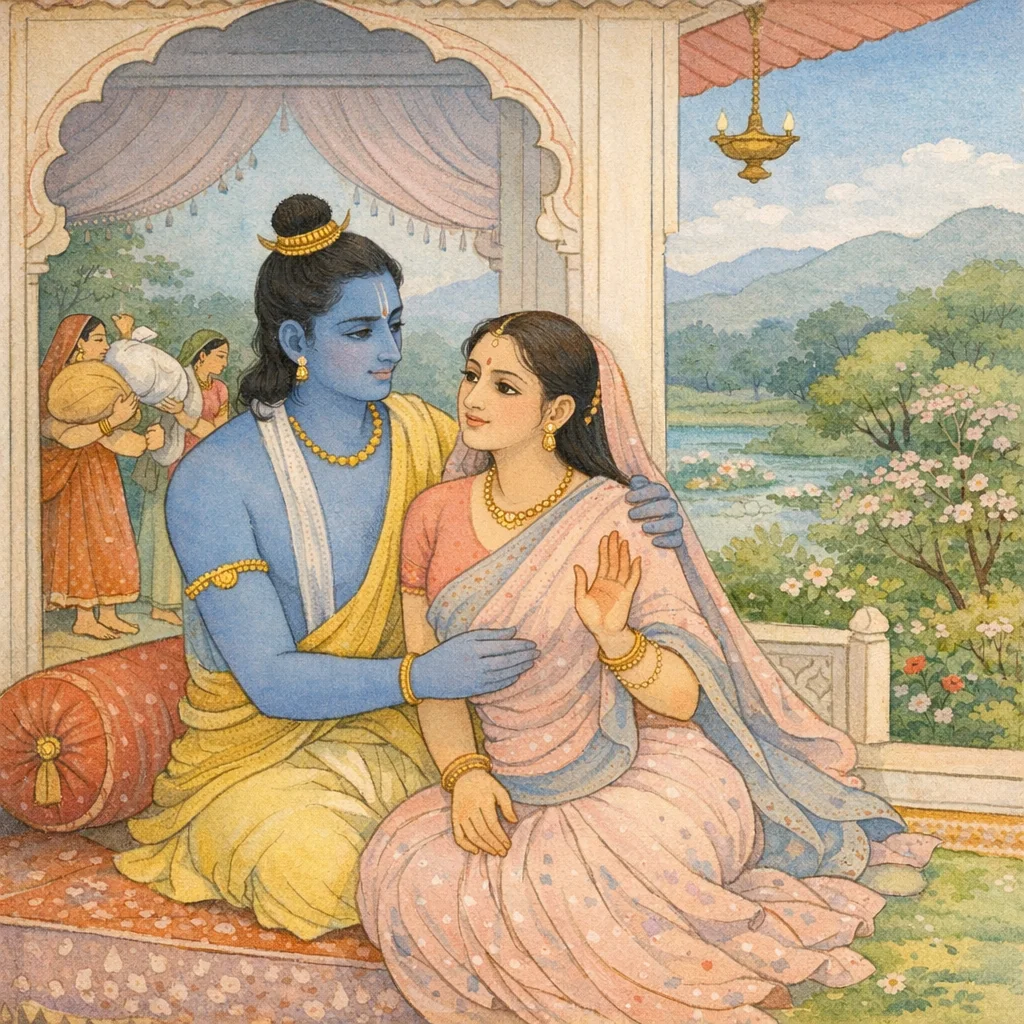
Sarga 30 centers on a spousal dharma-debate framed as consolation and counter-argument. Rāma initially attempts to dissuade Sītā from forest-exile, prompting Sītā’s forceful reply: she asserts exclusive marital devotion, rejects separation as intolerable, and reframes the forest’s hardships as comforts when shared with him (dust as sandal, grass as soft bedding, gathered fruits as nectar). Her rhetoric escalates into a stark ultimatum—death is preferable to abandonment or subjection to hostile powers in Ayodhyā. The chapter then pivots: Rāma embraces and reassures her, articulating his motive as filial obedience and the sanctity of parental command, presenting parents and guru as visible divinity and service to them as supremely efficacious. Accepting Sītā as sahadharmacāriṇī, he instructs her to begin practical preparations: distribute jewels, garments, couches, chariots, and other valuables to attendants and brāhmaṇas, and provide food to mendicants. The sarga concludes with Sītā’s delighted compliance, converting emotional contestation into ritualized renunciation and ethical readiness for exile.
Shlokas
Verse 1
सान्त्व्यमाना तु रामेण मैथिली जनकात्मजा।वनवासनिमित्ताय भर्तारमिदमब्रवीत्।।2.30.1।।
Though consoled by Rama regarding the impending forest-life, Maithilī—Janaka’s daughter—spoke these words to her husband.
Verse 2
सा तमुत्तमसंविग्ना सीता विपुलवक्षसम्।प्रणयाच्चाभिमानाच्च परिचिक्षेप राघवम्।।2.30.2।।
Sītā, deeply stirred by a grave concern, reproached Rāghava—the broad-chested scion of the Raghu line—out of love and also from wounded self-respect.
Verse 3
किं त्वाऽमन्यत वैदेहः पिता मे मिथिलाधिपः।राम जामातरं प्राप्य स्त्रियं पुरुषविग्रहम्।।2.30.3।।
“O Rāma—when my father, the king of Mithilā, accepted you as his son-in-law, did he imagine you to be a woman wearing the form of a man?”
Verse 4
अनृतं बत लोकोऽयमज्ञानाद्यदि वक्ष्यति।तेजो नास्ति परं रामे तपतीव दिवाकरे।।2.30.4।।
It would be false indeed if, out of ignorance, people were to say that no supreme radiance is found in Rama—radiance blazing like the sun.
Verse 5
किं हि कृत्वा विषण्णस्त्वं कुतो वा भयमस्ति ते।यत्परित्यक्तुकामस्त्वं मामनन्यपरायणाम्।।2.30.5।।
What has happened that you are so downcast? From where has this fear come to you, that you wish to abandon me—one who has no refuge but you alone?
Verse 6
द्युमत्सेनसुतं वीर सत्यवन्तमनुव्रताम्।सावित्रीमिव मां विद्धि त्वमात्मवशवर्तिनीम्।।2.30.6।।
O hero, know me to be like Sāvitrī—faithfully devoted to Satyavān, son of Dyumatsena—ever living in accordance with your will.
Verse 7
न त्वहं मनसाऽप्यन्यं द्रष्टाऽस्मि त्वदृतेऽनघ।त्वया राघव गच्छेयं यथाऽन्या कुलपांसिनी।।2.30.7।।
O blameless one, apart from you I have not looked upon another—even in thought. O Rāghava, I shall go with you; I am not like other women who bring disgrace upon their family.
Verse 8
स्वयं तु भार्यां कौमारीं चिरमध्युषितां सतीम्।शैलूष इव मां राम परेभ्यो दातुमिच्छसि।।2.30.8।।
Yet you yourself wish, O Rāma, to hand me over to others like an actor—me, your youthful and chaste wife who has long dwelt with you.
Verse 9
यस्य पथ्यं च रामाऽत्थ यस्य चार्थेऽवरुध्यसे।त्वं तस्य भव वश्यश्च विधेयश्च सदाऽनघ।।2.30.9।।
O sinless Rāma, for the sake of those whose welfare you speak of—and on whose account you restrain me—be ever compliant and obedient to them.
Verse 10
स मामनादाय वनं न त्वं प्रस्थातुमर्हसि।तपो वा यदि वाऽरण्यं स्वर्गो वा स्यात्सह मे त्वया।।2.30.10।।
You must not set out for the forest without taking me. Whether it is for austerity, for the wilderness, or even for heaven—I want it to be together with you.
Verse 11
न च मे भविता तत्र कश्चित्पथि परिश्रमः।पृष्ठतस्तव गच्छन्त्या विहारशयनेष्विव।।2.30.11।।
And for me there will be no hardship on the road, as I walk behind you—just as if I were on a pleasure outing or reclining on a couch.
Verse 12
कुशकाशशरेषीका ये च कण्टकिनो द्रुमाः।तूलाजिनसमस्पर्शा मार्गे मम सह त्वया।।2.30.12।।
Kuşa, kāśa, śara and iṣīkā grasses, and even thorny trees along the way, will feel to me—so long as I am with you—as soft as cotton or antelope-skin.
Verse 13
महावातसमुद्धूतं यन्मामपकरिष्यति।रजो रमण तन्मन्ये परार्थ्यमिव चन्दनम्।।2.30.13।।
O beloved, even the dust raised by strong winds that might sting or trouble me—I will regard it as though it were the finest sandal paste.
Verse 14
शाद्वलेषु यथा शिश्ये वनान्ते वनगोचर।कुथास्तरणतल्पेषु किं स्यात्सुखतरं ततः।।2.30.14।।
O forest-rover, when I can lie down on grassy meadows at the forest’s edge, what could be more comfortable than that—even compared to beds spread with fine coverings?
Verse 15
पत्रं मूलं फलं यत्त्वमल्पं वा यदि वा बहु।दास्यसि स्वयमाहृत्य तन्मेऽमृतरसोपमम्।।2.30.15।।
Whatever leaf, root, or fruit you yourself gather and give me—whether little or much—will be, for me, like nectar in taste.
Verse 16
न मातुर्न पितुस्तत्र स्मरिष्यामि न वेश्मनः।आर्तवान्युपभुञ्जाना पुष्पाणि च फलानि च।।2.30.16।।
There in the forest, enjoying the seasonal flowers and fruits, I will not long for my mother, or my father, or even for the comforts of home.
Verse 17
न च तत्र ततः किञ्चिद्द्रष्टुमर्हसि विप्रियम्।मत्कृते न च ते शोको न भविष्यामि दुर्भरा।।2.30.17।।
And for that reason, there in the forest you should not expect to see anything unpleasant arising from me: on my account you will have no sorrow, and I will not be a burden to you.
Verse 18
य स्त्वया सह स स्वर्गो निरयो यस्त्वया विना।इति जानन्परां प्रीतिं गच्छ राम मया सह।।2.30.18।।
Wherever I am with you—that alone is heaven; and what is without you is hell. Knowing this, O Rāma, accept great joy and go with me.
Verse 19
अथ मामेवमव्यग्रां वनं नैव नयिष्यति।विषमद्यैव पास्यामि मा विशं द्विषतां गमम्।।2.30.19।।
If, even when I stand thus resolved and unwavering, you still do not take me to the forest, then I will drink poison this very day—I will not go to live under the power of enemies.
Verse 20
पश्चादपि हि दुःखेन मम नैवास्ति जीवितम्।उज्झितायास्त्वया नाथ तदैव मरणं वरम्।।2.30.20।।
Even afterward, I would have no life left in me amid such sorrow. If I am abandoned by you, O my lord, then death at that very moment is better.
Verse 21
इमं हि सहितुं शोकं मुहूर्तमपि नोत्सहे।किं पुनर्दशवर्षाणि त्रीणि चैकं च दुःखिता।।2.30.21।।
I cannot endure this grief even for a single moment; what then of enduring it, a grieving woman, for fourteen years (ten, three, and one)?
Verse 22
इति सा शोकसन्तप्ता विलप्य करुणं बहु।चुक्रोश पतिमायस्ता भृशमालिङ्ग्य सस्वरम्।।2.30.22।।
Thus, tormented by grief, she lamented piteously at length; then, exhausted, she clung tightly to her husband and cried out aloud.
Verse 23
सा विद्धा बहुभिर्वाक्यैर्दिग्धैरिव गजाङ्गना।चिरसन्नियतं बाष्पं मुमोचाग्निमिवारणिः।।2.30.23।।
Pierced by many such words, like a female elephant struck by poisoned arrows, she released the tears she had long held back—like a fire-kindling stick that finally brings forth fire.
Verse 24
तस्या स्फटिकसङ्काशं वारि सन्तापसम्भवम्।नेत्राभ्यां परिसुस्राव पङ्कजाभ्यामिवोदकम्।।2.30.24।।
From her eyes, tears—clear as crystal and born of burning anguish—streamed down like water slipping from a pair of lotuses.
Verse 25
तच्चैवामलचन्द्राभं मुखमायतलोचनम्।पर्यशुष्यत बाष्पेण जलोद्धृतमिवाम्बुजम्।।2.30.25।।
That long-eyed face, radiant like the spotless moon, grew parched with tears—like a lotus pulled up from the water.
Verse 26
तां परिष्वज्य बाहुभ्यां विसंज्ञामिव दुःखिताम्।उवाच वचनं रामः परिविश्वासयंस्तदा।।2.30.26।।
Embracing her with both arms—grief-stricken and as if fainting—Rāma then spoke, seeking to steady her with reassurance.
Verse 27
न देवि तव दुःखेन स्वर्गमप्यभिरोचये।न हि मेऽस्ति भयं किञ्चित्स्वयम्भोरिव सर्वतः।।2.30.27।।
“O Devi, when you are in sorrow, I have no desire even for heaven. For I have no fear from any quarter—like Svayambhū (Brahmā) himself.”
Verse 28
तव सर्वमभिप्रायमविज्ञाय शुभानने।वासं न रोचयेऽरण्ये शक्तिमानपि रक्षणे।।2.30.28।।
“O fair-faced one, without fully knowing your resolve, I did not approve of your living in the forest—though I am capable of protecting you.”
Verse 29
यत्सृष्टाऽसि मया सार्धं वनवासाय मैथिलि।न विहातुं मया शक्या कीर्तिरात्मवता यथा।।2.30.29।।
“Since you are destined to share forest-dwelling with me, O Maithilī, I cannot abandon you—just as a man of self-respect cannot cast away his good name.”
Verse 30
धर्मस्तु गजनासोरु सद्भिराचरितः पुरा।तं चाहमनुवर्तेऽद्य यथा सूर्यं सुवर्चला।।2.30.30।।
“O you of elephant-trunk-like thighs, dharma was practised long ago by the virtuous; that very dharma I shall follow today, as Suvarcalā follows the Sun.”
Verse 31
न खल्वहं न गच्छेयं वनं जनकनन्दिनि।वचनं तन्नयति मां पितु स्सत्योपबृंहितम्।।2.30.31।।
“It is not that I would not go to the forest, O Janaka’s daughter; my father’s command—strengthened by truth—leads me there.”
Verse 32
एष धर्मस्तु सुश्रोणि पितुर्मातुश्च वश्यता।अतश्च तं व्यतिक्रम्य नाहं जीवितुमुत्सहे।।2.30.32।।
“This indeed is dharma, O fair-hipped one: obedience to father and mother. Therefore, having transgressed that, I would not have the heart to live.”
Verse 33
अस्वाधीनं कथं दैवं प्रकारैरभिराध्यते।स्वाधीनं समतिक्रम्य मातरं पितरं गुरुम्।।2.30.33।।
Mother, father, and teacher stand within our immediate reach; if one oversteps them, how could one, by any means, truly worship the Divine that lies beyond direct reach?
Verse 34
यत्त्रयं तत्त्रयो लोकाः पवित्रं तत्समं भुवि।नान्यदस्ति शुभापाङ्गे तेनेदमभिराध्यते।।2.30.34।।
Where those three—mother, father, and teacher—are present, there are, as it were, the three worlds; nothing on earth is holier than what equals them. Therefore, they are to be revered and worshipped.
Verse 35
न सत्यं दानमानौ वा न यज्ञाश्चाप्तदक्षिणाः।तथा बलकरा स्सीते यथा सेवा पितुर्हिता।।2.30.35।।
Neither truth-speaking, nor charity and honor, nor sacrifices with due gifts are as strengthening and effective, O Sita, as the wholesome service rendered to one’s father.
Verse 36
स्वर्गो धनं वा धान्यं वा विद्याः पुत्रास्सुखानि च।गुरुवृत्त्यनुरोधेन न किञ्चिदपि दुर्लभम्।।2.30.36।।
By conforming oneself to the rightful intention and guidance of one’s elders, nothing is hard to obtain—heaven, wealth, grain, learning, sons, and comforts alike.
Verse 37
देवगन्धर्वगोलोकान्ब्रह्मलोकां स्तथाऽपरान्।प्राप्नुवन्ति महात्मानो मातापितृपरायणाः।।2.30.37।।
Great-souled people devoted to their mother and father attain exalted realms—the worlds of the gods, the gandharvas, the go-loka, the world of Brahmā, and other higher worlds as well.
Verse 38
स मां पिता यथा शास्ति सत्यधर्मपथे स्थितः।तथा वर्तितुमिच्छामि स हि धर्मस्सनातनः।।2.30.38।।
As my father, steadfast on the path of truth and dharma, commands me, so I wish to act; for that is dharma—eternal and enduring.
Verse 39
मम सन्ना मतिस्सीते त्वां नेतुं दण्डकावनम्।वसिष्यामीति सा त्वं मामनुयातुं सुनिश्चिता।।2.30.39।।
O Sita, my mind is resolved about taking you to the Dandaka forest; and you—saying, ‘I shall live (there)’—are firmly determined to follow me.
Verse 40
सा हि सृष्टाऽनवद्याङ्गि वनाय मदिरेक्षणे।अनुगच्छस्व मां भीरु सहधर्मचरी भव।।2.30.40।।
O flawless-limbed one with enchanting eyes—gentle Sita—indeed you are fashioned for forest-life: follow me, and become my companion in dharma.
Verse 41
सर्वथा सदृशं सीते मम स्वस्य कुलस्य च।व्यवसायमनुक्रान्ता कान्ते त्वमतिशोभनम्।।2.30.41।।
O Sita—my beloved—you have undertaken, in fitting manner, a most splendid resolve, wholly worthy of me, of you, and of your noble family.
Verse 42
आरभस्व शुभश्रोणि वनवासक्षमाः क्रियाः।नेदानीं त्वदृते सीते स्वर्गोऽपि मम रोचते।।2.30.42।।
Begin, O Sītā of lovely hips, the preparations fit for life in the forest; for now, without you, even heaven itself holds no charm for me.
Verse 43
ब्राह्मणेभ्यश्च रत्नानि भिक्षुकेभ्यश्च भोजनम्।देहि चाशंसमानेभ्य स्सन्त्वरस्व च मा चिरम्।।2.30.43।।
Give jewels to the brāhmaṇas, and food to mendicants; give also to those who are in need—hurry, and do not delay.
Verse 44
भूषणानि महार्हाणि वरवस्त्राणि यानि च।रमणीयाश्च ये केचित्क्रीडार्थाश्चाप्युपस्कराः।।2.30.44।।शयनीयानि यानानि मम चान्यानि यानि च।देहि स्वभृत्यवर्गस्य ब्राह्मणानामनन्तरम्।।2.30.45।।
As for the highly precious ornaments, the fine garments, and whatever charming accessories there are for enjoyment and play—
Verse 45
भूषणानि महार्हाणि वरवस्त्राणि यानि च।रमणीयाश्च ये केचित्क्रीडार्थाश्चाप्युपस्कराः।।2.30.44।।शयनीयानि यानानि मम चान्यानि यानि च।देहि स्वभृत्यवर्गस्य ब्राह्मणानामनन्तरम्।।2.30.45।।
Give my couches and vehicles, and whatever other possessions there are, to your own attendants; thereafter, give (what remains) to the brāhmaṇas.
Verse 46
अनुकूलं तु सा भर्तुर्ज्ञात्वा गमनमात्मनः।क्षिप्रं प्रमुदिता देवी दातुमेवोपचक्रमे।।2.30.46।।
Knowing that her own going was agreeable to her husband, the noble lady—gladdened—quickly began the act of giving away (her possessions).
Verse 47
ततः प्रहृष्टा प्रतिपूर्णमानसायशश्विनी भर्तुरवेक्ष्य भाषितम्।धनानि रत्नानि च दातुमङ्गनाप्रचक्रमे धर्मभृतां मनस्स्विनी।।2.30.47।।
Then the illustrious lady, her heart fulfilled and rejoicing at her husband’s words, began to give away wealth and jewels—spiritedly offering them to the righteous.
Frequently Asked Questions
The dilemma is whether Sītā should be excluded from exile for her safety or included as Rāma’s sahadharmacāriṇī; Sītā frames separation as adharma toward marital unity, while Rāma balances spousal protection against the binding force of his father’s truth-backed command.
Dharma is enacted through relational obligations: marital companionship as a shared vocation, and filial obedience as a visible form of worship; the chapter also models renunciation by converting royal wealth into dāna before entering the forest discipline.
The forest-world is mapped through Dandaka as the intended destination and through culturally specific markers—kuśa and reeds, meadow sleeping, seasonal forest produce—along with courtly-to-ascetic transition practices such as gifting ornaments and provisions to brāhmaṇas and mendicants.