Sarga 117
अत्र्याश्रमगमनम् तथा अनसूयोपदेशः (Arrival at Atri’s Hermitage and Anasuya’s Counsel)
अयोध्याकाण्ड
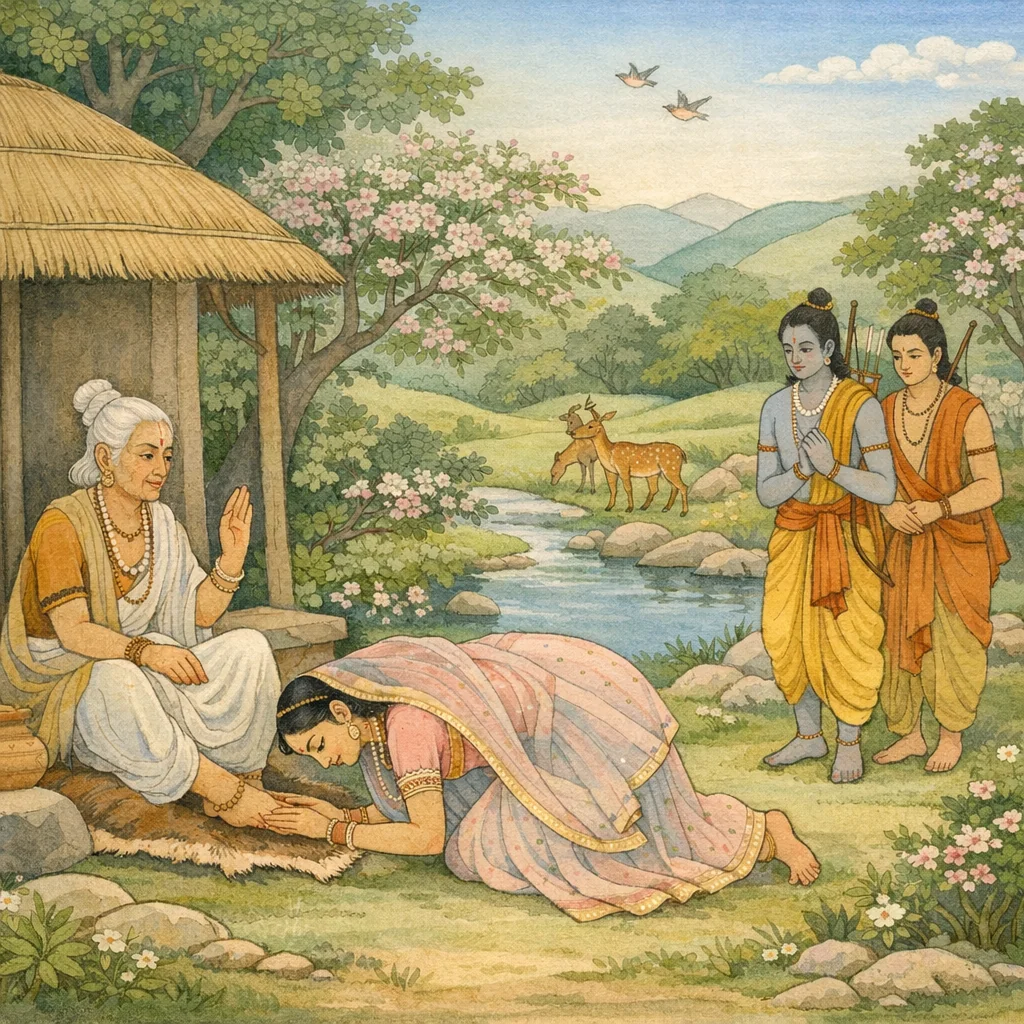
After the visiting ascetics depart, Rāma reflects and rejects continued residence at the prior spot, disturbed by memories of Bharata, the queens, and Ayodhyā’s citizens, and by the physical defilement caused by Bharata’s army camp (horses and elephants). Resolving to move, Rāma sets out with Sītā and Lakṣmaṇa and reaches the hermitage of Bhagavān Atri. Rāma offers reverence; Atri receives him affectionately like a son and provides exemplary hospitality, consoling both Lakṣmaṇa and Sītā. Atri summons his aged wife, the ascetic Anasūyā—renowned for severe tapas and extraordinary benefactions to the world (restoring sustenance, causing the Gaṅgā to flow, averting impediments, and performing time-altering austerity for divine purposes). He directs Sītā to approach her. Sītā respectfully circumambulates and salutes Anasūyā, noting her extreme old age and trembling body, and inquires about her wellbeing. Anasūyā, pleased by Sītā’s righteous conduct, praises her choice to follow Rāma into forest hardship and delivers a didactic instruction on pativratā-dharma: for women of noble disposition, the husband is the supreme refuge and ‘deity’ regardless of circumstances; fidelity yields renown and virtue, while uncontrolled desire leads to moral decline and infamy. The sarga thus blends itinerary, hospitality protocol, hagiographic praise of ascetic power, and a normative ethical discourse addressed to Sītā.
Shlokas
Verse 1
राघव स्त्वथ यातेषु तपस्विषु विचिन्तयन्।न तत्रारोचयद्वासं कारणैर्बहुभिस्तदा।।।।
When the ascetics had departed, Rāghava reflected deeply and, for many reasons, did not approve of staying there any longer.
Verse 2
इह मे भरतो दृष्टो मातरश्च सनागराः।सा च मे स्मृतिरन्वेति तान्नित्यमनुशोचतः।।।।
Here I saw Bharata, and my mothers too, along with the citizens. And as I grieve for them constantly, that very memory keeps pursuing me.
Verse 3
स्कन्धावारनिवेशेन तेन तस्य महात्मनः।हयहस्तिकरीषैश्च उपमर्दः कृतो भृशम्।।।।
Because the great-souled Bharata’s army had encamped there, the place was heavily fouled—trampled and made very dirty by the dung of horses and elephants.
Verse 4
तस्मादन्यत्र गच्छाम इति सञ्चिन्त्य राघवः।प्रातिष्ठत स वैदेह्या लक्ष्मणेन च सङ्गतः।।।।
Resolving, “Therefore, let us go elsewhere,” Rāghava set out, accompanied by Vaidehī and Lakṣmaṇa.
Verse 5
सोऽत्रेराश्रममासाद्य तं ववन्दे महायशाः।तं चापि भगवानत्रिः पुत्रवत्प्रत्यपद्यत।।।।
Reaching Atri’s hermitage, the illustrious Rāma bowed to the sage; and the revered Atri, in turn, received him as a son.
Verse 6
स्वयमातिथ्यमादिश्य सर्वमन्यत्सुसत्कृतम्।सौमित्रिं च महाभागां सीतां च समसान्त्वयत्।।।।
Atri personally arranged fitting hospitality in every way, and he also comforted Saumitri and the noble Sītā with kindly words.
Verse 7
पत्नीं च समनुप्राप्तां वृद्धामामन्त्र्य सत्कृताम्।सान्त्वयामास धर्मज्ञः सर्वभूतहिते रतः।।।।
The knower of dharma—devoted to the welfare of all beings—called his aged wife, revered by all, who had just arrived, and spoke to her in a reassuring way.
Verse 8
आनसूयां महाभागां तापसीं धर्मचारिणीम्प्रतिगृह्णीष्व वैदेहीमब्रवीदृषिसत्तमः।रामाय चाऽचचक्षे तां तापसीं धर्मचारिणीम्।।।।
The best of sages said to the noble Anasūyā—an ascetic devoted to righteous conduct—“Receive Vaidehī.” And to Rāma he also spoke of that ascetic woman, steadfast in dharma.
Verse 9
दश वर्षाण्यनावृष्ट्या दग्धे लोके निरन्तरम्।।।।यया मूलफले सृष्टे जाह्नवी च प्रवर्तिता।उग्रेण तपसा युक्ता नियमैश्चाप्यलङ्कृता।।।।दश वर्ष सहास्राणि तया तप्तं महत्तपः।अनसूया व्रतै स्स्नाता प्रत्यूहाश्च निवर्तिताः।।।।देवकार्यनिमित्तं च यया सन्त्वरमाणया।दशरात्रं कृता रात्रि स्सेयं मातेव तेऽनघ।।।।
“O blameless Rāma, when the world was continually scorched by drought for ten years, it was she who brought forth roots and fruits and caused the Jāhnavī (Gaṅgā) to flow. Disciplined by fierce austerity and adorned with observances, she practiced great tapas for ten thousand years; bathed in her vows, she turned back obstacles. And, urged on for the sake of the gods’ work, she even made ten nights become a single night. Such is this Anasūyā—like a mother to you.”
Verse 10
दश वर्षाण्यनावृष्ट्या दग्धे लोके निरन्तरम्।।2.117.9।।यया मूलफले सृष्टे जाह्नवी च प्रवर्तिता।उग्रेण तपसा युक्ता नियमैश्चाप्यलङ्कृता।।2.117.10।।दश वर्ष सहास्राणि तया तप्तं महत्तपः।अनसूया व्रतै स्स्नाता प्रत्यूहाश्च निवर्तिताः।।2.117.11।।देवकार्यनिमित्तं च यया सन्त्वरमाणया।दशरात्रं कृता रात्रि स्सेयं मातेव तेऽनघ।।2.117.12।।
It was she who brought forth roots and fruits and set the river Jāhnavī (Gaṅgā) in motion; adorned with strict observances, she was devoted to intense austerity.
Verse 11
दश वर्षाण्यनावृष्ट्या दग्धे लोके निरन्तरम्।।2.117.9।।यया मूलफले सृष्टे जाह्नवी च प्रवर्तिता।उग्रेण तपसा युक्ता नियमैश्चाप्यलङ्कृता।।2.117.10।।दश वर्षसहास्राणि यया तप्तं महत् तपः।अनसूया व्रतै स्स्नाता प्रत्यूहाश्च निवर्तिताः।।2.117.11।।देवकार्यनिमित्तं च यया सन्त्वरमाणया।दशरात्रं कृता रात्रि स्सेयं मातेव तेऽनघ।।2.117.12।।
For ten thousand years she practised a great and severe austerity. Anasūyā, purified by her vows, also turned back obstacles that arose.
Verse 12
दश वर्षाण्यनावृष्ट्या दग्धे लोके निरन्तरम्।।2.117.9।।यया मूलफले सृष्टे जाह्नवी च प्रवर्तिता।उग्रेण तपसा युक्ता नियमैश्चाप्यलङ्कृता।।2.117.10।।दश वर्ष सहास्राणि तया तप्तं महत्तपः।अनसूया व्रतै स्स्नाता प्रत्यूहाश्च निवर्तिताः।।2.117.11।।देवकार्यनिमित्तं च यया सन्त्वरमाणया।दशरात्रं कृता रात्रि स्सेयं मातेव तेऽनघ।।2.117.12।।
And for the sake of the gods’ work, she—acting with urgent resolve—made ten nights become a single night. Blameless one, she is like a mother to you.
Verse 13
तामिमां सर्वभूतानां नमस्कार्यां यशस्विनीम्अभिगच्छतु वैदेही वृद्धामक्रोधनां सदा।अनसूयेति या लोके कर्मभिः ख्यातिमागता।।।।
Let Vaidehī approach this illustrious woman, worthy of reverence from all beings—aged, and ever free from anger—she who in the world has won renown by her deeds as ‘Anasūyā’.
Verse 14
एवं ब्रुवाणं तमृषिं तथेत्युक्त्वा स राघवः।सीतामुवाच धर्मज्ञामिदं वचनमुत्तमम्।।।।
Thus, after saying “So be it” to the sage who spoke in this manner, Rāghava addressed Sītā—knower of dharma—with these excellent words.
Verse 15
राजपुत्रि श्रुतमिदं मुनेरस्य समीरितम्।श्रेयोऽर्थमात्मनश्शीघ्रमभिगच्छ तपस्विनीम्।।।।
O princess, you have heard what this sage has said; for your own welfare, go quickly and approach the ascetic woman.
Verse 16
सीता त्वेतद वचः श्रुत्वा राघवस्य हितैषिणः।तामत्रिपन्तीं धर्मज्ञामभिचक्राम मैथिली।।।।
Hearing these words of Rāghava, spoken for her good, Sītā of Mithilā approached Anasūyā, Atri’s wife, the knower of dharma.
Verse 17
शिथिलां वलितां वृद्धां जरापाण्डुरमूर्धजाम्।सततं वेपमानाङ्गीं प्रवाते कदलीं यथा।। ।।तां तु सीता महाभागामनसूयां पतिव्रताम्।अभ्यवादयदव्यग्रा स्वं नाम समुदाहरत्।।।।
She was feeble, wrinkled, and aged, her hair whitened by old age; her limbs trembled constantly like a plantain tree in a strong wind.
Verse 18
शिथिलां वलितां वृद्धां जरापाण्डुरमूर्धजाम्।सततं वेपमानाङ्गीं प्रवाते कदलीं यथा।। 2.117.17।।तां तु सीता महाभागामनसूयां पतिव्रताम्।अभ्यवादयदव्यग्रा स्वंनाम समुदाहरत्।।2.117.18।।
Then Sītā, unhurried and attentive, saluted the greatly blessed and chaste Anasūyā, announcing her own name.
Verse 19
अभिवाद्य च वैदेही तापसीं तामनिन्दिताम्।बद्धाञ्जलिपुटा हृष्टा पर्यपृच्छदनामयम्।।।।
And after offering homage to that blameless ascetic, Vaidehī—hands joined in reverence, and with gladness—asked about her well-being.
Verse 20
ततस्सीतां महाभागां दृष्ट्वा तां धर्मचारिणीम्।सान्त्वयन्त्यब्रवीद्धृष्टा दिष्ट्या धर्ममवेक्षसे।।।।
Then Anasūyā, delighted on seeing the illustrious Sītā, steadfast in righteous conduct, spoke to her in consoling words: “Fortunate indeed are you—you are keeping to dharma.”
Verse 21
त्यक्त्वा ज्ञातिजनं सीते मानमृद्धं च भामिनि।अवरुद्धं वने रामं दिष्ट्या त्वमनुगच्छसि।।।।
“O Sītā, O noble lady—forsaking your kinsfolk and your prosperous comforts, you are, by good fortune, following Rāma even when he is confined to life in the forest.”
Verse 22
नगरस्थो वनस्थो वा पापो वा यदि वा शुभः।यासां स्त्रीणां प्रियो भर्ता तासां लोका महोदयाः।।।।
“Whether the husband lives in the city or in the forest, whether he is sinful or virtuous—those women for whom the husband remains dear attain worlds of great reward.”
Verse 23
दुश्शीलः कामवृत्तो वा धनैर्वा परिवर्जितः।स्त्रीणामार्यस्वभावानां परमं दैवतं पतिः।।।।
“For women of noble disposition, the husband is held as the highest sacred authority—whether he is ill-conducted, pleasure-driven, or even lacking in wealth.”
Verse 24
नातो विशिष्टं पश्यामि बान्धवं विमृशन्त्यहम्।सर्वत्र योग्यं वैदेहि तपः कृतमिवाव्ययम्।।।।
“O Vaidehī, upon reflection I see no relation superior to a husband—fit to be relied on in every situation, like imperishable austerity once performed.”
Verse 25
न त्वेवमवगच्छन्ति गुणदोषमसत्त्स्रियः।कामवक्तव्यहृदया भर्तृनाथाश्चरन्ति याः।।।।
“But wicked women do not understand virtue and fault in this way—those whose hearts are driven by desire and self-will, who roam about treating their husbands as though the husbands were dependent on them.”
Verse 26
प्राप्नुवन्त्य यशश्चैव धर्मभ्रंशं च मैथिलि।अकार्यवशमापन्नाः स्त्रियो याः खलु तद्विधाः।।।।
“O Maithilī, women of that kind—who fall under the sway of what ought not be done—incur disgrace and also a fall from dharma.”
Verse 27
त्वद्विधास्तु गुणैर्युक्ता दृष्ट लोक परावराः।स्त्रिय स्स्वर्गे चरिष्यन्ति यथा धर्मकृतस्तथा।।।।
“But women like you—endowed with virtues and able to discern what is higher and lower in the world—will move freely in heaven, like those who have performed dharmic deeds.”
Verse 28
तदेवमेनं त्वमनुव्रता सती पतिव्रतानां समयानुवर्तिनी।भव स्वभर्तु स्सहधर्मचारिणी यशश्च धर्मं च तत स्समाप्स्यसि।।।।
“Therefore, being devoted and following Rāma, and keeping to the established conduct of chaste wives, be your husband’s companion in dharma; from this you will gain both renown and righteousness.”
Frequently Asked Questions
Rāma must decide whether to remain at a place burdened by grief-laden memories and ritual/physical impurity from an army camp; he chooses relocation, prioritizing mental steadiness, appropriate residence, and dharmic propriety during exile.
Anasūyā frames fidelity and disciplined conduct as a woman’s stabilizing dharma: the husband is treated as the highest relational refuge, discernment guards against desire-driven wrongdoing, and steadfast virtue yields lasting renown and merit.
The key landmark is Atri’s forest āśrama, a cultural node of ascetic hospitality and instruction; associated motifs include the skandhāvāra (army encampment) and the sacred Gaṅgā (Jāhnavī) invoked in Anasūyā’s hagiography.