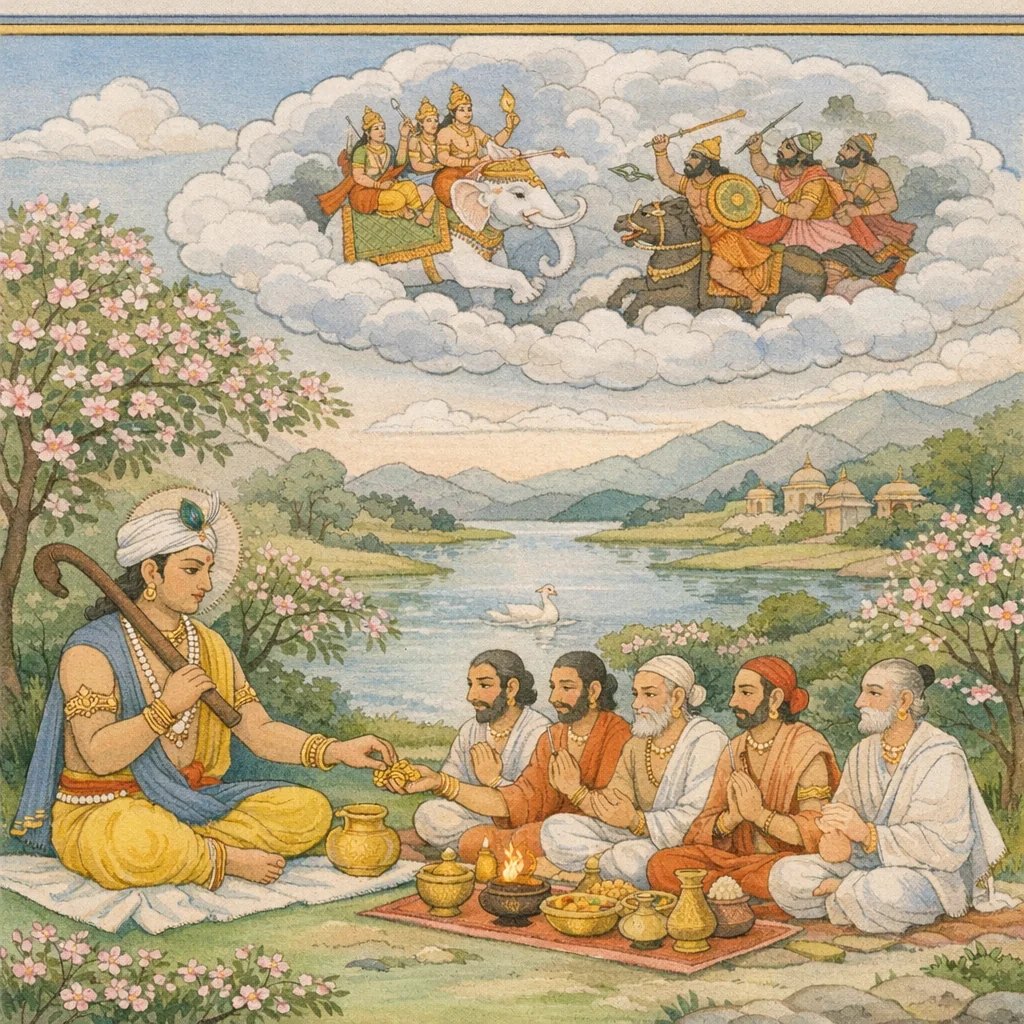
Adhyaya 49
Asita Devala Observes Jaigīṣavya’s Yogic Attainment and Chooses Mokṣa-dharma (देवल-जैगीषव्योपाख्यानम्)
Upa-parva: Mokṣa-dharma Episode: Devala–Jaigīṣavya Dialogue (Śalya-parva, Adhyāya 49)
Vaiśaṃpāyana describes Asita Devala as a disciplined householder-sage marked by equanimity, restraint, and ritual propriety. The mendicant-yogin Jaigīṣavya arrives and resides in Devala’s āśrama, remaining largely silent while being honored over many years. Devala becomes intellectually unsettled by the yogin’s non-communication and later observes an apparent paradox: Jaigīṣavya is seen both at the ocean (as if freshly bathed) and already seated in the āśrama. Seeking verification, Devala ascends and tracks Jaigīṣavya’s yogic passage through multiple cosmic regions associated with various rites and divine stations, until the yogin becomes untraceable in deep yogic absorption. Siddhas explain that Jaigīṣavya has reached Brahmā’s imperishable abode, a destination not accessible to Devala by mere pursuit. Returning, Devala requests instruction in mokṣa-dharma; Jaigīṣavya teaches the higher discipline of yoga and normative distinctions of what is to be done and avoided. As Devala inclines toward renunciation, dependent beings and ancestral stakeholders lament the loss of his distributive support, prompting Devala’s final deliberation. He resolves that mokṣa-dharma is superior, abandons household duty, attains higher yogic success, and is later praised by devas (with Nārada’s skepticism answered by others). The chapter closes with continued pilgrimage/ritual framing, integrating ascetic attainment with broader dharmic life.
Chapter Arc: वैशम्पायन जनमेजय को गदापर्व के भीतर बलराम की तीर्थयात्रा का अगला पड़ाव सुनाते हैं—इन्द्रतीर्थ की सनातन महिमा, जहाँ स्वयं देवराज ने यज्ञों की छाप छोड़ी थी। → इन्द्रतीर्थ, रामतीर्थ, यमुनातीर्थ और आदित्यतीर्थ—इन चारों के वर्णन में यज्ञ, दान, ब्राह्मण-पूजन और देवर्षि-सेवा की परंपरा उभरती है; पर यज्ञ-समाप्ति के बाद देव-दानव संग्राम का संकेत बताता है कि पुण्यस्थल भी संघर्ष की स्मृति से अछूते नहीं। → यमुनातीर्थ के प्रसंग में ‘श्रेष्ठ यज्ञ’ के पूर्ण होते ही देवताओं और दानवों के बीच त्रैलोक्य-भयावह युद्ध का उदय—यही अध्याय का तीव्रतम मोड़ है, जहाँ शांति का तीर्थ अचानक रण-स्मृति में बदल जाता है। → इन्द्रतीर्थ की पहचान ‘शतक्रतु’ इन्द्र के सौ यज्ञों से स्थिर होती है—यह तीर्थ ‘सर्वपापप्रमोचन’ कहा जाता है; बलराम विधिपूर्वक स्नान, दान और ब्राह्मण-सत्कार करते हुए आगे की यात्रा के लिए तैयार होते हैं। → बलराम का अगला प्रस्थान—शुभ रामतीर्थ की ओर—यात्रा की निरंतरता बनाए रखता है और आगे के तीर्थ-वर्णन/उपाख्यान के लिए द्वार खोलता है।
Shlokas
Verse 1
/ भीकम (2 अमान एकोनपज्चाशत्तमो<ड्ध्याय: इन्द्रतीर्थ
Vaiśampāyana said: Then Balarāma, the foremost of the Yadus, went to Indra-tīrtha. After bathing there in the prescribed manner, he duly bestowed wealth and jewels upon the brāhmaṇas—affirming the ethic that sacred pilgrimage is completed not merely by ritual purity but by generous, rule-guided giving.
Verse 2
तत्र हमरराजो5सावीजे क्रतुशतेन च । बृहस्पतेश्व देवेश: प्रददौ विपुलं धनम्
There, that king of the immortals (Indra) performed a sacrifice with a hundred rites; and the Lord of the gods bestowed abundant wealth upon Bṛhaspati. The passage underscores the Mahābhārata’s ethic that rightful prosperity is linked to duly performed sacred acts and to honoring spiritual counsel—wealth is portrayed not as mere possession, but as a gift aligned with ritual order and reverence for the preceptor.
Verse 3
उस तीर्थमें देवेश्वर देवराज इन्द्रने सौ यज्ञोंका अनुष्ठान किया था और बृहस्पतिजीको प्रचुर धन दिया था ।।
Vaiśampāyana said: At that sacred ford, Indra—the lord of the gods and king of the devas—performed a hundred sacrifices and bestowed abundant wealth upon Bṛhaspati. There, with learned Brāhmaṇas who had mastered the Vedas, he completed all those scripturally prescribed rites—richly furnished with many kinds of priestly gifts—without obstruction or hindrance. The passage highlights the ethical ideal of yajña joined with generosity: ritual power is affirmed as legitimate when accompanied by proper learning, correct procedure, and liberal giving.
Verse 4
तान् क्रतून् भरतश्रेष्ठ शतकृत्वो महाद्युति: । पूरयामास विधिवत् ततः ख्यात: शतक्रतु:
Vaiśampāyana said: O best of the Bharatas, the radiant Indra duly completed those sacrifices a hundred times; therefore he became renowned by the epithet Śatakratu, “he of a hundred rites.” The verse underscores how sustained, properly performed sacred action (done according to rule) becomes the ground of lasting fame and moral authority.
Verse 5
तस्य नाम्ना च तत् तीर्थ शिवं पुण्यं सनातनम् | इन्द्रतीर्थमिति ख्यातं सर्वपापप्रमोचनम्,उन्हींके नामसे वह सर्वपापापहारी, कल्याणकारी एवं सनातन पुण्य तीर्थ “इन्द्रतीर्थ' कहलाने लगा
And that sacred ford, auspicious, holy, and eternal, came to be known by his name as “Indra-tīrtha,” renowned as a place that releases one from all sins. The narrative underscores the ethical idea that remembrance of divine deeds and righteous association can sanctify a place and orient people toward purification and auspicious conduct.
Verse 6
उपस्पृश्य च तत्रापि विधिवन्मुसलायुध: । ब्राह्मणान् पूजयित्वा च सदाच्छादनभोजनै:
Vaiśampāyana said: There too, having performed the prescribed rite of purification by touching water, the wielder of the mace duly honored the Brahmins, providing them with proper clothing and food—acting in accordance with established custom and dharma even amid the pressures of the campaign.
Verse 7
यत्र रामो महाभागो भार्गव: सुमहातपा:
Vaiśampāyana said: There is the place where the illustrious Rāma of the Bhṛgu line—of immense austerity—after repeatedly destroying the kṣatriya kings and conquering this earth, set the foremost sage Kaśyapa before him as his preceptor, worshipped the Lord through a Vājapeya and a hundred Aśvamedha sacrifices, and then bestowed this entire earth, together with its encircling seas, as the sacrificial gift (dakṣiṇā).
Verse 8
असकृत् पृथिवीं जित्वा हतक्षत्रियपुड्भवाम् । उपाध्यायं पुरस्कृत्य कश्यपं मुनिसत्तमम्
Vaiśampāyana said: After repeatedly conquering the earth—having made it bereft of kṣatriyas—Paraśurāma placed the sage Kaśyapa, the foremost of seers, before him as his preceptor. Having thus acknowledged spiritual authority after violent victory, he proceeded to honor the Lord through great sacrifices and finally relinquished the earth itself as a gift, turning conquest into renunciation and expiation.
Verse 9
अयजदू वाजपेयेन सो<श्वमेधशतेन च । प्रददौ दक्षिणां चैव पृथिवीं वै ससागराम्
Vaiśampāyana said: He performed the Vājapeya sacrifice and also a hundred Aśvamedha rites; and as the sacrificial fee he bestowed the entire earth together with its encircling oceans. The narrative underscores a post-conquest turn toward ritual expiation and renunciation: worldly victory is followed by the ethical act of giving away sovereignty itself as dakṣiṇā, placing religious duty and restraint above continued possession and power.
Verse 10
दत्त्वा च दानं विविध नानारत्नसमन्वितम् | सगोहस्तिकदासीकं साजावि गतवान् वनम्,नाना प्रकारके रत्न, गौ, हाथी, दास, दासी और भेड़-बकरोंसहित अनेक प्रकारके दान देकर वे वनमें चले गये
Vaiśampāyana said: Having bestowed many kinds of gifts, richly furnished with various jewels—together with cows, elephants, male and female servants, and sheep and goats—he then departed for the forest. The verse underscores the ethical ideal of renunciation preceded by generous giving, marking a transition from worldly possession to a life of withdrawal.
Verse 11
पुण्ये तीर्थवरे तत्र देवब्रद्यर्षिसेविते मुनींश्चैवाभिवाद्याथ यमुनातीर्थमागमत्
Vaiśampāyana said: In that supremely holy and meritorious sacred ford, frequented by the gods and great seers, Balarāma first paid reverence to the sages and then proceeded to the Yamunā ford. The passage underscores the ethic of humility and right conduct: even the mighty honor ascetics and sanctified places before moving onward in their journey.
Verse 12
यत्रानयामास तदा राजसूयं महीपते । पुत्रोडदितेर्महाभागो वरुणो वै सितप्रभ:
Vaiśampāyana said: O lord of the earth, there is that sacred ford where, in former times, the illustrious Varuṇa—Aditi’s renowned son, radiant with white splendor—performed the Rājasūya sacrifice. (Having bowed to the sages at that supremely meritorious tīrtha, revered by gods and brahmarṣis, Balarāma then proceeded to the Yamunā ford.)
Verse 13
तत्र निर्जित्य संग्रामे मानुषान् देवतास्तथा । वरं क्रतुं समाजद्ने वरुण: परवीरहा,शत्रुवीरोंका संहार करनेवाले वरुणने संग्राममें मनुष्यों और देवताओंको जीतकर उस श्रेष्ठ यज्ञषका आयोजन किया था
There, having conquered in battle both men and the gods as well, Varuṇa—slayer of enemy heroes—then convened and arranged a most excellent sacrificial rite. The verse underscores how victory and power are followed by the public ordering of ritual, suggesting the ancient ideal that force, once exercised, is to be brought under the discipline of sacred obligation and social ceremony.
Verse 14
तस्मिन् क्रतुवरे वृत्ते संग्राम: समजायत । देवानां दानवानां च त्रैलोक्यस्य भयावह:,राजन! वह श्रेष्ठ यज्ञ समाप्त होनेपर देवताओं और दानवोंमें घोर संग्राम हुआ था, जो तीनों लोकोंके लिये भयंकर था
Vaiśampāyana said: When that excellent sacrifice had concluded, a fierce battle arose between the gods and the Dānavas—an upheaval so dreadful that it struck terror through all the three worlds. The verse underscores how even sacred rites, once completed, can be followed by conflict when rival powers contend for supremacy, reminding the listener that ritual merit does not automatically dissolve entrenched hostility or adharma-driven ambition.
Verse 15
राजसूये क्रतुश्रेष्ठे निवृत्ते जनमेजय । जायते सुमहाघोर: संग्राम: क्षत्रियान् प्रति,जनमेजय! क्रतुश्रेष्ठ राजसूयका अनुष्ठान पूर्ण हो जानेपर उस देशके क्षत्रियोंमें महाभयंकर संग्राम हुआ करता है
Vaiśampāyana said: “O Janamejaya, when the Rājasūya—foremost among sacrifices—has been concluded, there arises among the kṣatriyas a battle of exceedingly dreadful magnitude.”
Verse 16
तत्रापि लाड़ली देव ऋषीनभ्यर्च्य पूजया । इतरेभ्योडप्यदाद् दानमर्थिभ्य: कामदो विभु:,सबकी इच्छा पूर्ण करनेवाले भगवान् हलधरने उस तीर्थमें भी स्नान एवं ऋषियोंका पूजन करके अन्य याचकोंको भी धन दान किया
There too, the divine Lord—fulfiller of all desires—after bathing at that sacred ford and honoring the sages with reverent worship, also bestowed gifts of wealth upon other supplicants. The narrative highlights a ruler’s (and a deity’s) ideal conduct: reverence for holy persons and generous giving to those in need.
Verse 17
वनमाली ततो हृष्ट: स्तूयमानो महर्षिभि: | तस्मादादित्यतीर्थ च जगाम कमलेक्षण:,तदनन्तर महर्षियोंके मुखसे अपनी स्तुति सुनकर प्रसन्न हुए वममालाधारी कमलनयन बलराम वहाँसे आदित्यतीर्थमें गये
Then Balarāma, wearing a garland of forest-flowers, became delighted as the great seers praised him. Hearing their eulogy, the lotus-eyed hero departed from that place and went on to Āditya-tīrtha—a movement that underscores his reverence for sacred places and the purifying discipline of pilgrimage even amid the larger turmoil of the war narrative.
Verse 18
यत्रेष्टवा भगवान् ज्योतिर्भास्करो राजसत्तम | ज्योतिषामाधिपत्यं च प्रभावं चाभ्यपद्यत,नृपश्रेष्ठी वहीं यज्ञ करके ज्योतिर्मय भगवान् भास्करने ज्योतियोंका आधिपत्य एवं प्रभुत्व प्राप्त किया था
Vaiśaṃpāyana said: O best of kings, it was at that very place—having performed a sacrifice—that the radiant Lord Bhāskara (the Sun), the very light itself, attained sovereignty over the luminaries and the power of supreme brilliance. The verse evokes the ethical idea that rightful authority and splendor are grounded in sacred discipline and meritorious action, not mere force.
Verse 19
तस्या नद्यास्तु तीरे वै सर्वे देवा: सवासवा: । विश्वेदेवाः समरुतो गन्धर्वाप्सरसश्ष ह
Vaiśampāyana said: On the bank of that river, indeed, all the gods—together with Indra—were present; the Viśvedevas, the Maruts, and also the Gandharvas and Apsarases. The scene underscores that the unfolding events are witnessed and, in a sense, sanctioned by the cosmic order, reminding the listener that even amid war the moral weight of actions stands before divine and universal scrutiny.
Verse 20
द्वैषायन: शुकश्नैव कृष्णश्र मधुसूदन: । यक्षाश्ष राक्षसाश्षैव पिशाचाक्ष विशाम्पते
Vaiśampāyana said: “Dvaipāyana (Vyāsa), Śuka, and Kṛṣṇa—Madhusūdana—along with Yakṣas, Rākṣasas, and Piśācas, O lord of men.” The narration gathers revered sages and powerful non-human beings together, suggesting a vast moral and cosmic witness to the events of the war—where dharma is tested not only before kings and warriors, but before the wider order of beings as well.
Verse 21
एते चान्ये च बहवो योगसिद्धा: सहस्रश: । प्रजानाथ! उसी नदीके तटपर इन्द्र आदि सम्पूर्ण देवता, विश्वेदेव, मरुद्गण, गन्धर्व, अप्सराएँ, द्वैपायन व्यास, शुकदेव, मधुसूदन श्रीकृष्ण, यक्ष, राक्षस एवं पिशाच--ये तथा और भी बहुत-से पुरुष सहस्रोंकी संख्यामें योगसिद्ध हो गये हैं || १९-२० $ ।।
Vaiśampāyana said: “O lord of creatures! On the bank of this river, Indra and all the gods, the Viśvedevas, the hosts of the Maruts, Gandharvas, and Apsarases—along with Dvaipāyana Vyāsa, Śukadeva, Madhusūdana Śrī Kṛṣṇa, Yakṣas, Rākṣasas, and Piśācas—these and many other beings, in their thousands, have attained yogic perfection. In that sacred ford of the Sarasvatī—auspicious, holy, and subduer of foes—…”
Verse 22
तत्र हत्वा पुरा विष्णुरसुरी मधुकैटभौ । आप्लुत्य भरतश्रेष्ठ तीर्थप्रवर उत्तमे
There, long ago, Viṣṇu slew the two demonic beings Madhu and Kaiṭabha; and having bathed in that supremely excellent, foremost sacred ford—O best of the Bharatas—(he became purified and sanctified by that act).
Verse 23
द्वैपायनश्व धर्मात्मा तत्रैवाप्लुत्य भारत । सम्प्राप्प परमं॑ योगं सिद्धि च परमां गत:
And Dvaipāyana, that righteous-souled sage, having bathed there itself, O Bhārata, attained the supreme state of yoga and reached the highest perfection—signifying spiritual consummation beyond worldly conflict and sorrow.
Verse 24
शत्रुओंको संताप देनेवाले भरतश्रेष्ठ। सरस्वतीके उस परम उत्तम कल्याणकारी पुण्यतीर्थमें पहले मधु और कैटभ नामक असुरोंका वध करके भगवान् विष्णुने स्नान किया था। भारत! इसी प्रकार धर्मात्मा द्वैपायन व्यासने भी उसी तीर्थमें गोता लगाया था। इससे उन्होंने परम योगको पाकर उत्तम सिद्धि प्राप्त कर ली ।।
Vaiśampāyana said: O best of the Bharatas, that supremely auspicious and beneficent sacred ford of the Sarasvatī—one that scorches the enemies—was once sanctified when Lord Viṣṇu, after slaying the asuras named Madhu and Kaiṭabha, bathed there. O Bhārata, in the same way the righteous Dvaipāyana Vyāsa also plunged into that tīrtha; attaining the highest Yoga, he won excellent spiritual accomplishment. Likewise the great ascetic Asita Devala, taking refuge in the supreme Yoga at that very place, attained the lofty state of the seers.
Verse 48
इस प्रकार श्रीमहाभारत शल्यपर्वके अन्तर्गत गदापव॑नमें बलदेवजीकी तीर्थयात्रा और सारस्वतोपाख्यानके प्रसंगरमें बदरपाचनतीर्थका वर्णनविषयक अड्भतालीसवाँ अध्याय पूरा हुआ
Vaiśampāyana said: Thus ends the forty-eighth chapter, which—within the Śalya Parva, in the section concerning the club—describes Baladeva’s pilgrimage and, in the context of the Sārasvata episode, gives an account of the sacred ford known as Badarapācana. The narration marks the completion of this unit, framing pilgrimage and sacred geography as a moral counterpoint to the violence of the war.
Verse 49
इति श्रीमहाभारते शल्यपर्वणि गदापर्वणि बलदेवतीर्थयात्रायां सारस्वतोपाख्याने एकोनपज्चाशत्तमो<5 ध्याय:
Thus ends the forty-ninth chapter of the Śalya Parva of the Śrī Mahābhārata—within the section concerning the mace (Gadā-parvan)—in the context of Balarāma’s pilgrimage to sacred fords, concluding the episode known as the Sārasvata Upākhyāna. The colophon signals a formal closure: the narrative frame returns from the exemplary tale to the larger ethical horizon of the war, reminding the listener that sacred learning, restraint, and pilgrimage stand as counterweights to violence and pride.
Verse 636
शुभं तीर्थवरं तस्माद् रामतीर्थ जगाम ह | मुसलधारी बलरामजी वहाँ भी विधिपूर्वक स्नान तथा उत्तम भोजन-वस्त्रद्वारा ब्राह्मणोंका पूजन करके वहाँसे शुभ तीर्थप्रवर रामतीर्थमें चले गये
Vaiśampāyana said: From that auspicious and excellent sacred ford, Balarāma—bearing his mace—went on to Rāma-tīrtha. There too, following proper rites, he bathed and honored the brāhmaṇas with fine food and garments; then, departing from there, he proceeded to the supremely auspicious holy place known as Rāma-tīrtha. The passage underscores that even amid the shadow of war, sanctity is upheld through disciplined observance, charity, and reverence toward the learned.
Frequently Asked Questions
Devala confronts a dharma-sankat between sustaining gārhasthya obligations (hospitality, offerings, and social distribution) and pursuing mokṣa through renunciation, especially when dependent beings and ancestral claims voice the cost of his withdrawal.
Extraordinary capability (siddhi) is subordinated to ethical purpose: the chapter frames liberation as requiring disciplined instruction, discernment, and a revaluation of merit-making rites in favor of stable inner mastery and non-attachment.
Rather than a formal phalaśruti, the chapter offers meta-validation through narrative authority: siddhas delimit what is attainable by mere pursuit, and the devas’ subsequent discussion functions as commentary on authentic attainment and the criteria for recognizing spiritual excellence.