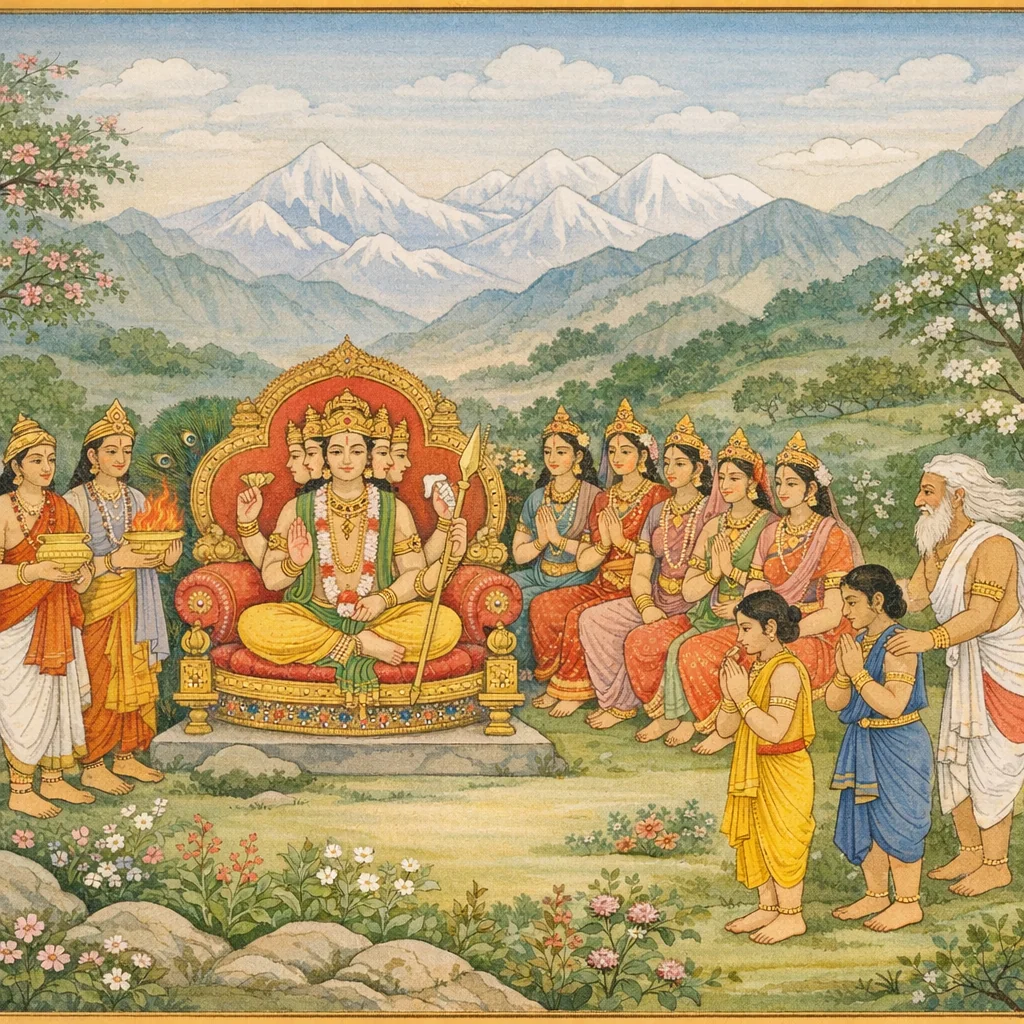
Adhyaya 45
Kārttikeya-Abhiṣecana: Mātṛgaṇa-Nāma Saṃkīrtana and Skanda’s Commission
Upa-parva: Kārttikeya-Abhiṣecana (Skanda’s Consecration and the Mātṛgaṇa Catalogue)
Vaiśaṃpāyana, speaking to Janamejaya, enumerates the renowned Mātṛs who attend Skanda (Kārttikeya), presenting an extensive onomastic catalogue that signals their multiplicity, liminal habitats, and variable forms. The narrative then describes the formal empowerment of Skanda as divine commander: major deities bestow weapons, insignia, garments, and auspicious objects (including Śakra’s śakti-weapon, Śiva’s formidable host, Viṣṇu’s vaijayantī garland, Umā’s garments, Gaṅgā’s divine kamaṇḍalu, Bṛhaspati’s staff, Varuṇa’s pāśa, Brahmā’s black antelope-skin, and other supports). Skanda’s army is depicted with martial soundscape and standards, and the episode transitions to a strategic engagement in which Skanda deploys the śakti-weapon with overwhelming effect, defeating leading adversaries (including Tāraka) and dispersing hostile forces. The account closes by reaffirming Skanda’s consecration at a tīrtha identified as Aujasa, and notes ritual acts performed there (including offerings and gifts), framing the episode as both mythic history and legitimizing charter for command, protection, and sacred geography.
Chapter Arc: युद्ध-धूलि के बीच कथा अचानक देव-लोक की ओर मुड़ती है—सप्त मातृकाएँ (ब्राह्मी से चामुण्डा तक) प्रकट होती हैं और स्कन्द के अभिषेक का मंगल-आयोजन आरम्भ होता है। → हिमवान् द्वारा मणि-रत्नों से शोभित दिव्य आसन दिया जाता है; देवगण विधि-मन्त्रों सहित अभिषेक-सामग्री लेकर एकत्र होते हैं। इन्द्र, विष्णु, सूर्य-चन्द्र, रुद्र-वासु-आदित्य, अश्विनीकुमार, गरुड, अरुण, वासुकि, औषधि-वृक्ष—समस्त लोक-शक्तियाँ इस एक क्षण में केन्द्रित होकर स्कन्द की सार्वभौम स्वीकृति रचती हैं। → देवताओं की आज्ञा से वायु स्कन्द (कृत्तिकाकुमार) को ‘बल’ और ‘अतिबल’ नामक दो महाबली सेवक प्रदान करता है—यह क्षण स्कन्द की सेनानायक-शक्ति को ठोस रूप देता है और उसके पार्षद-समुदाय का गठन निर्णायक रूप से स्थापित करता है। → देव-आज्ञा पाकर देवलोक, अन्तरिक्ष और भूलोक के वायुतुल्य वेगशाली शूर पार्षद स्कन्द के अनुचर बनते हैं; उनके विविध आयुध, विचित्र आभूषण और नाम-परम्परा का विस्तार स्कन्द-सेना की पूर्णता का बोध कराता है। → स्कन्द के अनुचरों और सैनिक-समूह की सूची आगे और भी फैलती जाती है—अगले अध्याय में यह देव-सेना किस प्रयोजन से स्मरण की जा रही है, यह संकेत अधूरा रह जाता है।
Shlokas
Verse 1
ऑपन--माज बछ। अं ऋाज - ब्राह्मी
Vaiśampāyana said: Then, having gathered all the requisites for the consecration in accordance with the scriptural injunctions, Bṛhaspati performed the prescribed oblations into the well-kindled sacred fire, exactly as the rite demands. The scene underscores that even divine or heroic elevation is to be grounded in disciplined, lawful procedure rather than impulse—power is legitimized through dharma and correct ritual order.
Verse 2
ततो हिमवता दत्ते मणिप्रवरशोभिते । दिव्यरत्नाचिते पुण्ये निषण्णं परमासने
Then, upon a supreme seat bestowed by Himavat—resplendent with excellent gems, heaped with divine jewels, and regarded as auspicious—he sat down on that highest throne. The narration underscores royal dignity and sacred legitimacy even amid the grim setting of war, suggesting that authority is to be exercised from a consecrated, orderly foundation rather than from mere force.
Verse 3
सर्वमड्रलसम्भारैरविधिमन्त्रपुरस्कृतम् । आभिषेचनिकं द्रव्यं गृहीत्वा देवतागणा:
Vaiśampāyana said: The hosts of gods, taking with them the materials required for a consecration—complete with every auspicious requisite and preceded by the proper mantras—prepared to perform the rite in due order. The scene underscores that even amid the pressures of war, legitimacy and moral authority are affirmed through correctly performed sacred procedure.
Verse 4
तत्पश्चात् हिमवान्के दिये हुए उत्तम मणियोंसे सुशोभित तथा दिव्य रत्नोंसे जटित पवित्र सिंहासनपर कुमार कार्तिकेय विराजमान हुए। उस समय उनके पास सम्पूर्ण मांगलिक उपकरणोंके साथ विधि एवं मन्त्रोच्चारणपूर्वक अभिषेकद्रव्य लेकर समस्त देवता वहाँ पधारे ।।
Thereafter, Kumāra Kārtikeya took his seat upon a pure throne, splendid with excellent gems bestowed by Himavān and inlaid with divine jewels. At that time all the gods arrived there, bringing the consecration materials together with every auspicious implement, performing the rite according to proper procedure and with the prescribed mantras. Indra and Viṣṇu of great prowess, the Sun and the Moon, Dhātā and Vidhātā, and also Wind and Fire—along with Rudras, Vasus, Ādityas, and the twin Aśvins—stood surrounding the radiant Lord Kārtikeya. The scene frames kingship as legitimate only when established through purity, correct ritual order, and the collective sanction of cosmic powers, implying that authority must be aligned with dharma rather than mere force.
Verse 5
पूष्णा भगेनार्यम्णा च अंशेन च विवस्वता । रुद्रश्न सहितो धीमान् मित्रेण वरुणेन च
Vaiśampāyana said: Surrounded by Pūṣan, Bhaga, Aryaman, Aṃśa, and Vivasvat (the Sun), and accompanied by the wise Rudra together with Mitra and Varuṇa—encircled as well by the Rudras, the Vasus, the Ādityas, and the twin Aśvins—the mighty Lord stood encompassed by these divine powers. The scene underscores how cosmic order and divine authority gather around a single commander, affirming legitimacy and auspicious support amid the unfolding war narrative.
Verse 6
विश्वेदेवैर्मरुद्धिश्न साध्यैश्व पितृभि: सह
Vaiśampāyana said: The Lord (Kārttikeya) stood surrounded by the Viśvedevas, the Maruts, the Sādhyas, and the Pitṛs; and also by the Rudras, the Vasus, the Ādityas, and the two Aśvins. Thus encircled by the foremost divine hosts, he appeared as the focal point of their reverence and power—an image of rightful authority upheld by the collective order of the gods.
Verse 7
गन्धर्वैरप्सरोभि क्ष् यक्षराक्षसपन्नगै: । देवर्षिभिरसंख्यातैस्तथा ब्रह्मर्षिभिस्तथा
Vaiśampāyana said: The Lord was surrounded by Gandharvas and Apsarases, by Yakṣas, Rākṣasas, and Nāgas; by countless divine seers and likewise by brahmin seers; and also by the Rudras, the Vasus, the Ādityas, and the two Aśvins. The scene presents a cosmic assembly in which all classes of beings—celestial, semi-divine, and powerful spirits—stand in reverent attendance, affirming the supremacy and auspicious authority of the central deity (here understood in the narrative as Kumāra/Kārttikeya).
Verse 8
वैखानसैर्वालखिल्यैवा्वाहारैर्मरीचिपै: । भगुभिश्नाज़िरोभिश्व यतिभिश्न महात्मभि:
Vaiśampāyana said: The Lord (Kārttikeya), mighty in prowess, stood surrounded by ascetics and divine seers—Vaikhānasas, Vālakhilyas, the Vāhāras, the Marīcipas, the Bhṛgus, the Aṅgirases, and other great-souled yatis. Around him also gathered the Rudras, the Vasus, the Ādityas, and the twin Aśvins—an assembly that signals the moral order of the cosmos aligning itself behind divine leadership and disciplined austerity.
Verse 9
सर्पर्विद्याधरै: पुण्यैयोगसिद्धैस्तथा वृत: । विश्वेदेव
Vaiśampāyana said: Encircled by serpents, Vidyādharas, and holy sages perfected in yoga, Kārtikeya stood surrounded. The Viśvedevas, hosts of Maruts, the Sādhyas, the Pitṛs, Gandharvas and Apsarases, Yakṣas and Rākṣasas, Nāgas, countless divine seers and brahma-seers, forest-dwelling munis, the Vālakhilyas, ascetics who live by drinking the wind, and sages who ‘drink’ the sun’s rays; great ṛṣis born in the lineages of Bhṛgu and Aṅgiras; and noble companies of renunciants—all these, along with serpents and Vidyādharas and other yoga-perfected holy men, gathered and stood around Kārtikeya. Then the Grandsire (Brahmā), Pulastya, the great ascetic Pulaha, and the mighty Lord surrounded by Rudras, Vasus, Ādityas, and the two Aśvins; and also Indra and Viṣṇu, the Sun and the Moon, Dhātā and Vidhātā, Vāyu and Agni, Pūṣan, Bhaga, Aryaman, Aṃśa, Vivasvān, Mitra, and Varuṇa—these powerful deities too came together and stood encircling the youthful commander Kārtikeya. The scene presents a cosmic consensus: the gods and seers honor disciplined power when it is aligned with protection of the world and rightful order.
Verse 10
अज्िरा: कश्यपोअत्रिश्न मरीचिर्भुगुरेव च । क्रतुर्हर: प्रचेता श्व मनुर्दक्षस्तथैव च
Vaiśampāyana said: Aṅgiras, Kaśyapa, Atri, Marīci, Bhṛgu, Kratu, Hara, Pracetas, Manu, and Dakṣa—together with Rudras, Vasus, Ādityas, and the two Aśvins—stood surrounding the mighty lord. Along with them came Indra and Viṣṇu; Sūrya and Candra; Dhātṛ and Vidhātṛ; Vāyu and Agni; Pūṣan, Bhaga, Aryaman, Aṃśa, Vivasvān, Mitra, and Varuṇa; the eleven Rudras, eight Vasus, twelve Ādityas, and the twin Aśvinīkumāras. Also arriving were Brahmā and the great seers Pulastya and Pulaha, the embodied Vedas, rivers and oceans, lakes and sacred fords, the earth and the quarters, mountains such as Himavat, Vindhya, and Meru, celestial beings like Airāvata and Uccaiḥśravas, Vāsuki, Aruṇa, Garuḍa, trees with medicinal herbs, and the powers of law and time—Dharma, Kāla, Yama, Mṛtyu, and Yama’s attendants. The passage presents a cosmic assembly: all orders of existence converge to witness and honor the divine commander (Kārttikeya/Skanda), underscoring that righteous power is not merely martial but sanctioned by the total moral and cosmic order.
Verse 11
ऋतवश्न ग्रहाश्षैव ज्योतींषि च विशाम्पते । मूर्तिमत्यश्न सरितो वेदाश्वैव सनातना:
Vaiśaṃpāyana said: “O lord of the people, the seasons and the planets, and the heavenly lights as well; the embodied rivers and the eternal, living Vedas—all of these came. Surrounded by the Rudras, the Vasus, the Ādityas, and the two Aśvins, the mighty Lord Skanda (Kārttikeya) stood encircled on every side. The passage presents a cosmic assembly: time, nature, sacred revelation, and the gods themselves gather to honor and attend the divine commander, suggesting that righteous power is not merely martial force but is upheld by the order of the universe (ṛta/dharma) and by sacred authority (veda).
Verse 12
समुद्राश्च हृदाश्नैव तीर्थानि विविधानि च । पृथिवी द्यौर्दिशश्वैव पादपाश्च॒ जनाधिप
Vaiśampāyana said: “O lord of men, the oceans and lakes, the many kinds of sacred fords, the Earth and the Sky, the directions, and the trees—all were present. And the mighty Lord stood surrounded by the Rudras, the Vasus, the Ādityas, and the twin Aśvins.”
Verse 13
अदितिर्देवमाता च ह्वी: श्री: स्वाहा सरस्वती । उमा शची सिनीवाली तथा चानुमति: कुहूः
Vaiśampāyana said: There stood around the mighty Lord—encircled by the Rudras, the Vasus, the Ādityas, and the twin Aśvins—along with the divine mothers and goddesses: Aditi the mother of the gods, Hrī (modesty), Śrī (splendour), Svāhā (the sacrificial invocation), Sarasvatī (wisdom and speech), Umā, Śacī, Sinīvālī, Anumati, and Kuhū. The scene presents a cosmic assembly in which the powers that sustain sacrifice, order, and prosperity gather in reverence, implying that true sovereignty and victory are grounded not merely in force but in alignment with dharma and the divine order.
Verse 14
राका च धिषणा चैव पत्न्यश्चान्या दिवौकसाम् | हिमवांश्वैव विन्ध्यश्न मेरुश्नानेकशुड्रवान्
Vaiśampāyana said: Rākā and Dhiṣaṇā, along with many other consorts of the gods, also arrived there; likewise Himavān, the Vindhya range, and Mount Meru adorned with many peaks. Thus, beings divine and cosmic—deities, their powers, and the very mountains—gathered together in solemn attendance, underscoring how the order of the world itself converges around a moment of great consequence.
Verse 15
ऐरावत: सानुचर: कला: काष्ठास्तथैव च । मासार्धमासा ऋतवस्तथा रात्रयहनी नूप
Vaiśampāyana said: O king, Airāvata came there together with his attendants; and likewise the divine measures of time—Kalā and Kāṣṭhā—along with the months, half-months, the seasons, and day and night. Thus even the very order of time and cosmic regulation is portrayed as assembling in attendance, underscoring that the event being described is of universal, world-sustaining significance rather than merely personal or local.
Verse 16
उच्चै:श्रवा हयश्रेष्ठो नागराजश्न वासुकि: । अरुणो गरुडश्जैव वृक्षाश्नौषधिभि: सह
Vaiśampāyana said: There stood assembled the foremost of horses, Uccaiḥśravā; the serpent-king Vāsuki; Aruṇa; and Garuḍa; along with trees together with medicinal herbs. The mighty Lord—surrounded by the Rudras, the Vasus, the Ādityas, and the two Aśvins—was encircled by these divine powers. The scene conveys a cosmic gathering: all orders of beings, from gods to nature-spirits, converge to honor and attend the supreme commander, underscoring that righteous authority and divine purpose draw the whole world into alignment.
Verse 17
धर्मश्न भगवान् देव: समाजम्मुर्हि सड़ता: । कालो यमश्न मृत्युश्न॒ यमस्यानुचराश्न ये
Vaiśampāyana said: There too the august god Dharma arrived in the assembly. Time (Kāla), Yama, Death (Mṛtyu), and the attendants of Yama also came. The Lord stood surrounded by the Rudras, the Vasus, the Ādityas, and the two Aśvins—signaling that the unfolding events are being witnessed and sanctioned by the cosmic powers that uphold order, retribution, and the inevitability of mortality.
Verse 18
बहुलत्वाच्च नोक्ता ये विविधा देवतागणा: । ते कुमाराभिषेकार्थ समाजग्मुस्ततस्तत:
Vaiśaṃpāyana said: Because they were so numerous, the many different hosts of gods are not all named here. Yet all of them—coming from every direction—assembled for the consecration (abhiṣeka) of Kumāra (Kārttikeya). The Lord stood surrounded by Rudras, Vasus, Ādityas, and the two Aśvins, as the divine community gathered in reverent order to honor and install him.
Verse 19
जगहुस्ते तदा राजन् सर्व एव दिवौकस: । आभिषेचनिकं भाण्डं मड़लानि च सर्वश:
Vaiśampāyana said: O King, at that time all the gods of heaven raised their voices in acclaim. They held in their hands the vessels for consecration and every kind of auspicious article. Surrounded by the Rudras, the Vasus, the Ādityas, and the two Aśvins, the mighty Lord stood encircled—an image of divine order, where rightful authority is affirmed through a public, sacred rite rather than mere force.
Verse 20
दिव्यसम्भारसंयुक्तैः कलशै: काउचनैर्न॑प । सरस्वतीभि: पुण्याभिर्दिव्यतोयाभिरेव तु
Vaiśaṃpāyana said: O king, with golden pitchers furnished with divine requisites and filled with sacred, celestial waters, the seven holy Sarasvatīs performed the consecration. Surrounded by the Rudras, the Vasus, the Ādityas, and the two Aśvins, the mighty Lord Kumāra Kārtikeya—terrible to the asuras and of great prowess—was anointed to the office of commander-in-chief. The scene presents a model of rightful investiture: power is not seized, but ritually entrusted by the gods through purity, order, and collective sanction.
Verse 21
अभ्यषिज्चन् कुमार वै सम्प्रहृषषशट दिवौकस: । सेनापतिं महात्मानमसुराणां भयंकरम्
Vaiśampāyana said: The gods, filled with joy, performed the consecration of the divine Youth—Kumāra Kārttikeya—installing that great-souled lord as commander of the celestial hosts, a terror to the Asuras. Surrounded by Rudras, Vasus, Ādityas, and the twin Aśvins, he stood in radiant majesty as the devas anointed him for leadership in the cosmic struggle against demonic forces.
Verse 22
पुरा यथा महाराज वरुण वै जलेश्वरम् । तथाभ्यषिज्चद् भगवान् सर्वलोकपितामह:
Vaiśampāyana said: “O great king, just as in former times Varuṇa—lord of the waters—was consecrated, so too did the blessed Grandsire of all worlds perform the consecration, surrounded by the Rudras, the Vasus, the Ādityas, and the two Aśvins.” In ethical and narrative terms, the passage underscores that legitimate authority is established through sacred consecration and the assent of cosmic powers, presenting kingship/leadership as a dharmic trust rather than mere force.
Verse 23
तस्मै ब्रह्मा ददौ प्रीतो बलिनो वातरंहस:
Vaiśampāyana said: Pleased with him, Brahmā bestowed upon that mighty, swift-moving one. The Lord stood surrounded by the Rudras, the Vasus, the Ādityas, and the two Aśvins—an assembly of divine powers gathered around him, affirming his consecration and the legitimacy of his strength through collective divine sanction.
Verse 24
कामवीर्यधरान् सिद्धान् महापारिषदान् प्रभु: । नन्दिसेनं लोहिताक्षं घण्टाकर्ण च सम्मतम्
Vaiśampāyana said: The Lord (Skanda/Kārttikeya), surrounded by perfected beings endowed with resolute valor and by the great attendants of the divine court, stood encircled by Nandisena, Lohitākṣa, and the esteemed Ghaṇṭākarṇa. He was further attended by the Rudras, the Vasus, the Ādityas, and the twin Aśvins. The scene underscores a moral vision of rightful power: true leadership is shown not by solitary force but by being upheld by disciplined, dharmic energies and the ordered ranks of the cosmos.
Verse 25
चतुर्थमस्यानुचरं ख्यातं कुमुदमालिनम् । उस समय भगवान् ब्रह्माने संतुष्ट होकर कार्तिकेयको वायुके समान वेगशाली, इच्छानुसार शक्तिधारी, बलवान् और सिद्ध चार महान् अनुचर प्रदान किये, जिनमें पहला नन्दिसेन, दूसरा लोहिताक्ष, तीसरा परम प्रिय घंटाकर्ण और उनका चौथा अनुचर कुमुदमालीके नामसे विख्यात था ।।
Vaiśampāyana said: “His fourth attendant was the renowned Kumudamālin.” In this episode, the gods—pleased and supportive—are portrayed as bestowing powerful companions upon Kārttikeya, emphasizing that divine strength is not merely personal might but also the ordered support of cosmic forces and loyal service. The narrative frames power as legitimate when granted for the protection of the world and the restraint of destructive beings.
Verse 26
मायाशतथधरं काम॑ कामवीर्य बलान्वितम् | ददौ स्कन्दाय राजेन्द्र सुरारिविनिबर्हणम्
Vaiśampāyana said: O king, Śiva bestowed upon Skanda a mighty being—one who bore hundreds of magical powers, whose strength and prowess could be summoned at will, and who was capable of crushing the enemies of the gods. The scene underscores a moral logic of the epic: when cosmic order is threatened, divine power is entrusted to a worthy commander, not for personal gain but for the protection of dharma and the restraint of destructive forces.
Verse 27
स हि देवासुरे युद्धे दैत्यानां भीमकर्मणाम् । जघान दोर्भ्या संक्रुद्धः प्रयुतानि चतुर्दश
Vaiśampāyana said: In the war between the gods and the asuras, that mighty one—enraged—slew fourteen prayutas of Daityas, warriors of dreadful deeds, using only his two arms. The verse underscores a model of overwhelming valor deployed in defense of cosmic order: when destructive forces threaten the balance upheld by the devas, righteous power is portrayed as swift, decisive, and proportionate to the danger.
Verse 28
तथा देवा ददुस्तस्मै सेनां नैऋतसंकुलाम् । देवशत्रुक्षयकरीमजय्यां विष्णुरूपिणीम्
Vaiśampāyana said: In the same way, the gods granted him an army crowded with Nairṛtas—an invincible host, bearing the form and power of Viṣṇu—destined to bring about the destruction of the enemies of the gods. The passage frames divine warfare as a sanctioned act: force is bestowed not for personal gain, but to restore cosmic order by removing those who threaten the devas’ rightful stability.
Verse 29
जयशब्दं तथा चक्रुर्देवा: सर्वे सवासवा: । गन्धर्वा यक्षरक्षांसि मुनय: पितरस्तथा
Vaiśaṃpāyana said: Then all the gods, together with Indra, raised a cry of victory. Gandharvas, Yakṣas, Rākṣasas, sages, and the Pitṛs likewise rejoiced. Surrounded by the Rudras, the Vasus, the Ādityas, and the two Aśvins, the mighty Lord stood encircled—an image of cosmic order affirming rightful power through collective reverence rather than mere force.
Verse 30
उस समय इन्द्रसहित सम्पूर्ण देवताओं, गन्धर्वों, यक्षों, राक्षसों, मुनियों तथा पितरोंने जय-जयकार किया ।।
Then Yama granted him two attendants—Unmātha and Pramātha—both resembling Time itself in their dread power, endowed with great valor and blazing splendor. The scene underscores how cosmic authority endorses and equips the divinely appointed leader: strength is not merely personal prowess but a responsibility sanctioned by higher order, meant to uphold dharma through disciplined service.
Verse 31
सुभ्राजो भास्वरश्वैव यौ तौ सूर्यानुयायिनौ । तौ सूर्य: कार्तिकेयाय ददौ प्रीत: प्रतापवान्
Vaiśampāyana said: “Subhrāja and Bhāsvara—those two radiant attendants who followed the Sun—were, in the Sun’s pleased generosity, bestowed upon Kārtikeya for his service. Thus the mighty Lord (Kārtikeya), surrounded by the Rudras, the Vasus, the Ādityas, and the two Aśvins, stood encircled by the gods—an image of divine sanction and disciplined allegiance, where even celestial powers are ordered into service under a worthy commander.”
Verse 32
कैलासशू्ज्गसंकाशोौ श्वेतमाल्यानुलेपनौ । सोमो>प्यनुचरीौ प्रादान्मर्णिं सुमणिमेव च
Vaiśampāyana said: Resplendent like the peaks of Kailāsa, adorned with white garlands and unguents, and further honored even by Soma with attendants and a radiant jewel, the mighty Lord stood surrounded—encircled by the Rudras, the Vasus, the Ādityas, and the two Aśvins. The passage emphasizes how divine power is recognized through reverent offering and orderly attendance, presenting a vision of cosmic hierarchy and collective homage rather than solitary dominance.
Verse 33
चन्द्रमाने भी कैलास-शिखरके समान श्वेतवर्णवाले तथा श्वेत माला और श्वेत चन्दन धारण करनेवाले दो अनुचर प्रदान किये, जिनके नाम थे मणि और सुमणि ।।
Vaiśampāyana said: The Moon also bestowed upon him two attendants—white in complexion, adorned with white garlands and white sandal-paste, radiant like the peak of Mount Kailāsa—named Maṇi and Sumaṇi. Likewise, Agni (Hutāśana) gave to his son two heroic attendants, Jvālājihva and Jyoti, mighty warriors who could crush hostile armies. Around that glorious Lord Skanda stood the great gods—Rudras, Vasus, Ādityas, and the two Aśvins—encircling him in reverent attendance, marking his divinely sanctioned authority and martial destiny.
Verse 34
परिघं च वर्ट चैव भीम॑ च सुमहाबलम् । दहतिं दहनं चैव प्रचण्डौ वीर्यसम्मतौ
Vaiśampāyana said: Around that mighty Lord stood formidable powers—Parigha and Varta, Bhīma of great strength, and Dahati and Dahana, both fierce and renowned for their valor—encircled as well by the Rudras, the Vasus, the Ādityas, and the two Aśvins. The scene underscores a vision of divine solidarity: many cosmic forces gather in ordered attendance, suggesting that true power is not mere violence but disciplined strength aligned with a higher purpose.
Verse 35
अंशो5प्यनुचरान् पञ्च ददौ स्कन्दाय धीमते । अंशने भी बुद्धिमान् स्कन्दको पाँच अनुचर प्रदान किये, जिनके नाम इस प्रकार हैं-- परिघ, वट, महाबली भीम तथा दहति और दहन। इनमेंसे दहति और दहन बड़े प्रचण्ड तथा बल-पराक्रमकी दृष्टिसे सम्मानित थे ।।
Vaiśampāyana said: Aṁśa too bestowed five attendants upon the wise Skanda. In this episode, the gods strengthen Skanda’s retinue for the work of subduing hostile forces—an image of delegated power in service of cosmic order, where might is organized under rightful leadership rather than used for private gain.
Verse 36
ददावनलपुत्राय वासव: परवीरहा । तौ हि शत्रून् महेन्द्रस्य जघ्नतु: समरे बहूनू
Vaiśampāyana said: Indra, the slayer of hostile heroes, bestowed upon Skanda—the son of Agni—two attendants, Utkrośa and Pañcaka. Surrounded by the mighty hosts of the gods—Rudras, Vasus, Ādityas, and the twin Aśvins—the Lord stood ready for battle. Those two attendants, bearing the thunderbolt and the staff, struck down many of Indra’s enemies on the battlefield. The passage underscores how divine power is organized through delegated duty: victory is achieved not by solitary might alone, but by disciplined support aligned with a righteous cause in war.
Verse 37
चक्र विक्रमकं चैव संक्रमं च महाबलम् | स्कन्दाय त्रीननुचरान् ददौ विष्णुर्महायशा:
Vaiśampāyana said: The illustrious Lord Viṣṇu bestowed upon Skanda three attendant powers—Cakra, Vikramaka, and the mighty Saṃkrama. In the narrative frame, the gods stand in reverent support around the youthful war-god, and Viṣṇu’s gift signifies the ethical ideal that divine strength is to be ordered, delegated, and used in the service of cosmic protection rather than personal pride.
Verse 38
वर्धनं नन्दनं चैव सर्वविद्याविशारदौ । स्कन्दाय ददतु: प्रीतावश्चिनौ भिषजां वरौ
Vaiśampāyana said: The two Aśvins—foremost among physicians and masters of all branches of knowledge—being pleased, bestowed upon Skanda two attendants named Vardhana and Nandana. The episode underscores how divine skill and learning, when joined with goodwill, are directed toward service: the healers’ gift is not merely a reward, but an act that strengthens the divine commander through capable support.
Verse 39
कुन्दं च कुसुमं चैव कुमुदं च महायशा: । डम्बराडम्बरौ चैव ददौ धाता महात्मने
Vaiśampāyana said: The illustrious Dhātā bestowed upon the great-souled Skanda five attendants—Kuṇḍa, Kusuma, Kumuda, Ḍambara, and Āḍambara. The scene underscores divine recognition of merit: the gods honor Skanda not merely with praise but with service and support, affirming that rightful leadership is strengthened by disciplined retinues and orderly delegation.
Verse 40
चक्रानुचक्रौ बलिनौ मेघचक्रौ बलोत्कटौ । ददौ त्वष्टा महामायौ स्कन्दायानुचरावुभौ
Vaiśampāyana said: Tvaṣṭṛ, the Prajāpati, appointed to Skanda two attendants named Cakra and Anucakra—both mighty, fierce in strength, endowed with great magical power, and bearing cloud-like discs. In the wider scene, the great gods—Rudra along with the Rudras, Vasus, Ādityas, and the two Aśvins—stand gathered around the powerful Kumāra Kārttikeya, affirming his divine authority and the ordered hierarchy of service that sustains cosmic and martial leadership.
Verse 41
सुव्रतं सत्यसंधं च ददौ मित्रो महात्मने । कुमाराय महात्मानौ तपोविद्याधरी प्रभु:
Vaiśaṃpāyana said: The mighty lord, endowed with ascetic power and sacred knowledge, bestowed upon the great-souled Kumāra (Kārttikeya) a companion—Mitra—who was of excellent vows and steadfast in truth. Then that resplendent lord stood surrounded by the Rudras, the Vasus, the Ādityas, and the two Aśvins—an assembly of divine powers encircling him, affirming the ethical ideal that truthfulness and disciplined vows are the proper ornaments of leadership and divine authority.
Verse 42
सुव्रतं च महात्मानं शुभकर्माणमेव च
Vaiśampāyana said: The Lord—of excellent vows, great-souled, and devoted to auspicious deeds—stood surrounded by the Rudras, the Vasus, the Ādityas, and the two Aśvins. In the narrative frame, this gathering of divine powers around the commander-god (Kumāra/Kārttikeya) signals collective sanction and protection: righteous might is shown as supported by disciplined conduct (vrata) and beneficent action (śubha-karman), not by mere force.
Verse 43
पाणीतकं कालिकं च महामायाविनायुभौ
Vaiśampāyana said: The mighty Lord—accompanied by the two great illusion-wielding beings, Pāṇītaka and Kālika—stood surrounded by the Rudras, the Vasus, the Ādityas, and the twin Aśvins. In this scene, the gods gather in reverent attendance around the divine commander, marking his supreme authority and the cosmic sanction behind the unfolding events of war.
Verse 44
बल॑ चातिबलं चैव महावक्त्रौ महाबलौ
Vaiśampāyana said: The Lord—mighty and surpassingly mighty, of vast countenance and great strength—stood surrounded by the Rudras, the Vasus, the Ādityas, and the two Aśvins. Thus the radiant hosts of the gods gathered around Kumāra Kārttikeya, honoring his power and station amid the war-torn world, as if to affirm that divine order and protection still stand behind rightful leadership and disciplined valor.
Verse 45
प्रददौ कार्तिकेयाय वायुर्भरतसत्तम । भरतश्रेष्ठ! वायु देवताने कृत्तिकाकुमारको महान् बलशाली एवं विशाल मुखवाले बल और अतिबल नामक दो सेवक प्रदान किये || ४४ $ ।।
Vaiśampāyana said: O best of the Bharatas, Vāyu bestowed upon Kārtikeya two mighty attendants—Yama and Atiyama—both of great strength and with formidable, whale-like faces. Then the glorious Lord (Skanda) stood surrounded by the Rudras, the Vasus, the Ādityas, and the twin Aśvins. The passage underscores how divine power is not merely personal prowess but a sanctioned, cosmic order: the gods collectively affirm Skanda’s authority and capacity to uphold dharma through disciplined strength.
Verse 46
सुवर्चसं महात्मानं तथैवाप्यतिवर्चसम्
Vaiśampāyana said: The Lord—radiant and great-souled, indeed surpassingly resplendent—stood surrounded by the Rudras, the Vasus, the Ādityas, and the two Aśvins. In this scene, the epic underscores how true sovereignty is marked not merely by force but by divine sanction and ordered harmony: the powers that govern the cosmos gather around the one whose splendor and authority are recognized by all.
Verse 47
काजउ्चनं च महात्मानं मेघमभालिनमेव च
Vaiśampāyana said: The mighty Lord—radiant like gold and like a cloud—stood surrounded by the hosts of gods: the Rudras, Vasus, Ādityas, and the two Aśvins. Indra of great prowess, Viṣṇu, the Sun and the Moon, Dhātṛ and Vidhātṛ, Vāyu and Agni, Pūṣan, Bhaga, Aryaman, Aṃśa, Vivasvān, Mitra, and Varuṇa—together with the wise Rudra and the eleven Rudras, the eight Vasus, the twelve Ādityas, and both Aśvinīkumāras—all these powerful deities stood encircling Kumāra Kārttikeya. The scene underscores a moral order in which divine powers align around a rightful commander, suggesting that legitimate leadership and cosmic duty (dharma) draw collective support.
Verse 48
स्थिरं चातिस्थिरं चैव मेरुरेवापरौ ददौ
Vaiśampāyana said: The Lord, surrounded by the Rudras, the Vasus, the Ādityas, and the two Aśvins, bestowed both firmness and unshakable stability—like Mount Meru itself. In that divine assembly, mighty deities such as Indra and Viṣṇu, Sūrya and Candra, Dhātā and Vidhātā, Vāyu and Agni, Pūṣan, Bhaga, Aryaman, Aṃśa, Vivasvān, Mitra, and Varuṇa, together with the wise Rudra—along with the eleven Rudras, eight Vasus, twelve Ādityas, and the twin Aśvinīkumāras—stood encircling the radiant Kumāra Kārttikeya.
Verse 49
उच्छूड़ूं चातिशुड्ं च महापाषाणयोधिनौ
Vaiśampāyana said: The mighty Lord—Kumāra Kārtikeya—stood surrounded by the great stone-weapon warriors Ucchūḍū and Atiśūḍū, and by the hosts of the Rudras, Vasus, Ādityas, and the two Aśvins. Around him gathered the great powers: Indra and Viṣṇu; the Sun and the Moon; Dhātṛ and Vidhātṛ; Vāyu and Agni; Pūṣan, Bhaga, Aryaman, Aṃśa, Vivasvān, Mitra, and Varuṇa—together with Rudradeva, the eleven Rudras, the eight Vasus, the twelve Ādityas, and the twin Aśvin-kumāras. All, radiant with might, encircled Kārtikeya and stood in attendance.
Verse 50
प्रददावग्निपुत्राय विन्ध्य: पारिषदावुभौ । विन्ध्य पर्वतने भी अग्निकुमारको दो पार्षद प्रदान किये, जिनके नाम थे उच्छृंग और अतिशंग। वे दोनों ही बड़े-बड़े पत्थरोंकी चट्टानोंद्वारा युद्ध करनेमें कुशल थे ।।
Vaiśampāyana said: The Vindhya mountain presented to the son of Agni two attendants—Ucchṛṅga and Atiśṛṅga—both expert in fighting with massive slabs of stone. Around the mighty lord Kārttikeya stood gathered the great powers: Indra and Viṣṇu, the Sun and the Moon, Dhātā and Vidhātā, Vāyu and Agni, Pūṣan, Bhaga, Aryaman, Aṃśa, Vivasvān, Mitra and Varuṇa; and also Rudra with the eleven Rudras, the eight Vasus, the twelve Ādityas, and the two Aśvin twins. The scene underscores a moral order in which even the highest gods assemble in disciplined support of a chosen commander, affirming hierarchy, duty, and collective responsibility in the face of conflict.
Verse 51
उन्मादं शड्कुकर्ण च पुष्पदन्तं तथैव च
Vaiśaṃpāyana said: The mighty Lord (Kārttikeya) stood surrounded—by Unmāda, Śaṅkukarṇa, and Puṣpadanta, and likewise by the Rudras, the Vasus, the Ādityas, and the twin Aśvins. The scene presents the war-god not as an isolated hero but as a divinity upheld by the cosmic order: the principal deities and their hosts gather around him, signaling collective sanction, disciplined power, and the alignment of martial force with divine governance.
Verse 52
जयं महाजयं चैव नागौ ज्वलनसूनवे
Vaiśampāyana said: Around the Lord—Agni’s son (Kārttikeya)—stood the Nāga chiefs Jaya and Mahājaya, and he was also encircled by the Rudras, the Vasus, the Ādityas, and the twin Aśvins. The scene presents the war-god not as a solitary power but as one upheld by the ordered forces of the cosmos, suggesting that true might is legitimized and restrained by divine order rather than mere violence.
Verse 53
प्रददौ पुरुषव्यात्र वासुकि: पन्नगेश्वर: । पुरुषसिंह! नागराज वासुकिने अग्निकुमारको पार्षदरूपसे जय और महाजय नामक दो नाग भेंट किये ।।
Vaiśampāyana said: O tiger among men, Vāsuki, lord of the serpents, presented (to the divine youth) two Nāgas named Jaya and Mahājaya, attendants in form and service. Then the Sādhyas, the Rudras, the Vasus, and the Pitṛs likewise—together with the Ādityas and the two Aśvins—stood surrounding that mighty lord. Indra of great prowess, Viṣṇu, the Sun and the Moon, Dhātā and Vidhātā, Vāyu and Agni, Pūṣan, Bhaga, Aryaman, Aṃśa, Vivasvān, Mitra, and Varuṇa—all these powerful deities encircled Kumāra Kārttikeya, standing in attendance. The scene underscores a moral order in which even the highest powers acknowledge rightful leadership and render service to the one appointed for the protection of the worlds.
Verse 54
सागरा: सरितश्चैव गिरयश्न महाबला: । ददुः सेनागणाध्यक्षान् शूलपट्टिशधारिण:
Vaiśaṃpāyana said: Even the oceans, the rivers, and the mighty mountains seemed to present forth the commanders of the army—men bearing spears and heavy weapons—suggesting that the very forces of nature were yielding up warriors for the coming clash. The scene heightens the moral gravity of war: when conflict swells to this scale, it appears as though the whole world is drawn into supplying instruments and agents of violence.
Verse 55
दिव्यप्रहरणोपेतान् नानावेषविभूषितान् । इस प्रकार साध्य, रुद्र, वसु, पितृगण, समुद्र, सरिताओं और महाबली पर्वतोंने उन्हें विभिन्न सेनापति अर्पित किये, जो शूल, पट्टिश और नाना प्रकारके दिव्य आयुध धारण किये हुए थे। वे सब-के-सब भाँति-भाँतिकी वेश-भूषासे विभूषित थे | ५३-५४ $ ।।
Vaiśampāyana said: “They were furnished with celestial weapons and adorned in many different guises and ornaments. Now hear also the names of those other warriors who serve under Skanda.”
Verse 56
शड्कुकर्णो निकुम्भश्न पद्म: कुमुद एव च
Vaiśampāyana said: “(There were) Śaḍkukarṇa, Nikumbha, Padma, and also Kumuda.” In the midst of the war narrative, this verse functions as a concise roll-call, preserving the memory of named warriors and underscoring the epic’s ethical insistence that even amid mass violence, individuals are not reduced to anonymity.
Verse 57
अनन्तो द्वादशभुजस्तथा कृष्णोपकृष्णकौ । प्राणश्रवा: कपिस्कन्ध: काज्चनाक्षो जलन्धम:
Vaiśampāyana said: “(Among them were) Ananta of twelve arms; also Kṛṣṇa and Upakṛṣṇa; Prāṇaśravā; Kapiskandha; Kāñcanākṣa; and Jalandhama.” In this war-context catalogue, the narration underscores the vast scale of the conflict by naming notable figures, reminding the listener that many distinct lineages and reputations are drawn into the consequences of adharma and battle.
Verse 58
अक्ष: संतर्जनो राजन् कुनदीकस्तमो<न्तकृत् । एकाक्षो द्वादशाक्षश्न तथैवैकजट: प्रभु:
Vaiśampāyana said: “O King, there was Akṣa, a fierce intimidator; Kunadīka, a slayer of darkness; and Antakṛt, a bringer of death. There was also Ekākṣa (‘One-eyed’), Dvādaśākṣa (‘Twelve-eyed’), and likewise the powerful Ekajaṭa (‘Single-matted-lock’).” In the war narrative, the verse functions as a roll-call of formidable fighters, emphasizing the many fearsome, almost emblematic personalities drawn into the conflict and the moral weight of a battle that consumes even the mighty.
Verse 59
सहख्बाहुर्विकटो व्याप्राक्ष: क्षितिकम्पन: । पुण्यनामा सुनामा च सुचक्र: प्रियदर्शन:
Vaiśampāyana said: “There were warriors named Sahakṣabāhu, Vikaṭa, Vyāprākṣa, and Kṣitikampana; also Puṇyanāmā and Sunāmā; and further Sucakra and Priyadarśana.” In the midst of the war narrative, the text records these names to mark the scale of the conflict and the many lives drawn into it, reminding the listener that fame and identity in battle are ultimately reduced to brief remembrance.
Verse 60
परिश्रुत: कोकनद: प्रियमाल्यानुलेपन: । अजोदरो गजशिरा: स्कन्धाक्ष: शतलोचन:
Vaiśampāyana said: He was famed far and wide; radiant like the kokanada lotus; fond of dear garlands and fragrant unguents. His belly was firm and compact; his head was like an elephant’s; his shoulders and eyes were powerful; and he was ‘hundred‑eyed’—marked by an extraordinary, awe-inspiring gaze. In the war narrative, such epithets heighten the sense of formidable presence and the moral weight of the conflict by portraying warriors as larger-than-life embodiments of strength, splendor, and reputation.
Verse 61
ज्वालाजिह्ठवः करालाक्ष: शितिकेशो जटी हरि: । परिश्रुत: कोकनद: कृष्णकेशो जटाधर:
Vaiśampāyana said: “He was famed by many fearsome and striking epithets—‘Flame-tongued,’ ‘Terrible-eyed,’ ‘White-haired,’ ‘Matted-haired,’ ‘Tawny (lion-like),’ ‘Widely renowned,’ ‘Lotus-like,’ ‘Black-haired,’ and ‘Bearer of matted locks.’” In the war narrative, such a piling up of names functions to intensify the listener’s sense of awe and dread, portraying a formidable figure whose appearance and reputation shape the moral atmosphere of the battlefield—where fame, fear, and perceived power influence resolve and conduct.
Verse 62
चर्तुर्वष्टोडष्टजिह्नश्व मेघनाद: पृथुश्रवा: | विद्युताक्षो धनुर्वकत्रो जाठरो मारुताशन:
Vaiśampāyana said: (There were warriors) named Megha-nāda, Pṛthu-śravā, Vidyutākṣa, Dhanur-vaktra, Jāṭhara, and Mārutāśana—men whose very names evoke thunder, lightning, and consuming fire, suggesting the fierce and destructive temper of battle as the war presses on.
Verse 63
उदाराक्षो रथाक्षश्न वज्ञनाभो वसुप्रभ: । समुद्रवेगो राजेन्द्र शैलकम्पी तथैव च
Vaiśampāyana said: “O king, (there were warriors) named Udārākṣa, Rathākṣa, Vajranābha, and Vasuprabha—along with Samudravega and likewise Śailakampī.”
Verse 64
वृषो मेष: प्रवाहश्चन तथा नन्दोपनन्दकौ । धूम्र: श्वेत: कलिड्रश्न सिद्धार्थो वरदस्तथा
Vaiśampāyana said: “(There were) Vṛṣa, Meṣa, and Pravāha; likewise Nanda and Upananda; also Dhūmra, Śveta, Kaliḍraśna, Siddhārtha, and Varada.” In the midst of the war narrative, the text records a catalogue of named figures—an enumerative passage that preserves memory and lineage, underscoring how the epic treats even lesser-known participants as part of the moral and historical fabric of the conflict.
Verse 65
प्रियकश्नैव नन्दश्न गोनन्दश्न प्रतापवान् । आनन्दश्न प्रमोदश्न स्वस्तिको ध्रुवकस्तथा
Vaiśampāyana said: “There were also Priyakṛ, Nanda, Gonanda—the valiant one—Ānanda, Pramoda, Svastika, and likewise Dhruvaka.” In the midst of the war narrative, this verse functions as a roll-call, preserving the memory of named participants and underscoring how many individuals—each with their own duty and fate—were drawn into the great conflict.
Verse 66
क्षेमवाह: सुवाहश्न सिद्धपात्रश्न भारत | गोव्रज: कनकापीडो महापारिषदेश्वर:
Vaiśampāyana said: “O Bhārata, (there were) Kṣemavāha, Suvāha, Siddhapātra, Govraja, Kanakāpīḍa, and Mahāpāriṣadeśvara.” (These are names listed in the course of the war narrative, marking notable figures present in the unfolding events.)
Verse 67
गायनो हसनश्नैव बाण: खड्गश्न वीर्यवान् वैताली गतिताली च तथा कथकवातिकौ
Vaiśampāyana said: There were performers and entertainers—Gāyana and Hasana, and also the valiant Bāṇa and Khaḍga; likewise Vaitālī and Gatitālī, and also Kathaka and Vātika. (The narrative here catalogs named individuals associated with performance and courtly entertainment, suggesting the presence of bards, dancers, and storytellers within the royal milieu that surrounds the war-episode, reminding the listener that even amid conflict, courts retained their cultural retinues and public voices.)
Verse 68
हंसज: पड्कदिग्धाड़: समुद्रोन्मादनश्न ह । रणोत्कट: प्रहासश्न श्वेतसिद्धश्ष नन्दन:
Vaiśampāyana said: “There was Haṃsaja, and Paṅkadigdha; Samudronmādana as well; Raṇotkaṭa and Prahāsa; and also Śvetasiddha and Nandana.” In the midst of the war narrative, the text here records a roster of named warriors, underscoring the vast scale of the conflict and the many lives drawn into it—an ethical reminder that war’s burden is borne not only by famed heroes but by countless others whose names are briefly preserved in the epic’s memory.
Verse 69
कालकण्ठ: प्रभासश्न॒ तथा कुम्भाण्डकोदर: । कालकक्ष: सितश्चैव भूतानां मथनस्तथा
Vaiśampāyana said: “There were also (warriors) named Kālakaṇṭha, Prabhāsa, and Kumbhāṇḍakodara; likewise Kālakakṣa and Sita, and also Bhūtānāṁmathana.” In the grim roll-call of the battlefield, such names—evoking darkness, terror, and the crushing of beings—underscore how war gathers men of fierce repute and ominous character, where identity is remembered as much by dread as by lineage.
Verse 70
यज्ञवाहः सुवाहश्च देवयाजी च सोमप: । मज्जानश्न महातेजा: क्रथक्राथौ च भारत
Vaiśampāyana said: “O Bhārata, (there were also) Yajñavāha and Suvāha, Devayājī and Somapa—mighty warriors—along with Majjānaśn and the two brothers Kratha and Krātha.”
Verse 71
तुहरश्न तुहारश्न चित्रदेवश्न वीर्यवान् मधुर: सुप्रसादश्चन॒ किरीटी च महाबल:
Vaiśampāyana said: “(There were) Tuharaśna, Tuhāraśna, and the valiant Citradeva; also Madhura, the gracious Suprasāda, and Kirīṭin, a man of great strength.” In the midst of the war narrative, the verse functions as a roll-call of notable warriors, emphasizing the scale of the conflict and the moral weight of leadership and valor when aligned (or misaligned) with dharma.
Verse 72
वत्सलो मधुवर्णश्ष कलशोदर एव च | धर्मदो मन्मथकर: सूचीवक्त्रश्न वीर्यवान्
Vaiśampāyana said: “He was affectionate; honey-hued in complexion; pot-bellied; a giver of dharma (one who upholds and bestows righteous order); a stirrer of desire; needle-faced; and indeed possessed of great strength.”
Verse 73
श्वेतवक्त्र: सुवक्त्रश्न चारुवक्त्रश्न पाण्डुर: । दण्डबाहु: सुबाहुश्चव रज: कोकिलकस्तथा
Vaiśampāyana said: “There were (horses) named Śvetavaktra, Suvaktra, Cāruvaktra, Pāṇḍura, Daṇḍabāhu, Subāhu, Rajaḥ, and Kokilaka.” In the midst of the war narrative, the careful naming of steeds underscores the epic’s attention to lineage, equipment, and the concrete supports of kṣatriya duty—how great deeds in battle rest upon well-appointed resources and loyal companions.
Verse 74
अचल: कनकाक्षश्न बालानामपि य: प्रभु: । संचारकः कोकनदो गृश्रपत्रश्चन जम्बुक:
Vaiśampāyana said: “He is steadfast; he is ‘Golden-eyed’; he is a master even over the young. He moves about as a messenger; he is called Kokanada; he is ‘Vulture-winged’—and he is no jackal.”
Verse 75
लोहाजवक्त्रो जवन: कुम्भवकत्रश्न कुम्भक: | स्वर्णग्रीवश्च॒ कृष्णौजा हंसवक्त्रश्न चन्द्रभ:
Vaiśampāyana said: “(Among them were) Lohājavaktra, Javaṇa, Kumbhavaktra, Kumbhaka, Svarṇagrīva, Kṛṣṇaujā, Haṃsavaktra, and Candrabha.” In the midst of the war narrative, this verse functions as a roll-call of notable warriors, underscoring how many distinct persons—each with a marked epithet—are drawn into the conflict and its moral consequences.
Verse 76
पाणिकूर्चश्न॒ शम्बूक: पञ्चवक्त्रश्न शिक्षक: | चाषवक्त्रश्न जम्बूक: शाकवक्त्रश्न कुडउजल:
Vaiśampāyana said: “(There were beings) named Śambūka, the ‘hand-tufted’ one; the Śikṣaka, the ‘five-faced’ one; Jambūka, the ‘crow-faced’ one; and Kuḍūjala, the ‘vegetable-faced’ one.” The narration here functions as a catalog-like listing of strange or ominous figures, heightening the atmosphere of disorder and moral inversion that accompanies the catastrophic close of the war.
Verse 77
शंकुकर्ण, निकुम्भ, पद्म, कुमुद, अनन्त, द्वादशभुज, कृष्ण, उपकृष्ण, प्राणश्रवा, कपिस्कन्ध, कांचनाक्ष, जलन्धम, अक्ष, संतर्जन, कुनदीक, तमो<न्तकृत, एकाक्ष, द्वादशाक्ष, एकजट, प्रभु, सहसख्रबाहु, विकट, व्याप्राक्ष, क्षतिकम्पन, पुण्यनामा, सुनामा, सुचक्र, प्रियदर्शन, परिश्रुत, कोकनद, प्रियमाल्यानुलेपन, अजोदर, गजशिरा, स्कन्धाक्ष, शतलोचन, ज्वालाजिह्न, करालाक्ष, शितिकेश, जटी, हरि, परिश्रुत, कोकनद, कृष्णकेश, जटाधर, चतुर्दष्ट, अष्टजिह्न, मेघनाद, पृथुश्रवा, विद्युताक्ष, धनुर्वक्त्र, जाठर, मारुताशन, उदाराक्ष, रथाक्ष, वज्नाभ, वसुप्रभ, समुद्रवेग, शैलकम्पी, वृष, मेष, प्रवाह, नन््द, उपनन्द, धूम्र, श्वेत, कलिंग, सिद्धार्थ, वरद, प्रियक, नन्द, प्रतापी गोनन्द, आनन्द, प्रमोद, स्वस्तिक, ध्रुवक, क्षेमवाह, सुवाह, सिद्धपात्र, गोव्रज, कनकापीड, महापरिषदेश्वर, गायन, हसन, बाण, पराक्रमी, खड्ग, वैताली, गतितली, कथक, वातिक, हंसज, पंकदिग्धांग, समुद्रोन्मादन, रणोत्कट, प्रहास, श्वेतसिद्ध, नन्दन, कालकण्ठ, प्रभास, कुम्भाण्डकोदर, कालकक्ष, सित, भूतमथन, यज्ञवाह, सुवाह, देवयाजी, सोमप, मज्जान, महातेजा, क्रथ, क्राथ, तुहर, तुहार, पराक्रमी चित्रदेव, मधुर, सुप्रसाद, किरीटी, महाबल, वत्सल, मधुवर्ण, कलशोदर, धर्मद, मनन््मथकर, शक्तिशाली सूचीवक्त्र, श्वेतवक्त्र, सुवक्त्र, चारुवक्त्र, पाण्डुर, दण्डबाहु, सुबाहु, रज, कोकिलक, अचल, कनकाक्ष, बालस्वामी, संचारक, कोकनद, गृध्रपत्र, जम्बुक, लोहवक्त्र, अजवक्त्र, जवन, कुम्भवक्त्र, कुम्भक, स्वर्णग्रीव, कृष्णौजा, हंसवक्त्र, चन्द्रभ, पाणिकूर्च, शम्बूक, पंचवक्त्र, शिक्षक, चापवकत्र, जम्बूक, शाकवक्त और कुंजल ।। ५६-- ७६ || योगयुक्ता महात्मान: सतत ब्राह्मणप्रिया: । पैतामहा महात्मानो महापारिषदाक्ष ये,जनमेजय! ये सब पार्षद योगयुक्त, महामना तथा निरन्तर ब्राह्मणोंसे प्रेम रखनेवाले हैं। इनके सिवा, पितामह ब्रह्माजीके दिये हुए जो महामना महापार्षद हैं, वे तथा दूसरे बालक, तरुण एवं वृद्ध सहस्रों पार्षद कुमारकी सेवामें उपस्थित हुए
Vaiśampāyana said: “O Janamejaya, there came a vast retinue of attendants of Kumāra (Skanda)—their names are recited in long succession. These attendants are disciplined in yoga, great-souled, and continually devoted to honoring and supporting brāhmaṇas. Besides them, there were also exalted ‘Mahāpārṣadas’ granted by Pitāmaha Brahmā himself; and along with these, thousands more—boys, youths, and elders—stood present in Skanda’s service.” Ethically, the passage frames martial divinity (Skanda’s host) as grounded in inner discipline and reverence for sacred learning: power is legitimized not merely by force, but by yogic restraint and sustained respect for brāhmaṇas and ritual order.
Verse 78
यौवनस्थाश्न बालाश्न वृद्धाश्ष जनमेजय । सहस््रश: पारिषदा: कुमारमवतस्थिरे
Vaiśampāyana said: “O Janamejaya, youths, children, and elders—thousands of attendants of the assembly—stood ready in attendance upon the Prince. The scene underscores disciplined service and reverence within a sacred gathering, where devotion to learned Brahmins and loyalty to a worthy leader are treated as marks of good conduct.”
Verse 79
वक्त्रैर्ननाविधैयें तु शूणु ताउज्जनमेजय । कूर्मकुक्कुटवकत्रा श्नव शशोलूकमुखास्तथा
Vaiśampāyana said: “Listen, O Janamejaya, to those beings who had faces of many different kinds—some with the faces of tortoises and cocks, and others with the mouths of dogs, hares, and owls.”
Verse 80
मार्जारशशवत्त्राश्न दीर्घवक्त्राक्ष भारत,भारत! बहुतोंके मुख बिल्ली और खरगोशके समान थे। किन्हींके मुख बहुत बड़े थे और किन्हींके नेवले, उल्लू, कौए, चूहे, बश्वु तथा मयूरके मुखोंके समान थे
Vaiśampāyana said: O Bhārata, their terror was like that of cats and hares. Many of them had faces resembling cats and rabbits; some had enormous mouths, while others bore faces like those of mongooses, owls, crows, rats, bulls, and peacocks—an ominous vision reflecting the moral disarray and dread that pervaded the battlefield.
Verse 81
नकुलोलूकवकत्राश्न काकवक्त्रास्तथा परे | आखुबश्रुकवक्त्राश्चन मयूरवदनास्तथा
Vaiśampāyana said: “Some had faces like a mongoose and an owl; others had faces like crows. Some bore faces like rats and like the ichneumon; and some had faces like peacocks.” Thus, in the dreadful vision of the battlefield, the narrator emphasizes the war’s dehumanizing horror by portraying combatants as if marked with animal-like visages—an image that underscores the moral collapse and terror surrounding the slaughter.
Verse 82
मत्स्यमेषाननाक्षान्ये अजाविमहिषानना: । ऋक्षशार्दूलवक्त्राश्न दीपिसिंहाननास्तथा,किन्हीं-किन्हींके मुख मछली, मेढे, बकरी, भेड़, भैंसे, रीछ, व्याप्र, भेड़िये तथा सिंहोंके समान थे
Vaiśampāyana said: Among them, some had faces like fish and rams; others bore the faces of goats, sheep, and buffaloes. Some were lion- and tiger-faced, and others had the visages of bears and fierce lions—portents of a world turned unnatural, reflecting the moral disorder unleashed by war.
Verse 83
भीमा गजाननाश्रैव तथा नक्रमुखाश्न ये । गरुडानना: कड़्कमुखा वृककाकमुखास्तथा
Vaiśaṃpāyana said: “There were also fearsome beings—some with the faces of elephants, others with crocodile-like mouths; some with the visage of Garuḍa, some with heron-like beaks, and others with the faces of wolves and crows.” In the grim atmosphere of war, the narration heightens the sense of dread by portraying unnatural, predatory forms—suggesting how violence distorts the world into a landscape of terror and ominous portents.
Verse 84
किन्हींके मुख हाथीके समान थे, इसलिये वे बड़े भयानक जान पड़ते थे। कुछ पार्षदोंके मुख मगर, गरुड़, कंक भेड़ियों और कौओंके समान जान पड़ते थे ।।
Vaishampayana said: “O Bharata, some of those attendants bore faces like cows, donkeys, camels, and wildcats; others had faces like bull-biting beasts. Many among them had enormous bellies, feet, and other limbs, and their eyes shone like stars.” The description underscores the terrifying, unnatural retinue that surrounds the scene, heightening the moral atmosphere of dread and the sense of ominous forces at work amid the war’s devastation.
Verse 85
पारावतमुखाश्चान्ये तथा वृषमुखा: परे । कोकिलाभाननाश्षान्ये श्येनतित्तिरिकानना:,कुछ पार्षदोंके मुख कबूतर, बैल, कोयल, बाज और तीतरोंके समान थे
Vaiśampāyana said: Among those attendants, some had faces like pigeons; others like bulls. Some had faces resembling cuckoos, and others had faces like hawks and partridges—describing a wondrous, otherworldly retinue marked by mixed, animal-like forms.
Verse 86
कृकलासमुखाश्वैव विरजो<म्बरधारिण: । व्यालवक्त्रा: शूलमुखाश्षण्डवक्त्रा: शुभानना:
Vaiśampāyana said: “Some had faces like lizards; some wore spotless white garments. Some bore serpent-like faces, others faces like spearheads. On some faces fierce wrath seemed to drip forth, while on others a gentle, auspicious calm prevailed.”
Verse 87
आशीविषाश्षीरधरा गोनासावदनास्तथा । स्थूलोदरा: कृशाज्श्च स्थूलाड्राश्न कृुशोदरा:
Vaiśampāyana said: “There were venomous serpents with raised hoods, and others with faces like the gonāsa (a kind of viper). Some were thick-bellied, some lean; some were massive and long, while others were slender-bellied.” In the grim atmosphere of the war narrative, the verse heightens the sense of dread by cataloguing fearful, varied forms of serpents—an image often used to evoke danger, treachery, and the lurking consequences of violence.
Verse 88
कुछ विषधर सर्पोंके समान जान पड़ते थे। कोई चीर धारण करते थे और किन्हीं- किन्हींके मुख गायके नथुनोंके समान प्रतीत होते थे। किन्हींके पेट बहुत मोटे थे और किन्हींके अत्यन्त कृश। कोई शरीरसे बहुत दुबले-पतले थे तो कोई महास्थूलकाय दिखायी देते थे ।।
Vaiśampāyana said: They appeared in many strange forms—some like venomous serpents, some wearing rags, and some with faces resembling a cow’s nostrils. Some had huge bellies while others were extremely emaciated; some were gaunt and thin, while others looked massively corpulent. With short necks and very large ears, they wore various snakes as ornaments. Some wrapped themselves in elephant-hide, and others wore black antelope-skins. The description underscores the unsettling, ascetic, and fearsome outward signs by which such beings were recognized, emphasizing how external appearance can signal a life shaped by severe vows, wildness, or deviation from ordinary social norms.
Verse 89
स्कन्धेमुखा महाराज तथाप्युदरतोमुखा: । पृष्ठेमुखा हनुमुखास्तथा जड्घामुखा अपि,महाराज! किन्हींके मुख कंधोंपर थे तो किन्हींके पेटमें। कोई पीठमें, कोई दाढ़ीमें और कोई जाँघोंमें ही मुख धारण करते थे
Vaiśampāyana said: “O King, some of those beings had faces upon their shoulders, and others had faces in their bellies. Some bore faces on their backs, some upon their jaws/chins, and some even upon their thighs.”
Verse 90
पार्शाननाश्व बहवो नानादेशमुखास्तथा । तथा कीटपतड्डानां सदृशास्या गणेश्वरा:
Vaiśampāyana said: Many were the horses with faces like those of wild beasts, and others whose mouths seemed to come from many different regions and kinds. Likewise, there were troop-lords whose faces resembled insects and flying creatures—an ominous, unnatural array that underscores the dread and moral disfigurement surrounding the war’s final violence.
Verse 91
बहुत-से ऐसे भी थे, जिनके मुख पार्श्चभागमें स्थित थे। शरीरके विभिन्न प्रदेशोंमें मुख धारण करनेवाले पार्षदोंकी संख्या भी कम नहीं थी। भिन्न-भिन्न गणोंके अधिपति कीट- पतंगोंके समान मुख धारण करते थे ।।
Vaiśampāyana said: “Others bore faces like various serpents, and some carried many arms and heads. Some had arms like the branches of diverse trees, while others had their heads set at the waist.” The verse heightens the epic’s vision of the uncanny and terrifying forms that appear amid the war’s climactic violence, suggesting a moral atmosphere where adharma and dread distort the very image of embodied life.
Verse 92
किन्हींके अनेक और सर्पाकार मुख थे। किन्हीं-किन्हींके बहुत-सी भुजाएँ और गर्दनें थीं। किन्हींकी बहुसंख्यक भुजाएँ नाना प्रकारके वृक्षोंके समान जान पड़ती थीं। किन्हीं- किन्हींके मस्तक उनके कटि-प्रदेशमें ही दिखायी देते थे ।।
Vaiśampāyana said: Some of those beings had faces like serpents and bodies coiled with massive arms; others seemed to dwell amid many kinds of shrubs and creepers, as though overgrown and concealed by vegetation. Some were covered only with ragged cloth, while others wore garments of varied golden splendor—an uncanny, morally unsettling spectacle that underscores the war’s descent into a world where the boundaries of the human and the monstrous appear to blur.
Verse 93
नानावेषधराश्चवैव नानामाल्यानुलेपना: । नानावस्त्रधराश्चैव चर्मवासस एव च,वे नाना प्रकारके वेश, भाँति-भाँतिकी माला और चन्दन तथा अनेक प्रकारके वस्त्र धारण करते थे। कोई-कोई चमड़ेका ही वस्त्र पहनते थे
Vaiśampāyana said: “They appeared in many different guises—adorned with various garlands and fragrant unguents. They wore garments of many kinds; some even clothed themselves only in hides.” The description underscores the heterogeneity of the gathered people and their outward marks, suggesting a scene where external appearance varies widely while the narrative moves toward the grave moral pressures of war.
Verse 94
उष्णीषिणो मुकुटिन: सुग्रीवाश्च॒ सुवर्चस: । किरीटिन: पञठचशिखास्तथा काज्चनमूर्धजा:
Vaiśampāyana said: Some wore turbans, others gleaming crowns. Some were broad-necked and radiant in complexion. Some bore diadems, while others had five topknots; and some had hair of a golden hue. (The verse paints the varied martial splendor of the warriors assembled for battle.)
Verse 95
त्रिशिखा द्विशिखाश्षैव तथा सप्तशिखा: परे | शिखण्डिनो मुकुटिनो मुण्डाश्व जटिलास्तथा
Vaiśampāyana said: “Some bore three topknots, some two, and others seven. Some were crested with plumes, some wore diadems; some had shaven heads, while others went with matted locks.” The verse paints the striking variety of outward marks among the assembled warriors, suggesting how many different vows, identities, and martial cultures converged in the same war—yet all were drawn into the single, fateful current of Kurukṣetra.
Verse 96
चित्रमालाधरा: केचित् केचिद् रोमाननास्तथा । विग्रहैकरसा नित्यमजेया: सुरसत्तमै:
Vaiśampāyana said: Some of them wore wondrous garlands, while others had faces thick with hair. Ever delighting only in strife, they were perpetually invincible—even to the foremost of the gods. The description underscores a terrifying class of warriors whose very nature is bound to conflict, suggesting how war can become an identity rather than a duty.
Verse 97
कृष्णा निर्मासवक्त्राश्च दीर्घपृष्ठास्तनूदरा: । स्थूलपृष्ठा हस्वपृष्ठा: प्रलम्बोदरमेहना:
Vaiśampāyana said: “They appeared dark and ghastly—some with faces stripped of flesh, showing only a framework of bones. Some had unusually long backs with bellies drawn inward; some were broad-backed, others short-backed; and some had distended bellies and enlarged organs of urination.” In the ethical atmosphere of the war’s aftermath, the verse underscores how violence deforms and reduces living beings to pitiable, unnatural states, evoking revulsion and compassion rather than triumph.
Verse 98
महाभुजा हस्वभुजा हस्वगात्राश्व॒ वामना: । कुब्जाश्न॒ हस्वजड्घाश्न हस्तिकर्णशिरोधरा:
Vaiśampāyana said: Among them, some had mighty arms, while others had very short arms. Some were small-limbed and dwarfish; some were hunchbacked; some had very short thighs; and some bore ears and a head like those of an elephant. The narration underscores the unsettling diversity of forms present in the war’s orbit, reminding the listener that the field of conflict draws in beings of many kinds and conditions, not all of them noble or beautiful, and that outward form is no sure measure of inner worth or dharma.
Verse 99
हस्तिनासा: कूर्मनासा वृकनासास्तथा परे । दीर्घोच्छवासा दीर्घजड़्घा विकराला हाधोमुखा:
Vaiśampāyana said: “Some had noses like elephants, some like tortoises, and others like wolves. Some breathed with long, heavy exhalations; some had exceedingly long thighs. Some were dreadful to behold, with faces turned downward.”
Verse 100
महादंष्टा: हस्वदंष्टा श्षतुर्दष्टास्तथा परे । वारणेन्द्रनिभाश्चान्ये भीमा राजन् सहस्रश:
Vaiśaṃpāyana said: Some had enormous tusks, some had short tusks, and others had four tusks. O King, thousands of other attendants too were terrifying—vast in body and formidable—like lordly elephants. The scene underscores the overwhelming, almost inhuman scale of the forces gathered, intensifying the moral weight of the war’s devastation.
Verse 101
सुविभक्तशरीराश्व दीप्तिमन्त: स्वलंकृता: । पिड़ाक्षा: शड्कुकर्णाश्न रक्तनासाश्न भारत
Vaiśampāyana said: “O Bhārata, their horses had well-proportioned bodies, each limb clearly and beautifully formed. They shone with vigor and were adorned with fine trappings. Their eyes were tawny, their ears cone-shaped, and their nostrils were reddish.”
Verse 102
पृथुदंष्टा महादंष्टा: स्थूलौष्ठा हरिमूर्थजा: । नानापादौष्टदंष्टाश्न नानाहस्तशिरोधरा:
Vaiśampāyana said: Some had broad fangs, others enormous fangs; some had thick lips and tawny or bluish hair upon their heads. Their feet, lips, teeth, hands, and necks were of many different kinds and in great variety—an unsettling catalogue of forms that underscores the chaotic, dehumanizing spectacle produced by war.
Verse 103
नानाचर्मभिराच्छन्ना नानाभाषाश्न भारत | कुशला देशभाषासु जल्पन्तो<न्योन्यमी श्व॒रा:
Vaiśampāyana said: “O Bhārata, there were men covered in many kinds of leather garments, speaking many different tongues. Skilled in the regional languages, they conversed confidently among themselves.”
Verse 104
हृष्टा: परिपतन्ति सम महापारिषदास्तथा । दीर्घग्रीवा दीर्घनखा दीर्घपादशिरो भुजा:,वे महापार्षदगण हर्षमें भरकर चारों ओरसे दौड़े चले आ रहे थे। उनकी ग्रीवा, मस्तक, हाथ, पैर और नख सभी बड़े-बड़े थे
Vaiśaṃpāyana said: Rejoicing, the great attendants came running in from all sides. Their necks were long, their nails long, and their feet, heads, and arms were all of extraordinary size—an ominous, otherworldly host surging forward in the midst of the war narrative.
Verse 105
पिड़ाक्षा नीलकण्ठाश्न लम्बकर्णाक्ष भारत । वृकोदरनिभाश्चैव केचिदज्जनसंनिभा:
Vaiśampāyana said: “O Bhārata, some had tawny-brown eyes; some bore a bluish mark upon the throat; some had long, pendulous ears. Some were of a hue like a wolf’s belly, while others were black like collyrium.”
Verse 106
श्वेताक्षा लोहितग्रीवा: पिड़ाक्षाश्ष॒ तथा परे । कल्माषा बहवो राजंश्षित्रवर्णाक्ष भारत
Vaiśampāyana said: “Some had white eyes and red necks; others had tawny-brown eyes. O king of Bharata’s line, many attendants were mottled and of variegated appearance, with eyes of diverse colors.”
Verse 107
चामरापीडकनिभा: श्वेतलोहितराजय: । नानावर्णा: सवर्णाश्व मयूरसदृशप्रभा:
Vaiśampāyana said: “Some of those attendants appeared white, like yak-tail fans and like garlands or crests of flowers. On some bodies there were visible streaks of white and red. Some attendants were of many different hues, while many others shared the same coloration. A few shone with a radiance like that of peacocks.”
Verse 108
पुन: प्रहरणान्येषां कीर्त्यमानानि मे शृणु । शेषै: कृत: पारिषदैरायुधानां परिग्रह:,अब शेष पार्षदोंने जिन आयुधोंको ग्रहण किया था, उनके नाम बता रहा हूँ, सुनो
Vaiśampāyana said: “Hear from me again the weapons of these men as they are being named. I shall now recount which arms were taken up by the remaining attendants in the assembly.”
Verse 109
पाशोद्यतकरा: केचिद् व्यादितास्या: खरानना: | पृष्ठाक्षा नीलकण्ठाश्न तथा परिघबाहव:
Vaiśampāyana said: Some of those attendants stood with nooses raised in their hands; some gaped with mouths wide open. Some had faces like donkeys; some had eyes set on their backs; some bore dark-blue marks upon their throats; and many had arms as massive and crushing as iron clubs. The scene underscores the fearful, otherworldly retinue that surrounds the powers moving through the war—an ethical reminder that violence and death draw in forces beyond ordinary human measure, intensifying dread and moral gravity on the battlefield.
Verse 110
शतघ्नीचक्रहस्ताश्व तथा मुसलपाणय: । असिमुद्गरहस्ताश्न दण्डहस्ताश्व भारत,भरतनन्दन! किन्हींके हाथोंमें शतघ्नी थी तो किन्हींके चक्र। कोई हाथमें मुसल लिये हुए थे तो कोई तलवार, मुद्गर और डंडे लेकर खड़े थे
Vaiśampāyana said: “O Bhārata, O delight of the Bharatas! Some stood with śataghnīs and discus-weapons in their hands; others held clubs. Some bore swords and maces, and others gripped staves—each armed according to his kind, ready for the violence of battle.”
Verse 111
गदाभुशुण्डिहस्ताश्व॒ तथा तोमरपाणय: । आयुर्धर्विविधैघोरिर्महात्मानो महाजवा:
Vaiśampāyana said: Some of those great-souled, exceedingly swift warriors bore maces and bhuśuṇḍis in their hands, while others carried spears. Equipped with many kinds of dreadful weapons, they stood ready for battle—an image of martial power that also underscores the grim moral weight of war, where prowess and preparedness serve a cause whose consequences are fearful.
Verse 112
महाबला महावेगा महापारिषदास्तथा | अभिषेक कुमारस्य दृष्टवा हृष्टा रणप्रिया:
Vaishampayana said: Mighty in strength, swift in onset, and eminent among the assembled chiefs as well, they—fond of battle—rejoiced upon witnessing the prince’s consecration. The scene underscores how royal legitimacy and public recognition can inflame martial enthusiasm, binding political order to the energies of war.
Verse 113
उनका बल और वेग महान् था। वे युद्धप्रेमी महा-पार्षदयगण कुमारका अभिषेक देखकर बड़े प्रसन्न हुए ।। घण्टाजालपिनद्धाज्ा ननृतुस्ते महौजस: । एते चान्ये च बहवो महापारिषदा नृप
Vaiśampāyana said: Those mighty warriors, their banners adorned with nets of bells, danced in jubilation. O king, they—along with many other eminent members of the royal assembly—were delighted, having witnessed the prince’s consecration, for his strength and speed were renowned and their hearts were set on war.
Verse 114
दिव्याश्षाप्यान्तरिक्षाश्ष पार्थिवाश्ञानिलोपमा:
Vaiśampāyana said: “Some were celestial, some moved through the mid-air, and others were earthly—swift and forceful like the wind.”
Verse 115
तादृशानां सहस्राणि प्रयुतान्यर्बुदानि च । अभिषिक्तं महात्मान॑ परिवार्योपतस्थिरे,ऐसे-ऐसे सहस्रों, लाखों और अरबों पार्षद अभिषेकके पश्चात् महात्मा स्कन्दको चारों ओरसे घेरकर खड़े हो गये
Vaiśampāyana said: “In such fashion, thousands, tens of thousands, and even crores gathered. After the consecration, they surrounded the great-souled Skanda on every side and stood in attendance upon him.”
Verse 416
सुदर्शनीयौ वरदौ त्रिषु लोकेषु विश्लुतौ । भगवान् मित्रने महात्मा कुमारको सुव्रत और सत्यसंध नामक दो सेवक प्रदान किये। वे दोनों ही तप और विद्या धारण करनेवाले तथा महामनस्वी थे। इतना ही नहीं
Vaiśaṃpāyana said: The venerable lord, the great-souled one, granted to Mitra two attendants named Kumāraka and Suvrata, both steadfast in truth. They were men of disciplined vows, bearing austerity and learning, and possessed of lofty minds. Not only were they strikingly handsome to behold, they were also capable of bestowing boons and were renowned across the three worlds—an ethical portrait of service grounded in tapas, knowledge, and fidelity to truth.
Verse 426
कार्तिकेयाय सम्प्रादाद् विधाता लोकविश्रुतौ । विधाताने कार्तिकेयको महामना सुव्रत और सुकर्मा--ये दो लोकविख्यात सेवक प्रदान किये
Vaiśampāyana said: The Creator (Vidhātā), renowned throughout the worlds, bestowed upon Kārtikeya two attendants celebrated everywhere—Suvrata and Sukarmā—both great-souled, to serve him. The episode underscores the rightful establishment of service and order through divinely sanctioned appointment.
Verse 436
पूषा च पार्षदौ प्रादात् कार्तिकेयाय भारत । भरतनन्दन! पूषाने कार्तिकेयको पाणीतक और कालिक नामक दो पार्षद प्रदान किये। वे दोनों ही बड़े भारी मायावी थे
Vaiśampāyana said: O Bhārata, Pūṣā also bestowed two attendants upon Kārttikeya. The narrative underscores how divine powers are supported by capable retinues—resources granted for the fulfillment of cosmic duties rather than for personal display.
Verse 453
प्रददौ कार्तिकेियाय वरुण: सत्यसड्गर: । सत्यप्रतिज्ञ वरुणने कृत्तिकानन्दन स्कन्दको यम और अतियम नामक दो महाबली पार्षद दिये, जिनके मुख तिमि नामक महामत्स्यके समान थे
Vaiśampāyana said: Varuṇa, steadfast in truth and firm in his resolve, bestowed upon Kārttikeya two exceedingly mighty attendants named Yama and Atiyama. Their faces were like that of the great fish called Timi. The narrative underscores Varuṇa’s fidelity to his pledged word and the honoring of divine commitments through the gifting of powerful allies.
Verse 466
हिमवान् प्रददौ राजन् हुताशनसुताय वै । राजन! हिमवानने अग्निकुमारको महामना सुवर्चा और अतिवर्चा नामक दो पार्षद प्रदान किये
Vaiśampāyana said: “O King, Himavān indeed bestowed (a gift) upon the son of Hutāśana (Agni). O King, in the Himālaya forest the noble Agni’s son was granted two attendant companions named Suvarcā and Ativarcā.”
Verse 476
ददावनुचरो मेरुरग्निपुत्राय भारत । भारत! मेरुने अग्निपुत्र स्कन््दको महामना कांचन और मेघमाली नामक दो अनुचर अर्पित किये
Vaiśampāyana said: O Bhārata, Meru bestowed his attendant upon Agniputra (Skanda). In this narrative of divine affiliations, the mountain Meru offers service and companions to Skanda, indicating the ethical ideal that rightful power is supported by willing, orderly allegiance rather than coercion.
Verse 483
महात्मा त्वग्निपुत्राय महाबलपराक्रमौ । महामना मेरुने ही अग्निपुत्र कार्तिकेयको स्थिर और अतिस्थिर नामक दो पार्षद और दिये। वे दोनों महान् बल और पराक्रमसे सम्पन्न थे
Vaiśampāyana said: The great-souled one bestowed upon Agni’s son, Kārtikeya, two attendants named Sthira and Ati-sthira. Both were endowed with extraordinary strength and heroic prowess. The passage underscores how divine or exalted figures appoint capable aides to uphold order and effectiveness in their sacred duties.
Verse 506
प्रददावग्निपुत्राय महापारिषदावुभौ । समुद्रने भी अग्निपुत्रको दो गदाधारी महापार्षद दिये, जिनके नाम थे--संग्रह और विग्रह
Vaiśampāyana said: He bestowed upon the son of Agni two eminent mace-bearing warriors, both great members of the royal assembly—named Saṅgraha and Vigraha—thereby strengthening his side with trusted, high-ranking champions in the unfolding war.
Verse 513
प्रददावग्निपुत्राय पार्वती शुभदर्शना । शुभदर्शना पार्वती देवीने अग्निपुत्रको तीन पार्षद दिये--उन्माद, शंकुकर्ण तथा पुष्पदन्त
Vaiśampāyana said: The goddess Pārvatī, of auspicious and beautiful appearance, bestowed (as attendants) upon Agni’s son three of her own retainers—Unmāda, Śaṅkukarṇa, and Puṣpadanta—thereby extending divine support and protection through loyal service rather than mere force.
Verse 793
खरोष्टमवदनाश्षान्ये वराहवदनास्तथा । जनमेजय! उन सबके नाना प्रकारके मुख थे। किनके कैसे मुख थे? यह बताता हूँ
Vaiśaṃpāyana said: “O Janamejaya, all of them bore faces of many different kinds. I shall tell you what sort of faces they had—listen. Some attendants had faces like tortoises and cocks; others had faces resembling a hare, an owl, a donkey, a camel, and a boar.”
Verse 1133
उपतस्थुर्महात्मानं कार्तिकेयं यशस्विनम् | वे अपने अंगोंमें छोटी-छोटी घंटियोंसे युक्त जालीदार वस्त्र पहने हुए थे। उनमें महान् ओज भरा था। नरेश्वर! वे हर्षमें भरकर नृत्य कर रहे थे। ये तथा और भी बहुत-से महापार्षदगण यशस्वी महात्मा कार्तिकेयकी सेवामें उपस्थित हुए थे
Vaiśampāyana said: Many attendants and great followers came forward to serve the illustrious, high-souled Kārtikeya. Filled with vigor and joy, they danced in exultation, presenting themselves in devoted attendance—an image of disciplined reverence offered to a worthy leader.
Verse 1146
व्यादिष्टा दैवतै: शूरा: स्कन्दस्यानुचराभवन् । देवताओंकी आज्ञा पाकर देवलोक, अन्तरिक्षलरोक तथा भूलोकके वायुतुल्य वेगशाली शूरवीर पार्षद स्कन्दके अनुचर हुए थे
Vaiśaṃpāyana said: Commanded by the gods, those swift and valiant warriors became attendants of Skanda. Having received divine sanction, they took their place as Skanda’s retinue—figures of disciplined power, acting not from personal whim but in obedience to a higher cosmic order.
Verse 2236
कश्यपश्च महातेजा ये चान्ये लोककीर्तिता: । महाराज! जैसे पूर्वकालमें जलके स्वामी वरुणका अभिषेक किया गया था
Vaiśampāyana said: “O great king, just as in ancient times the consecration of Varuṇa, lord of the waters, was performed, so too did the Grandfather of all worlds, the blessed Brahmā—together with the radiant Kaśyapa and other sages renowned throughout the world—perform the consecration of Kārtikeya. The passage underscores that rightful authority is affirmed through sacred sanction and the collective recognition of the wise.”
Verse 5536
विविधायुधसम्पन्नाश्चित्राभरणभूषिता: । स्कन्दके जो नाना प्रकारके अस्त्र-शस्त्रोंसे सम्पन्न और विचित्र आभूषणोंसे विभूषित अन्य सैनिक थे, उनके नाम सुनो
Vaiśampāyana said: “Hear now the names of those other warriors as well—men equipped with many kinds of weapons and arms, and adorned with splendid, varied ornaments.”
Frequently Asked Questions
The chapter stages a tension between force and legitimacy: martial power is depicted as effective only when ritually authorized and embedded within a sanctioned moral-cosmological order (abhiṣeka and divine bestowal).
Authority is not merely personal capacity; it is institutional and sacral: leadership becomes stable when supported by consecration, disciplined attendants, and responsibility toward collective protection.
Rather than a formal phalaśruti formula, the chapter provides meta-framing by naming the tīrtha (Aujasa) and emphasizing consecration and worship there, implicitly marking the account as purifying sacred history tied to ritual practice.
Read Mahabharata in the Vedapath app
Scan the QR code to open this directly in the app, with audio, word-by-word meanings, and more.