Adhyaya 47
Vaitaraṇī: Torments of the Sinful, Sins Enumerated, and the Vaitaraṇī Go-dāna Rite
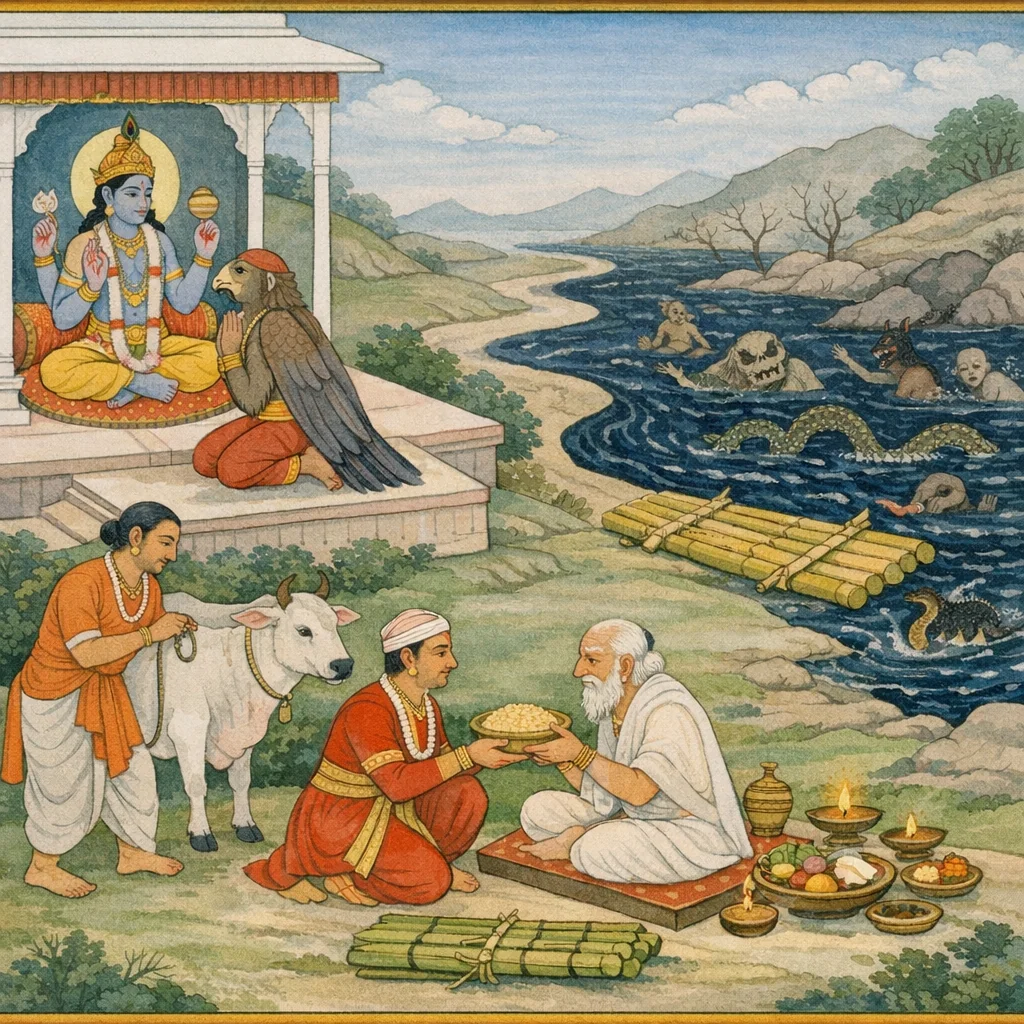
Continuing the Preta Kalpa’s teaching on the post-death journey, Garuḍa asks Viṣṇu/Kṛṣṇa to explain charity and the authoritative account of the Vaitaraṇī. The Lord portrays the river as a terrifying boundary on Yama’s road—boiling and impure, choked with flesh-mire and violent aquatic beings—where sinners wail and collapse in exhaustion. The chapter then names the moral causes of falling there: contempt for God, the guru, and elders; abandoning a virtuous wife; betraying or killing dependents; obstructing and deceiving brāhmaṇas; and a catalog of mahāpātaka-like crimes such as arson, poisoning, false witness, intoxication, adultery, boundary violations, and cruelty. From this diagnosis it turns to remedy: dāna, especially at auspicious calendrical junctions and unfailingly within śrāddha. A detailed Vaitaraṇī-dāna rite follows—cow adorned with gold/silver, grains, Yama’s golden image, a sugarcane raft, gifts to a brāhmaṇa, and mantra recitation—culminating in safe passage and multiplied merit. The chapter closes by moving from ritual to theology: Sūta frames the teaching as welfare for the world and liberation of the preta, and the sages affirm Vaiṣṇava victory—dharma and remembrance of Viṣṇu prevent an evil destination—preparing Garuḍa’s next questions on vows and tīrthas.
Shlokas
Verse 1
नाम षट्चत्वारिंशोध्यायः गरुड उवाच / भगवन्देवदेवेश कृपया परया वद / दानं दानस्य माहात्म्यं वैतरण्याः प्रमाणकम्
Garuda said: “O Blessed Lord, O God of the gods, out of supreme compassion, please tell me of the nature of dāna (charity), the greatness of giving, and the authoritative account of the Vaitaraṇī.”
Verse 2
श्रीकृष्ण उवाच / या सा वैतरणी नाम यममार्गे महासरित् / अगाधा दुस्तरा पापैर्दृष्टमात्रा भयावहा
Śrī Kṛṣṇa said: “That great river on Yama’s road, called Vaitaraṇī, is bottomless and hard for sinners to cross; merely seeing it brings terror.”
Verse 3
पूयशोणिततोयाढ्या मांसकर्दमसकुंला / पापिनञ्चागतान्दृष्ट्वा नानाभयसमावृता
It is filled with water of pus and blood, and choked with mire made of flesh; seeing the sinners who had arrived there, they were overwhelmed by many kinds of fear.
Verse 4
क्वाथ्यते सत्वरं तोयं पात्रमध्ये घृतं यथा / क्रिमिभिः सङ्कुलं पूयं वज्रतुण्डैः समावृतम्
The water is made to boil swiftly—like ghee boiling in a vessel—while foul pus, crowded with worms, surrounds the sufferer, enclosed on all sides by tormentors with beaks hard as thunderbolts.
Verse 5
शिशुमारैश्च मकरैर्वज्रकर्तरिकायुतैः / अन्यैश्च जलजीवैश्च हिंसकैर्मांसभेदिभिः
There, dolphins and makaras, furnished with thunderbolt-like shears, and other aquatic creatures—violent and flesh-tearing—torment the being.
Verse 6
उद्यान्ति द्वादशादित्याः प्रलयान्ते तथा हि ते / तपन्ति तत्र वै मर्त्याः क्रन्द मानास्तु पापिनः
At the end of pralaya, the twelve suns rise forth—so indeed it is. There mortals are scorched, and the sinful, wailing aloud, suffer that burning heat.
Verse 7
हा भ्रातः पुत्र तातेति प्रलपन्ति मुहुर्मुहुः / विचरन्ति निमज्जन्ति ग्लानिं गच्छन्ति जन्तवः
Crying again and again, “Alas, brother! Son! Father!”, the beings lament repeatedly; they wander about, sink down in despair, and fall into exhaustion.
Verse 8
चतुर्विधैः प्राणिगणैर्दृष्टा व्याप्ता महानदी / तरन्ति गोप्रदानेन त्वन्यथा च पतन्ति ते
That great river, seen and thronged by beings of four kinds, is crossed by the gift of a cow (go-dāna); otherwise, they fall into it.
Verse 9
मां नरा ये ऽवमन्यन्ते चाचार्यं गुरुमेव च / वृद्धानन्यांश्चापि मूढास्तेषां वासस्तु तत्र वै
Those deluded men who insult Me, and who also show contempt for the ācārya and the guru, and for elders and other worthy persons—indeed, their dwelling is there, in that realm of punishment.
Verse 10
पतिव्रतां साधुशीलामूढां धर्मेषु निश्चलाम् / परित्यजन्ति ये मूढास्तेषां वासस्तु सन्ततम्
Those fools who abandon a devoted and virtuous wife—faithful in her vow (pativratā), simple-hearted and steadfast in dharma—are destined to dwell in misery continually.
Verse 11
विश्वासप्रतिपन्नानां स्वामिमित्रतपस्विनाम् / स्त्रीबालविकलादीनां वधं कृत्वा पतन्ति हि / पच्यन्ते तत्र मध्ये तु क्रन्दमानास्तु पापिनः
Sinners who slay those who have placed their trust in them—such as their own master, friends, or ascetics—and who also kill women, children, the disabled, and others, surely fall into hell. There, amid that torment, the wicked are cooked, crying out in anguish.
Verse 12
शान्तं बुभुक्षितं विप्रंयो विघ्नायोपसर्पति / क्रिमिभिर्भक्ष्यते तत्र यावदाभूतसंप्लवम्
Whoever approaches a peaceful, hungry brāhmaṇa with the intent to obstruct him is, in that realm, eaten by worms, enduring it until the dissolution at the end of the age.
Verse 13
ब्राह्मणाय प्रतीश्रुत्य यमार्थं न ददाति तम् / आहूय नास्ति यो ब्रूयात्तस्य वासस्तु तत्र वै
He who, having promised a gift to a brāhmaṇa, does not give what was pledged, and he who, after calling someone, deceitfully says, “he is not here”—for such a person there is indeed a dwelling there, in Yama’s realm of retribution.
Verse 14
अग्निदो गरदश्चैव कूटसाक्षी च मद्यपः / यज्ञविध्वंसकश्चैव राज्ञीगामी च पैशुनः
The arsonist, the poisoner, the false witness, and the drunkard; the destroyer of yajña rites, the seducer of another man’s wife, and the malicious slanderer—all these too are counted among grievous sinners.
Verse 15
कथाभङ्गकरश्चैव स्वयन्दत्ता पहारकः / क्षेत्रसेतुविभेदी च परदारप्रधर्षकः
And also: one who breaks promises and agreements; one who takes back what he has given of his own accord; one who breaches field boundaries and embankments; and one who violates another man’s wife.
Verse 16
ब्राह्मणो रसविक्रेता तथा यो वृषलीपतिः / गोधनस्य तृषार्तस्य वाप्या भेदं करोति यः
The Garuḍa Purāṇa declares: a brāhmaṇa who sells intoxicating drink, one who keeps a Śūdra woman as his chief consort, and one who breaks the embankment of a water‑reservoir when cattle are tormented by thirst—such persons are counted among grievous sinners and incur painful consequences after death.
Verse 17
कन्याविदूषकश्चैव दानं दत्त्वानुतापकः / शूबद्रस्तु कपिलापायी ब्राह्मणो मांसभोजनः
Likewise: one who dishonours a maiden, one who repents after giving a gift, one who is cruel in conduct, one who drinks the milk of a tawny cow (kapilā), and a brāhmaṇa who eats meat—these too are counted among sinners and incur painful consequences after death.
Verse 18
एते वसन्ति सततं मा विचारं कृथाः क्वचित् / कृपणो नास्तिकः क्षुद्रः स तस्यां निवसेत्खग
“These beings dwell there constantly—do not doubt it at any time. The miser, the unbeliever (nāstika), and the petty-minded: he indeed resides in that state and place, O Bird, Garuḍa.”
Verse 19
सदामर्षो सदा क्रोधी निजवाक्यप्रमाणकृत् / परोक्त्युच्छेदको नित्यं वैतरण्या वसेच्चिरम्
One who is ever intolerant, ever wrathful, who accepts only his own words as authority, and who constantly cuts down or refutes what others say—such a person dwells for a long time in the Vaitaraṇī.
Verse 20
यस्त्वहङ्कारवान्पापी स्वविकत्थनकारकः / कृतघ्नो गर्भसन्तापी वैतरण्यां स मज्जति
But the sinful person who is full of ego, who delights in boastful self-glorification, who is ungrateful, and who causes suffering to the womb (harming the unborn or motherhood)—he sinks into the Vaitaraṇī.
Verse 21
कदापि भाग्ययोगेन तरणेच्छा भवेद्यदि / सानुकूला भवेद्येन तदाकर्णय काश्यप
If, by some conjunction of good fortune, the wish to cross should ever arise, then listen, O Kāśyapa, to that by which the passage becomes favorable and auspicious.
Verse 22
अयने विषुवे पुण्ये व्यतीपाते दिनोदये / चन्द्रसूर्योपरागे वा संक्रान्तौ दर्शवासरे
At the solstices and equinoxes, on the meritorious Vyatīpāta, at sunrise, during lunar or solar eclipses, at saṅkrānti (the sun’s transit), and on the new-moon day—these are occasions of special sanctity.
Verse 23
अन्येषु पुण्यकालेषु दीयते दानमुत्तमम् / यदा तदा भवेद्वापि श्राद्धा दानं प्रति ध्रुवम्
At other auspicious times, charity is indeed most excellent; yet whenever it may be, in the rite of Śrāddha the act of giving is held to be a sure and unfailing duty.
Verse 24
तदैब दानकालः स्याद्यतः सम्पत्तिरस्थिरा / अनित्यानि शरीराणि विभवो नैव शाश्वतः
That indeed is the proper time for giving, for wealth is unstable; bodies are impermanent, and prosperity is never everlasting.
Verse 25
नित्यं सन्निहितो मृत्युः कर्तव्यो धर्मसंगहः / कृष्णां वा पाटलां वापि कुर्याद्वैतरणीं शुभाम्
Death is ever close at hand; therefore one should always gather and uphold dharma. One should also prepare the auspicious Vaitaraṇī (the aid for crossing), whether by a black cow or by a pātalā-hued (reddish) cow.
Verse 26
स्वर्णशृङ्गीं रौप्यखुरां कांस्यपात्रोपदोहनीम् / कृष्णवस्त्रयुगाच्छन्नां सप्तधान्यसमन्विताम्
(One should offer) a cow with horns of gold and hooves of silver, milked into a bronze vessel; covered with a pair of black cloths and accompanied by the seven kinds of grains.
Verse 27
कार्पासद्रोणशिखरे आसीनं ताम्रभाजने / यमं हैमं प्रकुर्वीत लोहदण्डसमन्वितम् / इक्षुदण्डमयं बद्ध्वा प्लवं सुदृढबन्धनैः
One should fashion a golden image of Yama, seated upon the top of a heap of cotton and placed in a copper vessel, furnished with an iron staff; and one should also make a raft of sugarcane-stalks, binding it firmly with strong fastenings.
Verse 28
उडुपोपरि तां धेनुं सूर्यदेहसमुद्भवाम् / कृत्वा प्रकल्पयेद्विप्रश्छत्रोपानहसंयुतम्
Having fashioned that cow—said to be born of the Sun’s own radiance—upon a small boat, the Brahmin should duly arrange it, furnished with an umbrella and footwear.
Verse 29
अङ्गुलीयकवासांसि ब्राह्मणाय निवेदयेत् / इममुच्चारयेन्मन्त्रं संगृह्य सजलान्कुशान्
One should offer a ring and garments to a Brāhmaṇa. Then, holding kuśa grass moistened with water in the hand, one should recite this mantra.
Verse 30
यमद्वारे महाघोरे श्रुत्वा वैतरणीं तदीम् / तर्तुकामो ददाम्येनां तुभ्यं वैतरणीं नमः
At the dreadful gate of Yama, having heard of that river Vaitaraṇī, desiring to cross it I offer this ‘Vaitaraṇī’ (gift/rite) to you—salutations to the Vaitaraṇī.
Verse 31
गावो मे अग्रतः सन्तु गावो मे सन्तु पार्श्वतः / गावो मे हृदये सन्तु गवां मध्ये वसाम्यहम्
May cows be before me; may cows be at my sides. May cows dwell in my heart; may I abide in the midst of cows.
Verse 32
विष्णुरूप द्विजश्रेष्ठ मामुद्धर महीसुर / सदक्षिणा मया दत्ता तुभ्यं वैतरणीनमः
O best of the twice-born, bearing the form of Viṣṇu—O lord upon the earth—deliver me. I have given the rite-offering together with the dakṣiṇā; salutations to you as Vaitaraṇī, the one who ferries across.
Verse 33
धर्मराजञ्च सर्वेशं वैतरण्याख्यधेनुकाम् / सर्वं प्रदक्षिणीकृत्य ब्राह्मणाय निवेदयेत्
Having honored Dharmarāja (Yama), the Lord of all, and the cow-gift known as “Vaitaraṇī,” one should circumambulate the rite and its offerings, and then formally present it to a Brāhmaṇa.
Verse 34
पुच्छं संगृह्य धेन्वाश्च अग्रे कृत्वा तु वै व्दिजम् / धेनुके त्वं प्रतीक्षस्व यमद्वारे महाभये
Grasping the cow by her tail, and placing the brāhmaṇa in front, wait there—O gift-cow—at Yama’s gate, the place of great terror.
Verse 35
उत्तारणाय देवेशि वैतरण्ये नमो ऽस्तु ते / अनुव्रजेत्तु गच्छन्तं सर्वं तस्य गृहं नयेत्
O divine mistress who grants passage across, O Vaitaraṇī—salutations to you. One should follow the departing soul; and whatever belongs to him should be taken to his home and offered for his sake according to the prescribed rites.
Verse 36
एवं कृते वैनतेय सा सरित्सुतरा भवेत् / सर्वान्कामानवाप्नोति यो दद्याद्भुवि मानवः
O Vainateya (Garuda), when this is performed in the prescribed manner, that river becomes easy to cross; and the human who gives in charity upon the earth attains all desired aims.
Verse 37
सुकृतस्य प्रभावेण सुखञ्चेह परत्र च / स्वस्थे सहस्रगुणितमातुरे शतसंमितम्
By the power of sukṛta (merit), one gains happiness both in this world and in the next. The fruit of that merit is said to be multiplied a thousandfold when one is healthy, and reckoned a hundredfold when one is afflicted by illness.
Verse 38
मृतस्यैव तु यद्दानं परोक्षे तत्समं स्मृतम् / स्वहस्तेन ततो देयं मृते कः कस्य दास्यती
A gift made only after a person has died is regarded as merely an indirect offering. Therefore one should give with one’s own hand while alive—for when death comes, who will give to whom?
Verse 39
दानधर्मविहीनानां कृपणैर्जीवेतक्षितैः / अस्थिरेण शरीरेण स्थिरं कर्म समाचरेत्
Those who are devoid of charity and dharma live on, censured as miserly. With this unstable body, one should diligently perform enduring, meritorious deeds.
Verse 40
अवश्यमेव यास्यन्ति प्राणाः प्राघुणि (घूर्णि) का इव
Surely and inevitably, the life-breaths (prāṇa) depart—like a spinning top that whirls and cannot remain still.
Verse 41
इतीदमुक्तं तव पक्षिराज विडम्बनं जन्तुगणस्य सर्वम् / प्रेतस्य मोक्षाय तदौद्ध्वन्दैहिकं हिताय लोकस्य चरेच्छुभाय तु
Thus have I spoken to you, O King of Birds: this entire “mockery”—the deceptive play of worldly existence—of the multitude of beings. For the liberation of the preta, and for the welfare of the world—so that it may pursue what is auspicious—this teaching on the post-death and embodied states is set forth.
Verse 42
सूत उवाच / एवं विप्राः समाद्दिष्टो विष्णुना प्रभविष्णुना / गरुड प्रेतचरितं श्रुत्वा सन्तुष्टिमागतः
Sūta said: Thus, O brāhmaṇas, having been duly instructed by Viṣṇu—the all-powerful Lord—Garuḍa, after hearing the account of the condition and course of the preta, became satisfied.
Verse 43
व्रततीर्थादिकं सर्वं पुनः पप्रच्छ केशवम् / ध्यात्वा मनसि सर्वेशं सर्वकारणकारणम्
Having contemplated in his mind the Lord of all, the Cause of all causes, he again questioned Keśava about everything—vows (vrata), sacred bathing-places (tīrtha), and related rites.
Verse 44
ऋषयः सर्वमेवैतज्जन्तूनां प्रभवादिकम् / मरणं जन्म च तथा प्रेतत्वञ्चौर्ध्वदैहिकम्
The sages have taught all this in full—how beings originate and the like, as well as death and rebirth, and also the state of being a preta and the post-funeral rites (aūrdhvadaihika) performed for the departed.
Verse 45
मया प्रोक्तं वै मुक्त्यै निदानं चैव सर्वशः / लाभस्तेषां जयस्तेषां कुतस्तेषां पराजयः / येषामिन्दीवरश्यामो हृदयस्थो जनार्दनः
I have fully declared the means and the complete rationale that lead to liberation. For those in whose heart dwells Janārdana—dark-hued like a blue lotus—there is gain and there is victory; how could defeat ever be theirs?
Verse 46
धर्मो जयति नाधर्मः सत्यं जयति नानृतम् / क्षमा जयति न क्रोधो विष्णुर्जयति नासुराः
Dharma triumphs, not adharma. Truth triumphs, not falsehood. Forgiveness triumphs, not anger. Viṣṇu triumphs, not the asuras.
Verse 47
विष्णुर्माता पिता विष्णुर्विष्णुः स्वजनबान्धवाः / येषामेव स्थिरा बुद्धिर्न तेषां दुर्गतिर्भवेत्
For them, Viṣṇu alone is mother and father; Viṣṇu alone is their own kin and relatives. Those whose understanding is steady in Him do not fall into an evil destination.
Verse 48
मङ्गलं भगवान्विष्णुर्मङ्गलं गरुडध्वजः / मङ्गलं पुण्डरीकाक्षो मङ्गलायतनं हरिः
Auspicious is Lord Viṣṇu; auspicious is He whose banner bears Garuḍa. Auspicious is the Lotus-eyed One; Hari is the very abode of auspiciousness.
Verse 49
हरिर्भागीरथी विप्रा विप्रा भागीरथी हरिः / भागीरथी हरिर्विप्राः सारमेतज्जगत्त्रये
Hari, the sacred Bhāgīrathī (Gaṅgā), and the brāhmaṇas are one in essence; the brāhmaṇas, Bhāgīrathī, and Hari are one. In the three worlds, this is the very quintessence.
Verse 50
वैष्णविं वाक्सुधां पीत्वा ऋषयस्तुष्टिमाययुः
Having drunk the Vaiṣṇava nectar of speech, the sages attained deep satisfaction.
Verse 51
प्रशशंसुस्तथान्योन्यं सूतं सर्वार्थदर्शिनम् / प्रहर्षमतुलं प्रापुर्मुनयः शौनकादयः
Thus they praised one another, extolling Sūta, the seer of all meanings; and the sages—Śaunaka and the others—attained incomparable joy.
Verse 52
अपवित्रः पवित्रो वा सर्वावस्थां गतोपि वा / यः स्मरेत्पुण्डरीकाक्षं स बाह्याभ्यन्तरं शुचिः
Whether impure or pure, or even having entered any condition whatsoever, the one who remembers Puṇḍarīkākṣa, the lotus-eyed Lord, becomes purified both outwardly and inwardly.
Frequently Asked Questions
The chapter includes an offering formula addressed at Yama’s gate, explicitly offering the ‘Vaitaraṇī’ gift for crossing, followed by cow-invocations (cows before, at the sides, in the heart) and a plea to the brāhmaṇa—seen as bearing Viṣṇu’s form—to deliver the donor, concluding with salutations to Vaitaraṇī.
It states that while dāna is excellent at many auspicious times, within the śrāddha framework giving is certain duty because it directly supports the departed and aligns with dharma amid life’s impermanence; hence it is treated as especially reliable (niyata) and efficacious.
Because the agent of merit is the living person; post-death gifts performed by others are secondary in agency. Therefore the text urges dāna ‘with one’s own hand’ while alive, reinforcing personal responsibility for dharma before death intervenes.
The chapter closes by asserting the victory of dharma, truth, forgiveness, and Viṣṇu, and by declaring that remembrance of Puṇḍarīkākṣa purifies in any condition—positioning bhakti and right conduct as the ultimate protection from durgati (evil destination).
Read Garuda Purana in the Vedapath app
Scan the QR code to open this directly in the app, with audio, word-by-word meanings, and more.