Chapter 3: Karma Yoga
कर्मयोग
The Yoga of Action
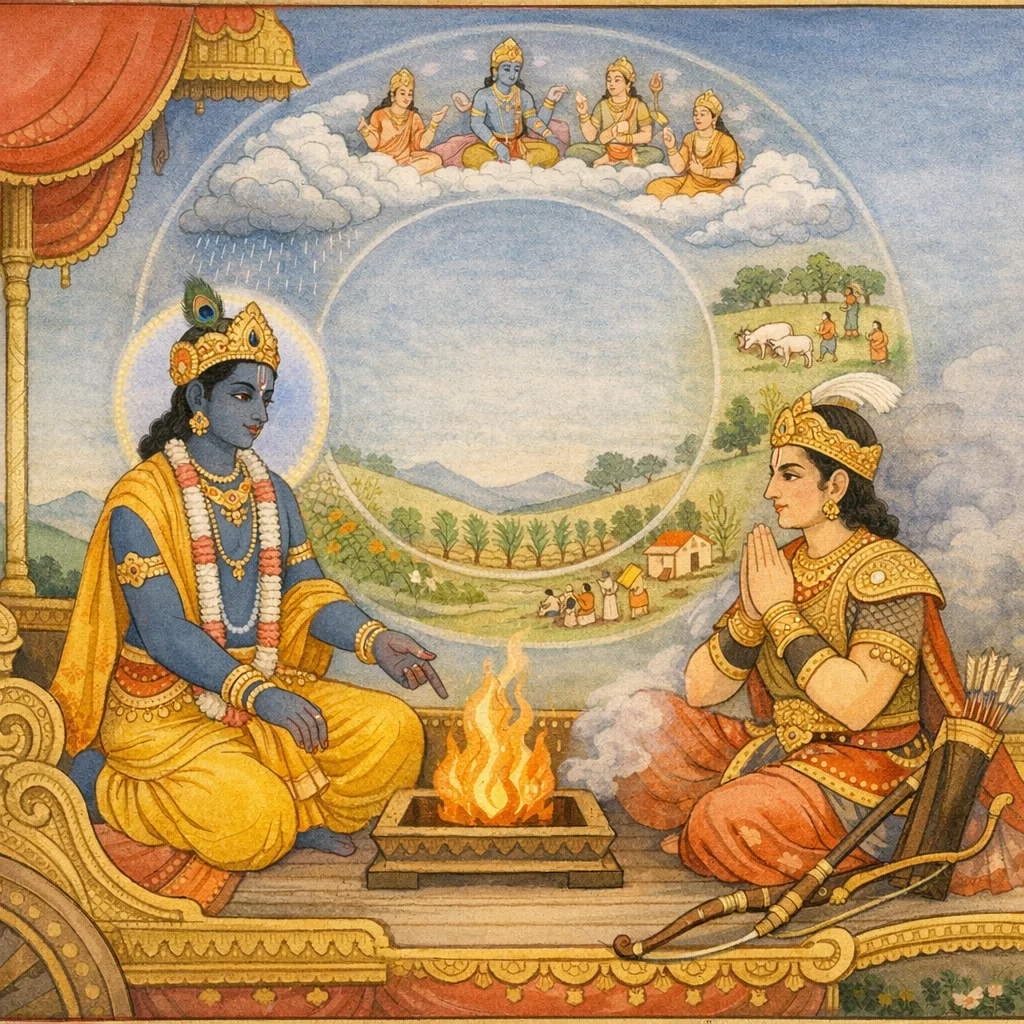
Chapter 3 develops the ethical framework of Karma Yoga in response to Arjuna’s cognitive dissonance: he hears praise of discerning wisdom yet is urged toward demanding action. Krishna clarifies that human life operates through two complementary disciplines—knowledge-oriented contemplation (for the reflective temperament) and action-oriented practice (for the active temperament)—and that mere abstention does not yield inner freedom. Action is unavoidable under the guṇas of prakṛti; therefore the soteriological path is to act without possessiveness and without craving for results, offering work as yajña (consecrated contribution) that sustains social and cosmic reciprocity. Krishna further grounds leadership ethics: exemplary persons act to stabilize collective order (loka-saṅgraha). The chapter then diagnoses the principal inner obstacle: desire (kāma), arising from rajas, which veils knowledge through the senses, mind, and intellect. The remedy is disciplined regulation of the senses and steady self-governance, culminating in action rooted in the higher Self rather than egoic doership.
Speakers
Key Concepts
Philosophical Constructs
Shlokas in Chapter 3
Verse 1
अर्जुन उवाच । ज्यायसी चेत्कर्मणस्ते मता बुद्धिर्जनार्दन तत्किं कर्मणि घोरे मां नियोजयसि केशव ॥ ३.१ ॥
Arjuna said: If You deem wisdom (buddhi) superior to action, O Janārdana, then why do You urge me toward this dreadful action, O Keśava?
Verse 2
व्यामिश्रेणेव वाक्येन बुद्धिं मोहयसीव मे । तदेकं वद निश्चित्य येन श्रेयोऽहमाप्नुयाम् ॥ ३.२ ॥
With words that seem as though mixed, You bewilder my understanding. Therefore, tell me decisively the one path by which I may attain the highest good.
Verse 3
श्रीभगवानुवाच । लोकेऽस्मिन्द्विविधा निष्ठा पुरा प्रोक्ता मयानघ । ज्ञानयोगेन सांख्यानां कर्मयोगेन योगिनाम् ॥ ३.३ ॥
The Blessed Lord said: In this world, O sinless one, a twofold steadfast discipline was taught by Me in ancient times—through the Yoga of Knowledge for the Sāṅkhyas, and through the Yoga of Action for the Yogins.
Verse 4
न कर्मणामनारम्भान्नैष्कर्म्यं पुरुषोऽश्नुते । न च संन्यसनादेव सिद्धिं समधिगच्छति ॥ ३.४ ॥
A person does not attain actionlessness by merely not commencing actions; nor does one reach perfection simply by renunciation alone.
Verse 5
न हि कश्चित्क्षणमपि जातु तिष्ठत्यकर्मकृत् । कार्यते ह्यवशः कर्म सर्वः प्रकृतिजैर्गुणैः ॥ ३.५ ॥
Indeed, no one ever remains even for a moment without performing action; everyone is helplessly driven to act by the qualities born of Prakṛti (Nature).
Verse 6
कर्मेन्द्रियाणि संयम्य य आस्ते मनसा स्मरन् । इन्द्रियार्थान्विमूढात्मा मिथ्याचारः स उच्यते ॥ ३.६ ॥
One who restrains the organs of action, yet sits remembering sense-objects in the mind—such a deluded soul is called a hypocrite (one of false conduct).
Verse 7
यस्त्विन्द्रियाणि मनसा नियम्यारभतेऽर्जुन । कर्मेन्द्रियैः कर्मयोगमसक्तः स विशिष्यते ॥ ३.७ ॥
But he who, controlling the senses by the mind, O Arjuna, engages the organs of action in Karma Yoga without attachment—he is superior.
Verse 8
नियतं कुरु कर्म त्वं कर्म ज्यायो ह्यकर्मणः । शरीरयात्रापि च ते न प्रसिद्ध्येदकर्मणः ॥ ३.८ ॥
Perform your ordained duty; for action is indeed superior to inaction. Even the maintenance of your body would not be possible through inaction.
Verse 9
यज्ञार्थात्कर्मणोऽन्यत्र लोकोऽयं कर्मबन्धनः । तदर्थं कर्म कौन्तेय मुक्तसङ्गः समाचर ॥ ३.९ ॥
This world is bound by action, except by action done for yajña (sacrifice). Therefore, O son of Kuntī, perform action for that purpose, free from attachment.
Verse 10
सहयज्ञाः प्रजाः सृष्ट्वा पुरोवाच प्रजापतिः । अनेन प्रसविष्यध्वमेष वोऽस्त्विष्टकामधुक् ॥ ३.१० ॥
In the beginning, having created beings together with yajña, Prajāpati said: “By this shall you prosper; let this be to you the wish-fulfilling cow.”
Verse 11
देवान्भावयतानेन ते देवा भावयन्तु वः । परस्परं भावयन्तः श्रेयः परमवाप्स्यथ ॥ ३.११ ॥
By this (yajña) nourish the devas, and let the devas nourish you. Thus, nourishing one another, you shall attain the supreme good.
Verse 12
इष्टान्भोगान्हि वो देवा दास्यन्ते यज्ञभाविताः । तैर्दत्तानप्रदायैभ्यो यो भुङ्क्ते स्तेन एव सः ॥ ३.१२ ॥
The devas, nourished by yajña, will indeed grant you the desired enjoyments. He who enjoys what is given by them without offering in return is truly a thief.
Verse 13
यज्ञशिष्टाशिनः सन्तो मुच्यन्ते सर्वकिल्बिषैः । भुञ्जते ते त्वघं पापा ये पचन्त्यात्मकारणात् ॥ ३.१३ ॥
The righteous, who partake of the remnants of sacrifice (yajña), are freed from all sins; but those sinful ones who cook only for their own sake eat sin indeed.
Verse 14
अन्नाद्भवन्ति भूतानि पर्जन्यादन्नसम्भवः । यज्ञाद्भवति पर्जन्यो यज्ञः कर्मसमुद्भवः ॥ ३.१४ ॥
From food beings come forth; from rain food is produced; from sacrifice rain arises; and sacrifice is born of action (karma).
Verse 15
कर्म ब्रह्मोद्भवं विद्धि ब्रह्माक्षरसमुद्भवम् । तस्मात्सर्वगतं ब्रह्म नित्यं यज्ञे प्रतिष्ठितम् ॥ ३.१५ ॥
Know action (karma) to arise from Brahman, and Brahman to arise from the Imperishable (Akṣara); therefore the all-pervading Brahman is ever established in sacrifice (yajña).
Verse 16
एवं प्रवर्तितं चक्रं नानुवर्तयतीह यः । अघायुरिन्द्रियारामो मोघं पार्थ स जीवति ॥ ३.१६ ॥
He who does not follow here this wheel thus set in motion—living in sin, delighting in the senses—he lives in vain, O Pārtha.
Verse 17
यस्त्वात्मरतिरेव स्यादात्मतृप्तश्च मानवः । आत्मन्येव च सन्तुष्टस्तस्य कार्यं न विद्यते ॥ ३.१७ ॥
But the person who delights in the Self alone, who is satisfied by the Self, and who is content in the Self—he has no duty to perform.
Verse 18
नैव तस्य कृतेनार्थो नाकृतेनेह कश्चन । न चास्य सर्वभूतेषु कश्चिदर्थव्यपाश्रयः ॥ ३.१८ ॥
For him there is no purpose to be served by what is done, nor any by what is left undone; and he has no dependence on any being for any end.
Verse 19
तस्मादसक्तः सततं कार्यं कर्म समाचर । असक्तो ह्याचरन्कर्म परमाप्नोति पूरुषः ॥ ३.१९ ॥
Therefore, ever without attachment, perform the work that ought to be done; for by performing action without attachment, a person attains the Supreme.
Verse 20
कर्मणैव हि संसिद्धिमास्थिता जनकादयः । लोकसंग्रहमेवापि संपश्यन्कर्तुमर्हसि ॥ ३.२० ॥
For by action alone Janaka and others attained perfection; and even with a view to the welfare and cohesion of the world, you ought to act.
Verse 21
यद्यदाचरति श्रेष्ठस्तत्तदेवेतरो जनः । स यत्प्रमाणं कुरुते लोकस्तदनुवर्तते ॥ ३.२१ ॥
Whatever a leading person does, that alone others do; whatever standard he establishes, the world follows accordingly.
Verse 22
न मे पार्थास्ति कर्तव्यं त्रिषु लोकेषु किंचन । नानवाप्तमवाप्तव्यं वर्त एव च कर्मणि ॥ ३.२२ ॥
O Pārtha, there is nothing whatsoever for Me to do in the three worlds; nor is there anything unattained that I must attain; yet I remain engaged in action.
Verse 23
यदि ह्यहं न वर्तेयं जातु कर्मण्यतन्द्रितः । मम वर्त्मानुवर्तन्ते मनुष्याः पार्थ सर्वशः ॥ ३.२३ ॥
For if I were ever not to engage tirelessly in action, O Pārtha, in every way people would follow My path.
Verse 24
उत्सीदेयुरिमे लोका न कुर्यां कर्म चेदहम् । संकरस्य च कर्ता स्यामुपहन्यामिमाः प्रजाः ॥ ३.२४ ॥
These worlds would fall into ruin if I did not perform action; I would become the cause of social intermixture (saṅkara) and would thereby harm these beings.
Verse 25
सक्ताः कर्मण्यविद्वांसो यथा कुर्वन्ति भारत । कुर्याद्विद्वांस्तथासक्तश्चिकीर्षुर्लोकसंग्रहम् ॥ ३.२५ ॥
As the unwise act with attachment to action, O Bhārata, so should the wise act without attachment, desiring the holding-together (welfare) of the world.
Verse 26
न बुद्धिभेदं जनयेदज्ञानां कर्मसङ्गिनाम् । जोषयेत्सर्वकर्माणि विद्वान्युक्तः समाचरन् ॥ ३.२६ ॥
Let the wise not create a split in the understanding of the ignorant who are attached to action; rather, disciplined, performing all actions himself, he should encourage them (to act).
Verse 27
प्रकृतेः क्रियमाणानि गुणैः कर्माणि सर्वशः । अहंकारविमूढात्मा कर्ताहमिति मन्यते ॥ ३.२७ ॥
All actions, in every way, are performed by the guṇas of prakṛti; but one whose self is deluded by ego thinks, ‘I am the doer.’
Verse 28
तत्त्ववित्तु महाबाहो गुणकर्मविभागयोः । गुणा गुणेषु वर्तन्त इति मत्वा न सज्जते ॥ ३.२८ ॥
But the knower of truth, O mighty-armed, understanding the distinction between the guṇas and actions, thinks, “The guṇas move among the guṇas,” and therefore is not attached.
Verse 29
प्रकृतेर्गुणसंमूढाः सज्जन्ते गुणकर्मसु । तानकृत्स्नविदो मन्दान्कृत्स्नविन्न विचालयेत् ॥ ३.२९ ॥
Those bewildered by the guṇas of prakṛti become attached to the actions of the guṇas; the knower of the whole should not disturb the dull who know only a part.
Verse 30
मयि सर्वाणि कर्माणि संन्यस्याध्यात्मचेतसा । निराशीर्निर्ममो भूत्वा युध्यस्व विगतज्वरः ॥ ३.३० ॥
Surrendering all actions to Me, with consciousness centered in the Self, free from expectation and possessiveness, fight—free from inner fever.
Verse 31
ये मे मतमिदं नित्यमनुतिष्ठन्ति मानवाः । श्रद्धावन्तोऽनसूयन्तो मुच्यन्ते तेऽपि कर्मभिः ॥ ३.३१ ॥
Those who constantly follow this teaching of Mine, with faith and without fault-finding, they too are freed from the bondage of actions.
Verse 32
ये त्वेतदभ्यसूयन्तो नानुतिष्ठन्ति मे मतम् । सर्वज्ञानविमूढांस्तान्विद्धि नष्टानचेतसः ॥ ३.३२ ॥
But those who, finding fault, do not follow My teaching—know them to be deluded in all knowledge, devoid of discernment, and headed for ruin.
Verse 33
सदृशं चेष्टते स्वस्याः प्रकृतेर्ज्ञानवानपि । प्रकृतिं यान्ति भूतानि निग्रहः किं करिष्यति ॥ ३.३३ ॥
Even the wise act in accordance with their own nature. Beings follow their prakṛti; what can mere restraint accomplish?
Verse 34
इन्द्रियस्येन्द्रियस्यार्थे रागद्वेषौ व्यवस्थितौ । तयोर्न वशमागच्छेत्तौ ह्यस्य परिपन्थिनौ ॥ ३.३४ ॥
For each sense with its object, attraction and aversion are set. One should not come under their sway, for they are indeed one’s obstructers on the path.
Verse 35
श्रेयान्स्वधर्मो विगुणः परधर्मात्स्वनुष्ठितात् । स्वधर्मे निधनं श्रेयः परधर्मो भयावहः ॥ ३.३५ ॥
Better is one’s own dharma, though deficient, than another’s dharma well performed. Better is death in one’s own dharma; another’s dharma is fraught with fear.
Verse 36
अर्जुन उवाच । अथ केन प्रयुक्तोऽयं पापं चरति पूरुषः अनिच्छन्नपि वार्ष्णेय बलादिव नियोजितः ॥ ३.३६ ॥
Arjuna said: Then by what is a person impelled to commit sin, even unwilling, O Vārṣṇeya, as though driven by force?
Verse 37
श्रीभगवानुवाच । काम एष क्रोध एष रजोगुणसमुद्भवः महाशनो महापाप्मा विद्ध्येनमिह वैरिणम् ॥ ३.३७ ॥
The Blessed Lord said: It is desire; it is anger—born of the guṇa of rajas—insatiable and greatly sinful. Know this here as the enemy.
Verse 38
धूमेनाव्रियते वह्निर्यथादर्शो मलेन च । यथोल्बेनावृतो गर्भस्तथा तेनेदमावृतम् ॥ ३.३८ ॥
As fire is veiled by smoke, as a mirror by dust, and as an embryo by the womb, so is this (knowledge) covered by that (desire).
Verse 39
आवृतं ज्ञानमेतेन ज्ञानिनो नित्यवैरिणा । कामरूपेण कौन्तेय दुष्पूरेणानलेन च ॥ ३.३९ ॥
By this— the wise one’s constant enemy—knowledge is veiled, O son of Kuntī: desire, insatiable like fire.
Verse 40
इन्द्रियाणि मनो बुद्धिरस्याधिष्ठानमुच्यते । एतैर्विमोहयत्येष ज्ञानमावृत्य देहिनम् ॥ ३.४० ॥
The senses, the mind, and the intellect are said to be its seat; through these it deludes the embodied being by veiling knowledge.
Verse 41
तस्मात्त्वमिन्द्रियाण्यादौ नियम्य भरतर्षभ । पाप्मानं प्रजहि ह्येनं ज्ञानविज्ञाननाशनम् ॥ ३.४१ ॥
Therefore, O best of the Bharatas, first restrain the senses and cast off this sin-causing force that destroys knowledge and realized wisdom.
Verse 42
इन्द्रियाणि पराण्याहुरिन्द्रियेभ्यः परं मनः । मनसस्तु परा बुद्धिर्यो बुद्धेः परतस्तु सः ॥ ३.४२ ॥
They say the senses are superior; superior to the senses is the mind; superior to the mind is the intellect; but superior to the intellect is That (the Self).
Verse 43
एवं बुद्धेः परं बुद्ध्वा संस्तभ्यात्मानमात्मना । जहि शत्रुं महाबाहो कामरूपं दुरासदम् ॥ ३.४३ ॥
Thus, having known That which is higher than the intellect, and steadying the self by the Self, O mighty-armed, slay the enemy—desire in its form—which is difficult to overcome.
Frequently Asked Questions
It reframes inner conflict as a problem of attachment and egoic doership: clarity arises when one accepts action as unavoidable, performs duty without craving for outcomes, and regulates the senses so that desire does not hijack discernment.
Agency is explained through guṇas and prakṛti: actions occur through nature’s qualities, while the Self is higher than senses, mind, and intellect. Freedom comes from identifying with the Self rather than with the ego’s claim, “I am the doer.”
Krishna resolves the apparent contradiction between wisdom and action by teaching Karma Yoga: act as a disciplined offering (yajña), without attachment, thereby transforming necessary duty into a liberating practice rather than a binding compulsion.
Treat work as contribution rather than self-validation: define your svadharma (role-responsibility), focus on process over outcomes, avoid comparison-driven agitation, and build habits of sense-management (attention hygiene) to reduce stress and improve ethical decision-making and leadership.