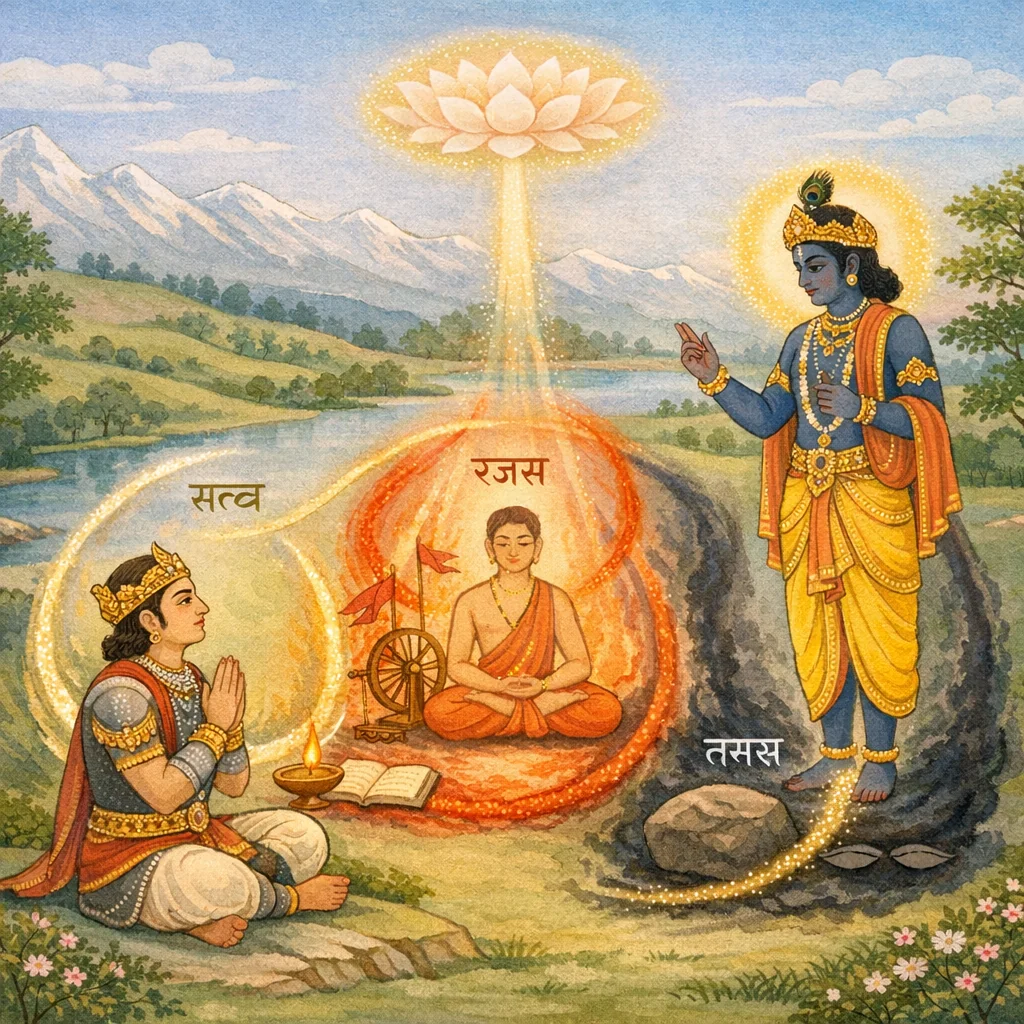
Chapter 14: Gunatraya Vibhaga Yoga
गुणत्रयविभागयोग
The Yoga of the Three Gunas
Chapter 14 develops a compact metaphysical psychology by analyzing prakṛti through the three guṇas—sattva, rajas, and tamas—and showing how they condition cognition, motivation, and embodied experience. Śrī Kṛṣṇa presents this as a higher clarification of liberating knowledge: the guṇas bind the imperishable self (dehin/ātman) to the field of action through distinct modes—sattva via attachment to happiness and knowledge, rajas via craving and compulsive activity, and tamas via delusion, inertia, and negligence. The chapter maps observable indicators of each guṇa’s increase, correlates them with ethical and experiential outcomes, and describes their post-mortem trajectories as an explanatory framework for moral causality. Arjuna then asks for the marks and conduct of one who has transcended the guṇas. Kṛṣṇa answers with a profile of steady equanimity and non-reactivity, culminating in devotion (avyabhicāriṇī bhakti) as the operative means to surpass the guṇas and attain brahma-bhāva, with Kṛṣṇa affirmed as the foundation of Brahman and enduring dharma.
Speakers
Key Concepts
Philosophical Constructs
Shlokas in Chapter 14
Verse 1
श्रीभगवानुवाच । परं भूयः प्रवक्ष्यामि ज्ञानानां ज्ञानमुत्तमम् यज्ज्ञात्वा मुनयः सर्वे परां सिद्धिम...
The Blessed Lord said: Again I shall declare the supreme knowledge—the highest of all knowledges—knowing which all sages have attained the supreme perfection.
Verse 2
इदं ज्ञानमुपाश्रित्य मम साधर्म्यमागताः । सर्गेऽपि नोपजायन्ते प्रलये न व्यथन्ति च ॥ १४.२ ॥
Taking refuge in this knowledge, they attain likeness to Me; they are not born even at creation, nor do they tremble at dissolution.
Verse 3
मम योनिर्महद्ब्रह्म तस्मिन्गर्भं दधाम्यहम् । संभवः सर्वभूतानां ततो भवति भारत ॥ १४.३ ॥
My womb is the great Brahman; in that I place the seed. From that, O Bhārata, arises the origin of all beings.
Verse 4
सर्वयोनिषु कौन्तेय मूर्तयः संभवन्ति याः । तासां ब्रह्म महद्योनिरहं बीजप्रदः पिता ॥ १४.४ ॥
In all wombs, O son of Kuntī, whatever forms are born—of them the great Brahman is the womb, and I am the seed-giving Father.
Verse 5
सत्त्वं रजस्तम इति गुणाः प्रकृतिसंभवाः । निबध्नन्ति महाबाहो देहे देहिनमव्ययम् ॥ १४.५ ॥
Sattva, rajas, and tamas—these guṇas born of prakṛti—bind the imperishable embodied Self within the body, O mighty-armed.
Verse 6
तत्र सत्त्वं निर्मलत्वात्प्रकाशकमनामयम् । सुखसङ्गेन बध्नाति ज्ञानसङ्गेन चानघ ॥ १४.६ ॥
Among them, sattva—by reason of its purity—is illuminating and free from affliction; it binds, O sinless one, through attachment to happiness and through attachment to knowledge.
Verse 7
रजो रागात्मकं विद्धि तृष्णासङ्गसमुद्भवम् । तन्निबध्नाति कौन्तेय कर्मसङ्गेन देहिनम् ॥ १४.७ ॥
Know rajas to be of the nature of passion, born of craving and attachment; it binds the embodied being, O son of Kuntī, through attachment to action.
Verse 8
तमस्त्वज्ञानजं विद्धि मोहनं सर्वदेहिनाम् । प्रमादालस्यनिद्राभिस्तन्निबध्नाति भारत ॥ १४.८ ॥
Know tamas to be born of ignorance, deluding all embodied beings; it binds, O Bhārata, through negligence, indolence, and sleep.
Verse 9
सत्त्वं सुखे संजयति रजः कर्मणि भारत । ज्ञानमावृत्य तु तमः प्रमादे संजयत्युत ॥ १४.९ ॥
Sattva binds one to happiness, rajas to action, O Bhārata; but tamas, veiling knowledge, binds indeed to negligence.
Verse 10
रजस्तमश्चाभिभूय सत्त्वं भवति भारत । रजः सत्त्वं तमश्चैव तमः सत्त्वं रजस्तथा ॥ १४.१० ॥
Overcoming rajas and tamas, sattva prevails, O Bhārata; rajas prevails over sattva and tamas; and tamas likewise prevails over sattva and rajas.
Verse 11
सर्वद्वारेषु देहेऽस्मिन्प्रकाश उपजायते । ज्ञानं यदा तदा विद्याद्विवृद्धं सत्त्वमित्युत ॥ १४.११ ॥
When, in this body, light arises through all the gates, then one should know that sattva has increased—so it is said.
Verse 12
लोभः प्रवृत्तिरारम्भः कर्मणामशमः स्पृहा । रजस्येतानि जायन्ते विवृद्धे भरतर्षभ ॥ १४.१२ ॥
Greed, outward activity, the undertaking of actions, restlessness, and craving—these arise when rajas increases, O best of the Bharatas.
Verse 13
अप्रकाशोऽप्रवृत्तिश्च प्रमादो मोह एव च । तमस्येतानि जायन्ते विवृद्धे कुरुनन्दन ॥ १४.१३ ॥
Darkness (absence of illumination), inactivity, heedlessness, and delusion—these arise when tamas grows, O joy of the Kurus.
Verse 14
यदा सत्त्वे प्रवृद्धे तु प्रलयं याति देहभृत् । तदोत्तमविदां लोकानमलान्प्रतिपद्यते ॥ १४.१४ ॥
When the embodied one meets dissolution (death) while sattva is predominant, then he attains the stainless worlds of the knowers of the Supreme.
Verse 15
रजसि प्रलयं गत्वा कर्मसङ्गिषु जायते । तथा प्रलीनस्तमसि मूढयोनिषु जायते ॥ १४.१५ ॥
Meeting dissolution in rajas, one is born among those attached to action; likewise, dying in tamas, one is born in deluded wombs.
Verse 16
कर्मणः सुकृतस्याहुः सात्त्विकं निर्मलं फलम् । रजसस्तु फलं दुःखमज्ञानं तमसः फलम् ॥ १४.१६ ॥
They say the fruit of good action is sāttvic and pure; the fruit of rajas is suffering; the fruit of tamas is ignorance.
Verse 17
सत्त्वात्संजायते ज्ञानं रजसो लोभ एव च । प्रमादमोहौ तमसो भवतोऽज्ञानमेव च ॥ १४.१७ ॥
From sattva arises knowledge; from rajas, greed; from tamas arise heedlessness and delusion, and indeed ignorance as well.
Verse 18
ऊर्ध्वं गच्छन्ति सत्त्वस्था मध्ये तिष्ठन्ति राजसाः । जघन्यगुणवृत्तिस्था अधो गच्छन्ति तामसाः ॥ १४.१८ ॥
Those established in sattva ascend upward; the rajasic abide in the middle; but those abiding in the activity of the lowest quality—tamas—go downward.
Verse 19
नान्यं गुणेभ्यः कर्तारं यदा द्रष्टानुपश्यति । गुणेभ्यश्च परं वेत्ति मद्भावं सोऽधिगच्छति ॥ १४.१९ ॥
When the seer beholds no doer other than the guṇas, and knows That which is beyond the guṇas, he attains My state of being.
Verse 20
गुणानेतानतीत्य त्रीन्देही देहसमुद्भवान् । जन्ममृत्युजरादुःखैर्विमुक्तोऽमृतमश्नुते ॥ १४.२० ॥
Having transcended these three guṇas, born of the body, the embodied one is freed from the sorrows of birth, death, and old age, and attains immortality.
Verse 21
अर्जुन उवाच । कैर्लिङ्गैस्त्रीन्गुणानेतानतीतो भवति प्रभो किमाचारः कथं चैतांस्त्रीन्गुणानतिवर्तते ॥ १४.२१ ॥
Arjuna said: By what marks is one known to have transcended these three guṇas, O Lord? What is his conduct, and how does he pass beyond these three guṇas?
Verse 22
श्रीभगवानुवाच । प्रकाशं च प्रवृत्तिं च मोहमेव च पाण्डव न द्वेष्टि संप्रवृत्तानि न निवृत्तानि काङ्क्षति ॥ १४.२२ ॥
The Blessed Lord said: O Pāṇḍava, he neither hates illumination, activity, and delusion when they arise, nor longs for them when they cease.
Verse 23
उदासीनवदासीनो गुणैर्यो न विचाल्यते । गुणा वर्तन्त इत्येव योऽवतिष्ठति नेङ्गते ॥ १४.२३ ॥
Seated as though indifferent, he is not shaken by the guṇas; knowing, “the guṇas alone act,” he remains established and does not waver.
Verse 24
समदुःखसुखः स्वस्थः समलोष्टाश्मकाञ्चनः । तुल्यप्रियाप्रियो धीरस्तुल्यनिन्दात्मसंस्तुतिः ॥ १४.२४ ॥
Equal in sorrow and joy, self-abiding; viewing a clod, a stone, and gold alike; to whom the dear and the undesired are the same; equal in blame and in praise—such is the steadfast one.
Verse 25
मानापमानयोस्तुल्यस्तुल्यो मित्रारिपक्षयोः । सर्वारम्भपरित्यागी गुणातीतः स उच्यते ॥ १४.२५ ॥
Equal in honor and dishonor, equal toward the side of friend and the side of foe; renouncing all self-initiated undertakings—he is said to have gone beyond the guṇas.
Verse 26
मां च योऽव्यभिचारेण भक्तियोगेन सेवते । स गुणान्समतीत्यैतान्ब्रह्मभूयाय कल्पते ॥ १४.२६ ॥
And he who serves Me with unwavering devotion through bhakti-yoga—he, having transcended these guṇas, becomes fit for Brahmanhood (brahma-bhūya).
Verse 27
ब्रह्मणो हि प्रतिष्ठाहममृतस्याव्ययस्य च । शाश्वतस्य च धर्मस्य सुखस्यैकान्तिकस्य च ॥ १४.२७ ॥
For I am the foundation of Brahman, and of immortality and imperishability, and of the eternal dharma, and of absolute (unmixed) bliss.
Frequently Asked Questions
It offers a precise map of mental conditioning: clarity and contentment can still bind through attachment (sattva), agitation binds through craving and over-activity (rajas), and avoidance binds through inertia and confusion (tamas). Freedom begins by observing these modes without self-identification.
The self (dehin/ātman) is distinct from prakṛti’s guṇas; bondage and experience arise from guṇic operations, while liberation is knowing the guṇas as processes and realizing what is beyond them—culminating in brahma-bhāva.
By shifting the locus of agency: the seeker learns to see guṇas as the operative forces in thought and behavior, reducing guilt, confusion, and reactive emotion, and replacing them with steadiness, discernment, and a workable path (bhakti with equanimity).
Use the guṇas as a self-audit: when clarity becomes pride or comfort-seeking (sattva), re-center on service; when restlessness drives compulsive productivity (rajas), reduce craving-based goals; when procrastination and doom-scrolling dominate (tamas), restore structure and light. Practice non-reactivity to praise/blame and anchor daily discipline in devotion or value-based commitment.
Read Bhagavad Gita in the Vedapath app
Scan the QR code to open this directly in the app, with audio, word-by-word meanings, and more.