
Bhagavad Gita — Arjuna Vishada Yoga, Shloka 8
Arjuna Vishada Yoga
भवान्भीष्मश्च कर्णश्च कृपश्च समितिंजयः । अश्वत्थामा विकर्णश्च सौमदत्तिस्तथैव च ॥
bhavān bhīṣmaś ca karṇaś ca kṛpaś ca samitiṃjayaḥ | aśvatthāmā vikarṇaś ca saumadattis tathaiva ca ||

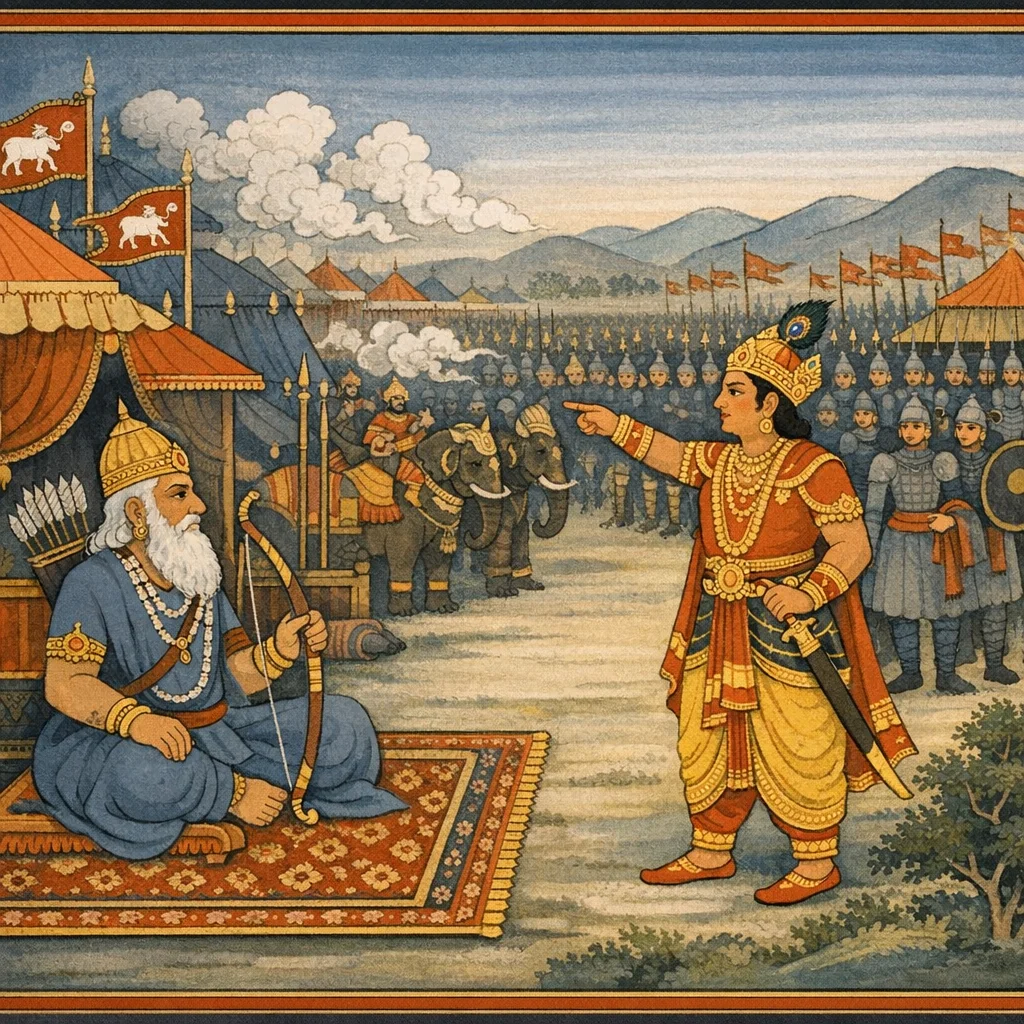
You yourself, Bhīṣma, Karṇa, and Kṛpa—the conqueror in battle; Aśvatthāmā, Vikarṇa, and also the son of Somadatta.
You yourself, Bhīṣma, Karṇa, and Kṛpa, the victor in battle; Aśvatthāmā, Vikarṇa, and also the son of Somadatta.
You, and Bhīṣma, and Karṇa, and Kṛpa—conqueror in assemblies; Aśvatthāmā, Vikarṇa, and likewise Saumadatti.
‘samitiṃjayaḥ’ (“conqueror in battle/assemblies”) is sometimes attached specifically to Kṛpa or read more generally as an epithet in the list; punctuation and apposition differ across translators.
FAQs
Invoking celebrated figures serves as reassurance and persuasion: the speaker seeks confidence by anchoring his cause to widely respected authorities.
The prominence of elders foreshadows the Gītā’s ethical complexity: reverence for authority is meaningful, yet moral discernment cannot be outsourced to status alone.
This is the core of the Kaurava roster, highlighting iconic personalities whose presence heightens the gravity of the impending confrontation.
People often appeal to ‘big names’ to justify positions. The verse invites reflection on when authority is informative versus when it becomes a substitute for ethical reasoning.