
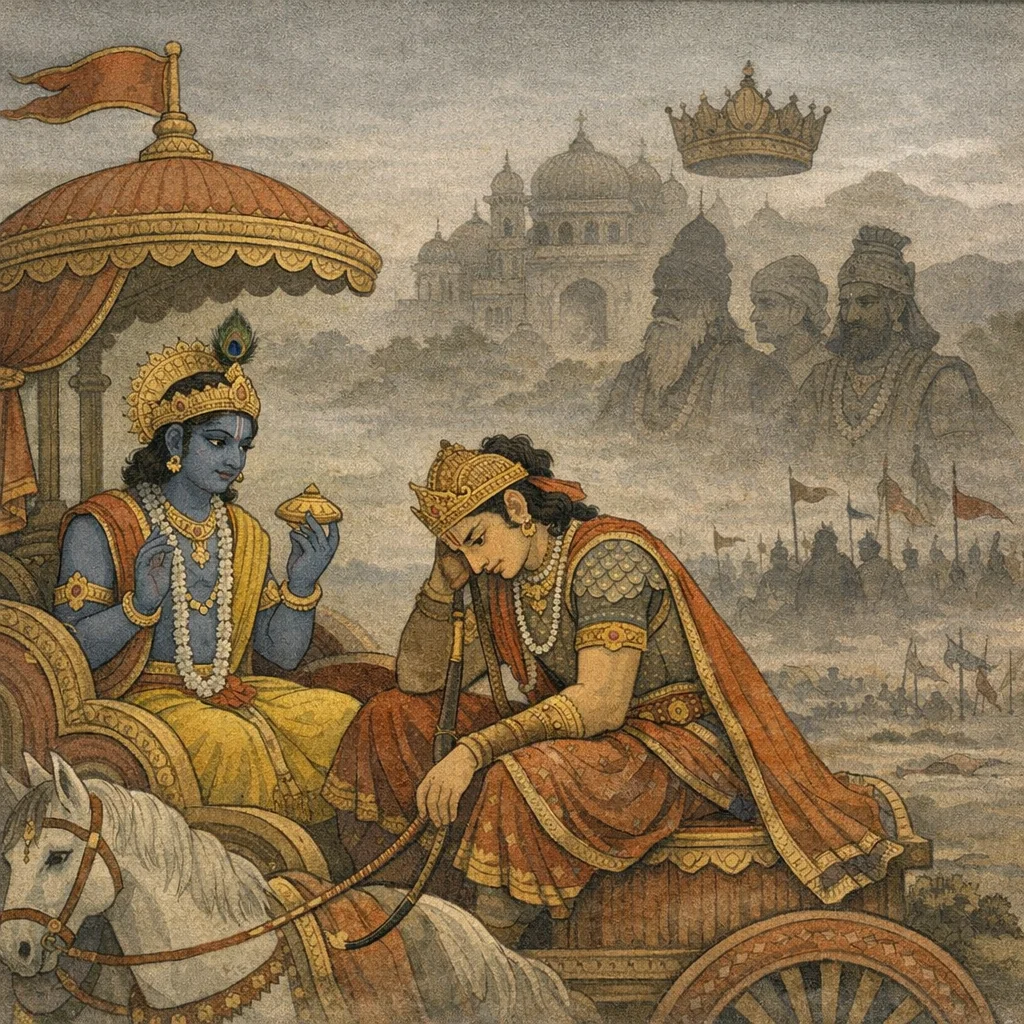
Bhagavad Gita — Arjuna Vishada Yoga, Shloka 32
Arjuna Vishada Yoga
किं नो राज्येन गोविन्द किं भोगैर्जीवितेन वा । येषामर्थे काङ्क्षितं नो राज्यं भोगाः सुखानि च ॥ १.३२ ॥
kiṃ no rājyena govinda kiṃ bhogair jīvitena vā | yeṣām arthe kāṅkṣitaṃ no rājyaṃ bhogāḥ sukhāni ca || 1.32 ||

O Govinda, what use is a kingdom to us, or enjoyments, or even life itself? Those for whose sake we longed for kingdom, enjoyments, and pleasures—
O Govinda, what is the use of a kingdom to us, or enjoyments, or even life? Those for whose sake we desired kingdom, enjoyments and pleasures…
What is sovereignty to us, O Govinda—what are enjoyments, or even life? Those for whose sake sovereignty, enjoyments, and pleasures were desired by us…
The verse is rhetorically structured: it begins negating the value of ‘goods’ (rājya, bhoga, jīvita) when severed from relational meaning. Many translations keep the ellipsis because the sentence completes in the next verse.
FAQs
Arjuna displays ‘value collapse’: when the people who give meaning to achievements are imperiled, the achievements themselves appear empty, intensifying indecision.
The verse foreshadows the later move from external goods (power, enjoyment) to an internal ground of meaning (self-knowledge and duty without attachment).
Arjuna argues that the usual aims of political struggle—rule, pleasure, security—are not worth pursuing if they undermine familial and social bonds.
It invites reflection on whether career, status, or consumption remain worthwhile when they compromise relationships or ethical commitments.