
Bhagavad Gita — Arjuna Vishada Yoga, Shloka 1
Arjuna Vishada Yoga
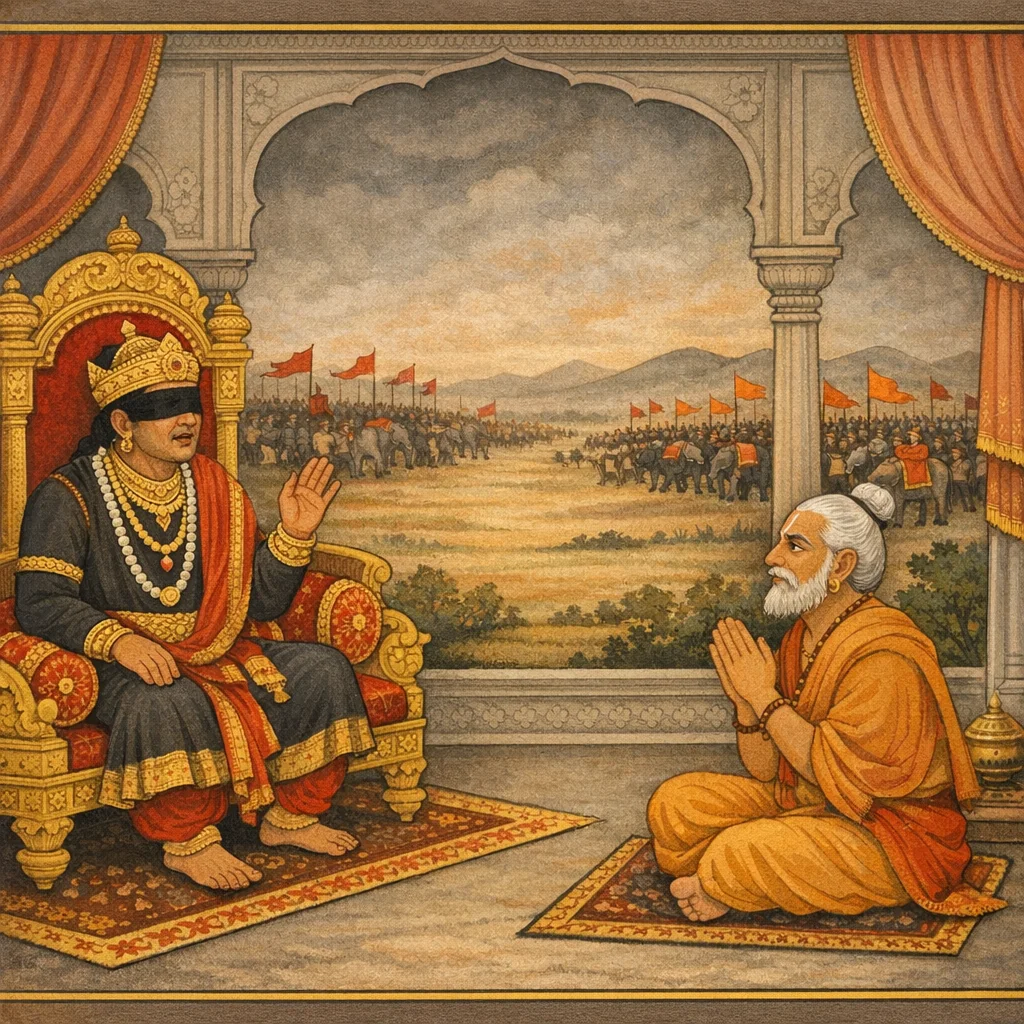
धृतराष्ट्र उवाच । धर्मक्षेत्रे कुरुक्षेत्रे समवेता युयुत्सवः मामकाः पाण्डवाश्चैव किमकुर्वत सञ्जय ॥
dhṛtarāṣṭra uvāca | dharmakṣetre kurukṣetre samavetā yuyutsavaḥ | māmakāḥ pāṇḍavāś caiva kim akurvata sañjaya ||

Dhṛtarāṣṭra said: O Sañjaya, gathered on the field of Dharma—Kurukṣetra—desiring to fight, what did my sons and the sons of Pāṇḍu do?
Dhṛtarāṣṭra said: O Sañjaya, assembled in the holy field of Kurukṣetra, eager to contend, what did my sons and the sons of Pāṇḍu do?
Dhṛtarāṣṭra said: At Kurukṣetra, the field of dharma, gathered together and wishing to engage in battle, what did my people and the Pāṇḍavas do, Sañjaya?
Most editions agree closely here. The key interpretive nuance is ‘dharmakṣetra’: traditional readings stress sanctity and moral gravity; a literal reading treats it as a recognized epithet of Kurukṣetra. ‘māmakāḥ’ can be rendered ‘my sons’ (contextual) or more broadly ‘my party/people’ (literal).
FAQs
The verse foregrounds partiality through ‘māmakāḥ’ (“my side”), suggesting an attachment-based lens that shapes perception before any action is described. It portrays a mind seeking reassurance amid uncertainty.
‘Dharmakṣetra’ can be read as the “field” where ethical order is tested through choice and consequence; the question anticipates the Gītā’s broader concern with right action (karma) within a morally charged world.
This is the narrative frame: the blind king asks his seer-narrator to report what occurs after both parties assemble at Kurukṣetra, initiating the dialogue that will lead to Kṛṣṇa’s teaching.
It highlights how identity-based allegiance can pre-structure judgment. In modern settings, it invites reflection on whether one’s “side” (family, group, ideology) is biasing one’s understanding of events.