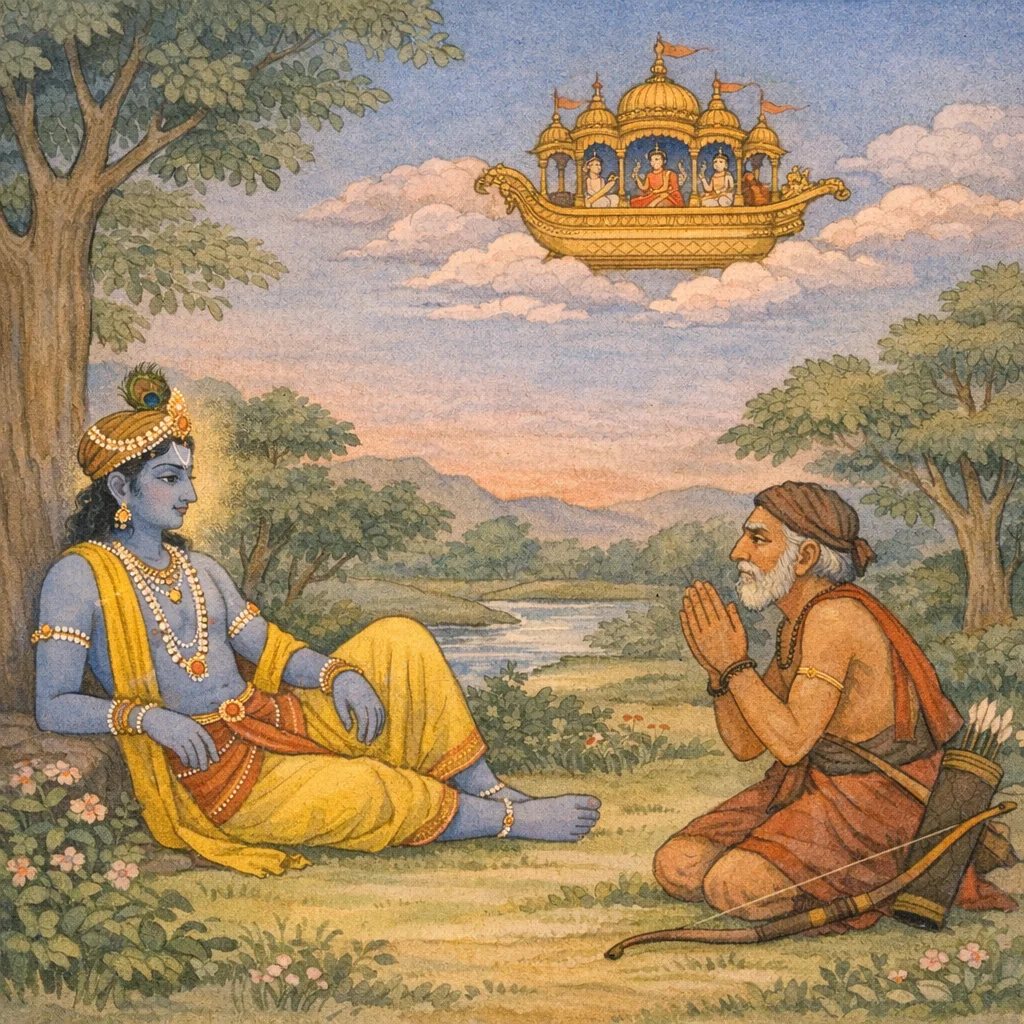
Adhyaya 211: The Hunter Jarā, Krishna’s Final Līlā, and the Lord’s Ascension
第211章叙述奎师那在人间利拉的终末,并以神学视野揭示其自愿回归不坏梵(Brahman)的奥义。达鲁迦奉奎师那之命前往都瓦拉迦,带回阿周那,并携瓦吉罗(Vajra),作为王统继承者的象征。随后经文转入戈文达的内在行持:在一切众生之中安住并维系至上的瓦苏德瓦(Vāsudeva)原则。为敬奉婆罗门杜尔瓦萨(Durvāsas)之言,奎师那端坐瑜伽之姿。此时猎人迦罗(Jarā)到来,持一支箭,其金属箭镞乃源自木槌(muśala)残余;他误将主的足当作鹿而射中。见到四臂圣相后,迦罗屡次求恕,承认无知。奎师那赦免之,并赐其乘天车(vimāna)即刻升天。继而,主将自我融入无垢、不可思议、不朽坏的梵——遍满万有的瓦苏德瓦——舍离人身,成就三重的超越归宿。
Chapter Arc
{"opening_hook":"The chapter opens in the wake of the Yādava collapse: Dāruka, obeying Kṛṣṇa’s final directive, hastens toward Dvārakā to summon Arjuna, while Vajra is positioned as a continuity-figure for royal succession—an immediate narrative bridge from catastrophe to dharmic aftermath.","rising_action":"Attention turns inward: Govinda is portrayed as the indwelling support of all beings, establishing the supreme Vāsudeva-principle within the self. In fidelity to the brāhmaṇa-word of Durvāsas, Kṛṣṇa assumes a yogic posture, and the ominous detail is introduced—an arrow tipped with the remaining iron of the muśala, now in the hands of the hunter Jarā.","climax_moment":"Jarā mistakes the Lord’s foot for a deer and releases the arrow; the revelation follows instantly when Jarā beholds the four-armed form. The theological peak is Kṛṣṇa’s untroubled absolution—transforming an apparent “accident” into a deliberate, sovereign closure of līlā and a demonstration of the Lord’s freedom from karma.","resolution":"Kṛṣṇa removes Jarā’s fear, grants him immediate heavenly ascent by vimāna, and then relinquishes the human body, uniting the self with the stainless, unthinkable, undecaying Brahman—described as Vāsudeva-pervading all—thus concluding the avatāra’s terminal movement as voluntary withdrawal into the imperishable.","key_verse":"“Seeing the Lord’s four-armed form, the hunter fell again and again, begging pardon; the Blessed One dispelled his fear and, having granted him heaven, Himself entered the stainless, undecaying Brahman—Vāsudeva, the Self of all.” (sense-translation; chapter’s central teaching)"}
Thematic Essence
{"primary_theme":"Kṛṣṇa’s voluntary withdrawal (līlā-saṃhāra) into Vāsudeva-Brahman","secondary_themes":["Succession and continuity after the Yādava end (Arjuna and Vajra)","Brāhmaṇa-vāk and dharma as cosmic constraint honored even by the Lord","Grace overriding apparent fault: Jarā’s fear removed and heaven granted","Muśala-iron as narrative causality: the remnant of internecine ruin becomes the final instrument"],"brahma_purana_doctrine":"The chapter crystallizes a Brahma Purāṇa-style metaphysical reading of avatāra: Kṛṣṇa is the indwelling Vāsudeva who sustains all beings and, at the end, does not ‘die’ but consciously re-identifies with the stainless, unthinkable, undecaying Brahman—making the event a yogic, sovereign consummation rather than karmic defeat.","adi_purana_significance":"As ‘Ādi Purāṇa,’ it models how primordial Purāṇic narration absorbs epic history into a cosmological-theological frame: the end of Kṛṣṇa’s earthly līlā is presented as a paradigmatic template for understanding divine descent and withdrawal within the larger Purāṇic vision of dharma and the Absolute."}
Emotional Journey
{"opening_rasa":"करुण (karuṇa)","climax_rasa":"अद्भुत (adbhuta)","closing_rasa":"शान्त (śānta)","rasa_transitions":["करुण → भयानक (Jarā’s fearful mistake) → अद्भुत (four-armed revelation and grace) → शान्त (Brahman-union)"],"devotional_peaks":["Govinda as inner support of all beings: contemplative bhakti grounded in metaphysics","Jarā’s repeated prostrations upon seeing the four-armed form","The Lord’s fear-dispelling absolution and gift of vimāna","Final union with the stainless Vāsudeva-Brahman as a śānta-bhakti summit"]}
Tirtha Focus
{"tirthas_covered":["द्वारका"],"jagannath_content":null,"surya_content":null,"cosmology_content":"Implicit dissolution motif at the microcosmic level: the avatāra’s embodied līlā is ‘withdrawn’ into the imperishable Brahman (Vāsudeva as all-pervading Self), echoing Purāṇic saṃhāra logic without a full sarga/pralaya excursus."}
Shlokas in Adhyaya 211
Verse 1
व्यास उवाच इत्य् उक्तो दारुकः कृष्णं प्रणिपत्य पुनः पुनः प्रदक्षिणं च बहुशः कृत्वा प्रायाद् यथोदितम् //
此偈:“1”——为《往世书》中圣言之编号标记。
Verse 2
स च गत्वा तथा चक्रे द्वारकायां तथार्जुनम् आनिनाय महाबुद्धिं वज्रं चक्रे तथा नृपम् //
此偈:“2”——为《往世书》圣言之次第编号。
Verse 3
भगवान् अपि गोविन्दो वासुदेवात्मकं परम् ब्रह्मात्मनि समारोप्य सर्वभूतेष्व् अधारयत् //
此偈:“3”——用于标识《往世书》中一则神圣语句。
Verse 4
स मानयन् द्विजवचो दुर्वासा यद् उवाच ह योगयुक्तो ऽभवत् पादं कृत्वा जानुनि सत्तमाः //
此偈:“4”——用于编排《往世书》圣言的顺序编号。
Verse 5
संप्राप्तो वै जरा नाम तदा तत्र स लुब्धकः मुशलशेषलोहस्य सायकं धारयन् परम् //
此偈:“5”——用于标定并引证《往世书》圣言的编号。
Verse 6
स तत्पादं मृगाकारं समवेक्ष्य व्यवस्थितः ततो विव्याध तेनैव तोमरेण द्विजोत्तमाः //
此偈(第6)被保存为《普拉那》传统中的神圣言辞。
Verse 7
गतश् च ददृशे तत्र चतुर्बाहुधरं नरम् प्रणिपत्याह चैवैनं प्रसीदेति पुनः पुनः //
此偈(第7)为可敬之圣言,适于诵读礼敬与学术研习。
Verse 8
अजानता कृतम् इदं मया हरिणशङ्कया क्षम्यताम् आत्मपापेन दग्धं मा दग्धुम् अर्हसि //
此偈(第8)阐明古老知识,并保持梵语原典之庄严。
Verse 9
व्यास उवाच ततस् तं भगवान् आह नास्ति ते भयम् अण्व् अपि गच्छ त्वं मत्प्रसादेन लुब्ध स्वर्गेश्वरास्पदम् //
此偈(第9)当以宁静恭敬之心诵读,方能领会其深义。
Verse 10
व्यास उवाच विमानम् आगतं सद्यस् तद्वाक्यसमनन्तरम् आरुह्य प्रययौ स्वर्गं लुब्धकस् तत्प्रसादतः //
此偈(第10)为古风之提要,延续《普拉那》之传承。
Verse 11
गते तस्मिन् स भगवान् संयोज्यात्मानम् आत्मनि ब्रह्मभूते ऽव्यये ऽचिन्त्ये वासुदेवमये ऽमले //
偈颂211.11:未提供梵文原文。请发送完整偈文,以便依《普罗那》庄严体例译出。
Verse 12
अजन्मन्य् अजरे ऽनाशिन्य् अप्रमेये ऽखिलात्मनि त्यक्त्वा स मानुषं देहम् अवाप त्रिविधां गतिम् //
偈颂211.12:未附梵文原句。请提供完整经文,以便准确而庄严地翻译。
Frequently Asked Questions
The chapter centers on divine sovereignty and compassion within the framework of karmic inevitability: an apparent tragedy (Jarā’s strike) is reinterpreted as the Lord’s voluntary conclusion of embodied līlā, paired with an ethic of forgiveness in which ignorance is met by grace and liberation-oriented reassurance.
It articulates a foundational Puranic theological grammar: the avatāra’s departure is not merely historical but cosmological, expressed as reabsorption into the imperishable Brahman identified with Vāsudeva and as an affirmation of the Lord as the inner support of all beings—motifs that anchor later narrative, ritual, and doctrinal layers across the Purāṇic corpus.
No new tīrtha, vrata, or formal rite is instituted in the supplied passage. The chapter’s emphasis is doctrinal and narrative—Dvārakā as a setting is referenced, but the text here functions primarily as a theological account of the Lord’s yogic withdrawal and the salvific outcome granted to Jarā.