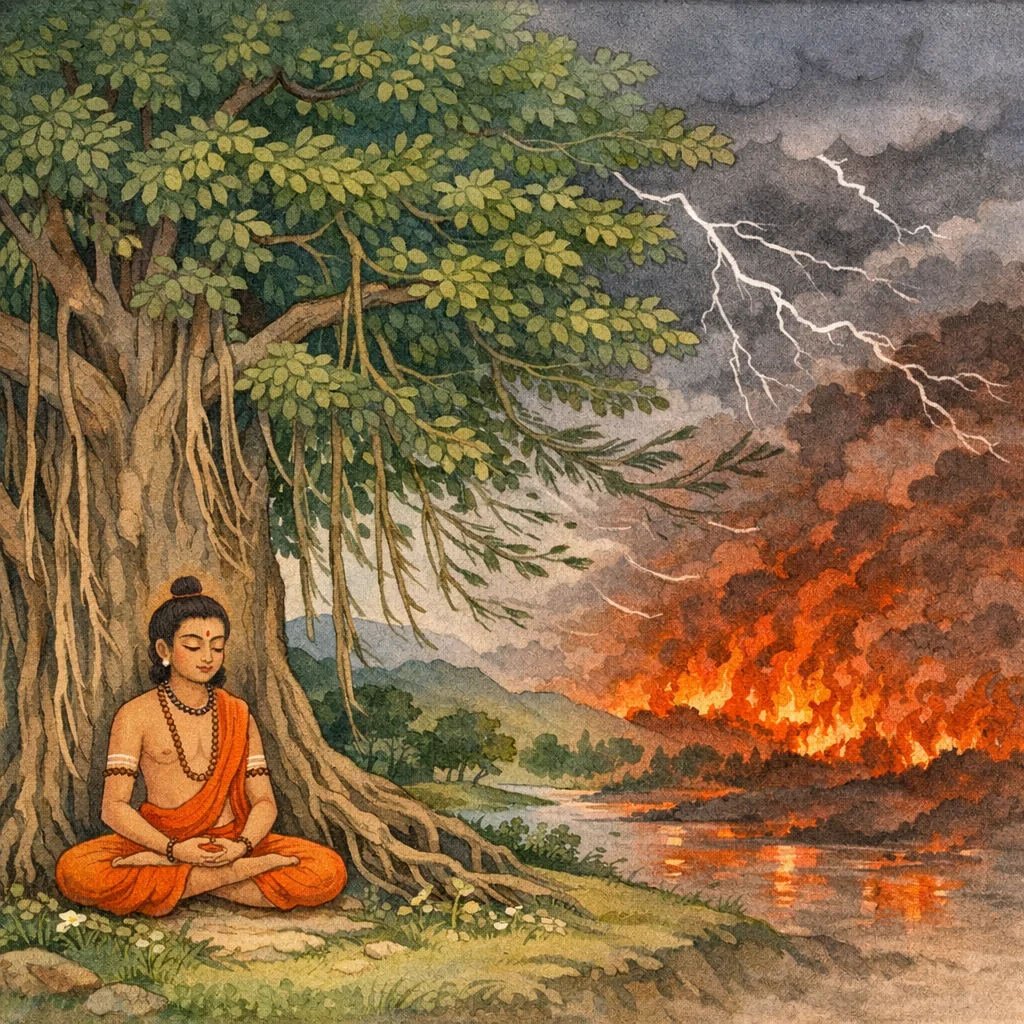
Adhyaya 52: The Conflagration of the Great Dissolution and Markandeya’s Refuge at the Eternal Banyan
第52章以宇宙尺度描绘大毁灭(mahāpralaya)的末劫景象:日月隐没,有情与无情诸类尽皆熄灭;雷鸣、电闪与摧折性的震荡等凶兆齐现,宣告全面溶解的到来。随劫火而起的“散坏之火”(saṃvartaka),即著名的劫火(kalpāgni),光耀如无量太阳,并挟猛烈狂风贯穿诸界,穿地而下至罗萨塔拉(rasātala),焚尽地下诸域,包括那伽界(nāgaloka),令天神与半神等众惊惧。三界与其众生迅速被焚。唯有圣贤摩尔坎德耶(Mārkaṇḍeya)孤身立于灾劫之中,德行高迈而身受干渴与迷惘之苦。为求究竟归依,他观念永恒的普鲁舍沙(Puruṣeśa),抵达与劫灭之因相应的神圣处所——“瓦塔拉阇”(Vaṭarāja),不朽的常青榕。其根下标示一处不为宇宙劫火与雷霆所及的境域,成为万有崩解之际的护佑中心。
Chapter Arc
{"opening_hook":"The chapter opens in a cosmic register: the familiar supports of order fail—sun and moon vanish, directions lose their bearings, and the world’s rhythms collapse, immediately pulling the listener into mahāpralaya’s dread.","rising_action":"Portents intensify: thunder and lightning tear the sky; hurricane-like winds drive the saṃvartaka fire through the worlds. The conflagration penetrates the earth, descends into rasātala, and consumes nāgaloka, spreading panic among devas, asuras, gandharvas, dānavas, yakṣas, uragas, and rākṣasas.","climax_moment":"At the height of universal burning—kalpāgni blazing like countless suns—the narrative pivots to the lone surviving sage Mārkaṇḍeya. Overcome by thirst and disorientation yet anchored in dhyāna, he fixes his mind on the eternal Puruṣeśa and reaches the timeless refuge: Vaṭarāja (the eternal banyan), where pralaya’s terrors do not operate.","resolution":"The chapter concludes by establishing a theological ‘safe zone’ amid dissolution: at the root of Vaṭarāja, the saṃvartaka fire and thunderbolts cannot harm the sage, implying that devotion and contemplative refuge in the Eternal Lord transcends cosmic cycles.","key_verse":null}
Thematic Essence
{"primary_theme":"Pralaya-varṇana (the description of cosmic dissolution) culminating in yogic refuge at Vaṭarāja.","secondary_themes":["Saṃvartaka fire and winds as instruments of kāla (time)","The collapse of cosmic order (lights, directions, atmospherics)","The netherworlds (rasātala/nāgaloka) are not exempt from dissolution","Bhakti-dhyāna as a metaphysical shelter beyond cosmic cycles"],"brahma_purana_doctrine":"Even when trailokya is consumed by kalpāgni, a locus of protection exists through remembrance of the Eternal Lord—symbolized by Vaṭarāja—indicating that sacred refuge is not merely geographic but ontological (beyond pralaya’s jurisdiction).","adi_purana_significance":"As an ‘Adi Purāṇa’ movement, it frames the universe’s end not as nihilism but as a doctrinal demonstration: cosmology serves theology, and the earliest Purāṇic voice links pralaya to the discovery of an eternal refuge-principle."}
Emotional Journey
{"opening_rasa":"bhayānaka","climax_rasa":"adbhuta","closing_rasa":"śānta","rasa_transitions":["bhayānaka → raudra → bhayānaka → adbhuta → śānta"],"devotional_peaks":["Mārkaṇḍeya’s inward turn to dhyāna on Puruṣeśa amid total collapse","Arrival at Vaṭarāja where pralaya’s weapons (fire/thunderbolts) lose efficacy"]}
Tirtha Focus
{"tirthas_covered":["वट / न्यग्रोध (Vaṭa / Nyagrodha; Vaṭarāja as a divine refuge-locus)"],"jagannath_content":null,"surya_content":null,"cosmology_content":"A full mahāpralaya tableau: disappearance of sun and moon; atmospheric portents; saṃvartaka winds; kalpāgni burning trailokya; fire penetrating earth into rasātala and consuming nāgaloka; universal terror across divine and semi-divine classes; a protected zone at Vaṭarāja accessed through contemplation of the Eternal Lord."}
Shlokas in Adhyaya 52
Verse 1
ब्रह्मोवाच आसीत् कल्पे मुनिश्रेष्ठाः संप्रवृत्ते महाक्षये नष्टे ऽर्कचन्द्रे पवने नष्टे स्थावरजङ्गमे //
新章开端宣说:世界之生成与护持有其秩序,依梵天(Brahmā)与毗湿奴(Viṣṇu)之威力而行。
Verse 2
उदिते प्रलयादित्ये प्रचण्डे घनगर्जिते विद्युदुत्पातसंघातैः संभग्ने तरुपर्वते //
此偈概述达摩之精要,令智者观照思惟并加以研习。
Verse 3
लोके च संहृते सर्वे महदुल्कानिबर्हणे शुष्केषु सर्वतोयेषु सरःसु च सरित्सु च //
当以寂静之心聆听古圣师所传之清净教言。
Verse 4
ततः संवर्तको वह्निर् वायुना सह भो द्विजाः लोकं तु प्राविशत् सर्वम् आदित्यैर् उपशोभितम् //
敬奉达摩而以诚实行持者,必得安乐与名誉。
Verse 5
पश्चात् स पृथिवीं भित्त्वा प्रविश्य च रसातलम् देवदानवयक्षाणां भयं जनयते महत् //
由学习与至诚供奉,智慧增长,愚昧无明得以消除。
Verse 6
निर्दहन् नागलोकं च यच् च किंचित् क्षिताव् इह अधस्तान् मुनिशार्दूलाः सर्वं नाशयते क्षणात् //
是故当以清净之心坚守达摩之道,以趋向圆满之善。
Verse 7
ततो योजनविंशानां सहस्राणि शतानि च निर्दहत्य् आशुगो वायुः स च संवर्तको ऽनलः //
此偈(第52章第7颂)未提供梵文原文;请发送原文,以便作出忠实而庄严的译释。
Verse 8
सदेवासुरगन्धर्वं सयक्षोरगराक्षसम् ततो दहति संदीप्तः सर्वम् एव जगत् प्रभुः //
此偈(第52章第8颂)未提供梵文原文;请发送原文,以便作出忠实而庄严的译释。
Verse 9
प्रदीप्तो ऽसौ महारौद्रः कल्पाग्निर् इति संश्रुतः महाज्वालो महार्चिष्मान् संप्रदीप्तमहास्वनः //
此偈(第52章第9颂)未提供梵文原文;请发送原文,以便作出忠实而庄严的译释。
Verse 10
सूर्यकोटिप्रतीकाशो ज्वलन्न् इव स तेजसा त्रैलोक्यं चादहत् तूर्णं ससुरासुरमानुषम् //
此偈(第52章第10颂)未提供梵文原文;请发送原文,以便作出忠实而庄严的译释。
Verse 11
एवंविधे महाघोरे महाप्रलयदारुणे ऋषिः परमधर्मात्मा ध्यानयोगपरो ऽभवत् //
此偈(第52章第11颂)未提供梵文原文;请发送原文,以便作出忠实而庄严的译释。
Verse 12
एकः संतिष्ठते विप्रा मार्कण्डेयेति विश्रुतः मोहपाशैर् निबद्धो ऽसौ क्षुत्तृष्णाकुलितेन्द्रियाः //
此偈仅标示数字“12”,未提供梵文原文;因此无法确切翻译其义。
Verse 13
स दृष्ट्वा तं महावह्निं शुष्ककण्ठौष्ठतालुकः तृष्णार्तः प्रस्खलन् विप्रास् तदासौ भयविह्वलः //
此偈仅标示数字“13”,未提供梵文原文;因此无法确切翻译其义。
Verse 14
बभ्राम पृथिवीं सर्वां कांदिशीको विचेतनः त्रातारं नाधिगच्छन् वै इतश् चेतश् च धावति //
此偈仅标示数字“14”,未提供梵文原文;因此无法确切翻译其义。
Verse 15
न लेभे च तदा शर्म यत्र विश्राम्यता द्विजाः करोमि किं न जानामि यस्याहं शरणं व्रजे //
此偈仅标示数字“15”,未提供梵文原文;因此无法确切翻译其义。
Verse 16
कथं पश्यामि तं देवं पुरुषेशं सनातनम् इति संचिन्तयन् देवम् एकाग्रेण सनातनम् //
此偈仅标示数字“16”,未提供梵文原文;因此无法确切翻译其义。
Verse 17
प्राप्तवांस् तत् पदं दिव्यं महाप्रलयकारणम् पुरुषेशम् इति ख्यातं वटराजं सनातनम् //
此为《梵天往世书》卷五十二第十七颂,属神圣之言,宜敬读研习。
Verse 18
त्वरायुक्तो मुनिश् चासौ न्यग्रोधस्यान्तिकं ययौ आसाद्य तं मुनिश्रेष्ठास् तस्य मूले समाविशत् //
此为《梵天往世书》五十二章第十八颂,庄严阐明法(Dharma)之义。
Verse 19
न कालाग्निभयं तत्र न चाङ्गारप्रवर्षणम् न संवर्तागमस् तत्र न च वज्राशनिस् तथा //
此为《梵天往世书》五十二章第十九颂,既可虔诵,亦可考释。
Frequently Asked Questions
The chapter centers on the contrast between cosmic impermanence (mahāpralaya) and an enduring theological refuge: the eternal Puruṣeśa symbolized by the Vaṭarāja. It frames dissolution as total at the level of worlds, yet not absolute with respect to the divine ground that remains untouched.
By foregrounding a cosmogonic-cycle endpoint (pralaya) and naming the kalpāgni/saṃvartaka mechanism, the chapter anchors Purāṇic chronology in recurring creation–dissolution rhythms. This reinforces the Brahma Purana’s archival posture as a foundational text mapping cosmic time and its governing principles.
No explicit tīrtha, vrata, or procedural rite is instituted in the supplied passage. Instead, the chapter establishes a sacral motif—Vaṭarāja/nyagrodha as a protected divine locus during pralaya—functioning more as a theological landmark than as a described pilgrimage protocol.