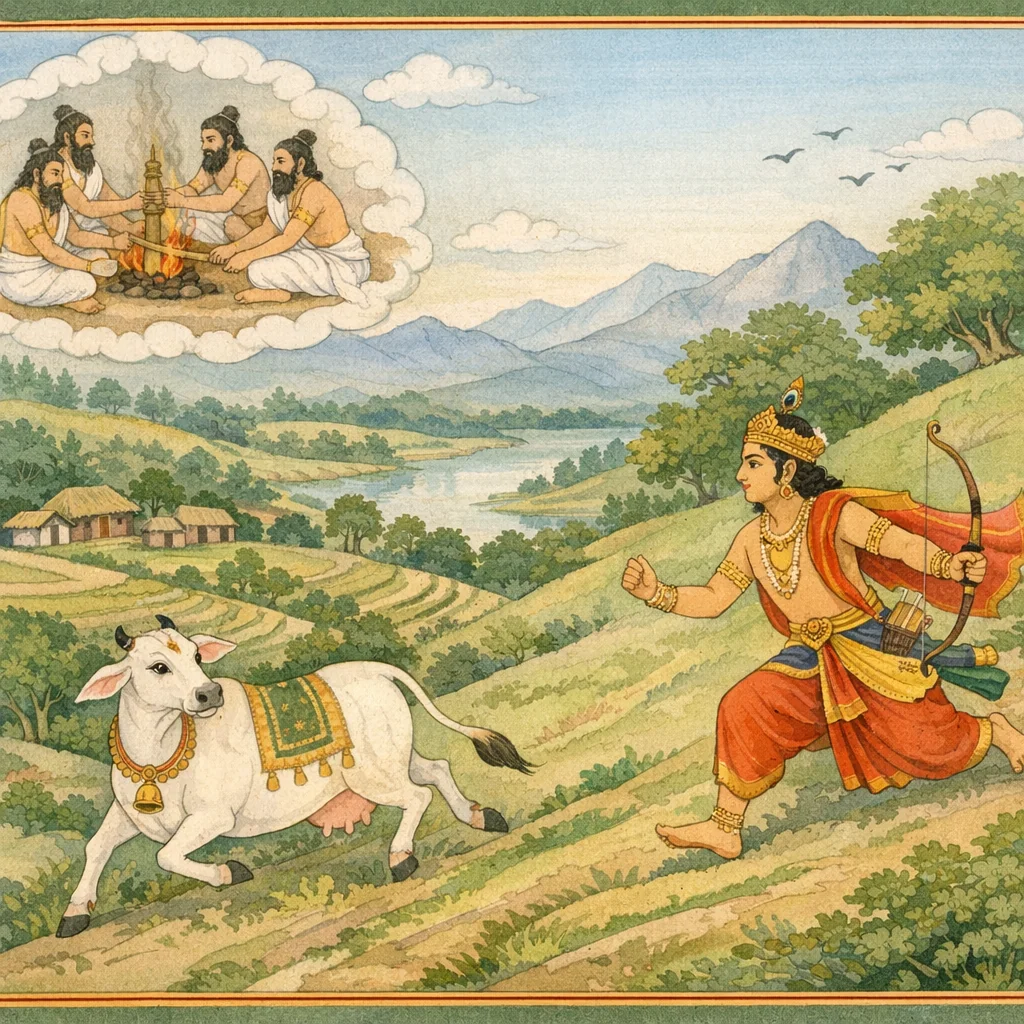
Adhyaya 4: Pṛthu’s Consecration, the Ordering of Realms, and the Milking of the Earth
本章展开政治—宇宙的叙事:祖父神毗多摩诃(梵天 Brahmā)先为普利图·维尼耶(Pṛthu Vainya)行灌顶加冕,立为至上君主,继而将主权制度化,按诸类众生与自然领域分派摄政与统辖。经文列举掌理祭祀秩序、天界、诸元素与大地事务的受任者,并进一步安立四方护世者,显示王权乃宇宙行政之延伸。随后转入谱系与伦理危机:出自阿特里(Atri)系的韦那王(Veṇa)否定吠陀祭祀秩序,自称唯一应受崇拜之所,致使社会与仪礼崩坏。诸仙(ṛṣi)制止之,并以“搅拌/磨炼”(mathana)其身,先生出尼沙陀(Niṣāda)之始祖,继而生出光辉持兵的普利图;其灌顶使达摩复兴。普利图追逐化作母牛的大地,令其顺从而不逾越道德克制,平整地势,并以“挤取大地之乳”开启农耕繁荣——为不同群体与众生设定各异的挤乳者、器皿与所得。章末尊普利图为阿底罗阇(Ādirāja),为君王与社会秩序之典范。
Chapter Arc
{"opening_hook":"The chapter opens with Pitāmaha Brahmā’s royal consecration of Pṛthu—immediately framing kingship not as mere politics but as a sacramental act that mirrors cosmic order.","rising_action":"Tension builds as Brahmā systematizes sovereignty by assigning regencies across devas, classes of beings, and natural domains, then installs directional guardians—only for the narrative to pivot into crisis when King Veṇa repudiates yajña and claims exclusive worship, collapsing ritual reciprocity between humans and gods.","climax_moment":"The climactic turning-point is the ṛṣis’ intervention: Veṇa is restrained and ‘churned’ (mathana), yielding first the Niṣāda progenitor and then Pṛthu, radiant and armed, whose consecration restores dharma; this is immediately matched by Pṛthu’s ethical confrontation with the Earth-as-cow—compelling her to yield without adharma.","resolution":"The chapter resolves with Pṛthu leveling the land, instituting agriculture and settlement, and organizing the ‘milking’ of the Earth through differentiated calves, milkers, vessels, and yields for diverse beings—ending with Pṛthu established as Ādirāja, the paradigmatic ruler whose governance is cosmic stewardship.","key_verse":null}
Thematic Essence
{"primary_theme":"राजधर्म as cosmic governance: consecration, delegated jurisdictions, and the ethical economy of Earth’s abundance.","secondary_themes":["Yajña as reciprocity: ritual order sustains divine-human-world balance; its rejection causes systemic collapse.","Genealogy as ethics: lineages encode dharma/adharma outcomes (Veṇa → Niṣāda/Pṛthu).","Stewardship over extraction: the Earth yields when approached with restraint, consent, and regulation.","Institutionalization of space: guardians of directions and ordered realms mirror political administration."],"brahma_purana_doctrine":"Kingship is a sacramental office (abhiṣeka) whose legitimacy depends on sustaining yajña-dharma and regulating the Earth’s resources for all beings—sovereignty is delegated cosmic duty, not personal divinity.","adi_purana_significance":"As an ‘Ādi’ (primordial) Purāṇa layer, it supplies a foundational template for later Purāṇic political theology: how cosmic hierarchy, ritual economy, and agrarian prosperity are integrated under the archetype of the first exemplary king (Ādirāja)."}
Emotional Journey
{"opening_rasa":"अद्भुत (adbhuta)","climax_rasa":"वीर (vīra)","closing_rasa":"शान्त (śānta)","rasa_transitions":["adbhuta → शान्त (śānta) → रौद्र (raudra) → भयानक (bhayānaka) → वीर (vīra) → करुण (karuṇa) → शान्त (śānta)"],"devotional_peaks":["The abhiṣeka of Pṛthu as a dharmic act aligning human kingship with cosmic order.","The restoration of yajña-logic after Veṇa’s rupture—reaffirming that worship is not self-deification but participation in dharma.","Pṛthu’s restraint before the Earth: power subordinated to righteousness, yielding prosperity for all beings."]}
Tirtha Focus
{"tirthas_covered":["हिमवान् (Himālaya)","मेरु","विन्ध्य","समुद्र (Sāgara)"],"jagannath_content":null,"surya_content":null,"cosmology_content":"Cosmic administration is foregrounded: Brahmā’s consecration of the king, assignment of regencies over classes of beings and natural domains, and installation of directional guardians—presenting political order as a reflection of cosmological order."}
Shlokas in Adhyaya 4
No shlokas available for this adhyaya yet.
Frequently Asked Questions
The chapter foregrounds dharmic kingship as a moral technology for world-maintenance: sovereignty is legitimate when aligned with Vedic order, social welfare (prajā-hitacikīrṣā), and restraint. Veṇa exemplifies adharma through egoic self-deification and rejection of yajña, while Pṛthu exemplifies righteous coercion—compelling the Earth to nourish beings without transgressing ethical limits (notably the explicit debate on violence and the inviolability of a ‘female’ figure).
It functions as an origin charter for normative institutions: the cosmic partitioning of jurisdictions, the installation of directional rulers, and the archetype of the first paradigmatic king (Ādirāja Pṛthu). By presenting governance, ritual reciprocity, and agrarian economy as primordial arrangements, the chapter supplies a foundational template that later Purāṇic genealogies and dharma-discourses presuppose.
No tīrtha or pilgrimage rite is inaugurated in this Adhyāya. Instead, it inaugurates a socio-ritual paradigm: the restoration of yajña disrupted by Veṇa, the rājasūya-style consecratory framing of kingship, and the etiological myth of Earth’s ‘milking’—a symbolic foundation for agricultural rites, prosperity-invocations, and the conceptual linkage between royal authority and the fertility of the land.