Adhyaya 79: Nārada Requests the Sequential Fruits of Tīrthas; The Origins of Tryambaka and Vārāha Tīrthas
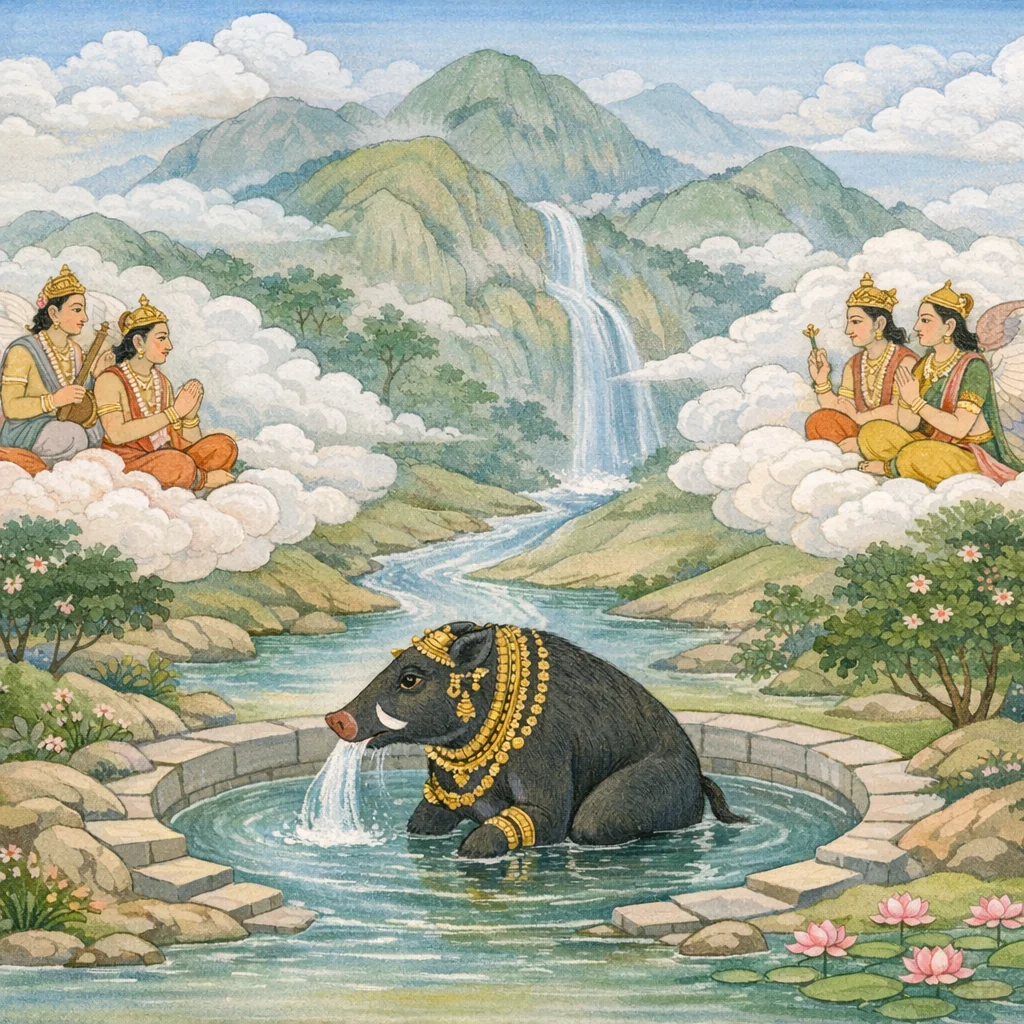
第79章开篇,圣贤那罗陀恳切请求梵天按次第宣说诸圣地渡口(tīrtha)各自的功德果报(tīrthaphala),尤重恒河(Gaṅgā)净化众生的行迹及其相关起源传说。梵天先作方法上的告诫:一切tīrtha的差别与其全部“圣地威德”(māhātmya)不可穷尽陈述,凡常之耳亦难尽受;然而仍依据近似“闻传”(śruti)之权威语句与既定圣地地理,赐予简要而可信的总述。随后重点提出两处tīrtha:Tryambaka,被赞能赐世间享乐与解脱;Vārāha,名闻三界。Vārāha tīrtha系于一段神话:罗刹Sindhusena夺取祭祀(yajña)并下沉至Rasātala,扰乱宇宙祭仪秩序;诸天不能制伏,遂祈请毗湿奴(Viṣṇu)。毗湿奴化身野猪(Vārāha)下行,诛灭敌类,复兴yajña,并循恒河昔日下降之路而出。出离之处,恒河之水洗净其血染之身,遂成Vārāha-kuṇḍa。经文宣示:于此圣地沐浴与布施,得一切祭祀之果;乃至忆念祖先,亦能令其净化并升至天界。
Chapter Arc
{"opening_hook":"Nārada, marked by sustained curiosity (jijñāsā), presses Brahmā to enumerate—“in proper sequence” (krameṇa)—the distinct fruits of tīrthas, beginning with Gaṅgā and the itihāsa that makes her course intelligible as sacred geography.","rising_action":"Brahmā first places an epistemic boundary: tīrtha-māhātmya is effectively immeasurable, and ordinary hearing cannot bear the whole; yet he agrees to give a condensed, śruti-like précis, then narrows the focus to two named loci whose merits are both practical (snāna/dāna) and soteriological (bhukti/mukti).","climax_moment":"The etiological myth of Vārāha tīrtha: Sindhusena drags the yajña down to Rasātala, the devas fail to recover it, and Viṣṇu—becoming Vārāha—descends, slays the hostile beings, restores the sacrifice, and re-emerges along Gaṅgā’s own descent-path; Gaṅgā washes the blood from his body, and that purificatory contact crystallizes as Vārāha-kuṇḍa.","resolution":"Brahmā codifies the ritual consequences: bathing and gifting at Vārāha tīrtha yield the fruit of all kratus; even pitṛ-smaraṇa there purifies ancestors and leads them heavenward—closing the chapter by converting myth into repeatable pilgrimage practice.","key_verse":"Teaching (translation): “At Vārāha-tīrtha, by bathing and by gifting, one attains the fruit of all sacrifices; and by remembering one’s ancestors there, the pitṛs are purified of sin and ascend to heaven.”"}
Thematic Essence
{"primary_theme":"Tīrtha-māhātmya as ordered sacred geography: how specific sites (Tryambaka, Vārāha) yield defined fruits through myth-grounded practice.","secondary_themes":["Epistemic restraint in purāṇic discourse (the immeasurable totality of tīrthas vs. a usable précis)","Bhukti–mukti synthesis: pilgrimage as both worldly welfare and liberation","Yajña as cosmic infrastructure; avatāra as ritual-restoration","Gaṅgā as purifying medium that sacralizes landscape through contact with the divine"],"brahma_purana_doctrine":"Tīrtha is not merely a place but a repeatable interface between mythic event and present practice: snāna/dāna/pitṛ-smaraṇa at a site created by avatāric action is declared equivalent to comprehensive sacrificial merit (sarva-kratu-phala).","adi_purana_significance":"As an ‘Ādi’ purāṇa-style chapter, it demonstrates the template by which primordial narrative (avatāra restoring yajña) is converted into dharma for later ages—mapping cosmic history onto a pilgrim’s itinerary and daily ritual acts."}
Emotional Journey
{"opening_rasa":"adbhuta","climax_rasa":"vīra","closing_rasa":"śānta","rasa_transitions":["adbhuta → śānta","śānta → raudra","raudra → vīra","vīra → adbhuta","adbhuta → śānta"],"devotional_peaks":["Brahmā’s ‘immeasurable yet mercifully condensed’ authorization of tīrtha-knowledge","Viṣṇu’s descent as Vārāha to restore the yajña (dharma re-established)","Gaṅgā cleansing the blood-stained Vārāha body—tīrtha born from purification","Promise that pitṛ-smaraṇa at Vārāha tīrtha uplifts ancestors to heaven"]}
Tirtha Focus
{"tirthas_covered":["Gaṅgā","Brahmagiri","Gaṅgāsravaṇa","Tryambaka tīrtha","Vārāha tīrtha","Vārāha-kuṇḍa"],"jagannath_content":null,"surya_content":null,"cosmology_content":"Rasātala is invoked as the netherworld arena where ritual order is disrupted and restored; the chapter links cosmic stability to the continuity of yajña and to avatāric intervention."}
Shlokas in Adhyaya 79
Verse 1
नारद उवाच न मनस् तृप्तिम् आधत्ते कथाः शृण्वत् त्वयेरिताः पृथक् तीर्थफलं श्रोतुं प्रवृत्तं मम मानसम् //
于此开篇(79.1),《普拉那》以庄严圣言开启后续主题之叙述。
Verse 2
क्रमशो ब्राह्मणानीतां गङ्गां मे प्रथमं वद पृथक् तीर्थफलं पुण्यं सेतिहासं यथाक्रमम् //
此偈(79.2)续加阐释教诲,引导其心归于达摩与内在安宁。
Verse 3
ब्रह्मोवाच तीर्थानां च पृथग् भावं फलं माहात्म्यम् एव च सर्वं वक्तुं न शक्नोमि न च त्वं श्रवणे क्षमः //
此偈(第3)出自《梵天往世书》,以庄严之辞阐明神圣的达摩与古老知识。
Verse 4
तथापि किंचिद् वक्ष्यामि शृणु नारद यत्नतः यान्य् उक्तानि च तीर्थानि श्रुतिवाक्यानि यानि च //
此偈(第4)承续阐释达摩之义与古老传承,语气恭敬而庄重。
Verse 5
तानि वक्ष्यामि संक्षेपान् नमस्कृत्वा त्रिलोचनम् यत्रासौ भगवान् आसीत् प्रत्यक्षस् त्र्यम्बको मुने //
此偈(第5)赞颂达摩,并陈述应受敬仰的宗教智慧与教义。
Verse 6
त्र्यम्बकं नाम तत् तीर्थं भुक्तिमुक्तिप्रदायकम् वाराहम् अपरं तीर्थं त्रिषु लोकेषु विश्रुतम् //
此偈(第6)以肃穆之辞叙述达摩,以及依古制引导人生的法则。
Verse 7
तस्य रूपं प्रवक्ष्यामि नाम विष्णोर् यथाभवत् पुरा देवान् पराभूय यज्ञम् आदाय राक्षसः //
此偈(第7)以申明真理与应当奉行的德行作结。
Verse 8
रसातलम् अनुप्राप्तः सिन्धुसेन इति श्रुतः यज्ञे तलम् अनुप्राप्ते निर्यज्ञा ह्य् अभवन् मही //
第8颂:此《往世书》阐明与吠陀相应的神圣真理与达摩之秩序。
Verse 9
नायं लोको ऽस्ति न परो यज्ञे नष्ट इतीत्वराः सुरास् तम् एव विविशू रसातलम् अनुद्विषम् //
第9颂:智者当以恭敬聆听,使智慧明朗,心意寂静。
Verse 10
नाशक्नुवंस् तु तं जेतुं देवा इन्द्रपुरोगमाः विष्णुं पुराणपुरुषं गत्वा तस्मै न्यवेदयन् //
第10颂:忆念神圣之名并奉行达摩,能增长福德,护持不堕恶趣。
Verse 11
राक्षसस्य तु तत् कर्म यज्ञभ्रंशम् अशेषतः ततः प्रोवाच भगवान् वाराहं वपुर् आस्थितः //
第11颂:以至诚研习《往世书》者,今世与来世皆得知识与安乐。
Verse 12
शङ्खचक्रगदापाणिर् गत्वा चैव रसातलम् आनयिष्ये मखं पुण्यं हत्वा राक्षसपुंगवान् //
第12颂:是故当敬奉达摩,恒常听闻与诵读,使恩德与功德不断增长。
Verse 13
स्वः प्रयान्तु सुराः सर्वे व्येतु वो मानसो ज्वरः येन गङ्गा तलं प्राप्ता पथा तेनैव चक्रधृक् //
此偈(《梵天往世书》79章13颂)被奉为往世书传统中的神圣言教。
Verse 14
जगाम तरसा पुत्र भुवं भित्त्वा रसातलम् स वराहवपुः श्रीमान् रसातलनिवासिनः //
此颂(79章14颂)承接前文,以往世书体例继续阐明其神圣义旨。
Verse 15
राक्षसान् दानवान् हत्वा मुखे धृत्वा महाध्वरम् वाराहरूपी भगवान् मखम् आदाय यज्ञभुक् //
此偈(79.15)宜以恭敬诵读,以明了达摩与往世书所载的古传。
Verse 16
येन प्राप तलं विष्णुः पथा तेनैव शत्रुजित् मुखे न्यस्य महायज्ञं निश्चक्राम रसातलात् //
此颂(79.16)宣示:聆听并忆持圣言,能成就福德与智慧。
Verse 17
तत्र ब्रह्मगिरौ देवाः प्रतीक्षां चक्रिरे हरेः पथस् तस्माद् विनिःसृत्य गङ्गास्रवणम् अभ्यगात् //
此颂(79.17)以赞颂达摩之力与正行清净之修持而作结。
Verse 18
प्राक्षालयच् च स्वाङ्गानि असृग्लिप्तानि नारद गङ्गाम्भसा तत्र कुण्डं वाराहम् अभवत् ततः //
此偈(第18)载于《梵天往世书》,作为神圣之言,用以承续叙事与教义之次第。
Verse 19
मुखे न्यस्तं महायज्ञं देवानां पुरतो हरिः दत्तवांस् त्रिदशश्रेष्ठो मुखाद् यज्ञो ऽभ्यजायत //
此偈(第19)为《梵天往世书》之圣言一部分,依次第继续阐明其义。
Verse 20
ततः प्रभृति यज्ञाङ्गं प्रधानं स्रुव उच्यते वाराहरूपम् अभवद् एवं वै कारणान्तरात् //
此偈(第20)编入《梵天往世书》,以维系叙事与神圣教诲之间的连贯。
Verse 21
तस्मात् पुण्यतमं तीर्थं वाराहं सर्वकामदम् तत्र स्नानं च दानं च सर्वक्रतुफलप्रदम् //
此偈(第21)承接圣言,依次第铺陈,使读者明了其旨并生恭敬礼拜之心。
Verse 22
तत्र स्थितो ऽपि यः कश्चित् पितॄन् स्मरति पुण्यकृत् विमुक्ताः सर्वपापेभ्यः पितरः स्वर्गम् आप्नुयुः //
此偈(第22)为本段作结,仍守古雅体例与《梵天往世书》之神圣庄严。
Frequently Asked Questions
The chapter centers on sacred topography as a vehicle for dharma: tīrthas are presented as concentrated sites of ritual efficacy where purification, restoration of cosmic order (through the recovery of the yajña), and soteriological benefit (bhukti and mukti) become accessible through disciplined acts such as snāna, dāna, and pitṛ-smaraṇa.
Vārāha tīrtha is explicitly framed as a practice-site where bathing and charitable gifting yield the fruit of all sacrifices (sarvakratu-phala). The chapter also emphasizes ancestor-remembrance at the tīrtha as an efficacious rite for the liberation and heavenly ascent of pitṛs.
The sanctity is grounded in a mythic restoration: when the yajña is seized by Sindhusena and taken to Rasātala, Viṣṇu assumes the Vārāha form, defeats the hostile beings, and retrieves the rite. The emergence along the same route associated with Gaṅgā’s descent, and the subsequent cleansing in Gaṅgā’s waters that forms Vārāha-kuṇḍa, sacralize the location as a permanent pilgrimage locus.