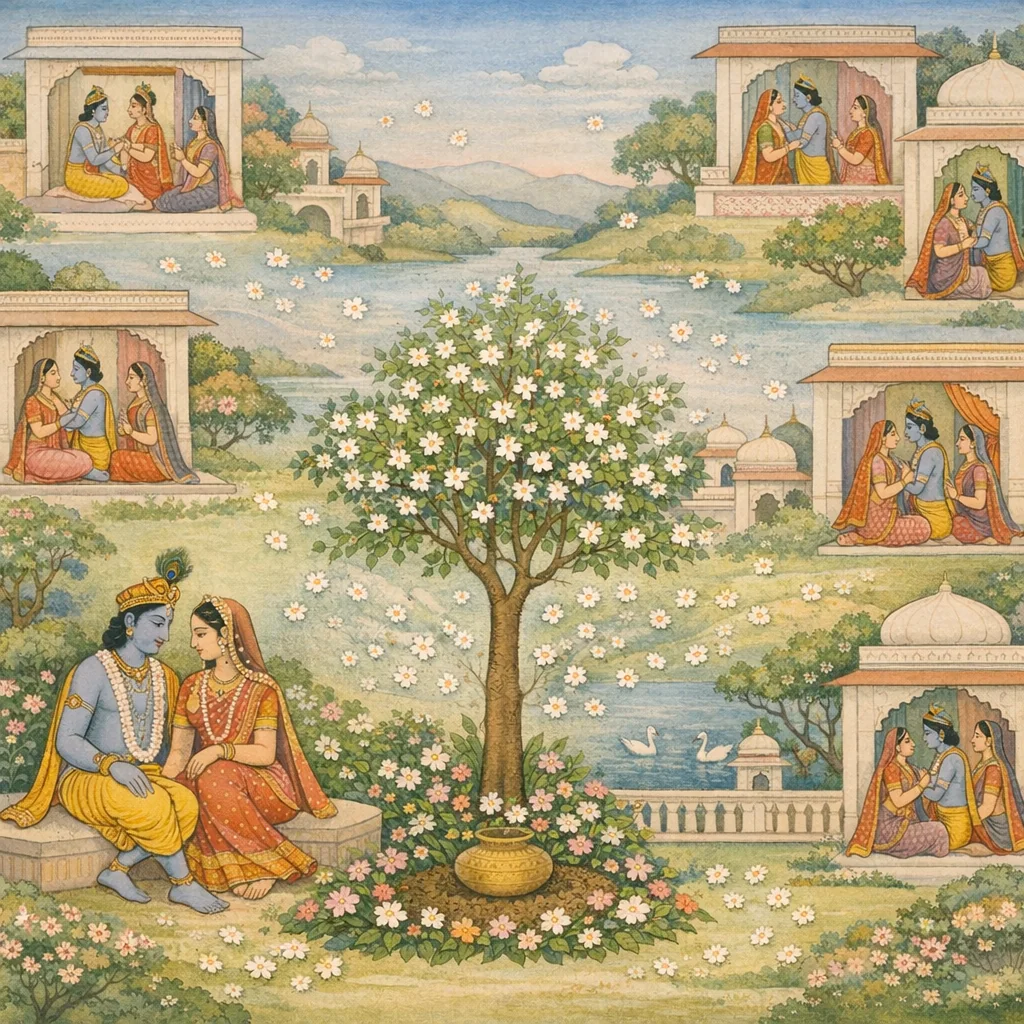
Adhyaya 204: Krishna Returns the Parijata Tree to Dvaraka and Marries the Rescued Maidens
第204章叙述从天界冲突转入人间复归的紧凑过渡,核心在于圣主克里希纳与因陀罗的和解之道,以及将神圣福泽移入人世。毗耶娑说:天帝因陀罗称颂之后,凯沙瓦庄重而安然地请求宽恕所谓“冒犯”,并说明取走帕利贾塔神树只是为守护真实誓约。克里希纳归还因陀罗的金刚杵(vajra),重申其正当主权与兵器。因陀罗识得克里希纳的宇宙神性,便请他将帕利贾塔带往都城德瓦拉瓦蒂,因为当克里希纳离世后,此树不久将不留人间。哈利在悉达、乾闼婆与诸仙圣(ṛṣi)的赞颂中降临,把帕利贾塔移植到德瓦拉卡王宫之内,其芬芳与奇瑞改变了城中的气象。随后章节转向社会与仪礼的圆满:克里希纳接纳曾被那罗迦囚禁的女子,于吉时依法与一万六千一百名少女成婚,并化现多身,使每一位都亲证他为自己的夫君,以神之遍在恢复正法(dharma)与名誉。
Chapter Arc
{"opening_hook":"The chapter opens in the afterglow of a divine confrontation: Indra praises Keśava, and the reader is drawn in by Kṛṣṇa’s unexpectedly grave, diplomatic reply—spoken as if he were merely “mortal,” even while the gods recognize his supremacy.","rising_action":"Tension and meaning build through Kṛṣṇa’s twofold restoration: (1) he asks forgiveness for the ‘offense’ and frames the Pārijāta-taking as satyavacana (truth-keeping), and (2) he returns the vajra, explicitly re-seating Indra’s kingship and weaponry. Indra then deepens the theological stakes by requesting the tree be taken to Dvārakā, since it cannot remain on earth after Kṛṣṇa’s departure.","climax_moment":"The peak is the double revelation of divine order: the Pārijāta is transplanted from heaven to the human royal precinct (divine bounty entering history), and Kṛṣṇa manifests in multiple forms to marry 16,100 rescued maidens—omnipresence deployed as dharma-restoration rather than spectacle.","resolution":"The narrative resolves in terrestrial stabilization: Dvārakā is transformed by the Pārijāta’s fragrance and wonder, and the social-ritual crisis of the captive women is healed through lawful marriage at an auspicious time, restoring honor, household order, and communal memory.","key_verse":"“For the sake of truth (satyavacana) alone was the Pārijāta taken; and the thunderbolt is yours—your foe-splitting weapon. Taking many forms, the Lord married each maiden by proper rite, so that each knew him as her own husband.” (sense-translation of the chapter’s central teaching)"}
Thematic Essence
{"primary_theme":"Dharma-restoration through divine conciliation and social rehabilitation (Pārijāta relocation + lawful marriages).","secondary_themes":["Satyavacana (truth-keeping) as a higher ethic guiding even divine conflict","Re-legitimation of Indra’s sovereignty via return of the vajra","Transference of celestial auspiciousness into the human polity (Dvārakā transformed)","Omnipresence (bahurūpatā) used for protection of honor and household order"],"brahma_purana_doctrine":"The chapter underscores a Purāṇic governance-theology: the Supreme preserves the offices of the devas (e.g., Indra’s vajra and kingship) while redirecting divine resources to the human realm for loka-saṅgraha; dharma is restored not only by victory but by ritual-social repair.","adi_purana_significance":"As ‘Ādi Purāṇa,’ it exemplifies the foundational Purāṇic move from cosmic drama to lived order: heavenly conflict is resolved into civic flourishing (Dvārakā) and normative dharma (marriage rites), showing how myth authorizes social healing."}
Emotional Journey
{"opening_rasa":"शान्त","climax_rasa":"अद्भुत","closing_rasa":"शान्त","rasa_transitions":["शान्त → वीर → अद्भुत → शृङ्गार → शान्त"],"devotional_peaks":["Indra’s praise and Kṛṣṇa’s composed, dharma-grounded reply","The descent to Bhūloka amid siddha-gandharva-ṛṣi acclamation","The multi-form marriage as a revelation of the Lord’s all-pervading capacity to protect dignity and dharma"]}
Tirtha Focus
{"tirthas_covered":["द्वारवती (द्वारका) पुरी"],"jagannath_content":null,"surya_content":null,"cosmology_content":null}
Shlokas in Adhyaya 204
Verse 1
व्यास उवाच संस्तुतो भगवान् इत्थं देवराजेन केशवः प्रहस्य भावगम्भीरम् उवाचेदं द्विजोत्तमाः //
此处经文继续叙述宇宙之创造与护持的次第,皆依神圣的法令而行。
Verse 2
श्रीभगवान् उवाच देवराजो भवान् इन्द्रो वयं मर्त्या जगत्पते क्षन्तव्यं भवतैवैतद् अपराधकृतं मम //
智者当知:业与时运之流转,乃引导众生于轮回之中的力量。
Verse 3
पारिजाततरुश् चायं नीयताम् उचितास्पदम् गृहीतो ऽयं मया शक्र सत्यावचनकारणात् //
以恭敬奉事神圣并如法修持达摩,人便能超越苦恼,证得至上的安乐。
Verse 4
वज्रं चेदं गृहाण त्वं यष्टव्यं प्रहितं त्वया तवैवैतत् प्रहरणं शक्र वैरिविदारणम् //
此偈(204.4)被视为《普拉那》中的神圣言教,庄严而具教化之义。
Verse 5
शक्र उवाच विमोहयसि माम् ईश मर्त्यो ऽहम् इति किं वदन् जानीमस् त्वां भगवतो ऽनन्तसौख्यविदो वयम् //
此偈(204.5)阐明崇高之达摩,宜以清净之心敬奉并研习。
Verse 6
यो ऽसि सो ऽसि जगन्नाथ प्रवृत्तौ नाथ संस्थितः जगतः शल्यनिष्कर्षं करोष्य् असुरसूदन //
此偈(204.6)劝诫听闻者铭记圣言,并以诚敬之心奉行达摩之法度。
Verse 7
नीयतां पारिजातो ऽयं कृष्ण द्वारवतीं पुरीम् मर्त्यलोके त्वया मुक्ते नायं संस्थास्यते भुवि //
此偈(204.7)赞叹对神圣者的礼敬与持戒修德,使内心获得安宁。
Verse 8
व्यास उवाच तथेत्य् उक्त्वा तु देवेन्द्रम् आजगाम भुवं हरिः प्रयुक्तैः सिद्धगन्धर्वैः स्तूयमानस् त्व् अथर्षिभिः //
此偈(204.8)宣示:聆听并忆持《普拉那》,能生福德,启发明净智慧。
Verse 9
जगाम कृष्णः सहसा गृहीत्वा पादपोत्तमम् ततः शङ्खम् उपाध्माय द्वारकोपरि संस्थितः //
此偈(第204章,第9偈)仅标注为“第9颂”,未提供梵文原文;因此无法作出严谨的对译。
Verse 10
हर्षम् उत्पादयाम् आस द्वारकावासिनां द्विजाः अवतीर्याथ गरुडात् सत्यभामासहायवान् //
此偈(第204章,第10偈)仅写作“第10颂”,未附梵文原文;故无法给出忠实译文。
Verse 11
निष्कुटे स्थापयाम् आस पारिजातं महातरुम् यम् अभ्येत्य जनः सर्वो जातिं स्मरति पौर्विकीम् //
此偈(第204章,第11偈)仅有“第11颂”的标记,缺少梵文正文;因此无法依据原典翻译。
Verse 12
वास्यते यस्य पुष्पाणां गन्धेनोर्वी त्रियोजनम् ततस् ते यादवाः सर्वे देवगन्धान् अमानुषान् //
此偈(第204章,第12偈)仅标为“第12颂”,未给出梵文经文;因此无法提供兼具学术与敬虔的译文。
Verse 13
ददृशुः पादपे तस्मिन् कुर्वतो मुखदर्शनम् किंकरैः समुपानीतं हस्त्यश्वादि ततो धनम् //
此偈(第204章,第13偈)仅注明“第13颂”,缺少梵文原文;因此无法作出准确释译。
Verse 14
स्त्रियश् च कृष्णो जग्राह नरकस्य परिग्रहात् ततः काले शुभे प्राप्त उपयेमे जनार्दनः //
此处仅标示“14”,即本章偈颂的序号,应依原始《往世书》语境来理解。
Verse 15
ताः कन्या नरकावासात् सर्वतो याः समाहृताः एकस्मिन्न् एव गोविन्दः कालेनासां द्विजोत्तमाः //
此处仅有“15”作为偈颂编号;其完整义理取决于原始梵文正文。
Verse 16
जग्राह विधिवत् पाणीन् पृथग्देहे स्वधर्मतः षोडश स्त्रीसहस्राणि शतम् एकं तथाधिकम् //
此处仅记“16”为本章偈号;应与原典上下文相参照而读。
Verse 17
तावन्ति चक्रे रूपाणि भगवान् मधुसूदनः एकैकशश् च ताः कन्या मेनिरे मधुसूदनम् //
此处仅列“17”为顺序编号;阐释须依据完整的梵文偈颂。
Verse 18
ममैव पाणिग्रहणं गोविन्दः कृतवान् इति निशासु जगतः स्रष्टा तासां गेहेषु केशवः उवास विप्राः सर्वासां विश्वरूपधरो हरिः //
此处仅记载“18”为偈号;其古雅的宗教义旨当从原文中求得。
Frequently Asked Questions
The chapter foregrounds dharma maintained through restraint and restitution: Kṛṣṇa de-escalates divine rivalry by returning Indra’s vajra and framing the Pārijāta episode as fidelity to truth (satyavacana), then restores social honor by ritually marrying the rescued maidens, converting captivity into protected household status.
Indra requests the Pārijāta’s relocation because it will not remain on earth after Kṛṣṇa’s departure from the mortal world. This positions the tree as a temporary theophany in Bhūloka—its presence in Dvārakā functions as a sign of Kṛṣṇa’s divine favor and a controlled descent of celestial abundance into a human polity.
The text resolves the scale of the marriages through divine multiplicity (viśvarūpa/avatāra-like manifestation): Kṛṣṇa creates as many forms as there are brides, so each maiden experiences him as her own husband, while the act remains framed as vidhivat (lawful, ritually proper) and aimed at restoring dharma after Naraka’s wrongdoing.