Adhyaya 113: Brahmatirtha, Rudratirtha, and Sauryatirtha: The Sanctification of Brahma’s Severed Fifth Head
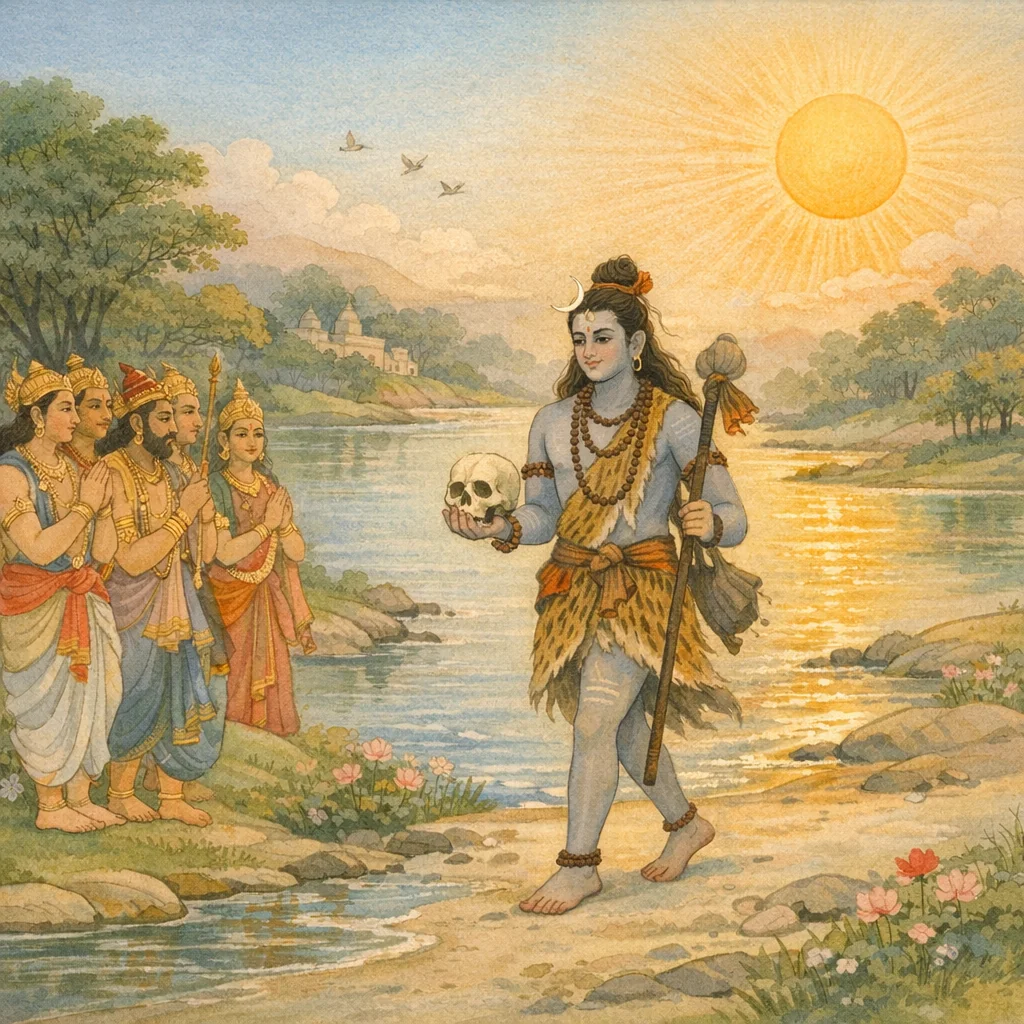
第113章以圣地缘起(tīrtha-māhātmya)的叙事,讲述梵摩圣渡(Brahmatīrtha)的出现与尊崇。梵天(Brahmā)称此朝圣处即使在诸天之中亦属罕有,能赐世间受用(bhukti)与解脱(mukti)两种功德。故事追忆一场危机:梵天可怖的第五首,形貌如驴,威胁天众,诸神遂求毗湿奴(Viṣṇu)援助。毗湿奴指出,若斩断此首将引发沉重业报,除非由三目大自在天湿婆(Śiva)承担其果。诸神以怜悯诸世界为由祈请湿婆托持被斩之首;湿婆思量后接受此重担。于是该处具三重神圣:因梵天之缘称为梵摩圣渡(Brahmatīrtha),因湿婆之行称为鲁陀罗圣渡(Rudratīrtha),又因太阳神显现而称为太阳圣渡(Sauryatīrtha)。经文末说,在不离圣域(Avimukta-kṣetra)之瞿多弥河(Gautamī)岸边,得见此首或已被圣化之颅骨者,能获净化并证得究竟归宿。
Chapter Arc
{"opening_hook":"Brahmā proclaims a tīrtha on the Gautamī’s bank in Avimukta-kṣetra as “rare even for the gods,” immediately promising the double fruit of bhukti (worldly fulfillment) and mukti (liberation), which draws the listener into a māhātmya framed as both map and myth.","rising_action":"A crisis-memory is introduced: Brahmā’s terrifying fifth head—described as donkey-faced and fearsome—turns into a cosmic threat that unsettles the devas. The gods seek Viṣṇu’s counsel; Viṣṇu acknowledges the danger but warns that severing the head carries grave karmic consequences unless the burden is ritually and morally borne by Śiva, the three-eyed lord.","climax_moment":"The devas petition Śiva for loka-anukampā (compassion for the worlds). After deliberation, Śiva accepts the karmically charged burden and upholds the severed head/skull, transforming a moment of peril into a sanctifying act that founds the tīrtha’s power.","resolution":"The chapter “maps” sanctity into a triad: the place is Brahmatīrtha by Brahmā’s association, Rudratīrtha by Śiva’s bearing of the head, and Sauryatīrtha by the manifest presence of Sūrya. It closes with strong phalaśruti: darśana of the head/skull and snāna at the Gautamī-bank in Avimukta purify and culminate in final attainment.","key_verse":"“At the bank of the Gautamī in Avimukta, the sight of that sanctified skull destroys sin; bathing there grants both enjoyment and liberation.” (memorable teaching; chapter’s phalaśruti summarized in translation)"}
Thematic Essence
{"primary_theme":"गौतमी-माहात्म्य (Gautamī tīrtha-māhātmya): the origin and exaltation of Brahmatīrtha through a mythic crisis and its sanctifying resolution.","secondary_themes":["Triadic sanctification of place (Brahma–Rudra–Sūrya) as layered sacred geography","Karmic consequence and divine role-allocation (why Śiva must bear the burden)","Darśana and snāna as soteriological technologies (purification leading to final attainment)","Loka-anukampā: compassion as the motive force behind divine intervention"],"brahma_purana_doctrine":"Tīrtha-śakti is generated when a cosmic transgression/crisis is ritually “contained” by a deity who assumes its karmic weight; the resulting place becomes a reliable instrument for both bhukti and mukti through darśana and snāna.","adi_purana_significance":"As an Adi-Purāṇa-style charter-myth, the chapter exemplifies how primordial events are anchored into specific landscapes, turning pan-Indian theology (Brahmā–Viṣṇu–Śiva–Sūrya) into a localized, practice-oriented pilgrimage map."}
Emotional Journey
{"opening_rasa":"अद्भुत (adbhuta)","climax_rasa":"भयानक (bhayānaka) → वीर (vīra)","closing_rasa":"शान्त (śānta)","rasa_transitions":["adbhuta → bhayānaka → cintā (anxiety-toned) → vīra → śānta"],"devotional_peaks":["The devas’ supplication to Śiva framed explicitly as loka-anukampā (world-compassion)","The naming of the triad—Brahmatīrtha, Rudratīrtha, Sauryatīrtha—as a liturgical moment of sacral mapping","The concluding phalaśruti promising purification and final attainment through darśana/snānā at Gautamī’s bank"]}
Tirtha Focus
{"tirthas_covered":["ब्रह्मतीर्थ (Brahmatīrtha)","रुद्रतीर्थ (Rudratīrtha)","सौर्यतीर्थ (Sauryatīrtha)","गौतमी-तट (Gautamī river bank)","अविमुक्त-क्षेत्र (Avimukta-kṣetra)"],"jagannath_content":null,"surya_content":"Sūrya is explicitly integrated into the site’s holiness as Sauryatīrtha, implying solar darśana as a purifier and merit-multiplier within the Gautamī pilgrimage network.","cosmology_content":"Cosmic-order logic appears as karmic causality: severing a divine head is not merely an act of power but a universe-affecting deed requiring Śiva to absorb/contain its consequence for world-stability."}
Shlokas in Adhyaya 113
Verse 1
ब्रह्मोवाच इदम् अप्य् अपरं तीर्थं देवानाम् अपि दुर्लभम् ब्रह्मतीर्थम् इति ख्यातं भुक्तिमुक्तिप्रदं नृणाम् //
此处仅标示数字“1”,未提供梵文正文;因此无法作出准确而忠实的译文。
Verse 2
स्थितेषु देवसैन्येषु प्रविष्टेषु रसातलम् दैत्येषु च मुनिश्रेष्ठ तथा मातृषु तान् अनु //
此处仅标示数字“2”,未提供梵文正文;因此无法作出准确而忠实的译文。
Verse 3
मदीयं पञ्चमं वक्त्रं गर्दभाकृति भीषणम् तद् वक्त्रं देवसैन्येषु मयि तिष्ठत्य् उवाच ह //
此处仅标示数字“3”,未提供梵文正文;因此无法作出准确而忠实的译文。
Verse 4
हे दैत्याः किं पलायन्ते न भयं वो ऽस्तु सत्वरम् आगच्छन्तु सुरान् सर्वान् भक्षयिष्ये क्षणाद् इति //
此处仅标示数字“4”,未提供梵文正文;因此无法作出准确而忠实的译文。
Verse 5
निवारयन्तं माम् एवं भक्षणायोद्यतं तथा तं दृष्ट्वा विबुधाः सर्वे वित्रस्ता विष्णुम् अब्रुवन् //
第113.5颂被传为《普拉那》中的神圣言教,阐明达摩与清净教诲。
Verse 6
त्राहि विष्णो जगन्नाथ ब्रह्मणो ऽस्य मुखं लुन चक्रधृग् विबुधान् आह च्छेद्मि चक्रेण वै शिरः //
第113.6颂继续阐释达摩的法则与对神圣者的敬奉,使心安定并增长功德。
Verse 7
किं तु तच् छिन्नम् एवेदं संहरेत् सचराचरम् मन्त्रं ब्रूमो ऽत्र विबुधाः श्रूयतां सर्वम् एव हि //
第113.7颂赞叹聆听并忆持圣言,由此智慧生起,愚痴得以消除。
Verse 8
त्रिनेत्रः कशिरश् छेत्ता स च धत्ते न संशयः मया च शंभुः सर्वैश् च स्तुतः प्रोक्तस् तथैव च //
第113.8颂指出:依正行而修、依法而礼敬,能得安乐,并开启通向解脱之道。
Verse 9
यागः क्षणी दृष्टफले ऽसमर्थः स नैव कर्तुः फलतीति मत्वा फलस्य दाने प्रतिभूर् जटीति निश्चित्य लोकः प्रतिकर्म यातः
第113.9颂总结:具信与慧者当恒常守持达摩,以得神恩与长久安乐。
Verse 10
ततः सुरेशः संतुष्टो देवानां कार्यसिद्धये लोकानाम् उपकारार्थं तथेत्य् आह सुरान् प्रति //
此偈(113.10)为《普拉那》之圣言,阐明达摩与至上真理。
Verse 11
तद्वक्त्रं पापरूपं यद् भीषणं लोमहर्षणम् निकृत्य नखशस्त्रैश् च क्व स्थाप्यं चेत्य् अथाब्रवीत् //
此偈(113.11)续说敬奉神圣、依达摩而行,以得安宁吉祥。
Verse 12
तत्रेला विबुधान् आह नाहं वोढुं शिरः क्षमा रसातलम् अथो यास्ये उदधिश् चाप्य् अथाब्रवीत् //
此偈(113.12)告诫:研习吠陀并践行达摩,是功德与智慧之根本。
Verse 13
शोषं यास्ये क्षणाद् एव पुनश् चोचुः शिवं सुराः त्वयैवैतद् ब्रह्मशिरो धार्यं लोकानुकम्पया //
此偈(113.13)宣示:以清净心布施与祈祷,必得神圣恩泽。
Verse 14
अच्छेदे जगतां नाशश् छेदे दोषश् च तादृशः एवं विमृश्य सोमेशो दधार कशिरस् तदा //
此偈(113.14)总结:诚心守持达摩者,必得昌盛与解脱。
Verse 15
तद् दृष्ट्वा दुष्करं कर्म गौतमीं प्राप्य पावनीम् अस्तुवञ् जगताम् ईशं प्रणयाद् भक्तितः सुराः //
此偈(15)载于《普拉那》传统之中,用以忆念正法与至上真理。
Verse 16
देवेष्व् अमित्रं कशिरो ऽतिभीमं तान् भक्षणायोपगतं निकृत्य नखाग्रसूच्या शकलेन्दुमौलिस् त्यागे ऽपि दोषात् कृपयानुधत्ते
此偈(16)开示:聆听并忆持圣言,能令心寂静,并增长功德。
Verse 17
तत्र ते विबुधाः सर्वे स्थिता ये ब्रह्मणो ऽन्तिके तुष्टुवुर् विबुधेशानं कर्म दृष्ट्वातिदैवतम् //
此偈(17)赞叹:以真诚敬奉正法、无我慢而事奉神圣者。
Verse 18
ततः प्रभृति तत् तीर्थं ब्रह्मतीर्थम् इति श्रुतम् अद्यापि ब्रह्मणो रूपं चतुर्मुखम् अवस्थितम् //
此偈(18)说:依正法而行,是通向安宁之道,并能舍离无明。
Verse 19
शिरोमात्रं तु यः पश्येत् स गच्छेद् ब्रह्मणः पदम् यत्र स्थित्वा स्वयं रुद्रो लूनवान् ब्रह्मणः शिरः //
此偈(19)总结:智者当持戒并研习经典,以达至至高之目标。
Verse 20
रुद्रतीर्थं तद् एव स्यात् तत्र साक्षाद् दिवाकरः देवानां च स्वरूपेण स्थितो यस्मात् तद् उत्तमम् //
第20颂:此为《普拉那》之神圣篇章,庄严阐明达摩与诸神圣传承。
Verse 21
सौर्यं तीर्थं तद् आख्यातं सर्वक्रतुफलप्रदम् तत्र स्नात्वा रविं दृष्ट्वा पुनर्जन्म न विद्यते //
第21颂:此教诲续说依达摩之本分,以及以清净之心行供奉礼敬之法。
Verse 22
महादेवेन यच् छिन्नं ब्रह्मणः पञ्चमं शिरः क्षेत्रे ऽविमुक्ते संस्थाप्य देवतानां हितं कृतम् //
第22颂:贤哲宣说,谛听并忆持圣言,能令心寂静,智慧澄明。
Verse 23
ब्रह्मतीर्थे शिरोमात्रं यो दृष्ट्वा गौतमीतटे क्षेत्रे ऽविमुक्ते तस्यैव स्थापितं यो ऽनुपश्यति कपालं ब्रह्मणः पुण्यं ब्रह्महा पूततां व्रजेत् //
第23颂:由奉行达摩并以至诚供奉,人得安乐,趋向至高之归趣。
Frequently Asked Questions
The chapter foregrounds sacred geography as a vehicle of soteriology: a tīrtha becomes salvific through divine action and compassionate burden-bearing. Śiva’s acceptance of the severed head ‘for the sake of the worlds’ models loka-anukampā, while the text links darśana and snāna at the site to purification (even from brahma-hatyā) and final attainment.
Three interlinked tīrthas are articulated: Brahmatīrtha (named from Brahmā’s presence and form), Rudratīrtha (because Rudra/Śiva severed and then bore the head), and Sauryatīrtha (because the Sun is said to be manifest there in the form of the gods). Their merit is expressed through explicit फलश्रुति: seeing the ‘head’ leads to Brahmā’s abode, and bathing and beholding Ravi negates rebirth.
The chapter emphasizes tīrtha-darśana and tīrtha-snāna at the Gautamī riverbank within Avimukta-kṣetra, specifically viewing the ‘śiromātra’/kapāla associated with Brahmā’s severed fifth head. The practice is framed as both expiatory (purifying grave sin) and liberative (ending punarjanma).