
Bhagavad Gita — Vishwarupa Darshana Yoga, Shloka 28
Vishwarupa Darshana Yoga
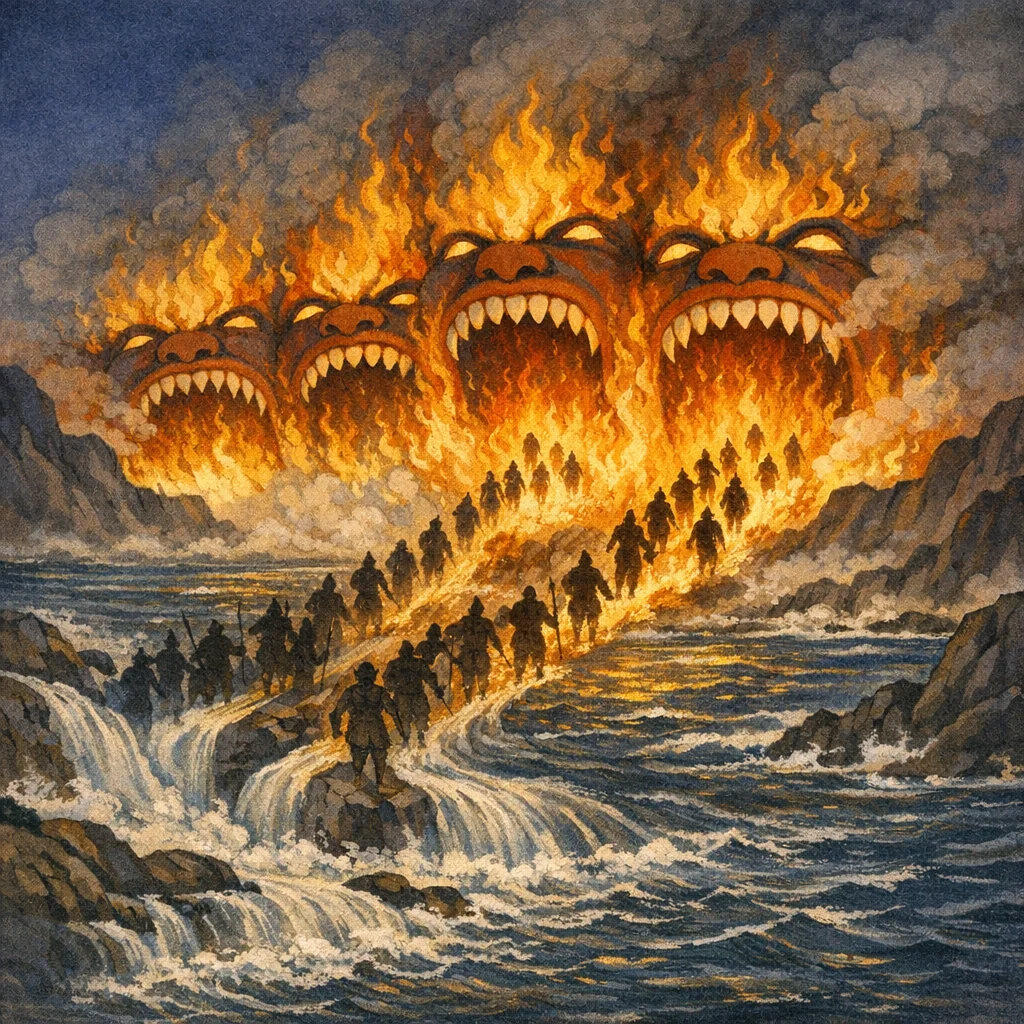
यथा नदीनां बहवोऽम्बुवेगाः समुद्रमेवाभिमुखा द्रवन्ति । तथा तवामी नरलोकवीरा विशन्ति वक्त्राण्यभिविज्वलन्ति ॥
yathā nadīnāṁ bahavo ’mbuvegāḥ samudram evābhimukhā dravanti | tathā tavāmī naralokavīrā viśanti vaktrāṇy abhivijvalanti ||

譬如众多河流的急流,皆面向大海奔注;如是,这些人间的英雄也正投入你那炽然燃烧的诸口之中。
जैसे अनेक नदियों के जलप्रवाह समुद्र की ओर दौड़ते हैं, वैसे ही ये नरलोक के वीर आपके प्रज्वलित मुखों में प्रवेश कर रहे हैं।
As many torrents of rivers rush facing the ocean alone, so these heroes of the human world enter your mouths that blaze forth.
The simile of rivers-to-ocean is stable across versions; some commentaries foreground it as a non-literal illustration of how all individual trajectories converge into a single cosmic principle.
FAQs
The river-ocean analogy captures an intuitive sense of inevitability: events seem to flow toward an outcome regardless of personal preference, echoing Arjuna’s heightened anxiety and awe.
It suggests that multiplicity (many streams) ultimately returns to unity (the ocean), a common Upaniṣadic-style image adapted here to the cosmic vision.
Arjuna is trying to describe the viśvarūpa using familiar natural images, bridging ordinary experience and extraordinary revelation.
It can be used to reflect on interdependence: individual lives and choices occur within larger systems—social, ecological, and temporal—that shape outcomes.