
Bhagavad Gita — Vishwarupa Darshana Yoga, Shloka 15
Vishwarupa Darshana Yoga
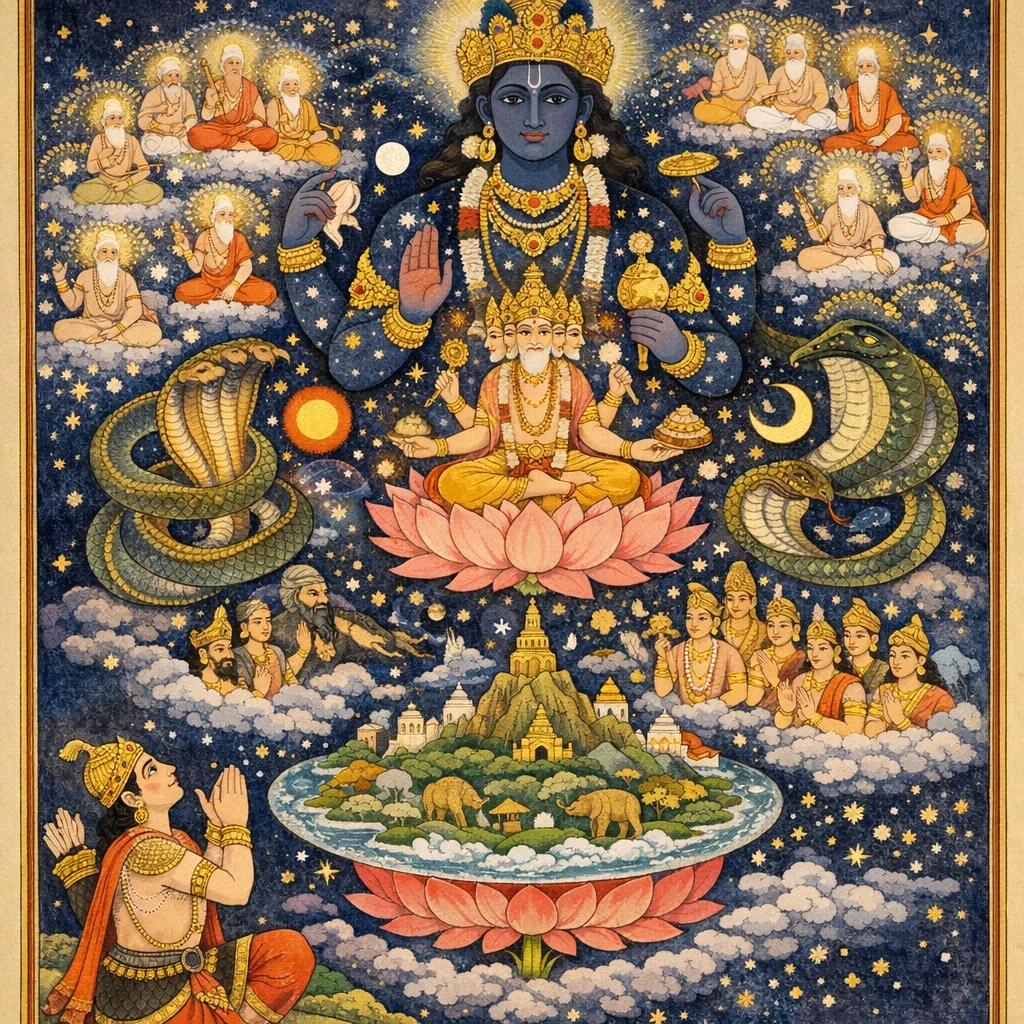
अर्जुन उवाच । पश्यामि देवांस्तव देव देहे सर्वांस्तथा भूतविशेषसंघान् । ब्रह्माणमीशं कमलासनस्थ- मृ...
arjuna uvāca | paśyāmi devāṃs tava deva dehe sarvāṃs tathā bhūta-viśeṣa-saṅghān | brahmāṇam īśaṃ kamalāsana-stha- mṛ...

阿周那说:大德啊!我在你的身中看见一切诸天,也看见种种众生的群类;又见坐于莲座之上的梵天——自在之主,以及诸位主宰……
अर्जुन ने कहा—हे देव! मैं आपके शरीर में समस्त देवताओं को तथा विविध प्राणियों के समूहों को देखता हूँ; और कमलासन पर स्थित ब्रह्मा तथा (अन्य) ईशों को भी ...
Arjuna said: I see, O god, in your body all the gods, and likewise the multitudes of distinct beings; Brahmā, the lord seated on the lotus, and ... (verse continues).
Because the input text is truncated, the translation is necessarily partial. In full form, the verse typically lists cosmological beings (devas, Brahmā, sages/serpents), reflecting an epic-Purāṇic sacred hierarchy embedded within the vision.
FAQs
Arjuna’s enumeration reflects an attempt to cognitively stabilize an overwhelming experience by naming recognizable categories and figures.
The verse suggests that multiple divine agencies and classes of beings are encompassed within a single ultimate locus, implying a unifying ground beneath plural religious cosmologies.
After the vision is shown, Arjuna becomes the primary witness, offering a first-person account that validates the narrative depiction.
It can encourage intellectual pluralism: diverse traditions and “levels” of meaning can be approached as potentially nested within broader frameworks of understanding.