
Shloka 33
Vibhuti Yoga — Vibhuti Yoga
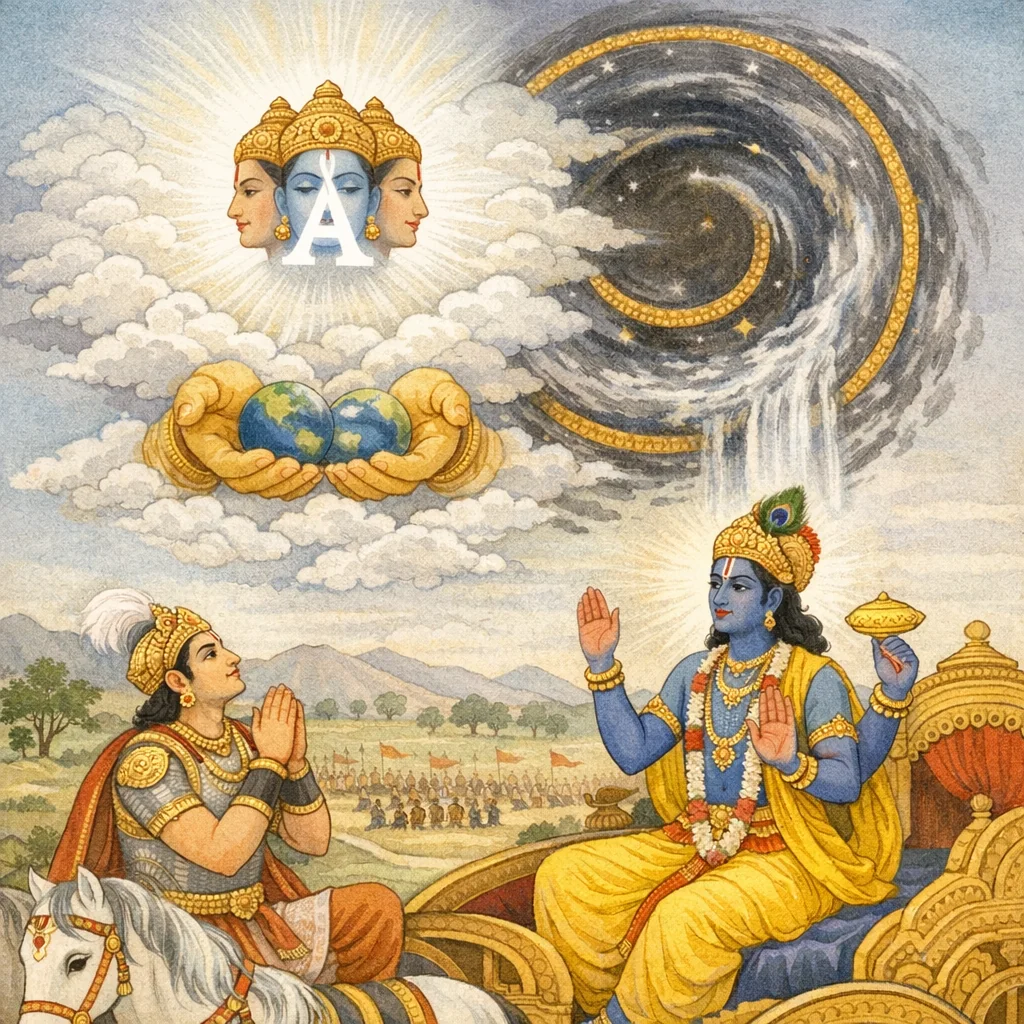
अक्षराणामकारोऽस्मि द्वन्द्वः सामासिकस्य च । अहमेवाक्षयः कालो धाताहं विश्वतोमुखः ॥ १०.३३ ॥
akṣarāṇām akāro 'smi dvandvaḥ sāmāsikasya ca | aham evākṣayaḥ kālo dhātāhaṃ viśvatomukhaḥ || 10.33 ||

在诸字母中,我是“阿”;在复合词中,我是并列合成(dvandva)。唯我为不灭之时;我为维持者,面向四方。
Among letters I am ‘A’; among compounds I am the dvandva. I alone am imperishable Time; I am the sustainer, facing all directions.
Among phonemes/letters I am the vowel ‘a’; among compound formations I am the dvandva (copulative compound). I am indeed inexhaustible Time; I am the arranger/sustainer (dhātṛ), with faces everywhere (omni-directional).
akāra as primordial sound is emphasized in many traditions. dhātā can mean ‘creator/establisher/sustainer.’ viśvatomukha is typically read metaphorically as omnipresent awareness or universal agency.
FAQs
The focus on ‘A’ and grammar suggests that cognition is structured by language; recognizing foundational patterns can reduce confusion and sharpen discernment.
By linking divinity to both language (structure of meaning) and time (structure of change), the verse presents the ultimate as the condition for intelligibility and temporality.
The verse reflects a classical Indian intellectual milieu where phonetics and grammar were major sciences, making linguistic exemplars culturally persuasive.
It can be read as valuing foundational literacy—clear definitions, careful syntax, and awareness of time’s constraints in planning and ethical decision-making.