
Bhagavad Gita — Vibhuti Yoga, Shloka 27
Vibhuti Yoga
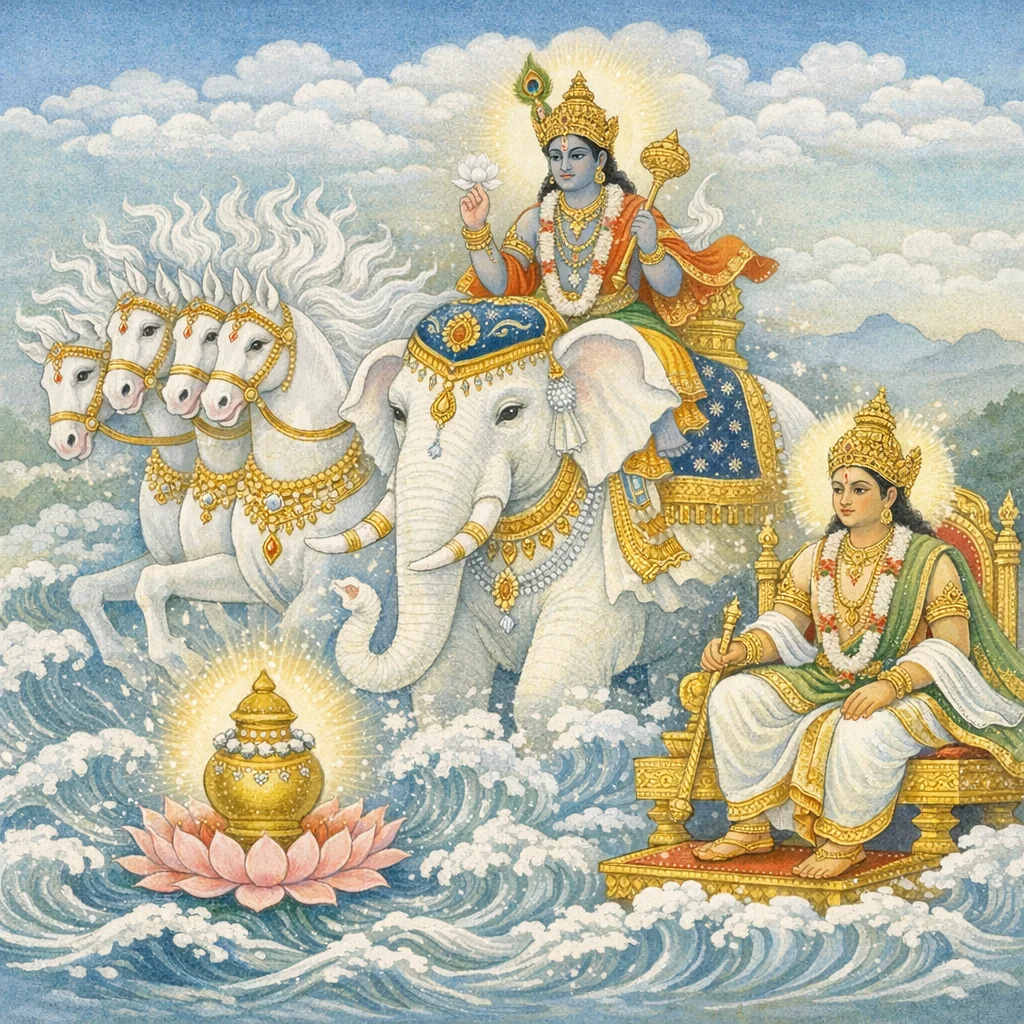
उच्चैःश्रवसमश्वानां विद्धि माममृतोद्भवम् । ऐरावतं गजेन्द्राणां नराणां च नराधिपम् ॥ १०.२७ ॥
uccaiḥśravasam aśvānāṃ viddhi mām amṛtodbhavam | airāvataṃ gajendrāṇāṃ narāṇāṃ ca narādhipam || 10.27 ||

在诸马之中,你当知我为优钵罗婆娑(Ucchaihśravas),由甘露而生;在象王之中,我是爱罗婆多(Airāvata);在人类之中,我是君王。
Among horses know Me as Ucchaihshravas, born of nectar; among lordly elephants I am Airavata; and among men I am the king.
Among horses know Me as Uccaiḥśravas, arisen from amṛta; among the best of elephants I am Airāvata; and among humans I am the ruler (narādhipa).
The first two refer to mythic beings associated with the churning of the ocean (amṛta). ‘narādhipa’ is generic (‘lord of men/king’), so translations vary between ‘king,’ ‘sovereign,’ or ‘ruler’.
FAQs
The imagery of ‘the finest’ suggests an evaluative lens: recognizing exemplary qualities can orient aspiration and ethical self-governance.
The divine is signaled through peak expressions of vitality and authority; sovereignty here can be read as the principle of order rather than mere power.
The verse employs well-known epic-mythic motifs (amṛta origin) to communicate the idea of divine presence in superlative forms.
Invites reflection on legitimate leadership as service to order and welfare, not coercion—an idealized ‘best case’ of rulership.