
Bhagavad Gita — Vibhuti Yoga, Shloka 23
Vibhuti Yoga
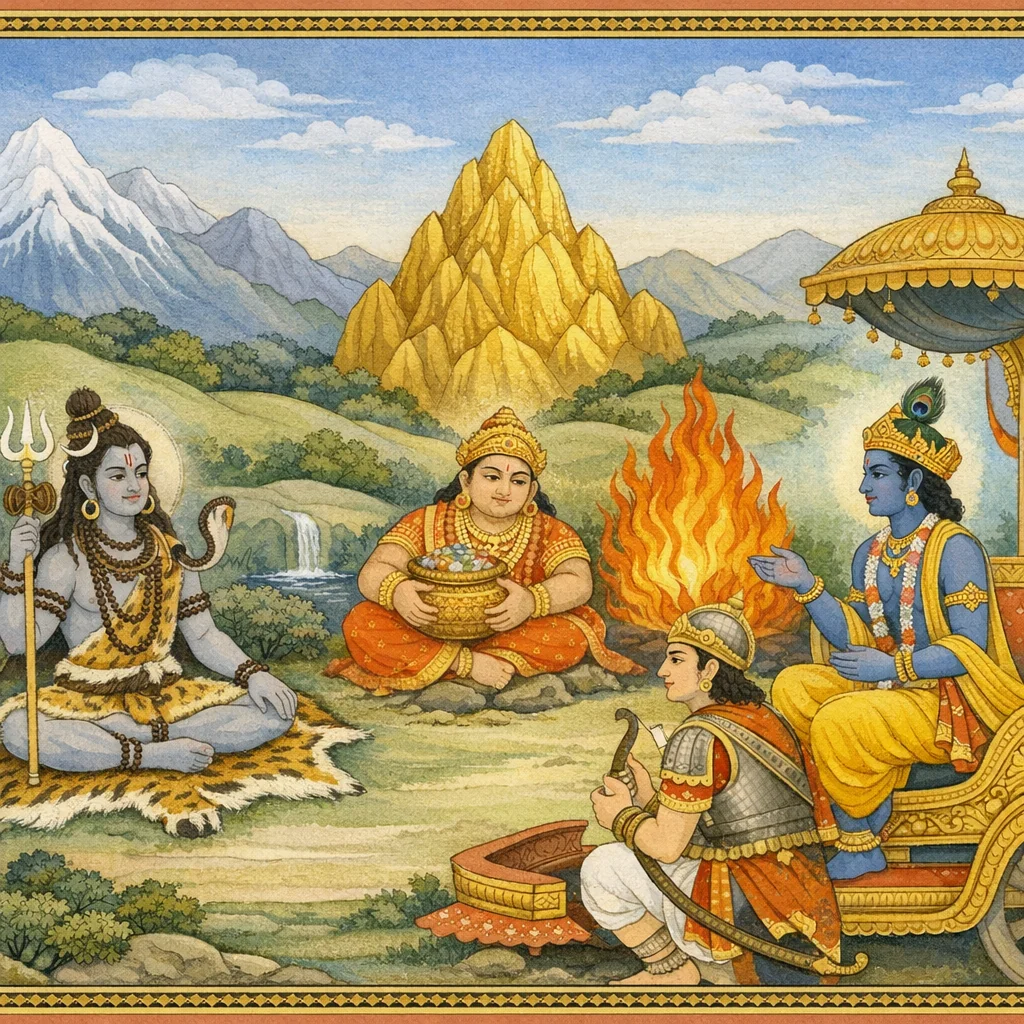
रुद्राणां शंकरश्चास्मि वित्तेशो यक्षरक्षसाम् । वसूनां पावकश्चास्मि मेरुः शिखरिणामहम् ॥ १०.२३ ॥
rudrāṇāṃ śaṅkaraś cāsmi vitteśo yakṣa-rakṣasām | vasūnāṃ pāvakaś cāsmi meruḥ śikhariṇām aham || 10.23 ||

在诸鲁陀罗中,我是商羯罗;在夜叉与罗刹之中,我是财宝之主(俱毗罗);在诸婆苏中,我是火;在群山之中,我是须弥山(梅鲁)。
Among the Rudras I am Shankara; among the Yakshas and Rakshasas I am the lord of wealth (Kubera); among the Vasus I am fire; among mountains I am Meru.
Among the Rudras I am Śaṅkara; among Yakṣas and Rākṣasas I am the Lord of wealth; among the Vasus I am Pāvaka (fire); among peaks I am Meru.
‘vitteśa’ is commonly identified with Kubera. ‘yakṣa-rakṣasa’ here functions as a mythic category rather than a moral judgment; the verse uses well-known cosmological groupings to convey ‘the eminent within each class.’
FAQs
The verse associates the sacred with archetypal images (ascetic power, wealth stewardship, transformative fire, lofty mountain), which can organize values and aspirations.
The divine is presented as the highest expression across heterogeneous domains, suggesting a unifying ground behind varied forms.
It continues the structured catalogue, drawing from Purāṇic/Vedic mythic taxonomies familiar in classical Indian thought.
Can be read as an invitation to recognize excellence and responsibility (e.g., wealth stewardship) as spiritually meaningful.