
Bhagavad Gita — Moksha Sannyasa Yoga, Shloka 65
Moksha Sannyasa Yoga
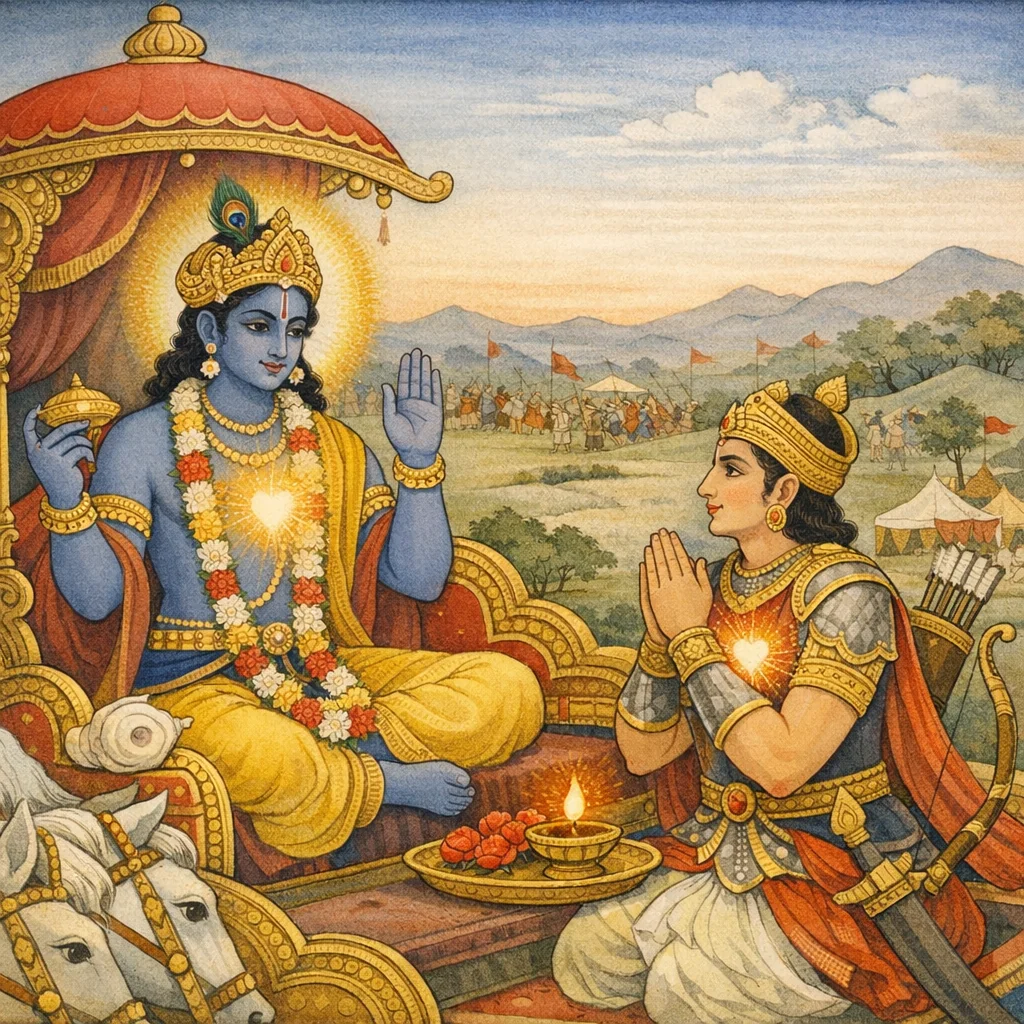
मन्मना भव मद्भक्तो मद्याजी मां नमस्कुरु । मामेवैष्यसि सत्यं ते प्रतिजाने प्रियोऽसि मे ॥ १८.६५ ॥
manmanā bhava madbhakto madyājī māṁ namaskuru | mām evaiṣyasi satyaṁ te pratijāne priyo 'si me || 18.65 ||

令心住于我,作我之奉爱者,祭祀于我,向我顶礼。汝必定到达于我;我以真实向汝誓言,因为汝为我所爱。
मुझमें मन लगा, मेरा भक्त बन, मेरा पूजन कर और मुझे नमस्कार कर; तू निश्चय ही मुझे प्राप्त होगा—मैं यह सत्य प्रतिज्ञा करता हूँ, क्योंकि तू मुझे प्रिय है।
Become one whose mind is on me, be my devotee, be one who worships me, bow to me; you will come to me alone—this I truly promise you, for you are dear to me.
The cluster of imperatives (mindfulness, devotion, worship, reverence) is interpreted either as specifically theistic practice or, more broadly, as total orientation of life toward the highest reality. ‘मामेवैष्यसि’ is central to later Vaiṣṇava readings as an explicit salvific promise.
FAQs
The verse prescribes attentional training (manmanā) and embodied ritual/reverence, which can consolidate motivation, reduce fragmentation, and stabilize ethical intention through repeated orientation.
It expresses a devotional soteriology: sustained devotion and worship culminate in ‘coming to’ the divine—interpreted as proximity, union, or realization depending on school.
Krishna distills the teaching into a practical program that integrates cognition (mind), affect (devotion), and action (worship, reverence).
As a general practice, it suggests daily disciplines that align attention, values, and conduct—such as contemplation, gratitude, and ritualized reminders of one’s guiding principles.
Ask anything about this verse
Curious about the meaning, context, or a word? Ask, and continue the conversation in the Vedapath app.
A free Google sign-in keeps your chat saved across web and the app.
Read Bhagavad Gita in the Vedapath app
Scan the QR code to open this directly in the app, with audio, word-by-word meanings, and more.