
Bhagavad Gita — Moksha Sannyasa Yoga, Shloka 60
Moksha Sannyasa Yoga
स्वभावजेन कौन्तेय निबद्धः स्वेन कर्मणा । कर्तुं नेच्छसि यन्मोहात्करिष्यस्यवशोऽपि तत् ॥ १८.६० ॥
svabhāvajena kaunteya nibaddhaḥ svena karmaṇā | kartuṁ necchasi yan mohāt kariṣyasy avaśo 'pi tat || 18.60 ||

拘提之子啊!你被自身本性所生之业所系缚;你因迷妄而不愿做的事,即使不由自主,也终将去做。
हे कौन्तेय! अपने स्वभाव से उत्पन्न कर्म के द्वारा बँधा हुआ तुम मोहवश जो करना नहीं चाहते, वही तुम विवश होकर भी करोगे।
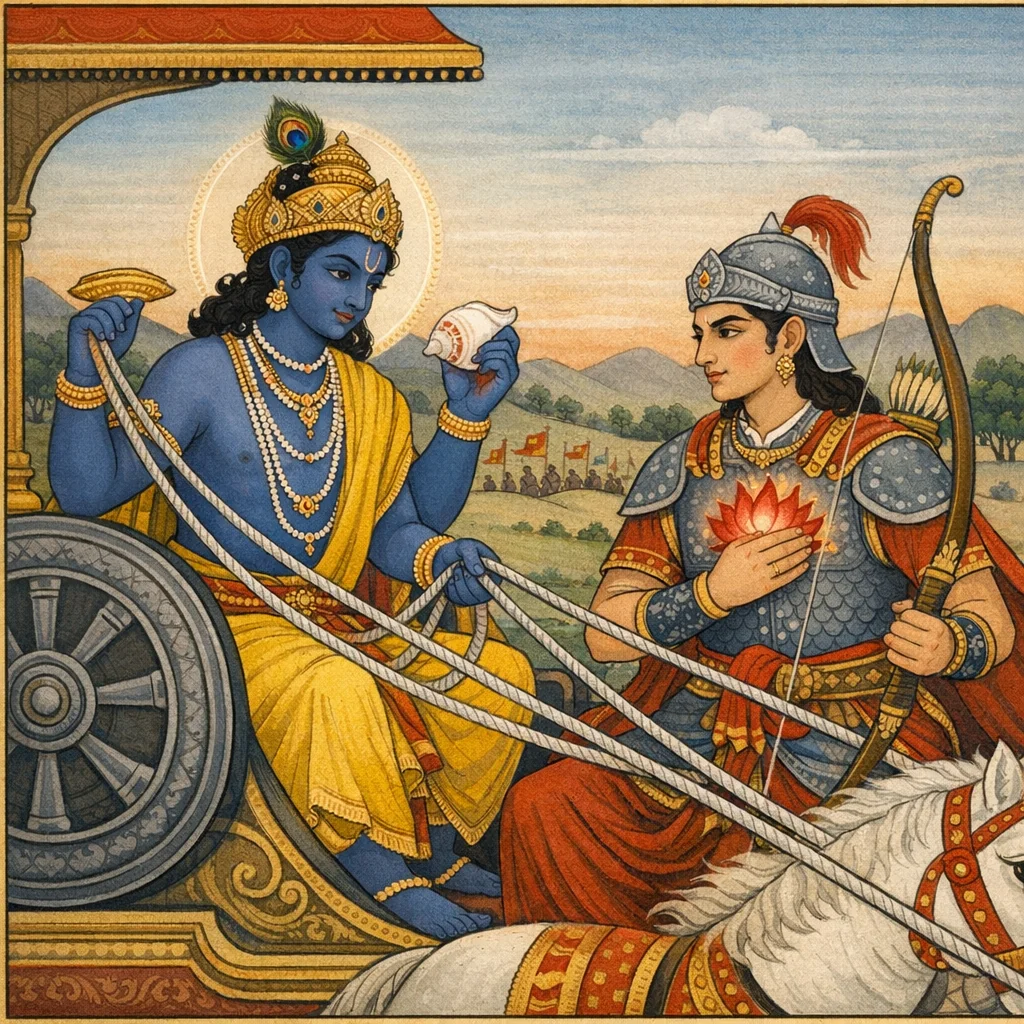
Bound by your own action arising from your nature, O son of Kuntī, what you do not wish to do out of delusion, that you will do even against your will.
‘स्वभावज’ is commonly glossed as ‘born of one’s nature/temperament,’ while ‘स्वेन कर्मणा’ can be taken as (a) one’s prescribed role-based action, or (b) accumulated karmic momentum expressed as tendency. The verse emphasizes compulsion through delusion (moha), not an absolute denial of moral responsibility.
FAQs
It describes akrasia-like behavior: under confusion, people act against their better intentions due to entrenched habits and identity-based pressures.
The verse supports the Gita’s layered agency model: the empirical self is driven by prakṛti and karmic dispositions; liberation involves disidentifying from these drivers through knowledge and disciplined practice.
Krishna presses Arjuna to recognize that avoidance is not a stable solution; inner and social dispositions will push him back toward action within the narrative’s dharma frame.
It can motivate reflective practice: identify the forces (habits, roles, conditioning) that steer behavior, and reduce ‘moha’ through clarity, values-based planning, and training.