
Shloka 31
Karma Yoga — Karma Yoga
ये मे मतमिदं नित्यमनुतिष्ठन्ति मानवाः । श्रद्धावन्तोऽनसूयन्तो मुच्यन्ते तेऽपि कर्मभिः ॥ ३.३१ ॥
ye me matam idaṁ nityam anu-tiṣṭhanti mānavāḥ | śraddhāvanto 'nasūyanto mucyante te 'pi karmabhiḥ || 3.31 ||

凡恒常奉行我此教诲之人,具信而不挑剔者,亦得从业之系缚中解脱。
Those people who constantly follow this teaching of Mine, with faith and without fault-finding, are also freed from the bondage of actions.
Those human beings who continually practice this view of Mine, endowed with trust and without disparagement, they too are released from actions.
Anasūyantaḥ is often rendered as ‘non-censorious’ or ‘not resentful/derisive.’ The verse links disciplined practice plus receptive attitude (śraddhā) with liberation from karmic binding, not from activity itself.
FAQs
A trusting, non-cynical stance supports sustained practice; chronic fault-finding can block learning and deepen inner conflict.
Liberation is presented as compatible with action when action is performed in the taught spirit—without egoic appropriation and with disciplined understanding.
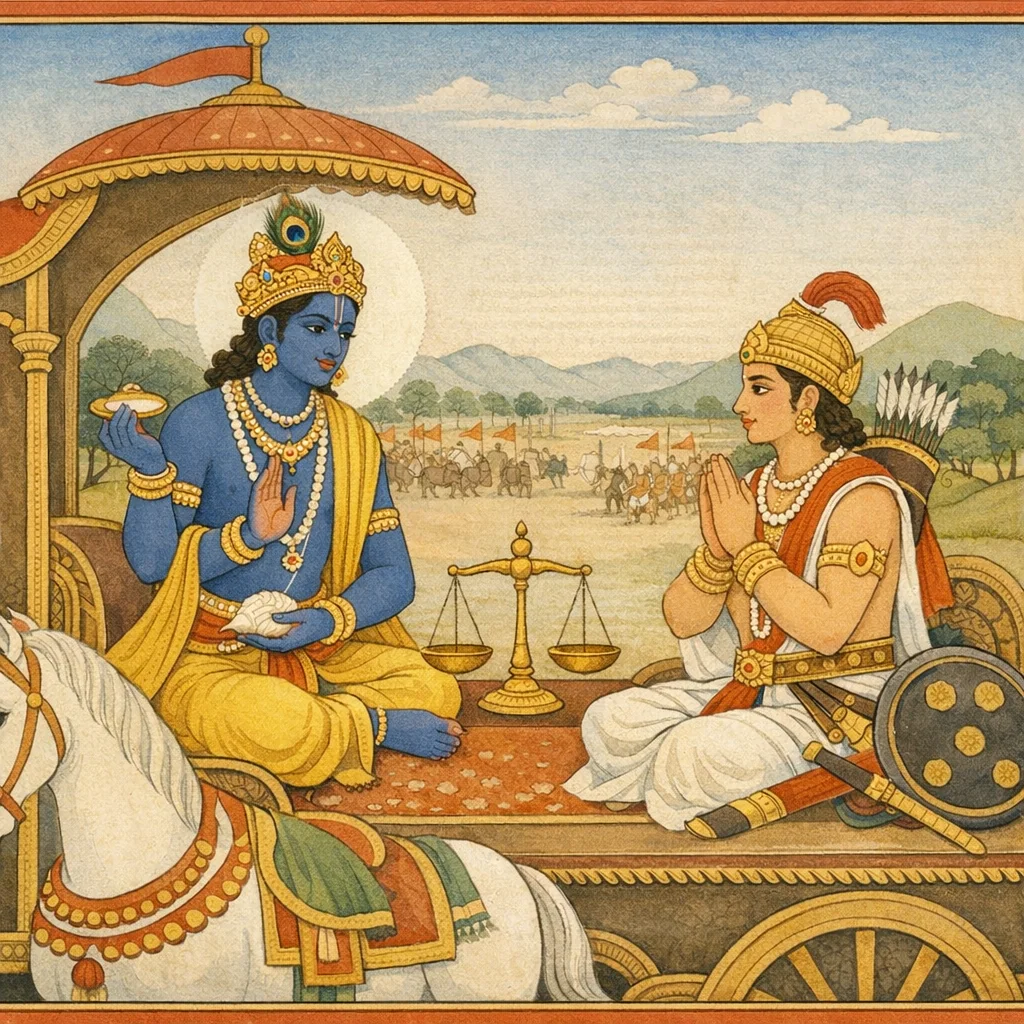
After outlining karma-yoga, Krishna states the benefit for practitioners who adopt the teaching with trust and without hostility.
Commit to a coherent ethical discipline and evaluate it fairly over time rather than dismissing it through reflexive skepticism.