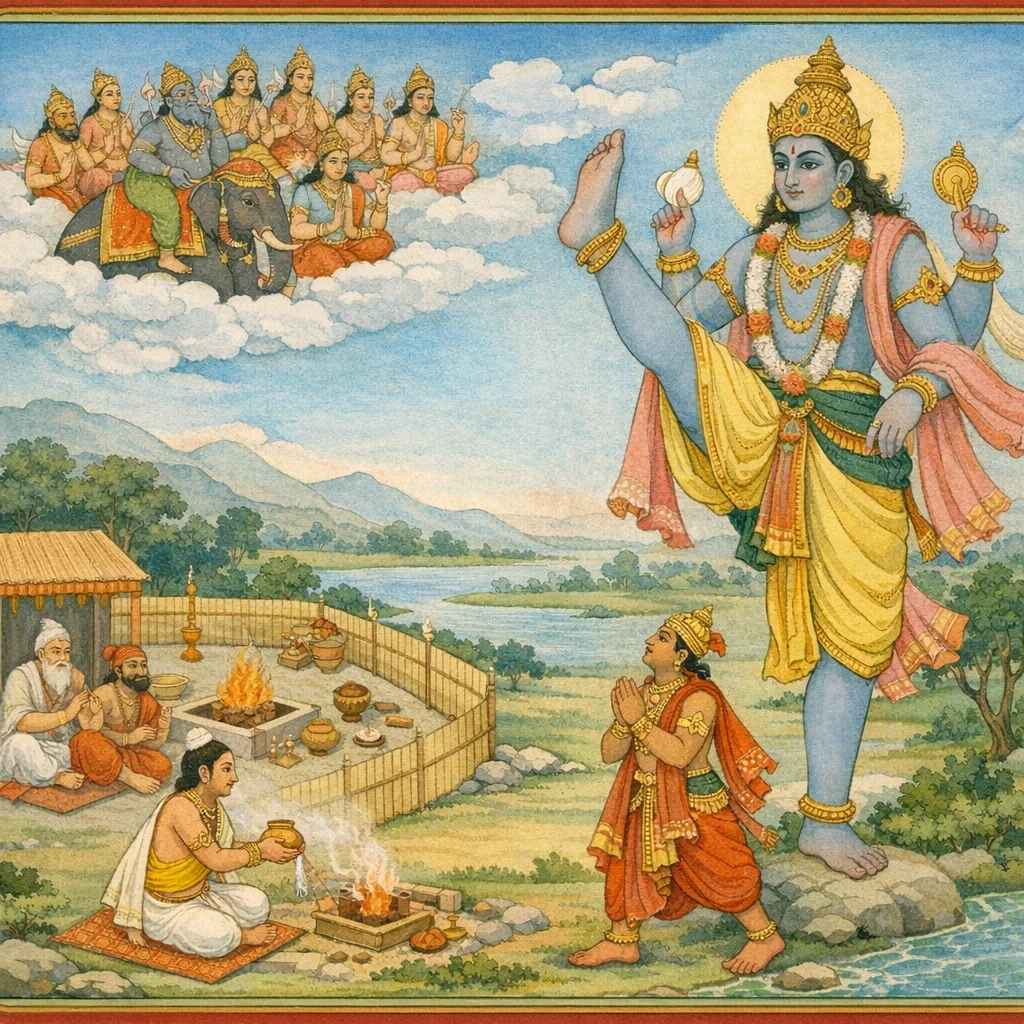
Adhyaya 65: Vamana’s Three Steps and the Binding of Bali
वामन-त्रिविक्रम-चरितम् (Vāmana–Trivikrama-Caritam)
Binding of Bali
Within the Pulastya–Nārada narrative frame, this Adhyāya recounts Viṣṇu’s descent as Vāmana into Bali’s yajña-enclosure and the juridical-ritual logic of dāna that culminates in the Trivikrama epiphany. Bali, embodying asura-dharma through unwavering generosity, offers “three steps,” after which Vāmana expands into a cosmic form whose iconographic mapping absorbs the worlds, deities, Vedas, and cosmic regions into his body. The first two strides encompass earth and the higher realms; the third remains “unfilled,” generating the ethical tension that leads to Bali’s submission and relocation to Sutala, framed not merely as punishment but as a divinely sanctioned dispensation with future sovereignty promised. Although this chapter is primarily Vaiṣṇava in narrative thrust, its syncretic theology appears in the Purāṇic habit of integrating Vedic śruti, yajña-orthopraxy, and cosmic order into Viṣṇu’s body-politic, thereby aligning sectarian devotion with a shared sacrificial cosmology rather than rivalry. Topographically, Kurukṣetra is explicitly invoked as the exemplary puṇya-deśa for dāna, anchoring the myth in North Indian tīrtha-imagery.
Divine Beings
Sacred Geography
Mortal & Asura Figures
Key Content Points
- Vāmana arrives at Bali’s yajña-vāṭa; Bali ritually receives him and offers a boon, foregrounding dāna as a binding sacrificial contract (yajña-orthopraxy and asura-dharma).
- Vāmana requests only ‘three steps’; upon the water-gift (udaka-dāna), he manifests as Trivikrama and performs a cosmic expansion with detailed iconographic descriptions of the universe located in his limbs and organs.
- The third step remains to be ‘completed’; Bali is compelled toward submission and is assigned Sutala, with prophetic assurances (future Indra-hood in a later Manvantara) and the institution of later observances/festivals connected to Bali.
Shlokas in Adhyaya 65
Verse 6
ततो ऽब्रवीत् सुरश्रेष्ठो दैत्यराजानमव्ययः विहस्य सुचिरं कालं भरद्वाजमवेक्ष्य च
Adhyaya 67 — (Pulastya reports Prahlāda’s response; Prahlāda praises Bali’s resolve and promises beneficial teaching)
Verse 7
गुरोर्मदीयस्य गुरुस्तस्यास्त्यग्निपरिग्रहः न स धारयते भूम्यां पारक्यां जातवेदसम्
“My preceptor’s preceptor has undertaken the maintenance of the sacred fires. He does not sustain Jātavedas (the sacrificial fire) upon land that belongs to another.”
Verse 8
तदर्थमभियाच्ऽहं मम दानवपार्थिव मच्छरीरप्रमाणेन देहि राजन् पदत्रयम्
“For that purpose I petition you, O king of the Dānavas: grant me, O ruler, three paces of land, measured by the extent of my own body.”
Verse 9
सुरारेर्वचनं श्रुत्वा बलिर्भार्यामवेक्ष्य च बाणं च तनयं वीक्ष्य इदं वचनमब्रवीत्
“Having heard the words of the enemy of the gods, Bali—glancing at his wife, and looking also at his son Bāṇa—spoke these words.”
Verse 10
न केवलं प्रमाणेन वामनो ऽयं लघुः प्रिये येन क्रमत्रयं मौर्ख्याद् याचते बुद्धितो ऽपि च
Beloved, this Vāmana is not ‘small’ merely in bodily measure; for he asks for three strides—whether from folly or even by deliberate intelligence.
Verse 11
प्रयो विधाताल्पधियां नराणां बहिष्कृतानां च महानुभाग्यैः धनादिकं भूरि न वै ददाति यथेह विष्णोर्न बहुप्रयासः
Generally, the Ordainer (Fate) does not grant abundant wealth and the like to men of little understanding, nor to those cast out (from good fortune); rather, great prosperity comes to the highly fortunate—just as, in this case, for Viṣṇu there is no great exertion (needed).
Verse 12
न ददाति विधिस्तस्य यस्य भाग्यविपर्ययः मयि दातरि यश्चायमद्य याचेत् पदत्रयम्
Providence does not grant (success) to one whose fortune has turned adverse—especially when I am the giver and this one today asks for three steps.
Verse 13
इत्येवमुक्त्वा वचनं महात्मा भूयो ऽप्युवाचाथ हरिं दनूजः याचस्व विष्णो गजवाजिभूमिं दासीहिरण्यं यदभीप्सितं च
Having spoken thus, the great-souled Dānava again addressed Hari: “Ask, O Viṣṇu, for land, for elephants and horses, for maidservants and gold—whatever you desire.”
Verse 14
भवान् याचयिता विष्णो अहं दाता जगत्पतिः दातुर्याचयितुर्लज्जा कथं न स्यात् पदत्रये
“You are the petitioner, O Viṣṇu; I am the giver, O Lord of the world. How could there not be shame—either for the giver or for the petitioner—when it comes to (a gift of) merely three steps?”
Verse 15
रसातलं वा वृथिवीं भुवं नाकमथापि वा एतभ्यः कतमं दद्यां स्थानं याचस्व वामन
“(Is it) Rasātala, or the Earth, or the mid-region (Bhuvaḥ), or even Heaven (Svarga)? From among these, which place should I give? Ask for a domain, O Vāmana.”
Verse 16
वामन उवाच गजाश्वभूहिरण्यादि तदर्थिभ्यः प्रदीयताम् एतावता त्वहं चार्थी देहि राजन् पदत्रयम्
Vāmana said: “Let elephants, horses, land, gold and the like be given to those who desire them. As for me, I seek only this much—O king, grant me three paces (of land).”
Verse 17
इत्येवमुक्ते वचने वामनेन महासुरः बलिर्भृङ्गारमादाय ददौ विष्णोः क्रमत्रयम्
When Vāmana had spoken thus, the great Asura Bali, taking up a water-vessel (for the gift-rite), granted to Viṣṇu the three strides (the three paces of land).
Verse 18
पाणौ तु पतिते तोये दिव्यं रूपं चकार ह त्रैलोक्यक्रमणार्थाय बहुरूपं जगन्मयम्
But when the water had fallen upon (his) hand, he assumed a divine form—multiform, pervaded by the universe—so as to stride across the three worlds.
Verse 19
पद्भ्यां भूमिस्तथा जङ्घे नभस्त्रैलोक्यवन्दितः सत्यं तपो जानुयुग्मे ऊरुभ्यां मेरुमन्दरौ
“From his feet is the Earth; from his shanks (arise) the two legs; from his thighs is the sky, revered by the three worlds. In the pair of knees abide Truth (satya) and Asceticism (tapas). From his two thighs (are manifested) Meru and Mandara.”
Verse 20
विश्वेदेवा कटीभागे मरुतो वस्तिशीर्षगाः लिङ्गे स्थितो मन्मथश्च वृषणाभ्यां प्रजापतिः
“The Viśvedevas are (situated) in the region of the hips; the Maruts are placed at the head of the bladder. In the generative organ abides Manmatha (Kāma); and from the two testicles (arises/abides) Prajāpati.”
Verse 21
कुक्षिभ्यामर्णवाः सप्त जठरे भुवनानि च वलिषु त्रिषु नद्यश्च यज्ञास्तु जठरे स्थिताः
“From his two flanks (are) the seven oceans; in the belly are the worlds. In the three folds (of the abdomen) are the rivers; and the sacrifices (yajñas) are established in the belly.”
Verse 22
इष्टापूर्तादयः सर्वाः क्रियास्तत्र तु संस्थिताः पृष्ठस्था वसवो देवाः स्कन्धौ रुद्रैरधिषठितौ
All acts beginning with iṣṭa and pūrta (sacrificial and public meritorious works) are established there (in that sacred embodied locus). The Vasus, the gods, abide in the back; and the two shoulders are presided over by the Rudras.
Verse 23
बाहवश्च दिशः सर्वा वसवो ऽष्टौ करे स्मृताः हृदये संस्थितो ब्रह्मा कुलिशो हृदयास्थिषु
The arms are all the directions. The eight Vasus are remembered as being in the hands. Brahmā is stationed in the heart; and the thunderbolt (vajra) is in the bones of the heart.
Verse 28
शिखायां देवदेवस्य ध्रुवो राजा न्यषीदत तारका रोमकूपेभ्यो रोमाणि च महर्षयः
भयभीत वह तपस्विनी स्त्री घर के मध्य से बाहर निकल आई; और वह श्रेष्ठ ब्राह्मण भी वहाँ उस शिशु को देख पड़ा।
Verse āviśya: having entered/possessed; dharmiṣṭha: most righteous, exemplary in dharma; bhāvyaṃ: what is to be effected/what must happen; bhūta: a being (spirit/entity; also ‘elemental being’), here implying an occult agent; sāmpratam: now, at present; chalayitum: to deceive, delude, trick; surūpī: handsome, fair-formed; bhuvi saṃsthitaḥ: established/standing on the earth (in the human realm)
भूमिं विक्रममाणस्य महारूपस्य तस्य वै दक्षिणो ऽभूत् स्तनश्चन्द्रः सूर्यो ऽभूदथ चोत्तरः नक्षश्चाक्रमतो नाभिं सूर्येन्दू सव्यदक्षिणौ
ਹੇ ਧਰਮਿਸ਼ਠ! ਇਸ ਵਿੱਚ ਪ੍ਰਵੇਸ਼ ਕਰ ਕੇ ਕਿਸੇ ਭੂਤ-ਸ਼ਕਤੀ ਨੇ ਹੁਣ ਕੁਝ ਕਰਨਾ ਹੈ; ਸਾਨੂੰ ਛਲਣ ਲਈ ਕੋਈ ਸੁੰਦਰ ਰੂਪ ਵਾਲਾ ਧਰਤੀ ਉੱਤੇ ਟਿਕਿਆ ਹੈ।
Verse 31
द्वितीयेन क्रमेणाथ स्वर्महर्जनतापसाः क्रान्तार्धार्धेन वैराजं मध्येनापूर्यताम्बरम्
Then, with the second stride, he traversed the realms of Svarga, Maharloka, and Tapoloka; and with half of that stride he crossed the Virāja (cosmic expanse), filling the mid-region and the sky.
Verse 32
ततः प्रतापिना ब्रह्मन् बृहद्विष्ण्वङ्घ्रिणाम्बरे ब्रह्माण्डोदरमाहत्य निरालोकं जगाम ह
{"bali_present": false, "generosity_display": null, "daana_type": null, "shukracharya_interaction": null, "devotion_quality": null, "patala_reference": false}
Verse 33
विश्वाङ्घ्रिणा प्रसरता कटाहो भेदितो बलान् कुटिला विष्णुपादे तु समेत्य कुटिला ततः
As the all-pervading foot spread forth, the ‘Kaṭāha’ was split open by force; and the river Kuṭilā, having met at Vishnu’s foot, thereafter became (known as) Kuṭilā.
Verse 34
तस्या विष्णुपदीत्येवं नामाख्यातमभून्मुने तथा सुरनदीत्येवं तामसेवन्त तापसाः भगवानप्यसंपूर्णे तृतीये तु क्रमे विभुः
O sage, thus her name became renowned as “Viṣṇupadī”; likewise she was known as “Surānadī” (the river of the gods). Ascetics resorted to her (banks) for religious practice. And the Lord, the all-pervading One, (then proceeded) to the third stride, though it was not yet fully completed.
Verse 35
समभ्येत्य बलिं प्राह ईषत् प्रस्फुरिताधरः ऋमाद् भवति दैत्येन्द्र बन्धनं घोरदर्शनम् त्वं पूरय पदं तन्मे नो चेद् बन्धं प्रतीच्छ भोः
Approaching Bali, (the Lord) spoke, his lower lip slightly quivering: “O lord of the Daityas, from this (default) there will arise a dreadful, terrifying bondage. Fulfill for me that step; otherwise, accept bondage, O sir.”
Verse 36
तन्मुरारिवचः श्रुत्वा विहस्याथ बलेः सुतः बाणः प्राहामरपतिं वचनं हेतुसंयुतम्
Hearing those words of Murāri (Viṣṇu), Bali’s son Bāṇa then laughed and spoke to the lord of the immortals, uttering a reasoned statement.
Verse 38
बाण उवाच कृत्वा महीमल्पतरां जगत्पते स्वायंभुवादिभुवनानि वै षट् कथं बलिं प्रार्थयसे सुविस्तृतां यां प्राग्भवान् नो विपुलामथाकरोत् // वम्प्_65.37 विभो सही यावतीयं त्वयाद्य सृष्टचा समेता भुवनान्तरालैः दत्ता च तातेन हि तावतीयं किं वाक्छलेनैष निबध्यते ऽद्य
Bāṇa said: “O Lord of the world, having made the earth so small—though there are the six worlds beginning with Svāyambhuva—how do You ask Bali for a gift of such vast extent, which formerly You Yourself made immeasurably great? O all-pervading One, as much as has today been created by You, together with the spaces between the worlds, that very measure has been given by my father (Bali). Why then is he now being bound by a trick of words?”
Verse 39
या नैव शक्य भवता हि पूरितुं कथं वितन्याद् दितिजेश्वरो ऽसौ शक्तस्तु संपूजयितुं मुरारे प्रसीद मा बन्धनमादिशस्व
“That (gift) which even You cannot possibly fill out in full—how could that lord of the Diti-born (Bali) extend it? Yet he is able to honor You, O slayer of Mura. Be gracious; do not command his bondage.”
Verse 40
प्रोक्तं श्रुतौ भवतापीश वाक्यं दानं पात्रे भवते सौख्यदायि देशे सुपुण्ये वरदे यच्च काले तच्चाशेषं दृश्यते चक्रपाणे
“O Lord, You Yourself have declared in the Śruti this teaching: a gift given to a worthy recipient becomes a giver of happiness; and whatever is given in a supremely meritorious place, and at the proper time, yields its boon. All of that is fully present here in You, O bearer of the discus.”
Verse 41
दानं भूमिः सर्वकामप्रदेयं भवान् पात्रं देवदेवो जितात्मा कालो ज्येष्ठामूलयोगे मृगाङ्गः कुरुक्षेत्रं पुण्यदेशं प्रसिद्धम्
“The gift of land is a bestower of all desired aims. You are the worthy recipient—God of gods, self-controlled. Time (itself), joined with the asterisms Jyeṣṭhā and Mūla, and the moon—(all are sanctified here). Kurukṣetra is renowned as a holy region.”
Verse 42
किं वा देवो ऽस्मद्विधैर्बुद्धिहीनैः शिक्षापनीयः साधु वासाधु चैव स्वयं श्रुतीनामपि चादिकर्त्ता व्याप्य स्थितः सदसद् यो जगद् वै
“How could the God be one to be instructed by people like us, devoid of understanding—whether about what is good or not good? He himself is the primal author even of the Vedas; pervading all, he stands as this universe, as both being and non-being.”
Verse 43
कृत्वा प्रमाणं स्वयसेव हीनं पदत्रयं याचितवान् भुवश्च किं त्वं न गृह्णासि जगत्त्रयं भो रूपेण लोकत्रयवन्दितेन
“Having assumed a measure (a small stature) as if by your own power diminished, you begged for three steps of land. Why then do you not take the three worlds, O (Lord), with that form which is revered by the three worlds?”
Verse 44
नात्राश्चर्यं यज्जगद् वै समग्रं क्रमत्रयं नैव पूर्णं तवाद्य क्रमेण त्वं लङ्घयितुं समर्थो लीलामेतां कृतवान् लोकनाथ
“It is no wonder that the entire universe is not fully encompassed by your three strides today. You are capable of overstepping it in a single step; O Lord of the worlds, you have performed this (three-stride act) merely as a divine play.”
Verse 45
प्रमाणहीनां स्वयमेव कृत्वा वसुंधरां माधव पद्मनाभ विष्णो न बध्नासि बलिं न दूरे प्रभुर्यदेवेच्छति तत्करोति
“O Mādhava, O Padmanābha, O Viṣṇu—having yourself rendered the earth ‘without measure’ (immeasurable), you do not bind Bali, nor do you keep him far away. The Lord does exactly whatever he wills.”
Verse 46
पुलस्त्य उवाच इत्येवमुक्ते वचने बाणेन बलिसूनुना प्रोवाच भगवान् वाक्यमादिकर्त्ता जनार्दनः
“Pulastya said: When these words had thus been spoken by Bāṇa, the son of Bali, the Blessed Lord Janārdana—the primordial creator—then spoke in reply.”
Verse 47
त्रिविक्रम उवाच यान्युक्तानि वचांसीत्थं त्वया बालेय साम्प्रतम् तेषां वैच हेतुसंयुक्तं शृणु प्रत्युत्तरं मम
Trivikrama said: “O descendant of Bali, the words you have just spoken—listen now to my reply to them, furnished with their proper reasons.”
Verse 48
पूर्वमुक्तस्तव पिता मया राजन् पदत्रयम् देहि मह्यं प्रमाणेन तदेतत् समनुष्ठितम्
“O King, your father was earlier addressed by me: ‘Give me three steps (of land) according to proper measure.’ That very request has been duly carried out.”
Verse 49
किं न वेत्ति प्रमाणं मे बलिस्तव पितासुर प्रायच्छद् येन निःशङ्कं ममानन्तं क्रमत्रयम्
“Does your father Bali, the Asura, not know my true measure? For it was he who, without hesitation, granted me my boundless three strides.”
Verse 50
सत्यं क्रमेण चैकेन क्रमेयं भूर्भुवादिकम् बलेरपि हितार्थाय कृतमेतत् क्रमत्रयम्
“Truly, with a single stride the realms beginning with Bhūḥ and Bhuvaḥ could be traversed; yet this threefold striding was undertaken for Bali’s own welfare.”
Verse 51
तस्माद् यन्मम बालेय त्वत्पित्राम्बु करे महत् दत्तं तेनायुरेतस्य कल्पं यावद् भविष्यति
“Therefore, O son of Bali, because your father gave that great (gift) into my hand with water, by that act his lifespan shall endure for as long as a kalpa.”
Verse 52
गते मन्वन्तरे बाण श्राद्धदेवस्य साम्प्रतम् सावर्णिके च संप्राप्ते बलिरिन्द्रो भविष्यति
“When the present Manvantara of Śrāddhadeva has passed, O Bāṇa, and the Sāvarṇika (Manvantara) has arrived, Bali shall become Indra.”
Verse 53
इत्थं प्रोक्त्वा बलिसुतं बाणं देवस्त्रिविक्रमः प्रोवाच बलिमभ्येत्य वचनं मधुराक्षरम्
Having thus addressed Bāṇa, the son of Bali, the divine Trivikrama then approached Bali and spoke words that were sweet in syllables (gentle and gracious in tone).
Verse 54
श्रीभगवानुवाच आपूरणाद् दक्षिणाया गच्छ राजन् महाफलम् सुतलं नाम पातालं वस तत्र निरामयः
The Blessed Lord said: ‘From Āpūraṇa, proceed southward, O king, (to a realm) of great reward. Dwell in the netherworld called Sutala; there you shall abide free from disease and affliction.’
Verse 55
बलिरुवाच सुतले वसतो नाथ मम भोगाः कुतो ऽव्ययाः भविष्यन्ति तु येनाहं निवत्स्यामि निरामयः
Bali said: ‘O Lord, while dwelling in Sutala, from where will my enjoyments and resources become inexhaustible—by which I may reside (there) free from affliction?’
Verse 56
त्रिविक्रम उवाच सुतलस्थस्य दैत्येन्द्र यानि भोगानि ते ऽधुना भिवष्यन्ति महार्हाणि तानि वक्ष्यामि सर्वशः
Trivikrama said: “O lord of the Daityas, I shall now declare in full the precious enjoyments that will be yours while dwelling in Sutala.”
Verse 57
दानान्यविधित्तानि श्राद्धान्यश्रोत्रियाणि च तथाधीतान्यव्रतिभिर्दास्यन्ति भवतः फलम्
“Even gifts made without proper rule, and śrāddha rites performed for those who are not śrotriyas, and likewise recitations/rites undertaken by persons without vows—these will nonetheless yield their fruit for you.”
Verse 58
तथान्यमुत्सवं पुण्यं वृत्ते शक्रमहोत्सवे द्वारप्रतिपदा नाम तव भावी महोत्सवः
“And another holy festival will arise: when the great festival of Śakra is being observed, there will be a great celebration for you called ‘Dvārāpratipadā.’”
Verse 59
तत्र त्वां नरशार्दूला हृष्टाः पुष्टाः स्वलङ्कृताः पुष्पदीपप्रदानेन अर्जयिष्यन्ति यत्नतः
There, O tiger among men, delighted, thriving, and well-adorned people will diligently honor you by the offering of flowers and lamps.
Verse 61
तत्रोत्सवो सुख्यतमो भविष्यति दिवानिशं हृष्टजनाभिरामम् यथैव राज्ये भवतस्तु साम्प्रतं तथैव सा भाव्यथ कौमुदी च // वम्प्_65.60 इत्येवमुक्त्वा मधुहा दितीश्वरं विसर्जयित्वा सुतलं सभार्यम् यज्ञं समादाय जगाम तूर्णं स शक्रसद्भामरसंघजुष्टम्
विष्णुतत्परो नरः भक्त्या ब्राह्मणानर्चयेत्। एवं हरीः पुरा प्राह— ब्राह्मणाः ममकैव तनुः॥
Verse 63
स्वर्गं गते धातरि वासुदेवे शाल्वो ऽसुराणां महता बलेन कृत्वा पुरं सौभमिति प्रसिद्धं तदान्तरिक्षे विचचार कामात्
["Secrecy and social surveillance (loka-paripaśyati)", "Nocturnal timing motif in narrative episodes", "Moral tension/temptation setting (implicit)"]
Frequently Asked Questions
This chapter is overtly Vaiṣṇava (Vāmana–Trivikrama), yet it advances syncretic theology by grounding devotion in shared Vedic-sacrificial cosmology: śruti, yajña, and the deva-gaṇas are portrayed as integrated within Viṣṇu’s cosmic body. The effect is not polemical supremacy but a unifying metaphysics in which sectarian forms participate in one cosmic order (ṛta/dharma) expressed through ritual and iconography.
Kurukṣetra is explicitly cited as the renowned puṇya-deśa where dāna becomes maximally efficacious (a model setting defined by deśa–kāla–pātra). While the narrative is not a full tīrtha-catalogue here, it uses Kurukṣetra as topographical sanctification—an authoritative pilgrimage landscape that legitimizes the ritual act (udaka-dāna) and frames the myth in the Sarasvatī-basin sacred imagination.
The Adhyāya reaches the decisive phase: Bali grants the three steps, Vāmana becomes Trivikrama, the first two strides encompass the worlds, and the unresolved third step forces Bali’s surrender. Bali is then assigned Sutala with boons and a future prophecy (Indra-hood in a later Manvantara), presenting the episode as moral theology of dāna—binding, transformative, and ultimately salvific even for an asura-king.