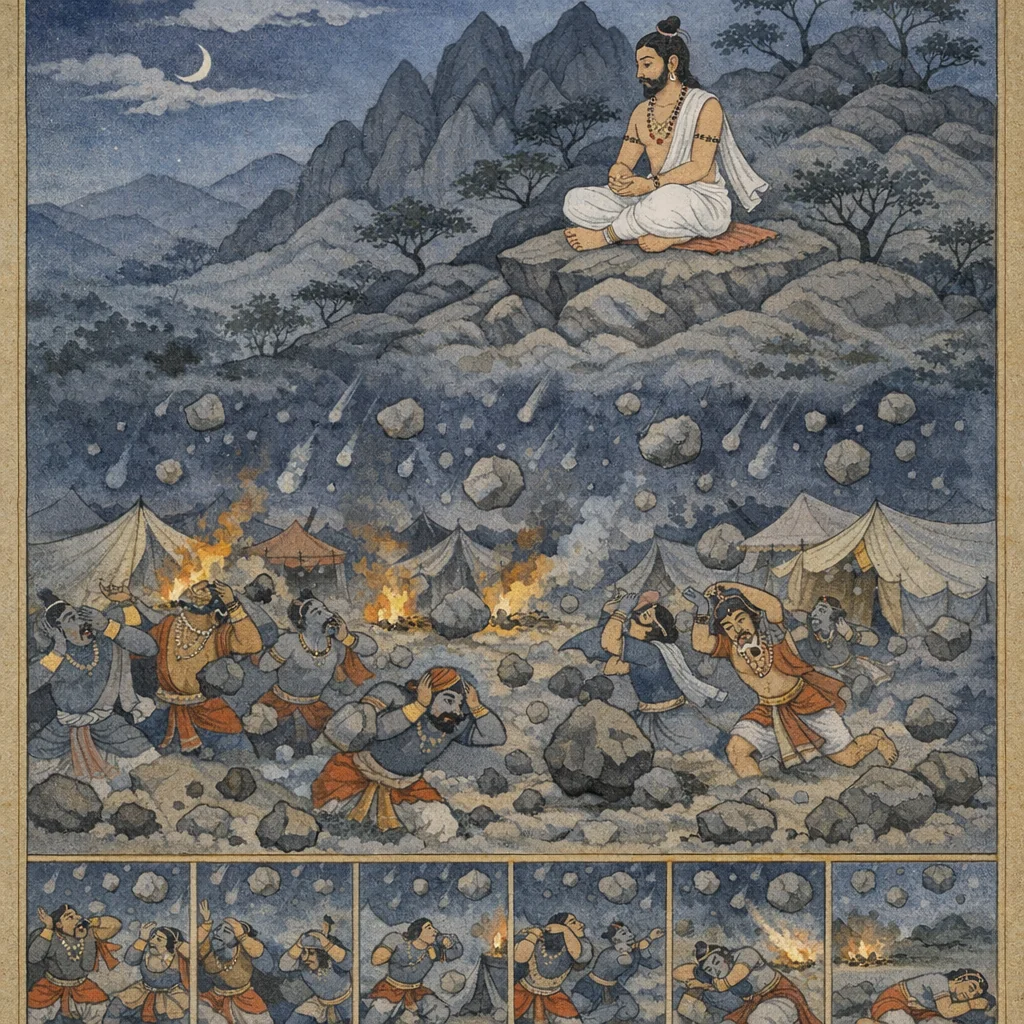
Adhyaya 40: Shukra’s Curse on King Danda and Prahlada’s Counsel to Andhaka on Dharma
शुक्रशापः—दण्डविनाशः तथा परदारवर्जनधर्मोपदेशः (Śukraśāpaḥ—Daṇḍavināśaḥ tathā Paradāravarjanadharmopadeśaḥ)
Shukra's Curse Continued
Pulastya, in dialogue with Nārada, narrates a two-part ethical and theologically syncretic episode that foregrounds asura-dharma and the inviolability of divine order. First, Araja (Śukra’s daughter) is violated by King Daṇḍa, prompting Śukra’s return from Pātāla and his juridical curse: within seven nights Daṇḍa, his realm, army, retinue, and vehicles are reduced to ashes by a rain of stones—an exemplary Purāṇic articulation of tapas-backed brahmanical authority. The narrative then pivots to Andhaka’s hubris against Tryambaka (Śiva), where Prahlāda counsels restraint through a didactic discourse attributed to Devarṣi Asita on dharma, especially the categorical prohibition of parādāra (coveting another’s wife). The chapter thus integrates Shaiva supremacy (Śaṅkara’s invincibility) with moral governance, presenting transgression as the cause of political and cosmic collapse rather than mere sectarian rivalry.
Divine Beings
Sacred Geography
Mortal & Asura Figures
Key Content Points
- Śukra discovers Araja’s dishonor and pronounces a tapas-powered curse that annihilates King Daṇḍa and his entire polity within seven nights via grāvavṛṣṭi (stone-rain), illustrating punitive cosmic jurisprudence.
- Prahlāda admonishes Andhaka using Asita’s dharma-teaching: parādāra-sevana leads to severe naraka consequences (including Raurava), while self-restraint and śāstra-alignment secure fearlessness and prosperity.
- Andhaka rejects dharma-counsel, sends Śambara to challenge Śaṅkara at Mandara, and mobilizes a vast asura host—setting the stage for a Shaiva-centered confrontation framed within the Pulastya–Nārada narration.
Shlokas in Adhyaya 40
Verse 1
इति श्रीवामनपुराणे एकोनचत्वारिंशो ऽध्यायः अरजा उवाच नात्मानं तव दास्यामि बुहनोक्तेन किं तव रक्षन्ती भवतः शापादात्मानं च मही पते
Verse 16
श्पत्वेत्थं भगवान् शुक्रो दण्डमिक्ष्वाकुनन्दनम् जगाम शिष्यसहितः पातालं दानवालयम्
Như vậy, sau khi nguyền rủa Daṇḍa—niềm hân hoan của dòng Ikṣvāku—bậc tôn kính Śukra đã cùng các đệ tử lên đường đến Pātāla, nơi cư trú của các Dānava.
Verse 17
दण्डो ऽपि भस्मसाद् भूतः सराष्ट्रबलवाहनः महता ग्राववरषेण सप्तरात्रान्तरे तदा
Then Daṇḍa too was reduced to ashes—along with his kingdom, his troops, and his mounts/vehicles—by a great shower of stones, within the span of seven nights.
Verse 23
किं ममासौ रणे योद्धुं शक्तस्त्रिमयनो ऽसुर एकाकी धर्मरहितो भस्मारुणितविग्रहः
“Làm sao đấng Ba Mắt ấy có thể đủ sức giao chiến với ta nơi trận địa, hỡi A-tu-la?—một mình, lìa bỏ dharma, thân thể đỏ/nhuốm vì tro bụi.”
Verse 24
नान्धको बिभियादिन्द्रान्नामरेभ्यः कथञ्चन स कथं वृषपत्राक्षाद् बिभेति स्त्रीमुखेक्षकात्
“Andhaka does not fear Indra, nor the gods, in any way. How then could he fear Vṛṣapatrākṣa—one who merely looks upon women’s faces?”
Verse 41
पुलस्त्य उवाच इत्येवमुक्ते वचने प्रह्लादं प्राह चान्धकः भवान् धर्मपरस्त्वेको नाहं धर्म समाचरे
Pulastya nói: Khi những lời ấy đã được nói như vậy, Andhaka nói với Prahlāda: “Chỉ riêng ngươi là người chuyên tâm với dharma; còn ta thì không thực hành dharma.”
Verse 43
भिक्षो किमर्थं शौलेन्द्रं स्वर्गोपम्यं सकन्दरम् परिभुञ्जसि केनाद्य तव दत्तो वदस्व माम
“Hỡi vị khất sĩ, vì cớ gì ngươi chiếm giữ/hưởng thụ ngọn núi uy nghi này—tựa cõi trời và đầy hang động? Hôm nay ai đã ban nó cho ngươi? Hãy nói cho ta.”
Verse ["Bhakti expressed through service", "Righteous warfare against adharma", "Śaiva martial theology"]
5
បន្ទាប់ពីក្រាបបង្គំដោយសទ្ធា គាត់បាននិយាយទៅកាន់មហេស្វរៈថា៖ «ហេតុអ្វីបានជាព្រះអង្គឈរនิ่ง ឱ ព្រះអម្ចាស់នៃលោក? សូមក្រោកឡើង—ដោយចិត្តប្រាថ្នាសង្គ្រាម!»
Verse ["apramāda", "giriputrī", "surakṣita geha", "rakṣaṇīyā", "Pārvatī protection", "Andhaka-vadha"]
यच्चाब्रवीद् दीयतां मे गिरिपुत्रीति दानवः तदेषा यातु स्वं कामं नाहं वारयितुं क्षमः
«သင်တို့အားလုံးသည် မပျက်မကွက် သတိရှိ၍ ကာကွယ်ထားသော အိမ်၌ သူမကို နေစေကြလော့။ တောင်သမီးကို အားထုတ်ကာ ကာကွယ်ရမည်၊ ပေါ့လျော့မှု မဖြစ်စေရ» ဟု မိန့်တော်မူ၏။
Verse 51
अहं पताका संग्रामे भवानीशश्च देविनौ प्रामद्यूतं परिस्तीर्य यो जेष्यति स लप्स्यते
“Trong trận chiến này, ta sẽ là lá cờ phần thưởng; và hai nữ thần—Bhavānī và Īśā—sẽ là vật đặt cược. Khi đã bày ra cuộc ‘prāmadyūta’ (trò cá cược cuồng nhiệt), kẻ nào chiến thắng sẽ được nhận.”
Verse 52
इत्येवमुक्तो मतिमान् शम्बरो ऽन्दकमागमत् समागम्याब्रवीद् वाक्यं शर्वगौर्योश्च भाषितम्
Được nói như vậy, Śambara, người trí tuệ, liền đến gặp Andhaka. Khi hội kiến, ông thuật lại lời nhắn, lặp lại những lời đã được nói liên quan đến Śarva (Śiva) và Gaurī.
Verse 53
तच्छ्रत्वा दानवपतिः क्रोधदीप्तेक्षणः श्वसन् समाहूयाब्रवीद् वाक्यं दुर्योधनमिदं वचः
Nghe vậy, chúa tể các Dānava, mắt bừng lửa giận và thở gấp, liền triệu gọi (thuộc hạ) và thốt ra lời lẽ nghiệt ngã này.
Verse 54
गच्छ शीघ्रं महाबाहो भेरीं सान्नाहिकीं दृढाम् ताडयस्व सुविश्रब्धं दुःशीलामिव योषितम्
“Hãy đi mau, hỡi bậc đại dũng có cánh tay hùng mạnh. Hãy đánh chiếc trống chiến kiên cố, gọi là sānnāhikī, với lòng tự tín—(đánh nó) như người ta đánh một phụ nữ có hạnh kiểm xấu.”
Verse 55
समादिष्टो ऽन्धकेनाथ भेरीं दुर्योधनो बलात् ताडयामास वेगेन यथाप्राणेन भूयसा
“Được Andhaka truyền lệnh, Duryodhana liền dùng sức mạnh thuần túy mà đánh trống thật nhanh—dốc vào đó hơi thở sinh lực (nỗ lực) nhiều nhất có thể, lại càng hơn nữa.”
Verse 56
सा ताडिता बलवता भेरी दुर्योधनेन हि सत्वरं भैरवं रावं रुराव सुरभी यथा
हर उवाच—नन्दिन्, अद्य मे जय एव भावी; न कथञ्चित् पराजयः। इह निमित्तानि दृश्यन्ते, संभूतानि गणेश्वर।
Verse 58
याथातथ्यं च तान् सर्वानाह सेनापतिर्बली ते चापि बलिनां श्रेष्ठाः सन्नद्धा युद्धकाङ्क्षिणः
“Rồi vị thống soái Bali thuật lại cho tất cả đúng như sự thật; và những bậc ưu tú nhất trong hàng dũng lực, đã trang bị đầy đủ, khát khao chiến trận.”
Verse 59
सहान्धका निर्ययुस्ते गजैरुष्ट्रैर्हयै रथैः अन्धको रथमास्थाय पञ्चनल्वप्रणमाणतः
Cùng với Andhaka, họ xuất phát—cưỡi voi, lạc đà, ngựa và xe chiến. Andhaka lên xe của mình và tiến lên theo mức đo gọi là “pañcanalva” (một đơn vị/độ dài đặc thù).
Verse 60
त्र्यम्बकं स पराजेतुं कृतबुद्धिर्विनिर्ययौ जम्भः कुजम्भो हुण्डश्च तुहुण्डः शम्बरो बलिः
Quyết tâm đánh bại Tryambaka (Śiva), hắn liền xuất phát. (Cùng đi có các daitya:) Jambha, Kujambha, Huṇḍa, Tuhuṇḍa, Śambara và Bali.
Verse 61
बाणाः कार्तस्वरो हस्ती सूर्यशत्रुर्महोदरः अयःशुङ्कुः शिबिः शाल्वो वृषपर्वा विरोचनः
तब आकाशमण्डल में देवगण—इन्द्र, विष्णु और पितामह (ब्रह्मा) सहित, तथा सूर्य और अग्नि को अग्रणी बनाकर—देखने की इच्छा से एकत्र हो गए।
Verse 62
हयग्रीवः कालनेमिः संह्लादः कालनाशनः शरभः शलभश्चैव विप्रचित्तिश्च वीर्यवान्
148
Verse 64
इत्थं दुरात्मा दनुसैन्यपालस्तदान्धको योद्धुमना हरेण महाचलं मन्दरमभ्युपेयिवान् स कालपाशावसितो हि मन्दधीः
Thus, that evil-souled Andhaka, commander of the Dānu host, intent on fighting with Hara, approached the great mountain Mandara—indeed, dull-witted, he was already ensnared by the noose of Time (Death).
Frequently Asked Questions
Within Pulastya’s narration to Nārada, the chapter advances a syncretic theology by treating dharma—not sectarian identity—as the governing principle: Śukra’s brahmanical tapas enforces cosmic justice, while Śaṅkara (Tryambaka) is presented as invincible even to sura–asura forces. Prahlāda’s counsel functions as an asura-dharma corrective, aligning political power with śāstra and restraint, thereby harmonizing divine authority across traditions.
This Adhyāya is not primarily a tīrtha-māhātmya unit; it contains minimal topographical sanctification. The explicit locations are Mandara Mountain (as Śiva’s residence with Bhavānī in this narrative context) and Pātāla (Śukra’s return-point). No Kurukṣetra/Sarasvatī-basin sites, rivers, sarovaras, or ritual prescriptions are specified in the received passage.
The core teaching is parādāra-varjana (renunciation of another’s spouse) as a universal dharma for all varṇas. It is illustrated by two linked consequences: Daṇḍa’s sexual transgression triggers Śukra’s curse and total political annihilation, while Andhaka’s refusal to heed Prahlāda’s dharma-counsel leads him to escalate toward conflict with Tryambaka, framed as self-destructive hubris.