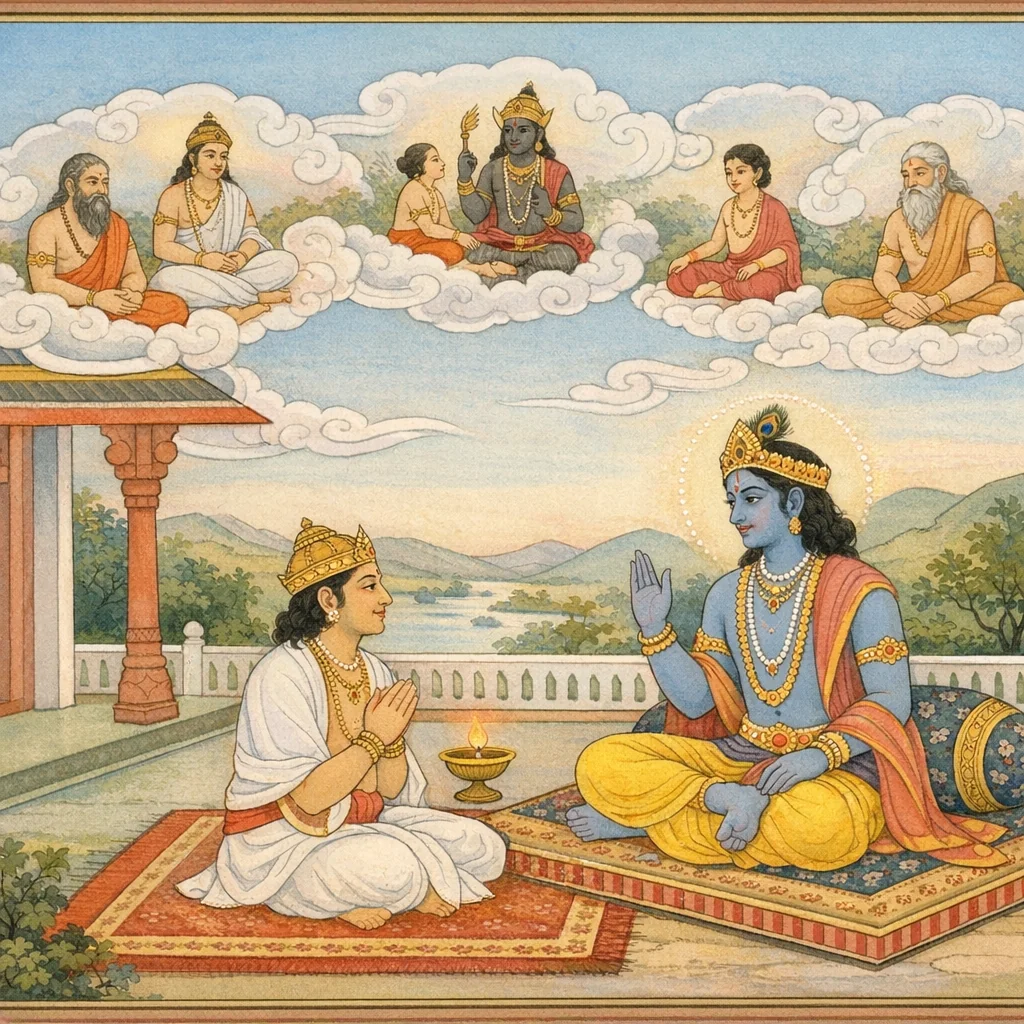
Adhyaya 19
सहधर्म-प्रश्नः तथा अष्टावक्रोपाख्यान-प्रस्तावः (Inquiry on Sahadharma and the Opening of the Aṣṭāvakra Narrative)
Upa-parva: Strī-dharma and Sahadharma Inquiry (Pāṇigrahaṇa Context)
Yudhiṣṭhira interrogates the technical meaning of “sahadharma” as recited at marriage, asking how ‘shared dharma’ is to be understood when (a) spouses may accrue distinct karmic results, (b) death may occur at different times, and (c) some textual strands contain critical characterizations of women’s truthfulness. He frames the issue as a potential contradiction between worldly association and post-mortem destinies (svarga/naraka trajectories). Bhīṣma responds methodologically by citing an ancient illustrative account: Aṣṭāvakra, seeking to establish household life, requests a virtuous woman (Suprabhā) in marriage. The bride’s father (Vadānya) imposes a condition: Aṣṭāvakra must first travel north, pass landmarks associated with Kubera and Himavat, observe Rudra’s sacred abode with attendant beings, and then meet and honor an elderly ascetic woman performing dīkṣā. Only after this encounter should he return to take the bride’s hand. The chapter thus functions as a hinge: it records the doubt, identifies the interpretive stakes, and initiates a precedent narrative intended to define sahadharma through concrete conditions and ritual-ethical procedure.
Chapter Arc: दानधर्मपर्व के भीतर महादेव-सहस्रनाम-स्तोत्र की परंपरा का द्वार खुलता है—यह स्तोत्र किसने, किससे, और किस विधि से पाया; यही प्रश्न कथा को आगे बढ़ाता है। → स्तुति की शक्ति को केवल भावुक प्रशंसा नहीं, बल्कि नियम, शुचिता, ब्रह्मचर्य और जितेन्द्रियता से सिद्ध होने वाला धर्म-उपाय बताया जाता है; साथ ही इसकी ‘अल्प-प्रसिद्धि’ का संकेत इसे दुर्लभ और गुप्त-धन बना देता है। → परंपरा-श्रृंखला का निर्णायक उद्घोष: वैवस्वत मनु से नारायण नामक साध्यदेव, फिर यम (वैवस्वत) से नाचिकेता, नाचिकेता से मार्कण्डेय, और मार्कण्डेय से जनार्दन/कृष्ण तक स्तोत्र का नियमपूर्वक संचार—और अब कृष्ण का उसे आगे देने का संकल्प। → कृष्ण युधिष्ठिर को साधना-नियम सहित फलश्रुति बताते हैं: जो शुचि, ब्रह्मचारी, जितेन्द्रिय और अखण्ड-योगयुक्त होकर इसका पाठ करे, वह अश्वमेध-यज्ञ के तुल्य फल प्राप्त करता है। → स्तोत्र का प्रत्यक्ष प्रयोग—पाठ-विधि, नाम-समूह, और उससे प्राप्त होने वाले विशिष्ट फल—अगले प्रसंग में विस्तार पाने को ठहरते हैं।
Shlokas
Verse 17
इति श्रीमहाभारते अनुशासनपर्वणि दानधर्मपर्वणि महादेवसहस्रनामस्तोत्रे सप्तदशोड्ध्याय:
Như vậy kết thúc chương thứ mười bảy của Mahābhārata, thuộc Anuśāsana Parva, trong phần về dharma của bố thí, nơi bài thánh ca ngàn danh hiệu của Mahādeva (Śiva).
Verse 178
वैवस्वत मनुने समाधिनिष्ठ और ज्ञानी नारायण नामक किसी साध्यदेवताको यह स्तोत्र प्रदान किया। धर्मसे कभी च्युत न होनेवाले उन पूजनीय नारायण नामक साध्यदेवने यमको इसका उपदेश किया
Vāyu nói: Vaivasvata Manu, bền vững trong định và đầy đủ chân tri, đã từng ban bài thánh ca này cho một vị thần Sādhya tên là Nārāyaṇa. Vị Sādhya đáng tôn kính ấy, mang danh Nārāyaṇa—người không bao giờ rời khỏi dharma—rồi lại truyền dạy nó cho Yama.
Verse 179
नाचिकेताय भगवानाह वैवस्वतो यम: । मार्कण्डेयाय वार्ष्णेय नाचिकेतो5भ्यभाषत,वृष्णिनन्दन! ऐश्वर्यशाली वैवस्वत यमने नाचिकेताको और नाचिकेतने मार्कण्डेय मुनिको यह स्तोत्र प्रदान किया
Vāyu nói: Yama đáng tôn kính, con của Vivasvān, đã nói điều này với Naciketā. Và, ô Vārṣṇeya—hậu duệ nhà Vṛṣṇi, niềm vui của dòng Vṛṣṇi—Naciketā lại tụng đọc nó cho hiền giả Mārkaṇḍeya. Thế là bài thánh ca này, trước hết do Yama vinh hiển truyền dạy, đã được Naciketā tiếp nối trao truyền đến Mārkaṇḍeya, cho thấy thánh tri được gìn giữ qua những bậc thầy xứng đáng và những môn đồ có kỷ luật.
Verse 180
मार्कण्डेयान्मया प्राप्तो नियमेन जनार्दन । तवाप्यहममित्रघ्न स्तवं दद्यां हविश्रुतम्
Thần Vāyu nói: “Hỡi Janārdana, nhờ giữ giới luật và kỷ hạnh nghiêm mật, ta đã thọ nhận được từ hiền giả Mārkaṇḍeya. Và cũng xin ban cho ngươi, hỡi kẻ diệt thù, bài tán tụng này—lừng danh, được truyền tụng như lễ vật havis dâng trong tế tự.”
Verse 181
शत्रुसूदन जनार्दन! मार्कण्डेयजीसे मैंने नियमपूर्वक यह स्तोत्र ग्रहण किया था। अभी इस स्तोत्रकी अधिक प्रसिद्धि नहीं हुई है, अतः मैं तुम्हें इसका उपदेश देता हूँ ।।
Thần Vāyu nói: “Hỡi Śatrusūdana, hỡi Janārdana! Ta đã thọ nhận bài tán tụng này từ hiền giả Mārkaṇḍeya với kỷ hạnh nghiêm mật. Nay nó chưa được truyền bá rộng rãi; vì thế ta truyền dạy cho ngươi. Bài tán tụng ngang hàng Veda này ban cho cõi trời, sức khỏe, thọ mạng dài lâu và phú quý. Dānavas, Yakṣas và Rākṣasas không thể gây chướng ngại; Piśācas, Yātudhānas, Guhyakas, cho đến cả loài rắn cũng không thể ngăn trở hiệu lực của nó.”
Verse 182
य: पठेत शुचि: पार्थ ब्रह्मचारी जितेन्द्रिय: । अभग्नयोगो वर्ष तु सो5श्वमेधफलं लभेत्
Thần Vāyu nói: “Hỡi Pārtha, ai giữ hạnh thanh tịnh, hành trì brahmacarya, chế ngự các căn, và trong suốt một năm trọn vẹn vẫn bền bỉ an trú trong yoga mà tụng đọc bài tán tụng này, người ấy sẽ đạt công đức ngang với lễ tế Aśvamedha.”
Frequently Asked Questions
Whether “sahadharma” in marriage denotes a truly shared moral destiny, despite individualized karma-phala, differing times of death, and divergent post-mortem outcomes—raising an interpretive tension between relational duty and personal causality.
Dharma terms operate at defined levels (rite, role, and context). Shared duty can be real as coordinated obligation in life without implying identical karmic results; clarification requires precedent narratives and careful alignment with śruti-smṛti reasoning.
No explicit phalaśruti appears here; instead, the meta-structure is pedagogical: Bhīṣma signals that resolution will come through the ensuing itihāsa (Aṣṭāvakra’s instructed journey and encounter), positioning narrative as the interpretive instrument.