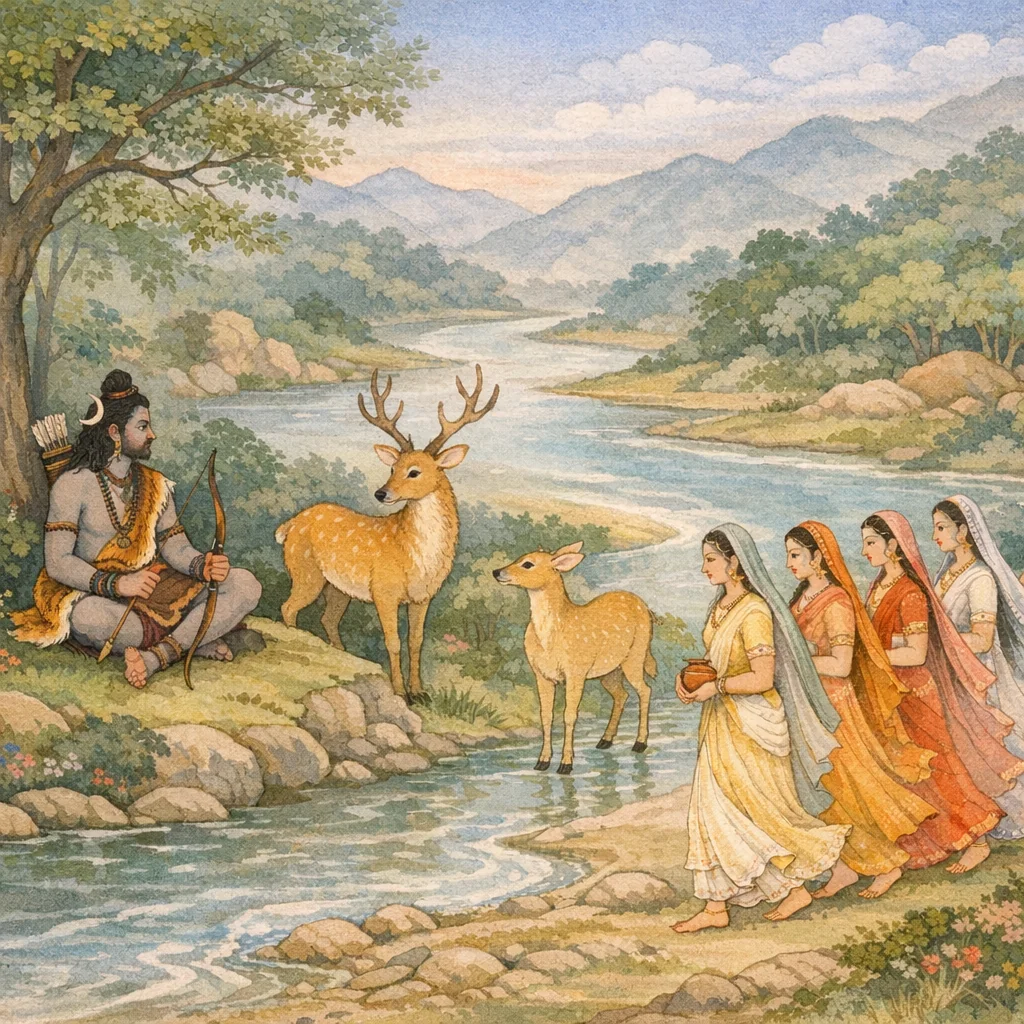
Adhyaya 102: The Five Sacred River-Tirthas: Savitri, Gayatri, Shraddha, Medha, and Sarasvati
Chương 102 thuật lại địa lý linh thiêng và nguồn gốc huyền thoại của năm tīrtha tối thượng gắn với các sông Savitrī, Gāyatrī, Śraddhā, Medhā và Sarasvatī. Đức Phạm Thiên (Brahmā) dạy Nārada rằng đây là những bến hành hương nổi tiếng, được các bậc hiền thánh biết đến; tắm và uống nước tại đó có thể rửa sạch mọi ô nhiễm đạo đức (kalmaṣa). Tiếp theo là tích nguyên khởi: năm dòng sông ấy là các trưởng nữ của Brahmā, liên hệ với việc thiết lập dharma. Rồi xảy ra biến cố khi một ái nữ tuyệt sắc (lokasundarī) bỏ chạy; nàng hóa thành nai cái, Brahmā hóa thành nai đực, còn Śambhu (Śiva) hiện làm thợ săn để hộ trì dharma. Năm người con gái sợ hãi tìm đến sông Gaṅgā; Brahmā dừng hành vi vượt chuẩn và gả thiếu nữ cho Vivasvat. Kết cuộc, năm dòng sông hội tụ và được thánh hóa thành các tīrtha; nghi lễ snāna và dāna tại đây ban thành tựu thế gian, phước trời và giải thoát, gồm cả quả báo của Mṛgavyādha-tīrtha và Brahma-tīrtha lừng danh.
Chapter Arc
{"opening_hook":"Brahmā, in dialogue with Nārada, abruptly elevates five named river-tīrthas—Sāvitrī, Gāyatrī, Śraddhā, Medhā, Sarasvatī—as “well-known to munis,” whose mere snāna and pāna erase kalmaṣa; the reader is drawn in by the promise of immediate ritual efficacy tied to specific sacred waters.","rising_action":"The tīrtha-listing turns into an etiological genealogy: the five rivers are disclosed as Brahmā’s elder daughters and as instruments of dharmasaṃsthāna. Tension rises when a uniquely beautiful lokasundarī maiden appears and flees, triggering a chain of metamorphoses and moral peril.","climax_moment":"At the narrative peak, the transgressive pursuit is arrested through cosmic role-reversal: the maiden becomes a doe, Brahmā a stag, and Śambhu assumes the form/function of a hunter (mṛgavyādha) to protect dharma—transforming a potentially scandalous episode into a dharma-restorative charter for a new tīrtha (Mṛgavyādha-tīrtha).","resolution":"Fearful, the five daughters/rivers move toward the Gaṅgā, and the story resolves with Brahmā’s withdrawal from the improper act and the gifting of the maiden to Vivasvat. The chapter closes by re-grounding the myth in sacred geography: the five rivers are sanctified as confluential tīrthas whose snāna and dāna yield sarvakāmaprāpti, svarga, and mokṣa, with special fruits for Mṛgavyādha-tīrtha and Brahma-tīrtha.","key_verse":"null"}
Thematic Essence
{"primary_theme":"Tīrtha-māhātmya of five sacred rivers as dharma-bearing daughters of Brahmā","secondary_themes":["Etiological myth: transformation (doe/stag) as a charter for Mṛgavyādha-tīrtha","Dharma-restoration through divine intervention (Śambhu as protector)","Confluence theology: Gaṅgā as purifier and integrator of subsidiary sacred streams","Ritual efficacy: snāna and dāna as instruments for kāma, svarga, and mokṣa"],"brahma_purana_doctrine":"Sacred geography is validated by creator-authority: Brahmā’s own progeny become rivers, so tīrtha is not merely a place but a dharma-function—waters that cleanse kalmaṣa because they embody śraddhā (faith), medhā (intelligence), and vāk (Sarasvatī).","adi_purana_significance":"As “Adi Purāṇa,” it models how primordial order is mapped onto the earth: cosmic genealogy (Brahmā’s daughters) becomes a pilgrim’s itinerary, making liberation accessible through sanctioned places and rites."}
Emotional Journey
{"opening_rasa":"शान्त (śānta)","climax_rasa":"भयानक (bhayānaka)","closing_rasa":"शान्त (śānta)","rasa_transitions":["śānta → अद्भुत (adbhuta) → शृङ्गार (śṛṅgāra) → भयानक (bhayānaka) → शान्त (śānta)"],"devotional_peaks":["The proclamation that snāna and pāna in the five rivers destroy kalmaṣa","The re-sanctification of the episode through Śambhu’s dharma-protecting intervention, converting fear into a tīrtha-boon","The concluding assurance that dāna and snāna at these confluences grant svarga and mokṣa (especially at Brahma-tīrtha)"]}
Tirtha Focus
{"tirthas_covered":["सावित्री-तीर्थ (Sāvitrī)","गायत्री-तीर्थ (Gāyatrī)","श्रद्धा-तीर्थ (Śraddhā)","मेधा-तीर्थ (Medhā)","सरस्वती-तीर्थ (Sarasvatī)","गङ्गा-संगम/गङ्गा (Gaṅgā and confluence setting)","मृगव्याध-तीर्थ (Mṛgavyādha-tīrtha)","ब्रह्म-तीर्थ (Brahma-tīrtha)"],"jagannath_content":null,"surya_content":"Vivasvat (the Sun) receives the maiden, subtly aligning the resolution with solar ṛta/order; no extended Sūrya-stuti is foregrounded in this chapter’s summary.","cosmology_content":"Cosmology appears in applied form: Brahmā’s progeny become rivers, showing creation as the sacralization of landscape; no full sarga/pralaya sequence is central here."}
Shlokas in Adhyaya 102
Verse 1
ब्रह्मोवाच सावित्री चैव गायत्री श्रद्धा मेधा सरस्वती एतानि पञ्च तीर्थानि पुण्यानि मुनयो विदुः //
Câu này chỉ ghi số “1” mà không có nguyên văn Sanskrit; vì vậy không thể dịch nội dung ý nghĩa.
Verse 2
तत्र स्नात्वा तु पीत्वा तु मुच्यते सर्वकल्मषात् सावित्री चैव गायत्री श्रद्धा मेधा सरस्वती //
Câu này chỉ ghi số “2” mà không có nguyên văn Sanskrit; vì vậy không thể dịch nội dung ý nghĩa.
Verse 3
एता मम सुता ज्येष्ठा धर्मसंस्थानहेतवः सर्वासाम् उत्तमां कांचिन् निर्ममे लोकसुन्दरीम् //
Câu này chỉ ghi số “3” mà không có nguyên văn Sanskrit; vì vậy không thể dịch nội dung ý nghĩa.
Verse 4
तां दृष्ट्वा विकृता बुद्धिर् ममासीन् मुनिसत्तम गृह्यमाणा मया बाला सा मां दृष्ट्वा पलायिता //
Câu này chỉ ghi số “4” mà không có nguyên văn Sanskrit; vì vậy không thể dịch nội dung ý nghĩa.
Verse 5
मृगीभूता तु सा बाला मृगो ऽहम् अभवं तदा मृगव्याधो ऽभवच् छंभुर् धर्मसंरक्षणाय च //
Câu kệ này nêu rõ Chánh pháp và lời dạy thiêng liêng của Purana.
Verse 6
ता मद्भीताः पञ्च सुता गङ्गाम् ईयुर् महानदीम् ततो महेश्वरः प्रायाद् धर्मसंरक्षणाय सः //
Nhờ lắng nghe và ghi nhớ, công đức và trí tuệ về Dharma được sinh khởi.
Verse 7
धनुर् गृहीत्वा सशरम् ईशो ऽपि मृगरूपिणम् माम् उवाच वधिष्ये त्वां मृगव्याधस् तदा हरः //
Bậc hiền trí kính lễ Thần linh và bậc Thầy để bước theo con đường chân thật.
Verse 8
तत्कर्मणो निवृत्तो ऽहं प्रादां कन्यां विवस्वते सावित्र्याद्याः पञ्च सुता नदीरूपेण संगताः //
Thực hành Dharma đem lại an tịnh và khiến người ta từ bỏ điều ác.
Verse 9
ता आगताः पुनश् चापि स्वर्गं लोकं ममान्तिकम् यत्र ताः संगता देव्या पञ्च तीर्थानि नारद //
Nhờ công đức và chí nguyện kiên định, người ta đạt đến mục tiêu tối thượng.
Verse 10
संगतानि च पुण्यानि पञ्च नद्यः सरस्वती तेषु स्नानं तथा दानं यत् किंचित् कुरुते नरः //
Câu này (10) chỉ nêu số câu, không kèm văn bản Phạn ngữ để dịch.
Verse 11
सर्वकामप्रदं तत् स्यान् नैष्कर्म्यान् मुक्तिदं स्मृतम् तत्राभवन् मृगव्याधं तीर्थं सर्वार्थदं नृणाम् स्वर्गमोक्षफलं चान्यद् ब्रह्मतीर्थफलं स्मृतम् //
Câu này (11) chỉ ghi số câu; không có nguyên văn Sanskrit để chuyển dịch.
Frequently Asked Questions
The chapter centers on tīrtha-māhātmya framed by dharma-restoration: sacred waters remove kalmaṣa through snāna and pāna, while the mythic episode of transformation and Śambhu’s intervention functions as an etiological justification for ethical restraint and the re-establishment of dharma.
It emphasizes the five river-tīrthas Savitrī, Gāyatrī, Śraddhā, Medhā, and Sarasvatī, especially at their confluence context with the Gaṅgā, stating that bathing and giving gifts there yield sarvakāmaprada results, svarga-phala, and mokṣa; it also names Mṛgavyādha-tīrtha as sarvārthada and notes Brahma-tīrtha as associated with svarga–mokṣa fruit.
Brahmā identifies the five as his elder daughters who become integrated in river-form; after a disruptive pursuit episode resolved by Śambhu’s dharma-protective role and Brahmā’s renunciation of the act, the daughters proceed to the Gaṅgā and are subsequently described as reunited and sanctified as five punyāḥ nadyaḥ and tīrthas.