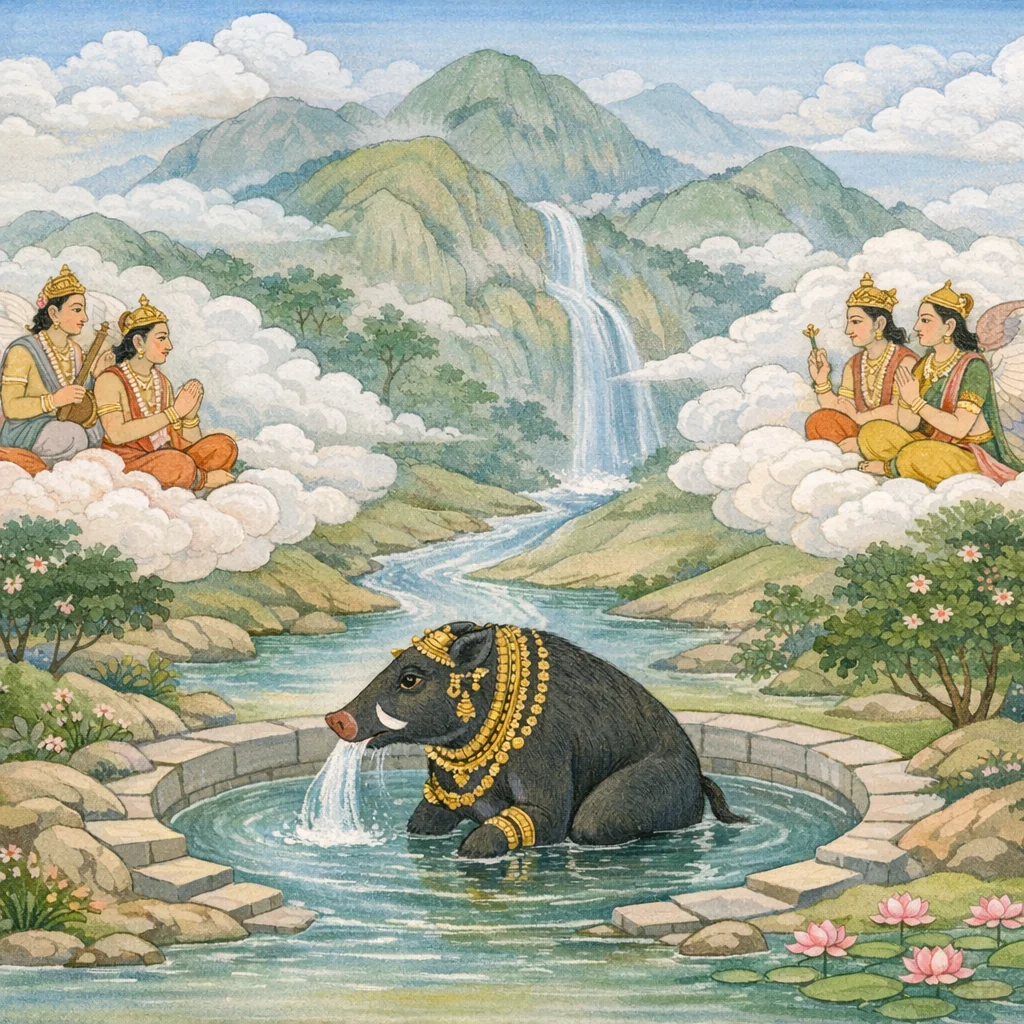
Adhyaya 79: Nārada Requests the Sequential Fruits of Tīrthas; The Origins of Tryambaka and Vārāha Tīrthas
Chương 79 mở đầu khi hiền giả Nārada tha thiết thỉnh cầu được nghe theo thứ tự những công đức riêng (tīrthaphala) của các thánh địa, đặc biệt là hành trình tẩy tịnh của sông Gaṅgā và các tích truy nguyên liên hệ. Phạm Thiên (Brahmā) đáp lời với sự dè dặt: mọi phân loại tīrtha và toàn bộ māhātmya không thể kể hết, và người thường cũng khó kham nhận trọn vẹn chỉ bằng nghe; tuy vậy, Ngài vẫn ban một bản lược thuật ngắn gọn, có thẩm quyền, dựa trên lời truyền như śruti và địa đồ linh thiêng đã được xác lập. Chương nêu bật hai tīrtha: Tryambaka, được ca ngợi ban cả phúc lạc thế gian lẫn giải thoát, và Vārāha, lừng danh khắp ba cõi. Tīrtha Vārāha gắn với một huyền tích: rākṣasa Sindhusena cướp lấy nghi lễ tế tự (yajña) rồi lặn xuống Rasātala, làm rối loạn trật tự nghi lễ vũ trụ. Chư thiên không thắng nổi bèn cầu Viṣṇu; Ngài hóa thân Vārāha, giáng xuống diệt kẻ thù, phục hồi yajña, rồi đi lên theo chính lối mà Gaṅgā đã từng đổ xuống. Tại nơi xuất hiện, nước Gaṅgā rửa sạch thân thể vấy máu, hình thành Vārāha-kuṇḍa. Thánh địa này được tôn xưng là nơi tắm gội và bố thí sẽ đạt quả báo của mọi tế lễ; thậm chí chỉ cần tưởng niệm tổ tiên cũng khiến họ được thanh tịnh và thăng lên cõi trời.
Chapter Arc
{"opening_hook":"Nārada, marked by sustained curiosity (jijñāsā), presses Brahmā to enumerate—“in proper sequence” (krameṇa)—the distinct fruits of tīrthas, beginning with Gaṅgā and the itihāsa that makes her course intelligible as sacred geography.","rising_action":"Brahmā first places an epistemic boundary: tīrtha-māhātmya is effectively immeasurable, and ordinary hearing cannot bear the whole; yet he agrees to give a condensed, śruti-like précis, then narrows the focus to two named loci whose merits are both practical (snāna/dāna) and soteriological (bhukti/mukti).","climax_moment":"The etiological myth of Vārāha tīrtha: Sindhusena drags the yajña down to Rasātala, the devas fail to recover it, and Viṣṇu—becoming Vārāha—descends, slays the hostile beings, restores the sacrifice, and re-emerges along Gaṅgā’s own descent-path; Gaṅgā washes the blood from his body, and that purificatory contact crystallizes as Vārāha-kuṇḍa.","resolution":"Brahmā codifies the ritual consequences: bathing and gifting at Vārāha tīrtha yield the fruit of all kratus; even pitṛ-smaraṇa there purifies ancestors and leads them heavenward—closing the chapter by converting myth into repeatable pilgrimage practice.","key_verse":"Teaching (translation): “At Vārāha-tīrtha, by bathing and by gifting, one attains the fruit of all sacrifices; and by remembering one’s ancestors there, the pitṛs are purified of sin and ascend to heaven.”"}
Thematic Essence
{"primary_theme":"Tīrtha-māhātmya as ordered sacred geography: how specific sites (Tryambaka, Vārāha) yield defined fruits through myth-grounded practice.","secondary_themes":["Epistemic restraint in purāṇic discourse (the immeasurable totality of tīrthas vs. a usable précis)","Bhukti–mukti synthesis: pilgrimage as both worldly welfare and liberation","Yajña as cosmic infrastructure; avatāra as ritual-restoration","Gaṅgā as purifying medium that sacralizes landscape through contact with the divine"],"brahma_purana_doctrine":"Tīrtha is not merely a place but a repeatable interface between mythic event and present practice: snāna/dāna/pitṛ-smaraṇa at a site created by avatāric action is declared equivalent to comprehensive sacrificial merit (sarva-kratu-phala).","adi_purana_significance":"As an ‘Ādi’ purāṇa-style chapter, it demonstrates the template by which primordial narrative (avatāra restoring yajña) is converted into dharma for later ages—mapping cosmic history onto a pilgrim’s itinerary and daily ritual acts."}
Emotional Journey
{"opening_rasa":"adbhuta","climax_rasa":"vīra","closing_rasa":"śānta","rasa_transitions":["adbhuta → śānta","śānta → raudra","raudra → vīra","vīra → adbhuta","adbhuta → śānta"],"devotional_peaks":["Brahmā’s ‘immeasurable yet mercifully condensed’ authorization of tīrtha-knowledge","Viṣṇu’s descent as Vārāha to restore the yajña (dharma re-established)","Gaṅgā cleansing the blood-stained Vārāha body—tīrtha born from purification","Promise that pitṛ-smaraṇa at Vārāha tīrtha uplifts ancestors to heaven"]}
Tirtha Focus
{"tirthas_covered":["Gaṅgā","Brahmagiri","Gaṅgāsravaṇa","Tryambaka tīrtha","Vārāha tīrtha","Vārāha-kuṇḍa"],"jagannath_content":null,"surya_content":null,"cosmology_content":"Rasātala is invoked as the netherworld arena where ritual order is disrupted and restored; the chapter links cosmic stability to the continuity of yajña and to avatāric intervention."}
Shlokas in Adhyaya 79
Verse 1
नारद उवाच न मनस् तृप्तिम् आधत्ते कथाः शृण्वत् त्वयेरिताः पृथक् तीर्थफलं श्रोतुं प्रवृत्तं मम मानसम् //
Trong đoạn mở đầu (79.1), Purana khởi sự trình bày đề mục kế tiếp bằng lời văn trang nghiêm thiêng thánh.
Verse 2
क्रमशो ब्राह्मणानीतां गङ्गां मे प्रथमं वद पृथक् तीर्थफलं पुण्यं सेतिहासं यथाक्रमम् //
Kệ (79.2) tiếp tục triển khai lời dạy, hướng tâm về Dharma và sự an tịnh nội tại.
Verse 3
ब्रह्मोवाच तीर्थानां च पृथग् भावं फलं माहात्म्यम् एव च सर्वं वक्तुं न शक्नोमि न च त्वं श्रवणे क्षमः //
Kệ này (số 3) trong Brahma Purana trình bày Chánh pháp thiêng liêng và tri thức cổ truyền.
Verse 4
तथापि किंचिद् वक्ष्यामि शृणु नारद यत्नतः यान्य् उक्तानि च तीर्थानि श्रुतिवाक्यानि यानि च //
Kệ này (số 4) tiếp nối việc giải bày ý nghĩa Dharma và truyền thống cổ xưa với lòng tôn kính.
Verse 5
तानि वक्ष्यामि संक्षेपान् नमस्कृत्वा त्रिलोचनम् यत्रासौ भगवान् आसीत् प्रत्यक्षस् त्र्यम्बको मुने //
Kệ này (số 5) tán dương Dharma và nêu bày tri thức tôn giáo đáng kính của bậc hiền thánh.
Verse 6
त्र्यम्बकं नाम तत् तीर्थं भुक्तिमुक्तिप्रदायकम् वाराहम् अपरं तीर्थं त्रिषु लोकेषु विश्रुतम् //
Kệ này (số 6) trang nghiêm thuật lại về Dharma và phép tắc dẫn dắt đời sống theo cổ lệ.
Verse 7
तस्य रूपं प्रवक्ष्यामि नाम विष्णोर् यथाभवत् पुरा देवान् पराभूय यज्ञम् आदाय राक्षसः //
Kệ này (số 7) kết lại bằng sự xác chứng chân lý và các đức hạnh cần thực hành.
Verse 8
रसातलम् अनुप्राप्तः सिन्धुसेन इति श्रुतः यज्ञे तलम् अनुप्राप्ते निर्यज्ञा ह्य् अभवन् मही //
Kệ 8: Bộ Purana này trình bày chân lý thanh tịnh và trật tự Dharma phù hợp với Veda.
Verse 9
नायं लोको ऽस्ति न परो यज्ञे नष्ट इतीत्वराः सुरास् तम् एव विविशू रसातलम् अनुद्विषम् //
Kệ 9: Bậc hiền trí nên lắng nghe với lòng tôn kính để trí tuệ sáng tỏ và tâm được an tịnh.
Verse 10
नाशक्नुवंस् तु तं जेतुं देवा इन्द्रपुरोगमाः विष्णुं पुराणपुरुषं गत्वा तस्मै न्यवेदयन् //
Kệ 10: Ghi nhớ danh Thần và hành trì Dharma làm tăng phước đức, che chở khỏi các cảnh giới đọa lạc.
Verse 11
राक्षसस्य तु तत् कर्म यज्ञभ्रंशम् अशेषतः ततः प्रोवाच भगवान् वाराहं वपुर् आस्थितः //
Kệ 11: Người học Purana với lòng chân thành sẽ được tri thức và an lạc ở đời này cùng đời sau.
Verse 12
शङ्खचक्रगदापाणिर् गत्वा चैव रसातलम् आनयिष्ये मखं पुण्यं हत्वा राक्षसपुंगवान् //
Kệ 12: Vì vậy, hãy tôn kính Dharma và tiếp tục nghe–đọc để ân phước luôn tăng trưởng.
Verse 13
स्वः प्रयान्तु सुराः सर्वे व्येतु वो मानसो ज्वरः येन गङ्गा तलं प्राप्ता पथा तेनैव चक्रधृक् //
Câu này (Brahma Purana, chương 79, kệ 13) được xem như lời thánh, ghi chép theo truyền thống Purana.
Verse 14
जगाम तरसा पुत्र भुवं भित्त्वा रसातलम् स वराहवपुः श्रीमान् रसातलनिवासिनः //
Kệ này (chương 79, kệ 14) tiếp nối việc trình bày ý nghĩa thiêng liêng theo lối văn Purana.
Verse 15
राक्षसान् दानवान् हत्वा मुखे धृत्वा महाध्वरम् वाराहरूपी भगवान् मखम् आदाय यज्ञभुक् //
Kệ này (79.15) nên được tụng đọc với lòng kính trọng để hiểu về Dharma và truyền sử Purana.
Verse 16
येन प्राप तलं विष्णुः पथा तेनैव शत्रुजित् मुखे न्यस्य महायज्ञं निश्चक्राम रसातलात् //
Kệ này (79.16) nêu rằng việc lắng nghe và ghi nhớ lời thánh dẫn đến công đức và trí tuệ.
Verse 17
तत्र ब्रह्मगिरौ देवाः प्रतीक्षां चक्रिरे हरेः पथस् तस्माद् विनिःसृत्य गङ्गास्रवणम् अभ्यगात् //
Kệ này (79.17) kết lại bằng việc tán dương sức mạnh của Dharma và sự hành trì chân chánh.
Verse 18
प्राक्षालयच् च स्वाङ्गानि असृग्लिप्तानि नारद गङ्गाम्भसा तत्र कुण्डं वाराहम् अभवत् ततः //
Câu kệ này (số 18) được ghi trong «Brahma Purana» như lời thánh điển, nhằm tiếp nối mạch thuật và trật tự giáo lý.
Verse 19
मुखे न्यस्तं महायज्ञं देवानां पुरतो हरिः दत्तवांस् त्रिदशश्रेष्ठो मुखाद् यज्ञो ऽभ्यजायत //
Câu kệ này (số 19) là phần của lời thánh trong «Brahma Purana», tiếp tục triển khai ý nghĩa theo trật tự.
Verse 20
ततः प्रभृति यज्ञाङ्गं प्रधानं स्रुव उच्यते वाराहरूपम् अभवद् एवं वै कारणान्तरात् //
Câu kệ này (số 20) được đặt trong «Brahma Purana» để giữ mạch nối giữa tự sự và giáo huấn thiêng liêng.
Verse 21
तस्मात् पुण्यतमं तीर्थं वाराहं सर्वकामदम् तत्र स्नानं च दानं च सर्वक्रतुफलप्रदम् //
Câu kệ này (số 21) là sự tiếp nối của lời thánh, được sắp theo thứ tự để người đọc vừa hiểu rõ vừa khởi tâm kính lễ.
Verse 22
तत्र स्थितो ऽपि यः कश्चित् पितॄन् स्मरति पुण्यकृत् विमुक्ताः सर्वपापेभ्यः पितरः स्वर्गम् आप्नुयुः //
Câu kệ này (số 22) khép lại đoạn này, vẫn giữ phong cách cổ truyền và tính thiêng của «Brahma Purana».
Frequently Asked Questions
The chapter centers on sacred topography as a vehicle for dharma: tīrthas are presented as concentrated sites of ritual efficacy where purification, restoration of cosmic order (through the recovery of the yajña), and soteriological benefit (bhukti and mukti) become accessible through disciplined acts such as snāna, dāna, and pitṛ-smaraṇa.
Vārāha tīrtha is explicitly framed as a practice-site where bathing and charitable gifting yield the fruit of all sacrifices (sarvakratu-phala). The chapter also emphasizes ancestor-remembrance at the tīrtha as an efficacious rite for the liberation and heavenly ascent of pitṛs.
The sanctity is grounded in a mythic restoration: when the yajña is seized by Sindhusena and taken to Rasātala, Viṣṇu assumes the Vārāha form, defeats the hostile beings, and retrieves the rite. The emergence along the same route associated with Gaṅgā’s descent, and the subsequent cleansing in Gaṅgā’s waters that forms Vārāha-kuṇḍa, sacralize the location as a permanent pilgrimage locus.