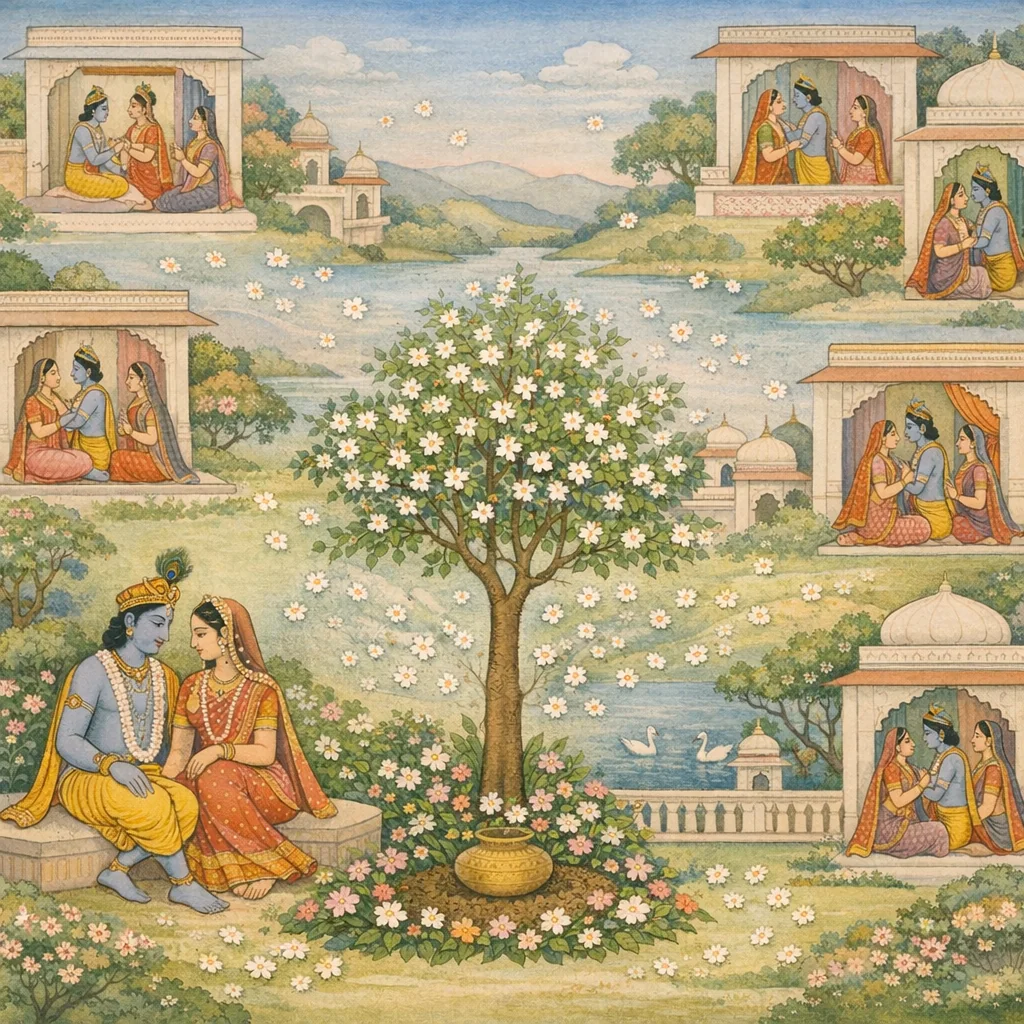
Adhyaya 204: Krishna Returns the Parijata Tree to Dvaraka and Marries the Rescued Maidens
Chương 204 thuật lại sự chuyển tiếp từ xung đột nơi thiên giới đến việc phục hồi ở nhân gian, xoay quanh ngoại giao của Đức Kṛṣṇa với Indra và việc đưa phúc báu thần linh vào cõi người. Vyāsa kể rằng sau khi được chúa tể chư thiên tán dương, Keśava điềm tĩnh xin Indra tha thứ “lỗi” và khẳng định việc lấy cây Pārijāta chỉ để giữ trọn lời thệ về chân thật. Kṛṣṇa hoàn trả lôi chùy vajra, xác nhận quyền chủ tể và vũ khí chính đáng của Indra. Indra nhận ra địa vị vũ trụ của Kṛṣṇa nên thỉnh cầu đem Pārijāta về Dvāravatī, vì khi Kṛṣṇa rời thế gian cây ấy sẽ không còn lưu lại trên đất. Hari hạ thế trong tiếng ca ngợi của các siddha, gandharva và ṛṣi, mang Pārijāta đến Dvārakā và trồng trong khu hoàng cung, khiến hương thơm và kỳ diệu làm đổi thay khí sắc thành đô. Phần sau giải quyết phương diện xã hội–nghi lễ: Kṛṣṇa tiếp nhận những phụ nữ từng bị Naraka giam giữ và vào giờ lành cử hành hôn lễ đúng pháp với 16.100 thiếu nữ, hóa hiện nhiều thân để mỗi người đều cảm nhận Ngài là phu quân của riêng mình—biểu lộ tính hiện diện khắp nơi nhằm phục hồi dharma và danh dự.
Chapter Arc
{"opening_hook":"The chapter opens in the afterglow of a divine confrontation: Indra praises Keśava, and the reader is drawn in by Kṛṣṇa’s unexpectedly grave, diplomatic reply—spoken as if he were merely “mortal,” even while the gods recognize his supremacy.","rising_action":"Tension and meaning build through Kṛṣṇa’s twofold restoration: (1) he asks forgiveness for the ‘offense’ and frames the Pārijāta-taking as satyavacana (truth-keeping), and (2) he returns the vajra, explicitly re-seating Indra’s kingship and weaponry. Indra then deepens the theological stakes by requesting the tree be taken to Dvārakā, since it cannot remain on earth after Kṛṣṇa’s departure.","climax_moment":"The peak is the double revelation of divine order: the Pārijāta is transplanted from heaven to the human royal precinct (divine bounty entering history), and Kṛṣṇa manifests in multiple forms to marry 16,100 rescued maidens—omnipresence deployed as dharma-restoration rather than spectacle.","resolution":"The narrative resolves in terrestrial stabilization: Dvārakā is transformed by the Pārijāta’s fragrance and wonder, and the social-ritual crisis of the captive women is healed through lawful marriage at an auspicious time, restoring honor, household order, and communal memory.","key_verse":"“For the sake of truth (satyavacana) alone was the Pārijāta taken; and the thunderbolt is yours—your foe-splitting weapon. Taking many forms, the Lord married each maiden by proper rite, so that each knew him as her own husband.” (sense-translation of the chapter’s central teaching)"}
Thematic Essence
{"primary_theme":"Dharma-restoration through divine conciliation and social rehabilitation (Pārijāta relocation + lawful marriages).","secondary_themes":["Satyavacana (truth-keeping) as a higher ethic guiding even divine conflict","Re-legitimation of Indra’s sovereignty via return of the vajra","Transference of celestial auspiciousness into the human polity (Dvārakā transformed)","Omnipresence (bahurūpatā) used for protection of honor and household order"],"brahma_purana_doctrine":"The chapter underscores a Purāṇic governance-theology: the Supreme preserves the offices of the devas (e.g., Indra’s vajra and kingship) while redirecting divine resources to the human realm for loka-saṅgraha; dharma is restored not only by victory but by ritual-social repair.","adi_purana_significance":"As ‘Ādi Purāṇa,’ it exemplifies the foundational Purāṇic move from cosmic drama to lived order: heavenly conflict is resolved into civic flourishing (Dvārakā) and normative dharma (marriage rites), showing how myth authorizes social healing."}
Emotional Journey
{"opening_rasa":"शान्त","climax_rasa":"अद्भुत","closing_rasa":"शान्त","rasa_transitions":["शान्त → वीर → अद्भुत → शृङ्गार → शान्त"],"devotional_peaks":["Indra’s praise and Kṛṣṇa’s composed, dharma-grounded reply","The descent to Bhūloka amid siddha-gandharva-ṛṣi acclamation","The multi-form marriage as a revelation of the Lord’s all-pervading capacity to protect dignity and dharma"]}
Tirtha Focus
{"tirthas_covered":["द्वारवती (द्वारका) पुरी"],"jagannath_content":null,"surya_content":null,"cosmology_content":null}
Shlokas in Adhyaya 204
Verse 1
व्यास उवाच संस्तुतो भगवान् इत्थं देवराजेन केशवः प्रहस्य भावगम्भीरम् उवाचेदं द्विजोत्तमाः //
Tại đây, kinh tiếp tục thuật lại trật tự của sự sáng tạo và gìn giữ thế giới theo thánh ý.
Verse 2
श्रीभगवान् उवाच देवराजो भवान् इन्द्रो वयं मर्त्या जगत्पते क्षन्तव्यं भवतैवैतद् अपराधकृतं मम //
Bậc trí nên biết rằng nghiệp và thời vận là sức mạnh dẫn dắt chúng sinh trong vòng luân hồi.
Verse 3
पारिजाततरुश् चायं नीयताम् उचितास्पदम् गृहीतो ऽयं मया शक्र सत्यावचनकारणात् //
Nhờ kính thờ Thần linh và hành trì Dharma đúng đắn, con người có thể vượt qua khổ đau và đạt an lạc tối thượng.
Verse 4
वज्रं चेदं गृहाण त्वं यष्टव्यं प्रहितं त्वया तवैवैतत् प्रहरणं शक्र वैरिविदारणम् //
Câu (204.4) này được xem như lời thánh trong Purana, mang tính trang nghiêm và giáo huấn.
Verse 5
शक्र उवाच विमोहयसि माम् ईश मर्त्यो ऽहम् इति किं वदन् जानीमस् त्वां भगवतो ऽनन्तसौख्यविदो वयम् //
Câu (204.5) nêu rõ Pháp thiêng liêng, đáng kính trọng và học hỏi với tâm thanh tịnh.
Verse 6
यो ऽसि सो ऽसि जगन्नाथ प्रवृत्तौ नाथ संस्थितः जगतः शल्यनिष्कर्षं करोष्य् असुरसूदन //
Câu (204.6) nhắc người nghe ghi nhớ lời thánh và thực hành theo khuôn phép Dharma với lòng chân thành.
Verse 7
नीयतां पारिजातो ऽयं कृष्ण द्वारवतीं पुरीम् मर्त्यलोके त्वया मुक्ते नायं संस्थास्यते भुवि //
Câu (204.7) ca ngợi sự tôn thờ Thần linh và giữ giới hạnh, để tâm được an tịnh.
Verse 8
व्यास उवाच तथेत्य् उक्त्वा तु देवेन्द्रम् आजगाम भुवं हरिः प्रयुक्तैः सिद्धगन्धर्वैः स्तूयमानस् त्व् अथर्षिभिः //
Câu (204.8) khẳng định rằng lắng nghe và ghi nhớ Purana đem lại công đức và trí tuệ sáng tỏ.
Verse 9
जगाम कृष्णः सहसा गृहीत्वा पादपोत्तमम् ततः शङ्खम् उपाध्माय द्वारकोपरि संस्थितः //
Câu này (chương 204, kệ 9) chỉ được ghi là “śloka 9” mà không có nguyên văn Sanskrit; vì vậy không thể dịch chính xác theo văn bản gốc.
Verse 10
हर्षम् उत्पादयाम् आस द्वारकावासिनां द्विजाः अवतीर्याथ गरुडात् सत्यभामासहायवान् //
Kệ này (chương 204, kệ 10) chỉ ghi “śloka 10” mà không có văn bản Sanskrit; vì thế không thể cung cấp bản dịch trung thực.
Verse 11
निष्कुटे स्थापयाम् आस पारिजातं महातरुम् यम् अभ्येत्य जनः सर्वो जातिं स्मरति पौर्विकीम् //
Kệ này (chương 204, kệ 11) chỉ có nhãn “śloka 11” mà không có nguyên văn Sanskrit; do đó không thể dịch dựa trên bản gốc.
Verse 12
वास्यते यस्य पुष्पाणां गन्धेनोर्वी त्रियोजनम् ततस् ते यादवाः सर्वे देवगन्धान् अमानुषान् //
Kệ này (chương 204, kệ 12) chỉ ghi “śloka 12” mà không có văn bản Sanskrit; vì vậy không thể dịch theo chuẩn mực học thuật và tôn kính.
Verse 13
ददृशुः पादपे तस्मिन् कुर्वतो मुखदर्शनम् किंकरैः समुपानीतं हस्त्यश्वादि ततो धनम् //
Kệ này (chương 204, kệ 13) chỉ có ghi “śloka 13” mà không có nguyên văn Sanskrit; vì vậy không thể dịch cho đúng nghĩa.
Verse 14
स्त्रियश् च कृष्णो जग्राह नरकस्य परिग्रहात् ततः काले शुभे प्राप्त उपयेमे जनार्दनः //
Câu kệ này chỉ ghi số «14», tức số thứ tự của tụng trong chương, cần hiểu theo văn mạch Purāṇa cổ.
Verse 15
ताः कन्या नरकावासात् सर्वतो याः समाहृताः एकस्मिन्न् एव गोविन्दः कालेनासां द्विजोत्तमाः //
Đoạn này chỉ có «15» như số thứ tự của śloka; ý nghĩa đầy đủ tùy thuộc văn bản Sanskrit gốc.
Verse 16
जग्राह विधिवत् पाणीन् पृथग्देहे स्वधर्मतः षोडश स्त्रीसहस्राणि शतम् एकं तथाधिकम् //
Chỗ này chỉ ghi «16» như số của tụng trong chương; cần đặt trong bối cảnh kinh điển nguyên thủy.
Verse 17
तावन्ति चक्रे रूपाणि भगवान् मधुसूदनः एकैकशश् च ताः कन्या मेनिरे मधुसूदनम् //
Câu này chỉ có «17» là số thứ tự; việc diễn giải phải dựa vào toàn văn śloka Sanskrit.
Verse 18
ममैव पाणिग्रहणं गोविन्दः कृतवान् इति निशासु जगतः स्रष्टा तासां गेहेषु केशवः उवास विप्राः सर्वासां विश्वरूपधरो हरिः //
Đoạn này chỉ chép «18» là số của śloka; ý nghĩa tôn giáo cổ kính cần tra từ bản văn gốc.
Frequently Asked Questions
The chapter foregrounds dharma maintained through restraint and restitution: Kṛṣṇa de-escalates divine rivalry by returning Indra’s vajra and framing the Pārijāta episode as fidelity to truth (satyavacana), then restores social honor by ritually marrying the rescued maidens, converting captivity into protected household status.
Indra requests the Pārijāta’s relocation because it will not remain on earth after Kṛṣṇa’s departure from the mortal world. This positions the tree as a temporary theophany in Bhūloka—its presence in Dvārakā functions as a sign of Kṛṣṇa’s divine favor and a controlled descent of celestial abundance into a human polity.
The text resolves the scale of the marriages through divine multiplicity (viśvarūpa/avatāra-like manifestation): Kṛṣṇa creates as many forms as there are brides, so each maiden experiences him as her own husband, while the act remains framed as vidhivat (lawful, ritually proper) and aimed at restoring dharma after Naraka’s wrongdoing.