Adhyaya 209: Balarama Slays Dvivida and Restores Cosmic Order
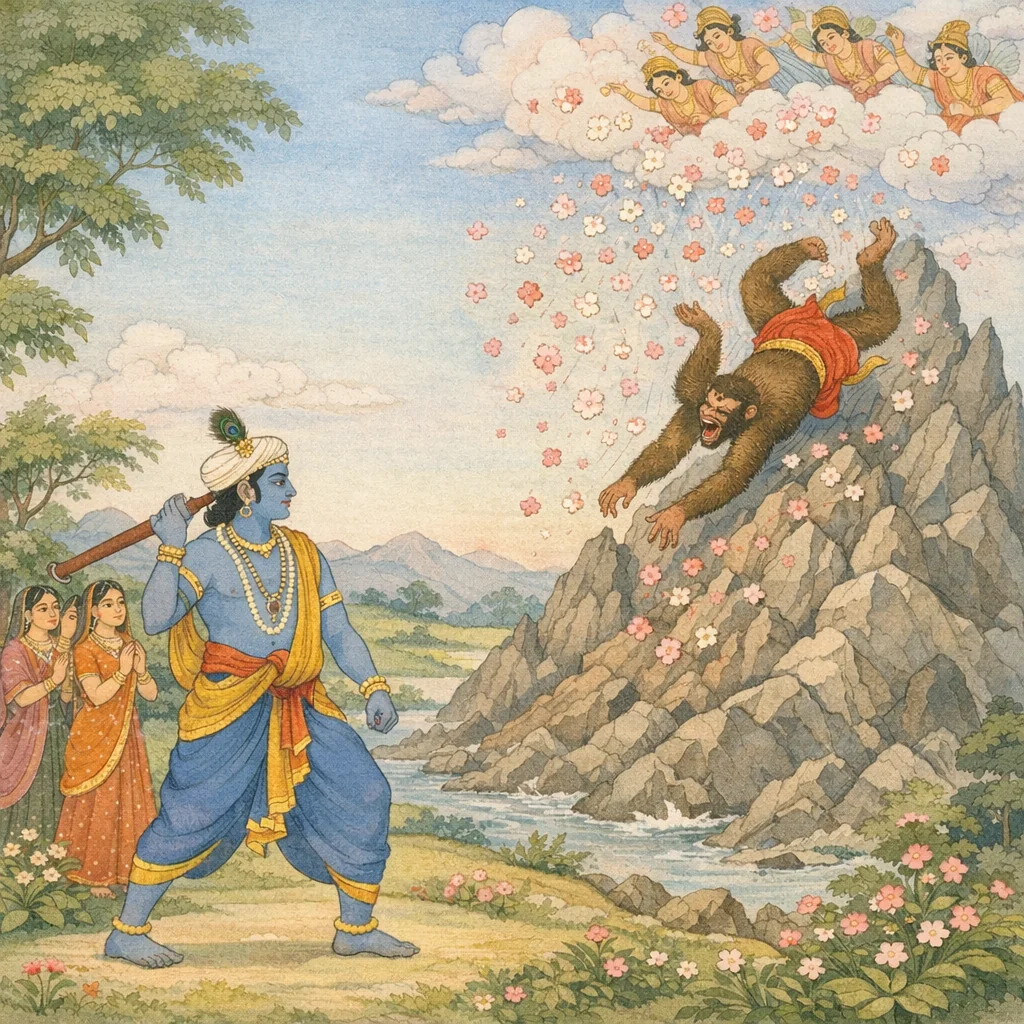
Chương 209, qua lời Vyāsa thuật lại cho các hiền triết, kể về sự quấy nhiễu và cái chết của Dvivida, một vānara hùng mạnh kết minh với Naraka—vua asura thù nghịch chư thiên. Vì oán hận sau khi Kṛṣṇa diệt Naraka, Dvivida mở chiến dịch bạo lực chống nghi lễ: ngăn cản yajña, phá vỡ khuôn phép chánh hạnh, tàn phá thôn ấp, ném núi đè làng, nhổ đá quăng xuống nước, khuấy biển khiến sóng tràn bờ làm ngập cư dân ven duyên hải. Đỉnh điểm là tại vườn của Raivata, khi Balarāma (Halāyudha) đang vui cùng Revatī và các phụ nữ thì bị khỉ ấy chế nhạo, tấn công. Trận đấu đá đối chùy, nhảy vọt và giáng đòn kết thúc bằng cú đánh quyết định của Balarāma giết Dvivida, khiến hắn ngã làm vỡ một đỉnh núi. Chư thiên rải hoa tán thán; Vyāsa kết lại, đặt chiến công này trong vô lượng kỳ tích của Baladeva, được đồng nhất với Śeṣa—đấng nâng đỡ địa cầu.
Chapter Arc
{"opening_hook":"Vyāsa, in the purāṇic frame of instruction to the sages, introduces a single disruptive figure—Dvivida the vānarā—whose strength is turned into a vow of retaliation against the devas after Naraka’s fall at Kṛṣṇa’s hands. The hook is moral-cosmic: one being’s grudge becomes a public calamity.","rising_action":"Dvivida’s campaign escalates from anti-ritual violence (yajña-obstruction, breaking dharma-boundaries) to geo-environmental assault: he devastates settlements, hurls mountain-masses onto villages, uproots rocks and casts them into waters, and even churns the ocean so it swells beyond its limits, flooding coastal habitations. Disorder spreads from the sacrificial ground to the landscape itself, signaling a collapse of ṛta/dharma.","climax_moment":"At Raivata’s garden, the disorder becomes personal and immediate: Dvivida mocks and attacks Balarāma (Halāyudha) and harasses the women. The combat—stone and mountain fragments against the plough-bearing club—reaches its peak when Balarāma lands the decisive blow, killing Dvivida; the fall shatters a mountain peak, visually sealing the restoration of order.","resolution":"The devas shower flowers and praise, reading the victory as cosmic re-stabilization. Vyāsa closes by placing this deed among Baladeva’s immeasurable exploits and explicitly identifying him with Śeṣa, the earth-bearer—thereby interpreting the episode as the triumph of the sustaining principle over chaotic force.","key_verse":null}
Thematic Essence
{"primary_theme":"धर्म-रक्षा द्वारा लोक-व्यवस्था-स्थापनम् (Restoration of cosmic and social order through Baladeva’s slaying of Dvivida)","secondary_themes":["यज्ञ-विघ्न और वेद-मार्ग-विरोध (anti-ritual violence as adharma)","पर्यावरण/भूगोल-हिंसा: पर्वत-प्रक्षेप, शिलाक्षेप, सागर-क्षोभ (geo-cosmic destabilization)","नरक-वधोत्तर प्रतिशोध-राजनीति (asuric retaliation after Naraka’s death)","उद्यान-लीला से रण-लीला तक: रैवतोद्यान में स्त्री-अपमान का प्रतिकार (defense of dignity and protection of the vulnerable)"],"brahma_purana_doctrine":"Adharma is diagnosed not only as moral failing but as yajña-disruption and boundary-breaking that spills into nature; the Purāṇa reads Baladeva-as-Śeṣa as the dhāraṇa-śakti that re-establishes maryādā (limits) in society and in the elements.","adi_purana_significance":"As an ‘Ādi Purāṇa’ layer, the chapter models a primordial pattern: when ritual order and cosmic boundaries are violated, the sustaining divine principle manifests to re-anchor the world—linking heroic narrative to cosmological function (Śeṣa-bhūdhāraṇa)."}
Emotional Journey
{"opening_rasa":"भयानक (bhayānaka)","climax_rasa":"वीर (vīra)","closing_rasa":"शान्त (śānta)","rasa_transitions":["bhayānaka → रौद्र (raudra) → vīra → अद्भुत (adbhuta) → śānta"],"devotional_peaks":["Devas’ flower-shower and stuti after Dvivida’s death, reading the act as dharma’s victory.","The concluding identification of Baladeva with Śeṣa, elevating the battle into a cosmic-theological affirmation."]}
Tirtha Focus
{"tirthas_covered":["रैवतोद्यान (Raivata’s garden/park)"],"jagannath_content":null,"surya_content":null,"cosmology_content":"Implicit cosmology through ‘boundary’ imagery: ocean swelling beyond limits and the earth’s stability restored via Baladeva’s Śeṣa-identity (bhū-dhāraṇa)."}
Shlokas in Adhyaya 209
Verse 1
व्यास उवाच शृणुध्वं मुनयः सर्वे बलस्य बलशालिनः कृतं यद् अन्यद् एवाभूत् तद् अपि श्रूयतां द्विजाः //
Kệ 209.1: Mở đầu chương mới, Purāṇa tiếp tục thuật về dharma và lịch sử các dòng vương tộc.
Verse 2
नरकस्यासुरेन्द्रस्य देवपक्षविरोधिनः सखाभवन् महावीर्यो द्विविदो नाम वानरः //
Kệ 2: Lời thánh này được nêu trong Purāṇa để soi sáng Chánh pháp và làm rõ đạo lý.
Verse 3
वैरानुबन्धं बलवान् स चकार सुरान् प्रति //
Kệ 3: Bậc hiền trí nên lắng nghe với lòng cung kính và ghi nhớ ý nghĩa sâu xa của lời ấy.
Verse 4
द्विविद उवाच नरकं हतवान् कृष्णो बलदर्पसमन्वितम् करिष्ये सर्वदेवानां तस्माद् एष प्रतिक्रियाम् //
Kệ 4: Nhờ thường xuyên tụng đọc và lắng nghe, công đức tăng trưởng và vô minh được tiêu trừ.
Verse 5
व्यास उवाच यज्ञविध्वंसनं कुर्वन् मर्त्यलोकक्षयं तथा ततो विध्वंसयाम् आस यज्ञान् अज्ञानमोहितः //
Kệ 5: Người thực hành Chánh pháp theo lời thánh ấy sẽ đạt an lạc và sự tĩnh lặng trong tâm.
Verse 6
बिभेद साधुमर्यादां क्षयं चक्रे च देहिनाम् ददाह चपलो देशं पुरग्रामान्तराणि च //
Kệ 6: Vì thế, hãy kính trọng Purāṇa này và nắm giữ Chánh pháp như con đường tối thượng.
Verse 7
क्वचिच् च पर्वतक्षेपाद् ग्रामादीन् समचूर्णयत् शैलान् उत्पाट्य तोयेषु मुमोचाम्बुनिधौ तथा //
Chưa có văn bản Sanskrit của câu này. Xin gửi nguyên văn để có thể dịch chính xác theo tinh thần kinh điển.
Verse 8
पुनश् चार्णवमध्यस्थः क्षोभयाम् आस सागरम् तेनातिक्षोभितश् चाब्धिर् उद्वेलो जायते द्विजाः //
Chưa có văn bản Sanskrit của câu này. Xin gửi nguyên văn để có thể dịch chính xác theo tinh thần kinh điển.
Verse 9
प्लावयंस् तीरजान् ग्रामान् पुरादीन् अतिवेगवान् कामरूपं महारूपं कृत्वा सस्यान्य् अनेकशः //
Chưa có văn bản Sanskrit của câu này. Xin gửi nguyên văn để có thể dịch chính xác theo tinh thần kinh điển.
Verse 10
लुठन् भ्रमणसंमर्दैः संचूर्णयति वानरः तेन विप्रकृतं सर्वं जगद् एतद् दुरात्मना //
Chưa có văn bản Sanskrit của câu này. Xin gửi nguyên văn để có thể dịch chính xác theo tinh thần kinh điển.
Verse 11
निःस्वाध्यायवषट्कारं द्विजाश् चासीत् सुदुःखितम् कदाचिद् रैवतोद्याने पपौ पानं हलायुधः //
Chưa có văn bản Sanskrit của câu này. Xin gửi nguyên văn để có thể dịch chính xác theo tinh thần kinh điển.
Verse 12
रेवती च महाभागा तथैवान्या वरस्त्रियः उद्गीयमानो विलसल्ललनामौलिमध्यगः //
Kệ này (số 12) trong Purana nêu bày Chánh pháp thiêng liêng và tri thức cổ truyền.
Verse 13
रेमे यदुवरश्रेष्ठः कुबेर इव मन्दरे ततः स वानरो ऽभ्येत्य गृहीत्वा सीरिणो हलम् //
Kệ (13) tiếp tục trình bày trật tự của thế giới và những nguyên lý Dharma nhiệm mầu.
Verse 14
मुशलं च चकारास्य संमुखः स विडम्बनाम् तथैव योषितां तासां जहासाभिमुखं कपिः //
Kệ (14) nêu rõ việc tôn thờ Thần linh và giữ giới luật để đạt an lạc.
Verse 15
पानपूर्णांश् च करकांश् चिक्षेपाहत्य वै तदा ततः कोपपरीतात्मा भर्त्सयाम् आस तं बलम् //
Kệ (15) nhắc rằng nghiệp và Dharma là con đường dẫn chúng sinh đến quả báo tương xứng.
Verse 16
तथापि तम् अवज्ञाय चक्रे किलकिलाध्वनिम् ततः समुत्थाय बलो जगृहे मुशलं रुषा //
Kệ (16) tán dương bậc hiền trí biết lắng nghe và ghi nhớ Purana để tăng trưởng trí tuệ và tín tâm.
Verse 17
सो ऽपि शैलशिलां भीमां जग्राह प्लवगोत्तमः चिक्षेप च स तां क्षिप्तां मुशलेन सहस्रधा //
Câu kệ này (số 17) được ghi nhận theo truyền thống, nhưng văn bản Sanskrit chưa được cung cấp để dịch.
Verse 18
बिभेद यादवश्रेष्ठः सा पपात महीतले अपतन् मुशलं चासौ समुल्लङ्घ्य प्लवंगमः //
Kệ này (số 18) chỉ có số thứ tự; chưa có nguyên văn Sanskrit nên không thể dịch chuẩn xác.
Verse 19
वेगेनायम्य रोषेण बलेनोरस्य् अताडयत् ततो बलेन कोपेन मुष्टिना मूर्ध्नि ताडितः //
Câu kệ (số 19) được liệt kê, nhưng thiếu bản Sanskrit nên không thể chuyển dịch đúng tinh thần kinh điển.
Verse 20
पपात रुधिरोद्गारी द्विविदः क्षीणजीवितः पतता तच्छरीरेण गिरेः शृङ्गम् अशीर्यत //
Kệ (số 20) không kèm nguyên văn Sanskrit, nên không thể thực hiện bản dịch đa ngữ một cách chuẩn mực.
Verse 21
मुनयः शतधा वज्रिवज्रेणेव हि ताडितम् पुष्पवृष्टिं ततो देवा रामस्योपरि चिक्षिपुः //
Kệ (số 21) cần có nguyên văn Sanskrit để dịch đúng phong vị thánh điển, nhưng hiện chưa được cung cấp.
Verse 22
प्रशशंसुस् तदाभ्येत्य साध्व् एतत् ते महत् कृतम् अनेन दुष्टकपिना दैत्यपक्षोपकारिणा जगन् निराकृतं वीर दिष्ट्या स क्षयम् आगतः //
Câu này chỉ ghi số “22” trong nguồn; không có văn bản Sanskrit để dịch.
Verse 23
व्यास उवाच एवंविधान्य् अनेकानि बलदेवस्य धीमतः कर्माण्य् अपरिमेयानि शेषस्य धरणीभृतः //
Câu này chỉ ghi số “23” trong nguồn; không có văn bản Sanskrit để dịch.
Frequently Asked Questions
The chapter foregrounds the restoration of dharmic order against forces that sabotage yajña and social boundaries. Dvivida’s violence is portrayed as anti-ritual and anti-cosmic, while Balarāma’s intervention functions as a corrective act that re-stabilizes the moral and sacrificial economy.
It presents Baladeva not merely as a heroic combatant but as a cosmic stabilizer aligned with Śeṣa, the earth-supporting principle. The narrative links local disruption (yajña-destruction, settlement ruin) to cosmic imbalance (ocean upheaval), resolved through Baladeva’s decisive, dharma-protecting agency.
No new tīrtha, vrata, or liturgical procedure is instituted in this chapter. Ritual appears primarily through its negation—yajñas being obstructed—so the emphasis is on safeguarding sacrificial practice rather than prescribing a novel observance.