
Shloka 21
Vishwarupa Darshana Yoga — Vishwarupa Darshana Yoga
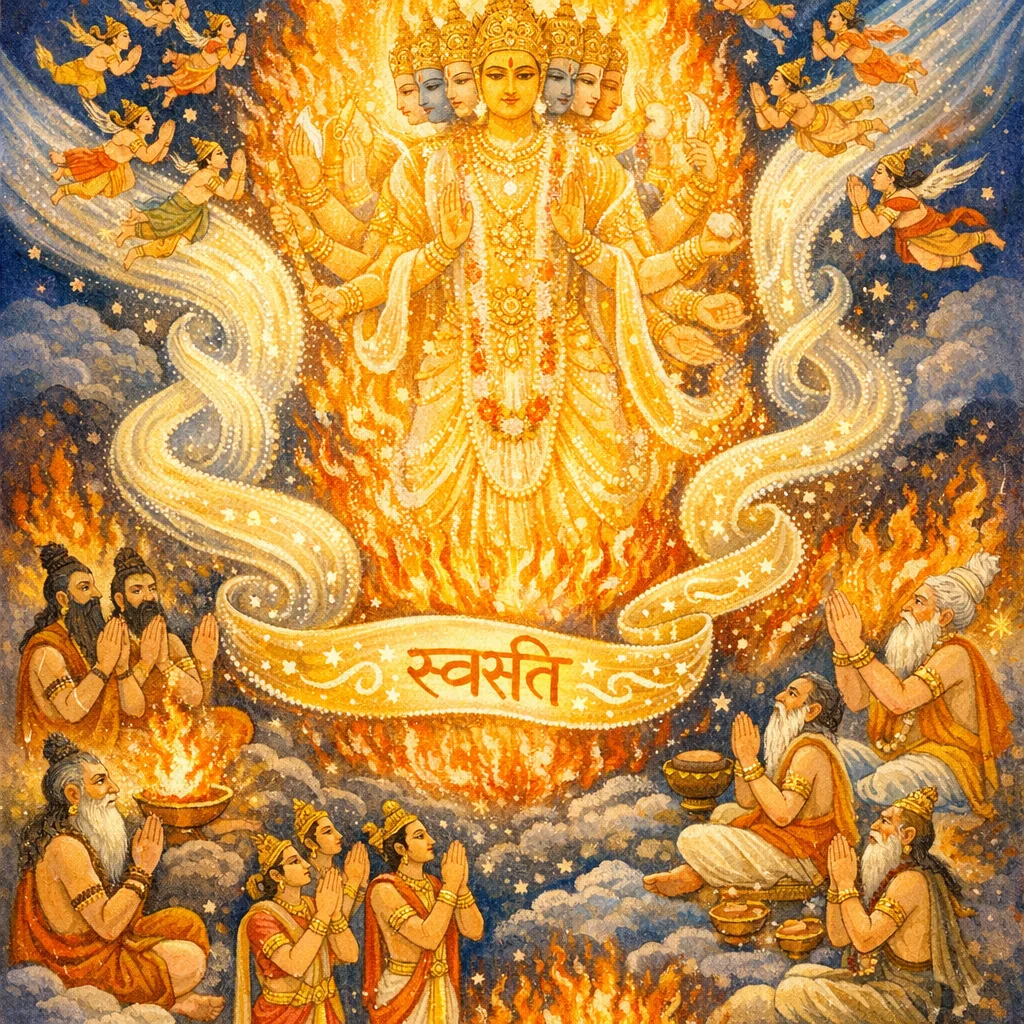
अमी हि त्वां सुरसंघा विशन्ति केचिद्भीताः प्राञ्जलयो गृणन्ति । स्वस्तीत्युक्त्वा महर्षिसिद्धसंघाः स्तुवन्ति त्वां स्तुतिभिः पुष्कलाभिः ॥
amī hi tvāṃ sura-saṅghā viśanti kecid bhītāḥ prāñjalayo gṛṇanti | svastīty uktvā maharṣi-siddha-saṅghāḥ stuvanti tvāṃ stutibhiḥ puṣkalābhiḥ ||

Những đoàn chư thiên này đi vào trong Ngài; có kẻ vì kính sợ mà chắp tay tán thán. Xướng lời “svasti” (cát tường), các hội chúng đại hiền và bậc thành tựu ca ngợi Ngài bằng vô số thánh ca.
These hosts of gods enter into You; some, in awe, praise You with joined hands. Saying ‘svasti’ (well-being), the groups of great seers and perfected beings extol You with abundant hymns.
For these companies of deities enter you; some, awestruck, recite praises with folded hands. Having uttered ‘svasti,’ the assemblies of great sages and siddhas laud you with copious eulogies.
bhītāḥ is often translated ‘afraid,’ but in this context it frequently denotes reverential awe before the numinous. viśanti (‘enter’) can be understood as participation/absorption imagery rather than a physical scene.
FAQs
The verse portrays multiple affective responses—reverent trembling, prayer, and praise—suggesting that intense experiences can evoke both fear-like arousal and devotion.
If ‘entering’ is read symbolically, it indicates that finite powers (deities) are grounded in, and return to, a more comprehensive reality.
Arjuna’s vision includes not only the divine form but also other revered beings, reinforcing the claim that the revelation is cosmically authoritative.
It highlights the role of communal language—blessings and praise—in stabilizing meaning during overwhelming events.