
Bhagavad Gita — Vishwarupa Darshana Yoga, Shloka 19
Vishwarupa Darshana Yoga
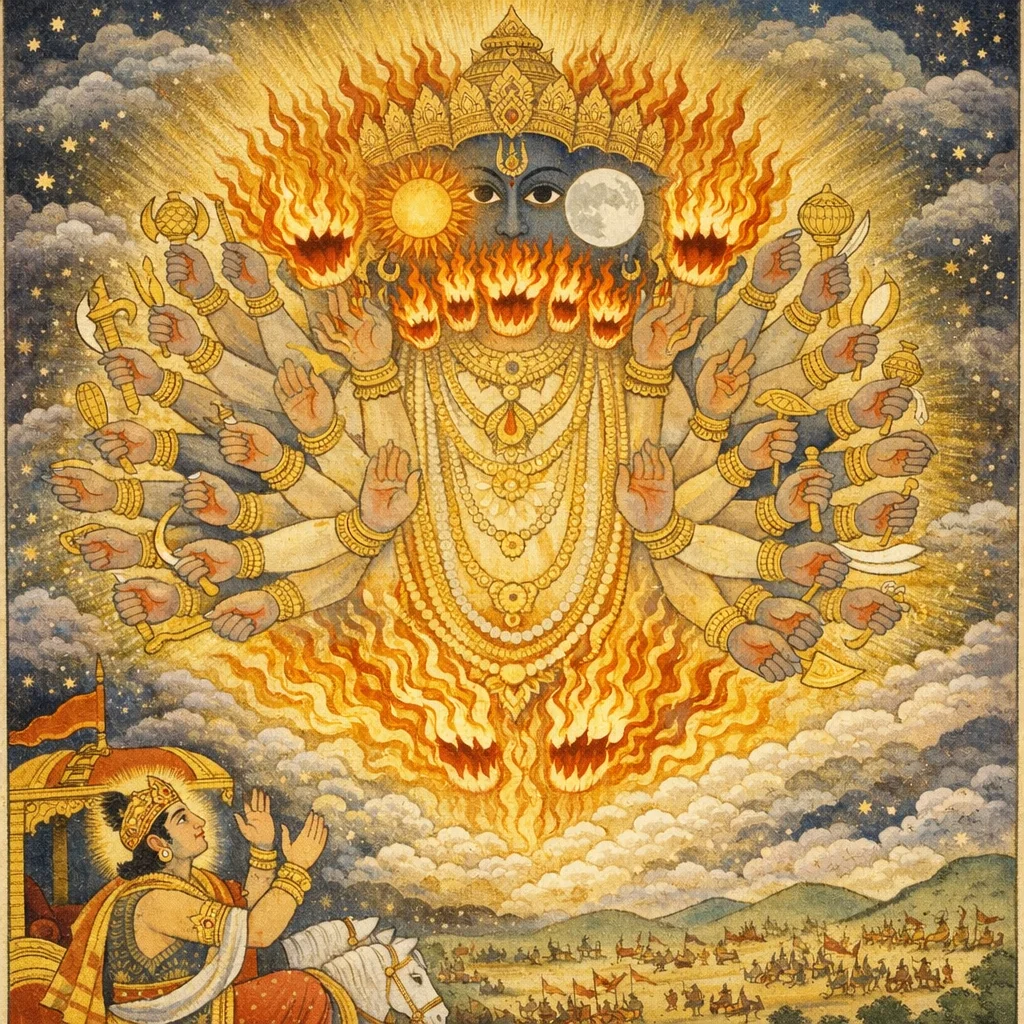
अनादिमध्यान्तमनन्तवीर्यं अनन्तबाहुं शशिसूर्यनेत्रम् । पश्यामि त्वां दीप्तहुताशवक्त्रं स्वतेजसा विश्वमिदं तपन्तम् ॥
anādi-madhyāntam ananta-vīryaṃ ananta-bāhuṃ śaśi-sūrya-netram | paśyāmi tvāṃ dīpta-hutāśa-vaktraṃ sva-tejasā viśvam idaṃ tapantam ||

Con thấy Ngài không khởi đầu, không trung đoạn, không tận cùng; oai lực vô biên; vô số cánh tay; trăng và mặt trời làm đôi mắt. Con thấy Ngài với miệng như lửa tế rực cháy, lấy chính quang minh của mình mà sưởi ấm, chiếu soi toàn vũ trụ này.
I see You without beginning, middle, or end; of infinite power; with countless arms; with moon and sun as eyes; with a face like blazing fire; warming/illuminating this whole universe with Your own radiance.
I behold you: without beginning, middle, or end; of limitless potency; with endless arms; with the moon and sun as eyes; with a mouth like blazing fire—by your own brilliance pervading and ‘heating’ this entire world.
tapantam can be read neutrally as ‘warming/irradiating’ rather than harshly ‘burning’; many translators choose a cosmological sense (solar heat/light as life-sustaining), consistent with the cosmic form imagery.
FAQs
The mind confronts the unbounded (no beginning/middle/end), a classic trigger for awe; the verse models how language stretches to represent what exceeds ordinary temporal thinking.
The divine is depicted as infinite potency and immanent cosmic intelligence, integrating natural phenomena (sun/moon) into a single metaphysical subject.
This continues Arjuna’s eyewitness account, intensifying the claim that the vision is not merely a deity’s body but the cosmos as a unified field of power.
As a contemplative reading, it encourages seeing interconnected systems—ecological, social, psychological—as parts of a larger whole rather than isolated fragments.