
Bhagavad Gita — Moksha Sannyasa Yoga, Shloka 58
Moksha Sannyasa Yoga
मच्चित्तः सर्वदुर्गाणि मत्प्रसादात्तरिष्यसि । अथ चेत्त्वमहंकारान्न श्रोष्यसि विनङ्क्ष्यसि ॥ १८.५८ ॥
maccittaḥ sarvadurgāṇi matprasādāt tariṣyasi | atha cet tvam ahaṅkārān na śroṣyasi vinaṅkṣyasi || 18.58 ||

Nếu tâm con luôn ở trong Ta, nhờ ân sủng của Ta con sẽ vượt qua mọi hiểm nạn. Nhưng nếu vì ngã mạn mà con không nghe, con sẽ diệt vong.
मन को मुझमें लगाकर तुम मेरी कृपा से सब कठिनाइयों को पार कर जाओगे; परन्तु यदि अहंकार के कारण मेरी बात न सुनोगे, तो तुम्हारा पतन होगा।
With your mind fixed on me, you will cross over all difficulties by my favor; but if, out of egoism, you will not listen, you will come to ruin.
‘सर्वदुर्गाणि’ is often rendered as ‘all obstacles/dangers’ (ethical and spiritual impediments), not necessarily external threats. ‘विनङ्क्ष्यसि’ is interpreted as ‘perish/come to ruin’ and in commentarial traditions may mean spiritual downfall (loss of discernment) rather than physical destruction.
FAQs
The verse frames egoism (ahaṅkāra) as a key psychological barrier: refusing guidance due to self-assertion leads to impaired judgment and self-defeating choices, whereas sustained attention on a stabilizing ideal (maccittaḥ) supports resilience.
It presents a theistic soteriology: liberation-oriented progress is enabled by divine favor (prasāda) when the practitioner’s consciousness is oriented toward the divine; egoism disrupts receptivity to that transformative knowledge.
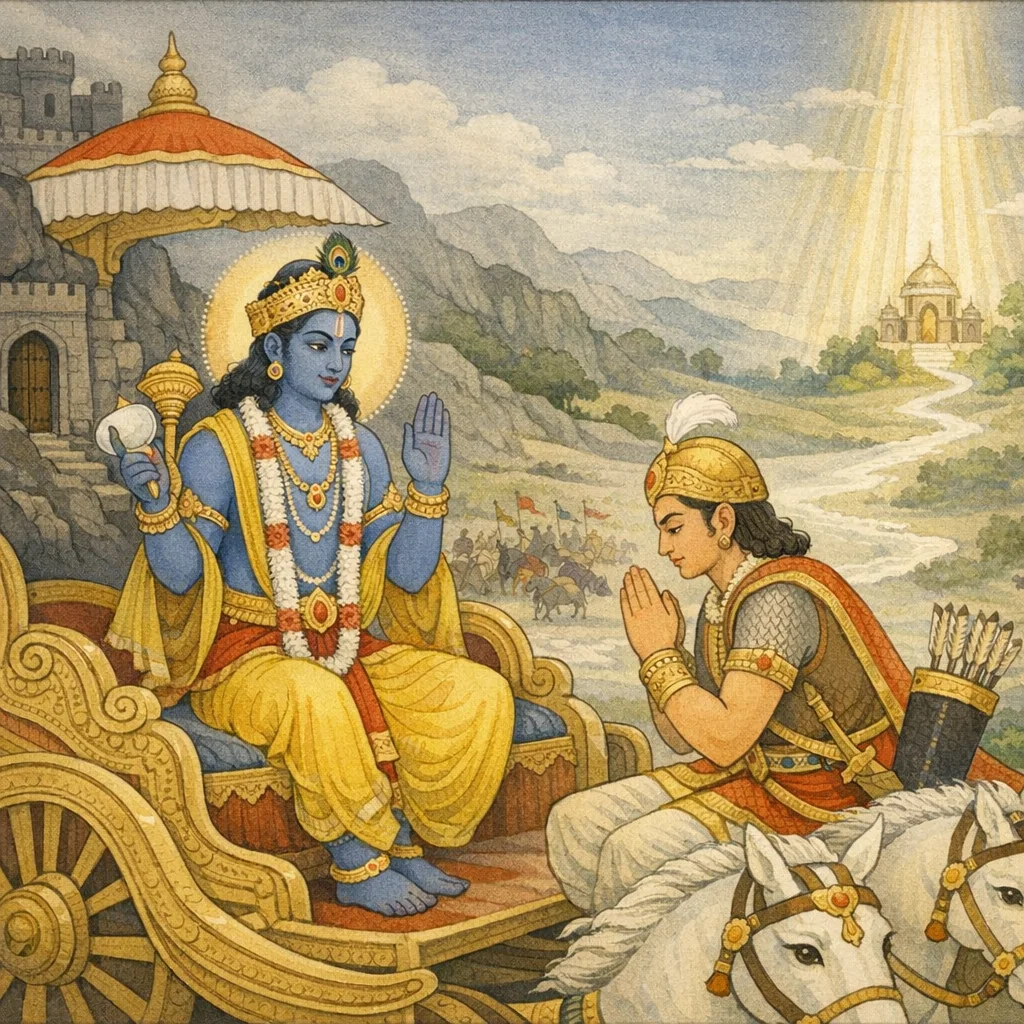
Near the conclusion of the dialogue, Krishna summarizes the practical condition for Arjuna’s success: inner alignment and receptivity to instruction, contrasted with the destabilizing force of ego-driven refusal.
As a nonsectarian practice, it can be read as: keep attention anchored in a higher value or disciplined framework, seek mentorship, and watch for ego-based resistance that blocks learning and constructive action.
Ask anything about this verse
Curious about the meaning, context, or a word? Ask, and continue the conversation in the Vedapath app.
A free Google sign-in keeps your chat saved across web and the app.
Read Bhagavad Gita in the Vedapath app
Scan the QR code to open this directly in the app, with audio, word-by-word meanings, and more.