
Bhagavad Gita — Moksha Sannyasa Yoga, Shloka 20
Moksha Sannyasa Yoga
सर्वभूतेषु येनैकं भावमव्ययमीक्षते । अविभक्तं विभक्तेषु तज्ज्ञानं विद्धि सात्त्विकम् ॥ १८.२० ॥
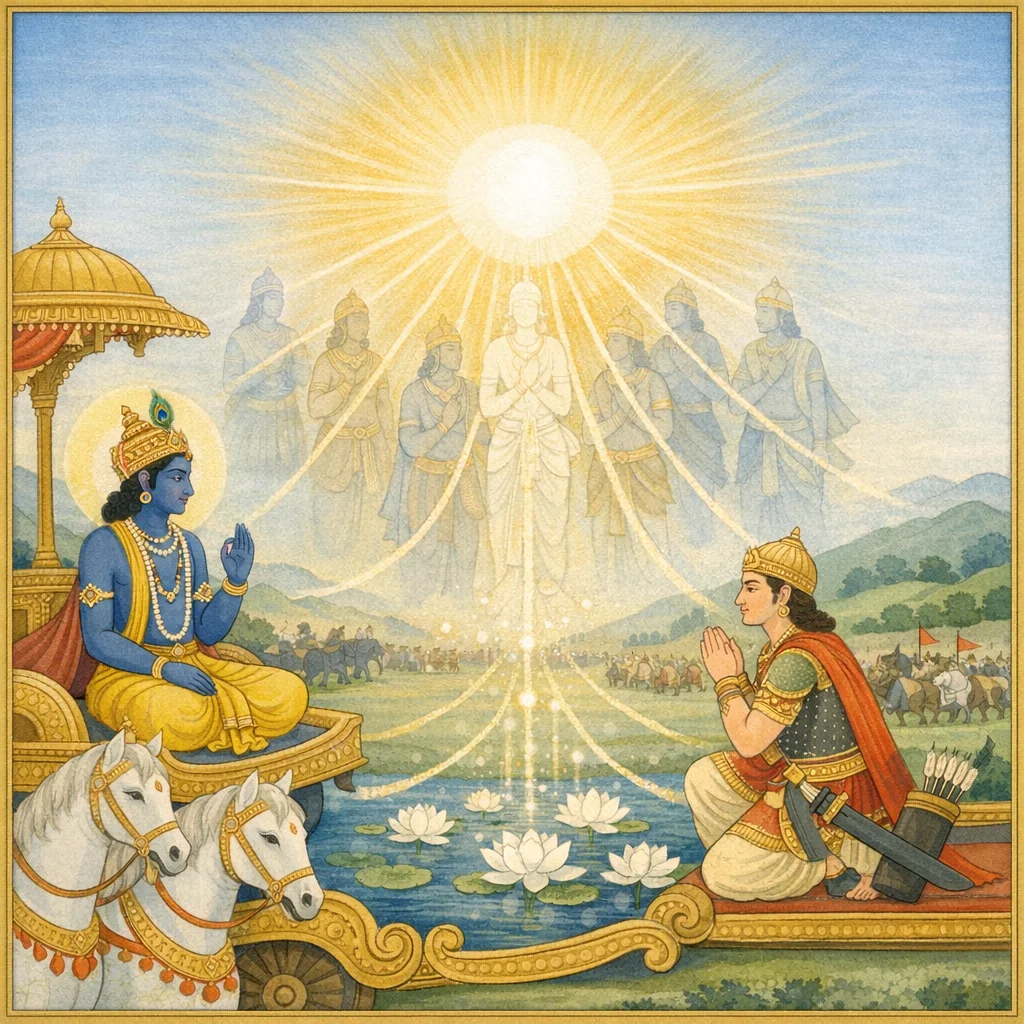
sarvabhūteṣu yenaikaṁ bhāvam avyayam īkṣate | avibhaktaṁ vibhakteṣu taj jñānaṁ viddhi sāttvikam || 18.20 ||

Tri thức nhờ đó người ta thấy trong mọi loài hữu tình một bản thể duy nhất, bất hoại—không phân chia giữa những gì dường như phân chia—hãy biết tri thức ấy là sattva.
जिस ज्ञान के द्वारा मनुष्य समस्त प्राणियों में एक अविनाशी भाव (सत्ता) को देखता है, जो विभक्तों में अविभक्त है—उस ज्ञान को सात्त्विक जानो।
That knowledge by which one sees one imperishable being/state in all beings—undivided among the divided—know that knowledge to be sattvic.
Traditional interpreters often read ‘ekaṁ bhāvam’ as the one Self/Brahman present in all, aligning with non-dual or theistic unity-in-diversity. Academic-literal translation keeps ‘bhāva’ open as ‘being/state/essence’, allowing multiple philosophical construals (Advaita, Viśiṣṭādvaita, etc.).
FAQs
Sattvic knowledge is portrayed as integrative perception: it reduces reactive fragmentation by recognizing a shared, enduring dimension across persons and situations, supporting empathy and steadiness.
It asserts an imperishable principle present across the multiplicity of beings. Philosophical schools interpret this as the Self, Brahman, or a single underlying reality that is not divided by empirical distinctions.
This is the first of three definitions of knowledge by guṇa, setting sattva as clarity that apprehends unity rather than mere plurality.
In pluralistic settings, it can be read as a discipline of seeing common dignity or shared consciousness beneath social and psychological differences, improving ethical decision-making.
Read Bhagavad Gita in the Vedapath app
Scan the QR code to open this directly in the app, with audio, word-by-word meanings, and more.