
Bhagavad Gita — Karma Yoga, Shloka 1
Karma Yoga
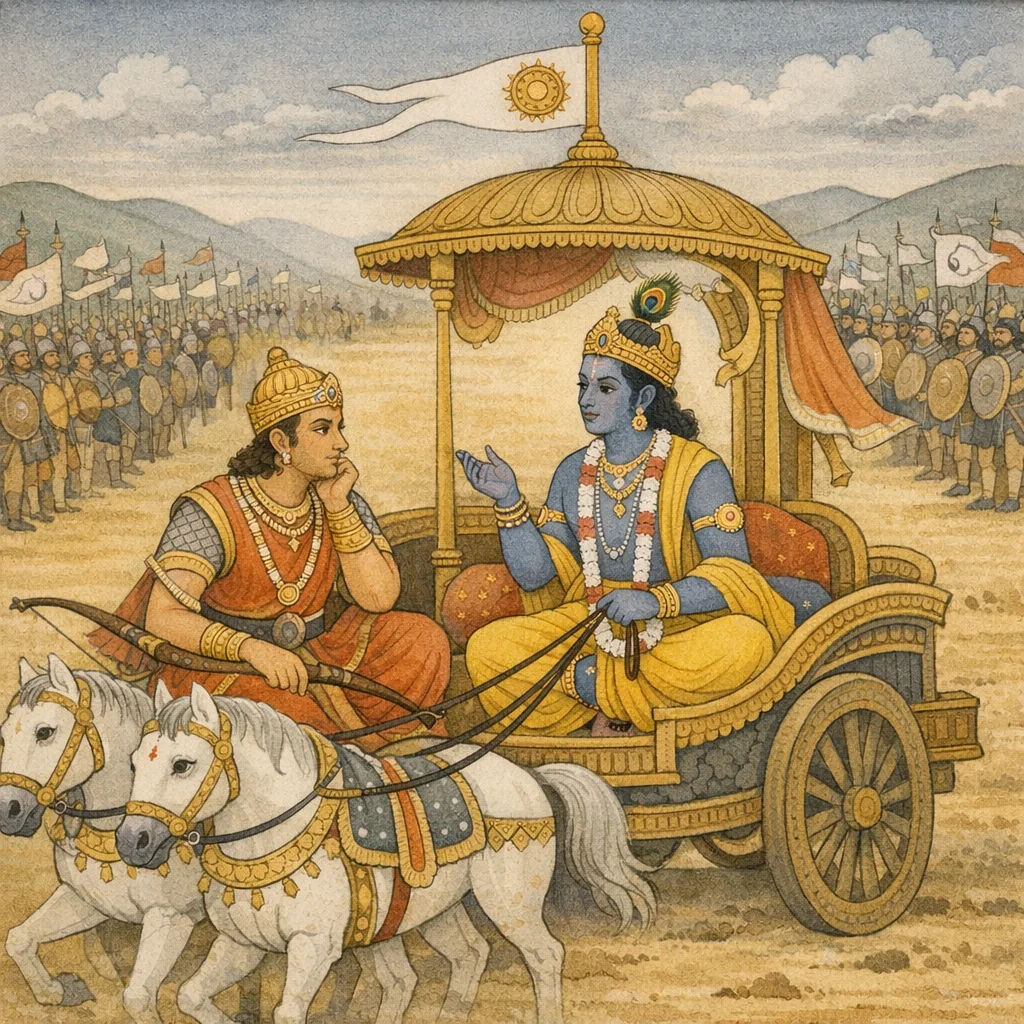
अर्जुन उवाच । ज्यायसी चेत्कर्मणस्ते मता बुद्धिर्जनार्दन तत्किं कर्मणि घोरे मां नियोजयसि केशव ॥ ३.१ ॥
arjuna uvāca | jyāyasī cet karmaṇas te matā buddhir janārdana tat kiṁ karmaṇi ghore māṁ niyojayasi keśava || 3.1 ||

Arjuna nói: Nếu Ngài cho rằng trí tuệ (buddhi) cao hơn hành động, hỡi Janārdana, vậy vì sao Ngài lại thúc giục con dấn thân vào hành động khốc liệt này, hỡi Keśava?
Arjuna said: If You consider knowledge (buddhi) superior to action, O Janārdana, then why do You urge me to engage in this difficult action, O Keśava?
Arjuna said: If, in your view, understanding is better than action, O Janārdana, then why do you enjoin me upon such arduous action, O Keśava?
Karmaṇi ghore is commonly rendered ‘terrible’ or ‘dreadful’; in context it can be read as ‘formidable/arduous duty’ within a martial-social setting, or more broadly as demanding ethical action under pressure.
FAQs
Arjuna articulates cognitive dissonance: he hears praise of inner wisdom yet faces a demanding obligation, prompting a need for an integrated framework.
The question sets up the Gītā’s synthesis: insight is not necessarily opposed to action; later verses argue for action informed by non-attachment and right understanding.
This opens Chapter 3 by challenging the apparent hierarchy implied in Chapter 2, pressing Krishna to reconcile jñāna-oriented teaching with prescribed duty.
It parallels dilemmas where reflective ideals seem to conflict with practical responsibilities—e.g., whether to withdraw or to act in complex social situations.