
Shloka 6
Akshara Brahma Yoga — Akshara Brahma Yoga
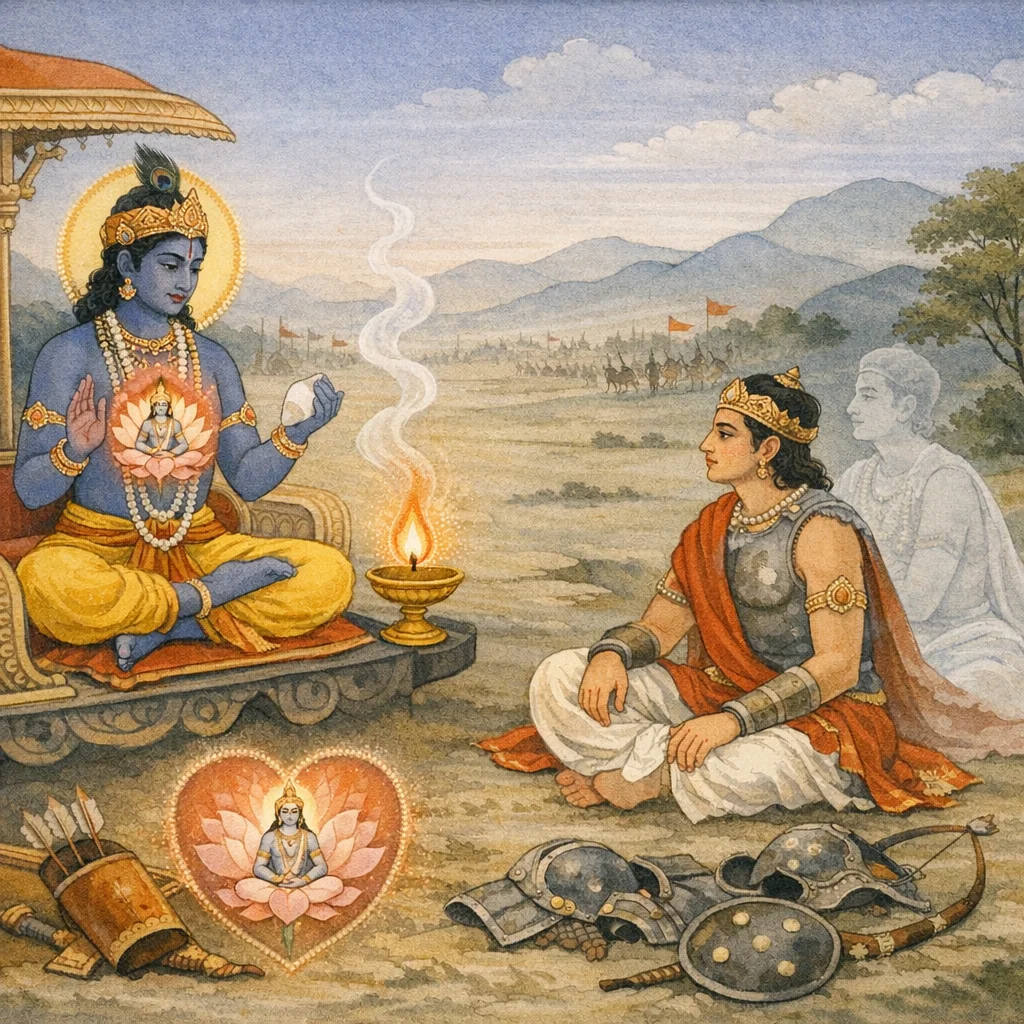
यं यं वापि स्मरन्भावं त्यजत्यन्ते कलेवरम् । तं तमेवैति कौन्तेय सदा तद्भावभावितः ॥ ८.६ ॥
yaṁ yaṁ vāpi smaran bhāvaṁ tyajaty ante kalevaram | taṁ tam evaiti kaunteya sadā tadbhāvabhāvitaḥ || 8.6 ||

Bất cứ trạng thái nào người ta nhớ đến khi lìa bỏ thân xác vào lúc cuối, hỡi con của Kuntī, người ấy đạt đến chính trạng thái ấy, vì luôn được hun đúc bởi trạng thái đó.
Whatever state one remembers when leaving the body at the end, that very state one attains, O son of Kuntī, being constantly shaped by that state.
A general psychological-metaphysical rule is stated: the remembered 'bhāva' (dominant state/disposition/object of identification) at death conditions the trajectory one reaches thereafter, because one has been habitually formed by that orientation.
'Bhāva' ranges in meaning from emotion and disposition to object of meditation. Commentarial traditions connect it to saṁskāra (habit-traces), explaining why the last thought is not accidental but the culmination of lifelong conditioning.
FAQs
It anticipates a habit-based model of mind: attention repeatedly returns to what has been practiced, so long-term dispositions predict what becomes salient in critical moments.
The verse links mental orientation with ontological outcome, expressing a continuity thesis between consciousness and future embodiment or state.
It generalizes 8.5: remembrance of Kṛṣṇa leads to Kṛṣṇa, but the same mechanism applies to any dominant identification.
Supports the practical idea that repeated focus—values, skills, contemplations—shapes identity and responses under pressure.