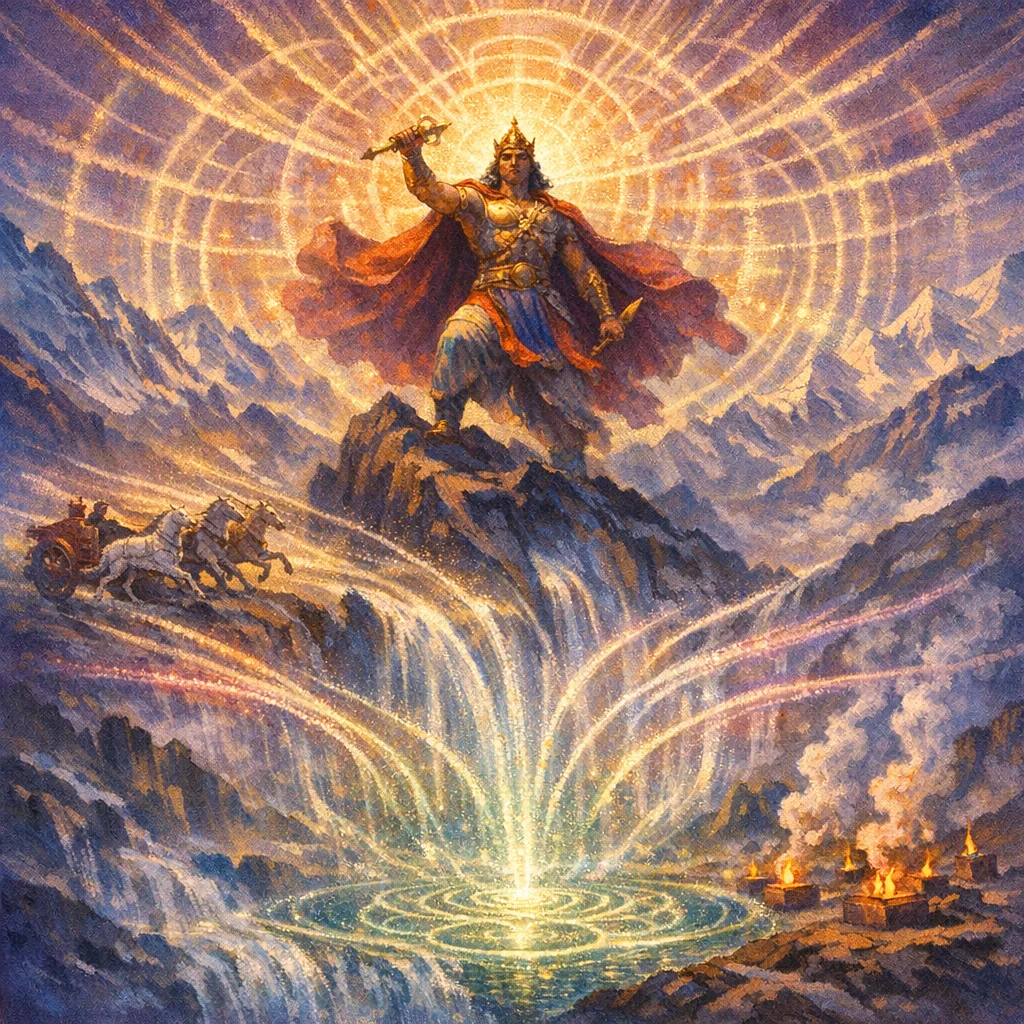
Dashati 5
Aindra victory and wealth secured through Soma’s purifying flow and Indra-invocation
Indra
Heroic and exultant with a bright forward-driving sacrificial urgency
R̥ṣi attribution is not provided in the input; thematically the verses sit in the Indra–Soma/Pavamāna sphere common to Soma liturgy rather than a clearly marked single family here.
Soma pressing and purification (pavamāna) oriented toward empowering Indra’s reception of the oblation and the resulting dakṣiṇā/prosperity
Mantras
Mantra 1
प्र सेनानीः शूरो अग्रे रथानां गव्यन्नेति हर्षते अस्य सेना भद्रान्कृण्वन्निन्द्रहवान्त्सखिभ्य आ सोमो वस्त्रा रभसानि दत्ते
Forth goes the leader of hosts, the hero, in front of the chariots, seeking cattle; his host exults; making auspicious (things), invoking Indra, Soma gives to his friends swift (gifts), even garments.
Mantra 2
प्र ते धारा मधुमतीरसृग्रन्वारं यत्पूतो अत्येष्यव्यम् पवमान पवसे धाम गोनां जनयन्त्सूर्यमपिन्वो अर्कैः
Forth have flowed thy honeyed streams, when, purified, thou passest beyond the woollen strainer; purifying Soma, thou flowest to the station, producing cattle (wealth); thou fillest (the rite) with splendour, strengthened by hymns.
Mantra 3
प्र गायताभ्यर्चाम देवान्त्सोमं हिनोत महते धनाय स्वादुः पवतामति वारमव्यमा सीदतु कलशं देव इन्दुः
Sing forth; let us praise the gods; urge on the Soma for great wealth: let the sweet (Soma) purify, passing beyond the woollen strainer; let the divine Indu take his seat in the pitcher.
Mantra 4
प्र हिन्वानो जनिता रोदस्यो रथो न वाजं सनिषन्नयासीत् इन्द्रं गच्छन्नायुधा संशिशानो विश्वा वसु हस्तयोरादधानः
Urged onward, the generator of heaven and earth advances, like a chariot winning the prize of strength; going unto Indra, sharpening his weapons, he bestows all riches into the hands (of the sacrificers).
Mantra 5
तक्षद्यदी मनसो वेनतो वाग्ज्येष्ठस्य धर्मं द्युक्षोरनीके आदीमायन्वरमा वावशाना जुष्टं पतिं कलशे गाव इन्दुम्
He fashioned, whether from the longing mind or from desire, the ordinance of the chief (Indra) in the bright face of heaven; the eager, well-moving (agents) drew near; the cows (of the rite) in the vessel (received) the acceptable lord, the radiant Soma.
Mantra 6
साकमुक्षो मर्जयन्त स्वसारो दश धीरस्य धीतयो धनुत्रीः हरिः पर्यद्रवज्जाः सूर्यस्य द्रोणं ननक्षे अत्यो न वाजी
The bull with his companions—his ten sisters—cleanse him; the devout thoughts of the wise are weapon-bearing: the tawny (Soma) courses around, and reaches the Sun’s trough, like a swift steed (that wins) the prize.
Mantra 7
अधि यदस्मिन्वाजिनीव शुभः स्पर्धन्ते धियः सूरे न विशः अपो वृणानः पवते कवीयन्व्रजं न पशुवर्धनाय मन्म
When, over him, like a splendid prize-winning steed, the devout thoughts contend; when, as men (gather) to the Sun, he chooses the waters, the most sage (Soma) flows, (bringing) the stall, as it were, for the increase of cattle—(such is) the hymn.
Mantra 8
इन्दुर्वाजी पवते गोन्योघा इन्द्रे सोमः सह इन्वन्मदाय हन्ति रक्षो बाधते पर्यरातिं वरिवस्कृण्वन्वृजनस्य राजा
The bright Soma, bestower of strength, flows purified, bringing kine; for Indra the Soma, aiding (him) together (with might), for exhilaration: he slays the Rakṣas, he repels surrounding hostility, making ample room, the king of the worshippers.
Mantra 9
अया पवा पवस्वैना वसूनि मांश्चत्व इन्द्रो सरसि प्र धन्व ब्रघ्नश्चिद्यस्य वातो न जूतिं पुरुमेधाश्चित्तकवे नरं धात्
Flow, be purified by this (path); bring riches, both to me and to thee: let Indra, in the basin, impel (them) forth; he whose impulse is as the wind’s—though (he be) even Braghna, though even Purumedhas—may he bestow (wealth) upon the patron.
Mantra 10
महत्तत्सोमो महिषश्चकारापां यद्गर्भो ऽवृणीत देवान् अदधादिन्द्रे पवमान ओजो ऽजनयत्सूर्ये ज्योतिरिन्दुः
Great is that which Soma, the mighty one, hath done: the embryo of the waters chose the gods; purified, he deposited strength in Indra; the bright drop generated light in the Sun.
Mantra 11
असर्जि वक्वा रथ्ये यथाजौ धिया मनोता प्रथमा मनीष दश स्वसारो अधि सानो अव्ये मृजन्ति वह्निं सदनेष्वच्छ
He hath been sent forth, swift as upon a chariot-course in the race, by devotion—the foremost hymn: the ten sisters, when he is laid upon the sheep’s-wool, cleanse the bearer, (sending him) towards the stations.
Mantra 12
अपामिवेदूर्मयस्तर्त्तुराणाः प्र मनीषा ईरते सोममच्छ नमस्यन्तीरुप च यन्ति सं चाच विशन्त्युशतीरुशन्तम्
Like the waves of waters hastening, the hymns arise and proceed towards Soma; adoring, they draw near, and entering together, eager (they seek) the desired (Soma).
Frequently Asked Questions
They link Indra’s power to win victory and cattle with Soma’s purified flow: the offering is prepared, praised, and directed so Indra is effectively drawn to grant success and rewards.
These are ritual-poetic images for Indra’s triumph and wealth-bestowal. “Seeking cattle” signals prosperity gained through Indra’s favor, not merely a battlefield scene.
As Soma is purified through waters, the priests’ praises also ‘move’ toward the offering—converging in sound and intent—so the rite becomes a unified current carrying the oblation to the gods.