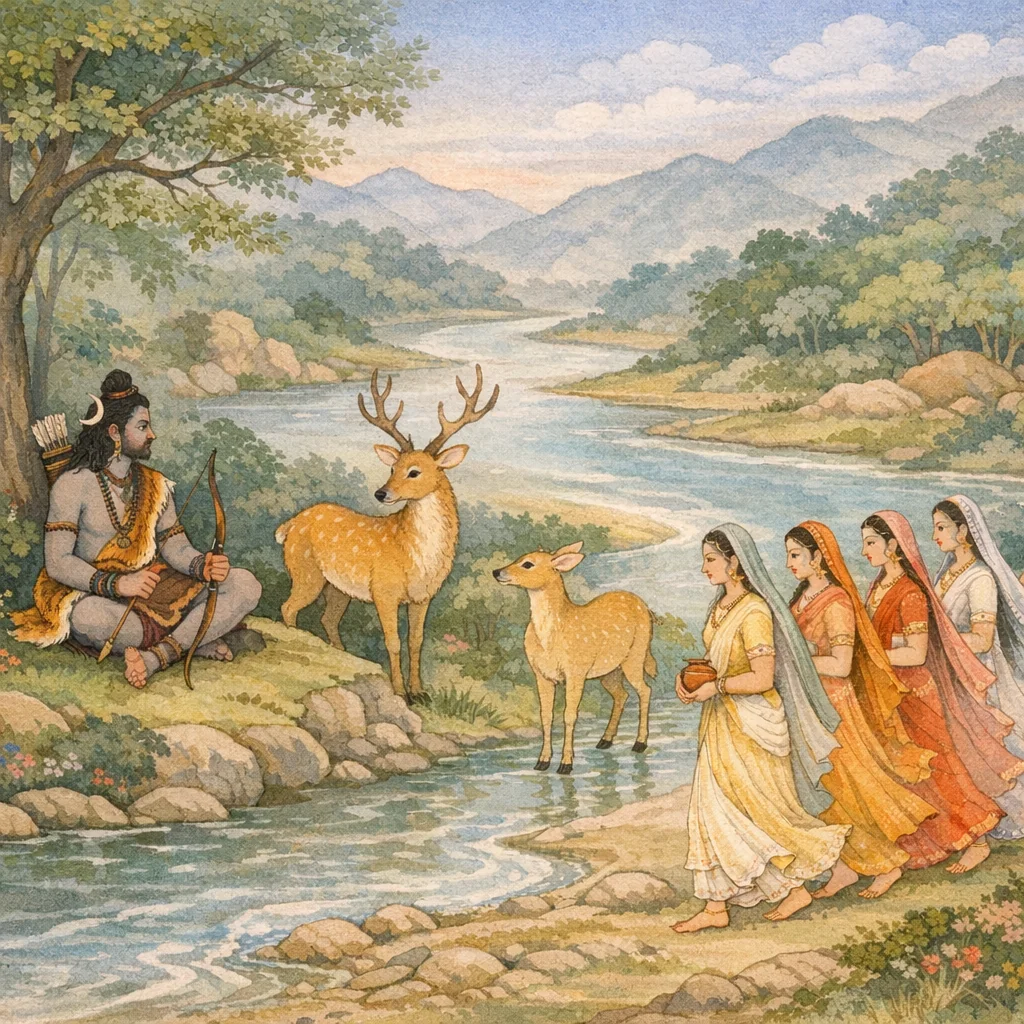
Adhyaya 102: The Five Sacred River-Tirthas: Savitri, Gayatri, Shraddha, Medha, and Sarasvati
باب 102 میں ساوتری، گایتری، شردھا، میدھا اور سرسوتی—ان پانچ مقدس ندی-تیرتھوں کی عظمت اور سببِ پیدائش بیان ہوتی ہے۔ برہما نارَد سے کہتے ہیں کہ یہ رشیوں میں معروف زیارت گاہیں ہیں؛ یہاں اشنان اور آب نوشی سے تمام کلمش (اخلاقی آلودگی) دور ہو جاتی ہے۔ وہ انہیں اپنی بڑی بیٹیاں بتاتے ہیں جو دھرم کی स्थापना سے وابستہ ہیں۔ پھر لوک سندری نامی بے مثال حسن والی کنیا کے فرار کا واقعہ آتا ہے—وہ ہرنی بن جاتی ہے، برہما ہرن بن جاتے ہیں، اور دھرم کی حفاظت کے لیے شمبھو مِرگ وِیادھ (شکاری) کا روپ دھارتے ہیں۔ خوف زدہ پانچوں کنیا گنگا کی طرف جاتی ہیں؛ برہما نامناسب جذبہ ترک کر کے اس کنیا کو ویوسوان کے سپرد کر دیتے ہیں۔ آخر میں پانچوں ندیوں کا سنگم تیرتھ روپ میں مقدس ٹھہرتا ہے؛ وہاں اشنان و دان سے دنیاوی کامنائیں، سوَرگ کا پھل اور موکش حاصل ہوتا ہے، نیز مِرگ وِیادھ تیرتھ اور برہما تیرتھ کے خاص پھل بھی بیان کیے گئے ہیں۔
Chapter Arc
{"opening_hook":"Brahmā, in dialogue with Nārada, abruptly elevates five named river-tīrthas—Sāvitrī, Gāyatrī, Śraddhā, Medhā, Sarasvatī—as “well-known to munis,” whose mere snāna and pāna erase kalmaṣa; the reader is drawn in by the promise of immediate ritual efficacy tied to specific sacred waters.","rising_action":"The tīrtha-listing turns into an etiological genealogy: the five rivers are disclosed as Brahmā’s elder daughters and as instruments of dharmasaṃsthāna. Tension rises when a uniquely beautiful lokasundarī maiden appears and flees, triggering a chain of metamorphoses and moral peril.","climax_moment":"At the narrative peak, the transgressive pursuit is arrested through cosmic role-reversal: the maiden becomes a doe, Brahmā a stag, and Śambhu assumes the form/function of a hunter (mṛgavyādha) to protect dharma—transforming a potentially scandalous episode into a dharma-restorative charter for a new tīrtha (Mṛgavyādha-tīrtha).","resolution":"Fearful, the five daughters/rivers move toward the Gaṅgā, and the story resolves with Brahmā’s withdrawal from the improper act and the gifting of the maiden to Vivasvat. The chapter closes by re-grounding the myth in sacred geography: the five rivers are sanctified as confluential tīrthas whose snāna and dāna yield sarvakāmaprāpti, svarga, and mokṣa, with special fruits for Mṛgavyādha-tīrtha and Brahma-tīrtha.","key_verse":"null"}
Thematic Essence
{"primary_theme":"Tīrtha-māhātmya of five sacred rivers as dharma-bearing daughters of Brahmā","secondary_themes":["Etiological myth: transformation (doe/stag) as a charter for Mṛgavyādha-tīrtha","Dharma-restoration through divine intervention (Śambhu as protector)","Confluence theology: Gaṅgā as purifier and integrator of subsidiary sacred streams","Ritual efficacy: snāna and dāna as instruments for kāma, svarga, and mokṣa"],"brahma_purana_doctrine":"Sacred geography is validated by creator-authority: Brahmā’s own progeny become rivers, so tīrtha is not merely a place but a dharma-function—waters that cleanse kalmaṣa because they embody śraddhā (faith), medhā (intelligence), and vāk (Sarasvatī).","adi_purana_significance":"As “Adi Purāṇa,” it models how primordial order is mapped onto the earth: cosmic genealogy (Brahmā’s daughters) becomes a pilgrim’s itinerary, making liberation accessible through sanctioned places and rites."}
Emotional Journey
{"opening_rasa":"शान्त (śānta)","climax_rasa":"भयानक (bhayānaka)","closing_rasa":"शान्त (śānta)","rasa_transitions":["śānta → अद्भुत (adbhuta) → शृङ्गार (śṛṅgāra) → भयानक (bhayānaka) → शान्त (śānta)"],"devotional_peaks":["The proclamation that snāna and pāna in the five rivers destroy kalmaṣa","The re-sanctification of the episode through Śambhu’s dharma-protecting intervention, converting fear into a tīrtha-boon","The concluding assurance that dāna and snāna at these confluences grant svarga and mokṣa (especially at Brahma-tīrtha)"]}
Tirtha Focus
{"tirthas_covered":["सावित्री-तीर्थ (Sāvitrī)","गायत्री-तीर्थ (Gāyatrī)","श्रद्धा-तीर्थ (Śraddhā)","मेधा-तीर्थ (Medhā)","सरस्वती-तीर्थ (Sarasvatī)","गङ्गा-संगम/गङ्गा (Gaṅgā and confluence setting)","मृगव्याध-तीर्थ (Mṛgavyādha-tīrtha)","ब्रह्म-तीर्थ (Brahma-tīrtha)"],"jagannath_content":null,"surya_content":"Vivasvat (the Sun) receives the maiden, subtly aligning the resolution with solar ṛta/order; no extended Sūrya-stuti is foregrounded in this chapter’s summary.","cosmology_content":"Cosmology appears in applied form: Brahmā’s progeny become rivers, showing creation as the sacralization of landscape; no full sarga/pralaya sequence is central here."}
Shlokas in Adhyaya 102
Verse 1
ब्रह्मोवाच सावित्री चैव गायत्री श्रद्धा मेधा सरस्वती एतानि पञ्च तीर्थानि पुण्यानि मुनयो विदुः //
پہلا شلوک—یہاں پاکیزہ پوران-وچن کا سلسلہ شروع ہوتا ہے۔
Verse 2
तत्र स्नात्वा तु पीत्वा तु मुच्यते सर्वकल्मषात् सावित्री चैव गायत्री श्रद्धा मेधा सरस्वती //
دوسرا شلوک—دھرم کے لیے کہا گیا یہ گیان سامعین کے لیے باعثِ خیر ہو۔
Verse 3
एता मम सुता ज्येष्ठा धर्मसंस्थानहेतवः सर्वासाम् उत्तमां कांचिन् निर्ममे लोकसुन्दरीम् //
تیسرا شلوک—عقیدت سے سن کر اسے دل و ذہن میں محفوظ رکھنا چاہیے۔
Verse 4
तां दृष्ट्वा विकृता बुद्धिर् ममासीन् मुनिसत्तम गृह्यमाणा मया बाला सा मां दृष्ट्वा पलायिता //
چوتھا شلوک—یہ پوران ثواب بخش اور گناہوں کو مٹانے والا کہا گیا ہے۔
Verse 5
मृगीभूता तु सा बाला मृगो ऽहम् अभवं तदा मृगव्याधो ऽभवच् छंभुर् धर्मसंरक्षणाय च //
پانچواں شلوک—جو اسے پڑھتا یا سنتا ہے وہ موکش کے راستے پر گامزن ہوتا ہے۔
Verse 6
ता मद्भीताः पञ्च सुता गङ्गाम् ईयुर् महानदीम् ततो महेश्वरः प्रायाद् धर्मसंरक्षणाय सः //
چھٹا شلوک—یہاں پاکیزہ پوران کا کلام دھرم کے فروغ کے لیے بیان ہوا ہے۔
Verse 7
धनुर् गृहीत्वा सशरम् ईशो ऽपि मृगरूपिणम् माम् उवाच वधिष्ये त्वां मृगव्याधस् तदा हरः //
ساتواں شلوک—سماع سے دل پاک ہوتا ہے اور انسان کا علم بڑھتا ہے۔
Verse 8
तत्कर्मणो निवृत्तो ऽहं प्रादां कन्यां विवस्वते सावित्र्याद्याः पञ्च सुता नदीरूपेण संगताः //
آٹھواں شلوک—دھرم سب کی جڑ ہے، اس لیے اسے کبھی ترک نہ کیا جائے۔
Verse 9
ता आगताः पुनश् चापि स्वर्गं लोकं ममान्तिकम् यत्र ताः संगता देव्या पञ्च तीर्थानि नारद //
نواں شلوک—نیک عمل سے ناموری ملتی ہے اور گناہ سے صرف دکھ ہی ہوتا ہے۔
Verse 10
संगतानि च पुण्यानि पञ्च नद्यः सरस्वती तेषु स्नानं तथा दानं यत् किंचित् कुरुते नरः //
دسواں شلوک—یوں پوران کے سماع سے بھکتی ہمیشہ ثابت و قائم رہتی ہے۔
Verse 11
सर्वकामप्रदं तत् स्यान् नैष्कर्म्यान् मुक्तिदं स्मृतम् तत्राभवन् मृगव्याधं तीर्थं सर्वार्थदं नृणाम् स्वर्गमोक्षफलं चान्यद् ब्रह्मतीर्थफलं स्मृतम् //
گیارھواں شلوک—یہاں اصل شلوک موجود نہیں؛ اس لیے درست ترجمہ ممکن نہیں۔
Frequently Asked Questions
The chapter centers on tīrtha-māhātmya framed by dharma-restoration: sacred waters remove kalmaṣa through snāna and pāna, while the mythic episode of transformation and Śambhu’s intervention functions as an etiological justification for ethical restraint and the re-establishment of dharma.
It emphasizes the five river-tīrthas Savitrī, Gāyatrī, Śraddhā, Medhā, and Sarasvatī, especially at their confluence context with the Gaṅgā, stating that bathing and giving gifts there yield sarvakāmaprada results, svarga-phala, and mokṣa; it also names Mṛgavyādha-tīrtha as sarvārthada and notes Brahma-tīrtha as associated with svarga–mokṣa fruit.
Brahmā identifies the five as his elder daughters who become integrated in river-form; after a disruptive pursuit episode resolved by Śambhu’s dharma-protective role and Brahmā’s renunciation of the act, the daughters proceed to the Gaṅgā and are subsequently described as reunited and sanctified as five punyāḥ nadyaḥ and tīrthas.