
Shloka 32
Sankhya Yoga — The Yoga of Knowledge
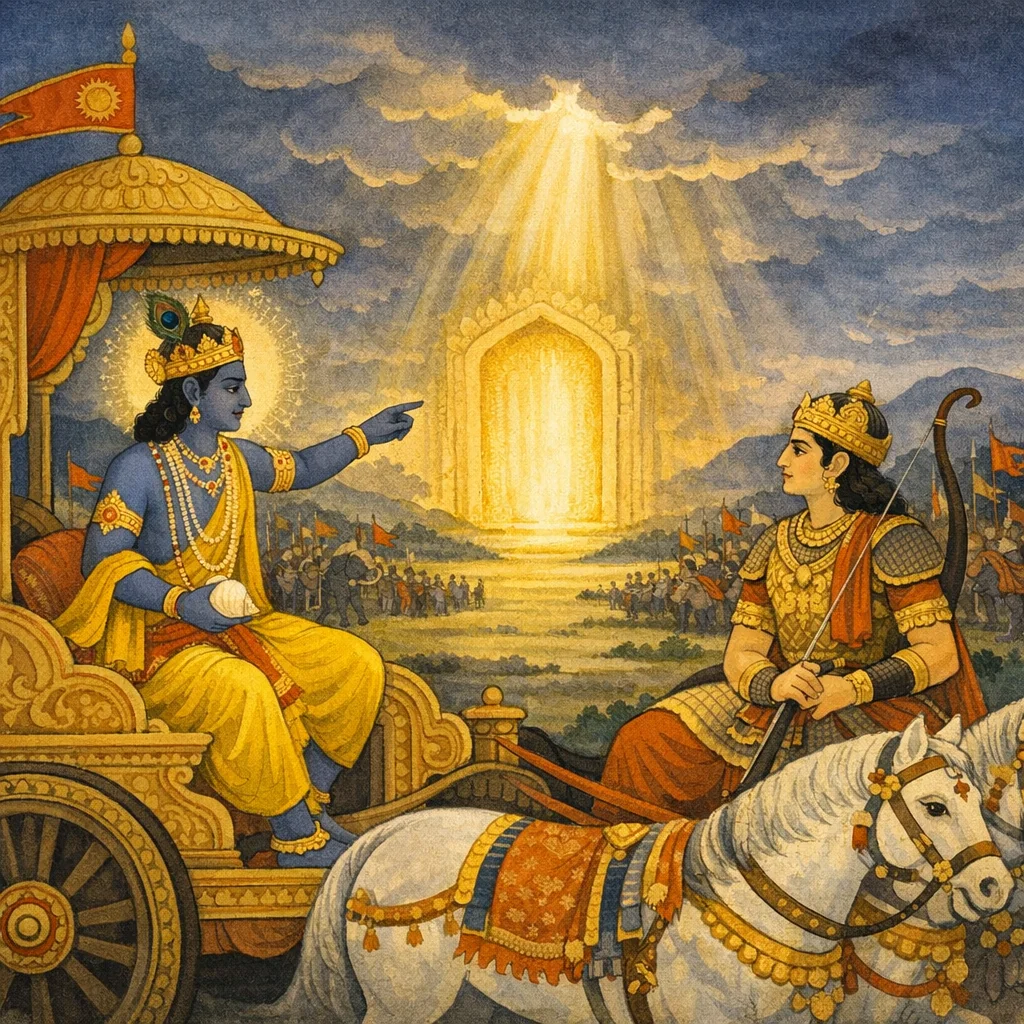
यदृच्छया चोपपन्नं स्वर्गद्वारमपावृतम् । सुखिनः क्षत्रियाः पार्थ लभन्ते युद्धमीदृशम् ॥ २.३२ ॥
yadṛcchayā copapannaṁ svargadvāram apāvṛtam | sukhinaḥ kṣatriyāḥ pārtha labhante yuddham īdṛśam || 2.32 ||

O Pārtha, blessed are the kṣatriyas who obtain such a battle that comes unsought, as an opened gate to heaven.
O Partha, happy are the warriors who obtain such a battle that comes of itself, as an open gate to heaven.
And such a conflict, arrived at by chance—as if an opened gateway to heaven—fortunate are the kṣatriyas, O Pārtha, who obtain it.
“Heaven” (svarga) is often read as the epic’s idiom for honor and posthumous merit; modern readings may treat it as a culturally situated incentive rather than a universal claim.
FAQs
It uses culturally resonant motivation—honor and meaningful purpose—to counter demoralization and withdrawal.
The verse operates mainly within a moral-cosmological framework of merit (puṇya) and reward (svarga), rather than nondual metaphysics.
Krishna appeals to Arjuna’s identity as a kṣatriya in the Mahābhārata milieu, where a just contest could be framed as spiritually and socially significant.
It may be read metaphorically as recognizing moments when ethical responsibility presents itself clearly, calling for courageous engagement rather than avoidance.