
Bhagavad Gita — Moksha Sannyasa Yoga, Shloka 61
Moksha Sannyasa Yoga
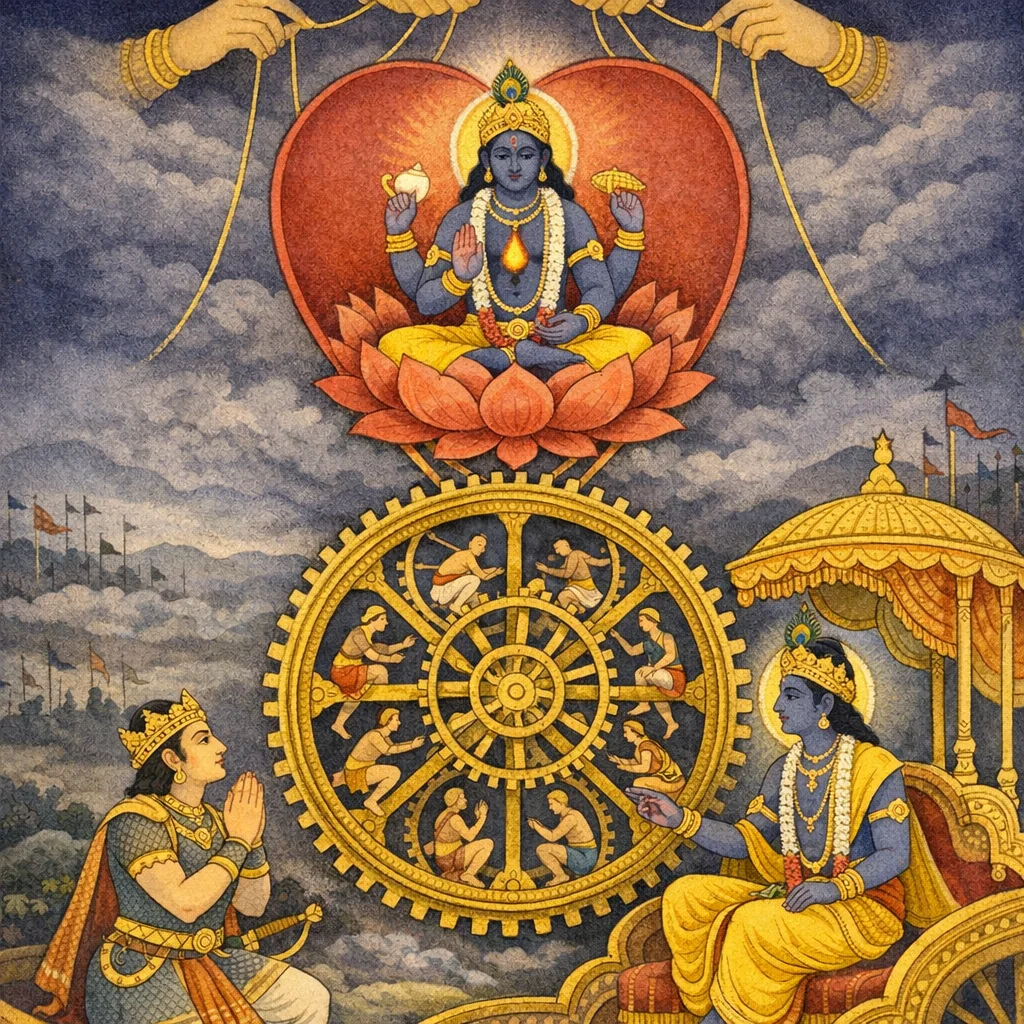
ईश्वरः सर्वभूतानां हृद्देशेऽर्जुन तिष्ठति । भ्रामयन्सर्वभूतानि यन्त्रारूढानि मायया ॥ १८.६१ ॥
īśvaraḥ sarvabhūtānāṁ hṛddeśe 'rjuna tiṣṭhati | bhrāmayan sarvabhūtāni yantrārūḍhāni māyayā || 18.61 ||

O Arjuna, the Lord abides in the heart-region of all beings, causing all beings to revolve by His māyā, as though mounted on a machine.
हे अर्जुन! ईश्वर समस्त प्राणियों के हृदय में स्थित है और अपनी माया से उन्हें यंत्र पर आरूढ़ की भाँति घुमाता है।
The Lord abides in the heart-region of all beings, O Arjuna, causing all beings to revolve, as if mounted on a machine, by (his) māyā.
The ‘machine’ (yantra) metaphor is interpreted variously: as the body-mind apparatus, or the causal network of guṇas and karma. ‘Māyā’ here often denotes divine power of manifestation and governance rather than illusion in a purely epistemic sense; schools differ on whether this implies determinism or a compatibilist model.
FAQs
The ‘machine’ image can be read as a model of how cognition and behavior are shaped by built-in tendencies and situational forces, encouraging humility and careful self-observation.
It asserts an indwelling divine principle coordinating the motion of embodied beings. Interpretations range from strong providential control to a view where divine presence underwrites order while individuals retain responsibility within karmic law.
As Krishna concludes his instruction, he situates Arjuna’s decision within a larger metaphysical framework: individual action occurs within divine immanence and the conditioned dynamics of prakṛti.
It can function as a contemplative prompt: treat the mind-body as an instrument that can be trained, and cultivate a sense of accountability coupled with awareness of systemic influences.