
Bhagavad Gita — Gunatraya Vibhaga Yoga, Shloka 15
Gunatraya Vibhaga Yoga
रजसि प्रलयं गत्वा कर्मसङ्गिषु जायते । तथा प्रलीनस्तमसि मूढयोनिषु जायते ॥ १४.१५ ॥
rajasi pralayaṁ gatvā karmasaṅgiṣu jāyate | tathā pralīnas tamasi mūḍhayoniṣu jāyate || 14.15 ||

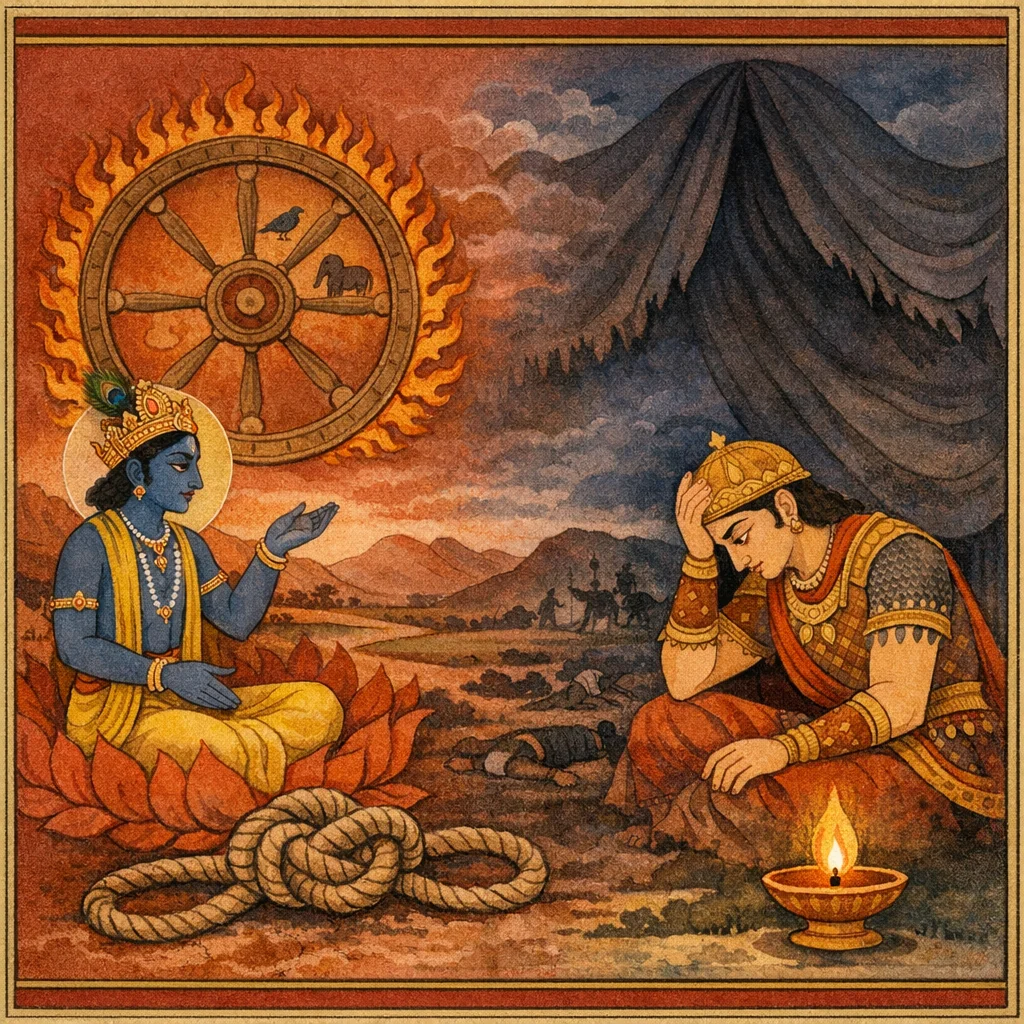
Meeting dissolution in rajas, one is born among those attached to action; likewise, dying in tamas, one is born in deluded wombs.
Meeting death in rajas, one is born among those attached to action; likewise, dying in tamas, one is born in deluded wombs (bewildered forms of birth).
Having reached death while rajas predominates, one is born among those bound by attachment to acts; similarly, one who dies while tamas predominates is born in confused/benighted origins of birth.
‘Mūḍhayoni’ is variously rendered as ‘deluded wombs,’ ‘bewildered births,’ or ‘lower/ignorant forms of birth’; many modern interpreters soften hierarchical readings by emphasizing cognitive-ethical ‘confusion’ rather than a fixed biological ranking.
FAQs
The verse suggests continuity of dominant tendencies: restless attachment to doing (rajas) and confused inertia (tamas) reproduce similar environments and habits.
In a rebirth framework, guṇa-dominance at death conditions the next embodiment, aligning one with communities or life-conditions resonant with one’s prevailing dispositions.
Paired with 14.14, it completes the mapping of post-mortem outcomes for the three guṇas (sattva, rajas, tamas).
Read metaphorically, it highlights how entrenched patterns—compulsive striving or disengaged confusion—tend to recreate similar social and psychological ‘worlds’ over time.