
Shloka 44
Dhyana Yoga — Atma Samyama Yoga
पूर्वाभ्यासेन तेनैव ह्रियते ह्यवशोऽपि सः । जिज्ञासुरपि योगस्य शब्दब्रह्मातिवर्तते ॥ ६.४४ ॥
pūrvābhyāsena tenaiva hriyate hy avaśo 'pi saḥ | jijñāsur api yogasya śabdabrahmātivartate || 6.44 ||

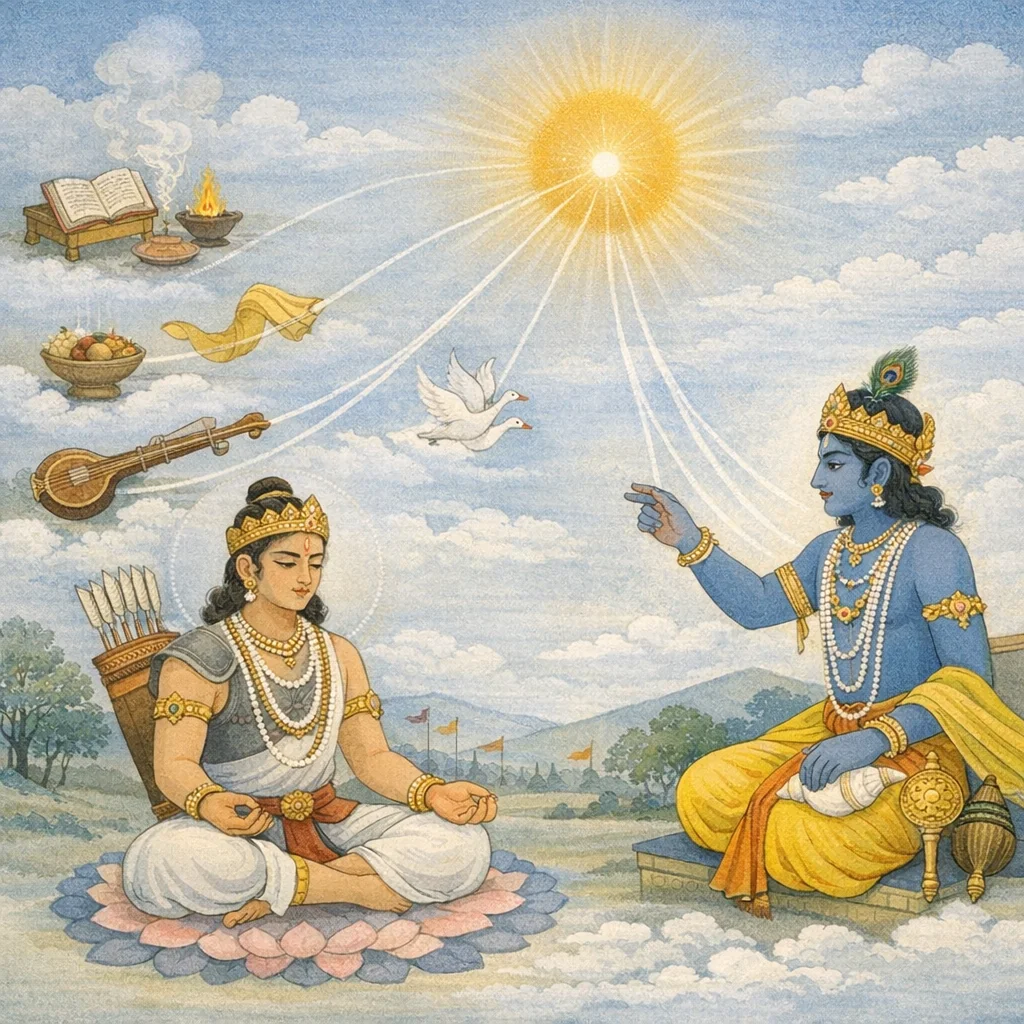
By that very former practice, he is indeed borne onward, even against his will; and even one who merely longs to know Yoga transcends the realm of the Vedic word (ritualistic injunctions).
“By that very previous practice he is carried forward even unwillingly; even one who merely seeks to know yoga goes beyond the Vedic word (ritual portion).”
“By that prior practice alone he is drawn onward, even without full control; even an inquirer into yoga surpasses śabda-brahman (Brahman as sacred word/recitation).”
‘śabda-brahman’ is interpreted traditionally as the Veda, especially its ritual/phonetic authority; some academic readings gloss it as ‘Brahman in the form of sound’ (scriptural formulation). The verse contrasts inquiry/practice with mere verbal-ritual religiosity.
FAQs
It describes motivational inertia in a positive sense: once internalized, a discipline can reassert itself and guide behavior even after setbacks.
It suggests that experiential pursuit of yoga can transcend reliance on sacred formulations alone, orienting the practitioner toward direct realization.
Kṛṣṇa strengthens the reassurance: not only is there no ruin, but prior practice actively propels the aspirant forward.
It can be read as privileging practice and insight over mere recitation or external conformity—learning by doing rather than only by repeating formulas.