
Shloka 21
Dhyana Yoga — Atma Samyama Yoga
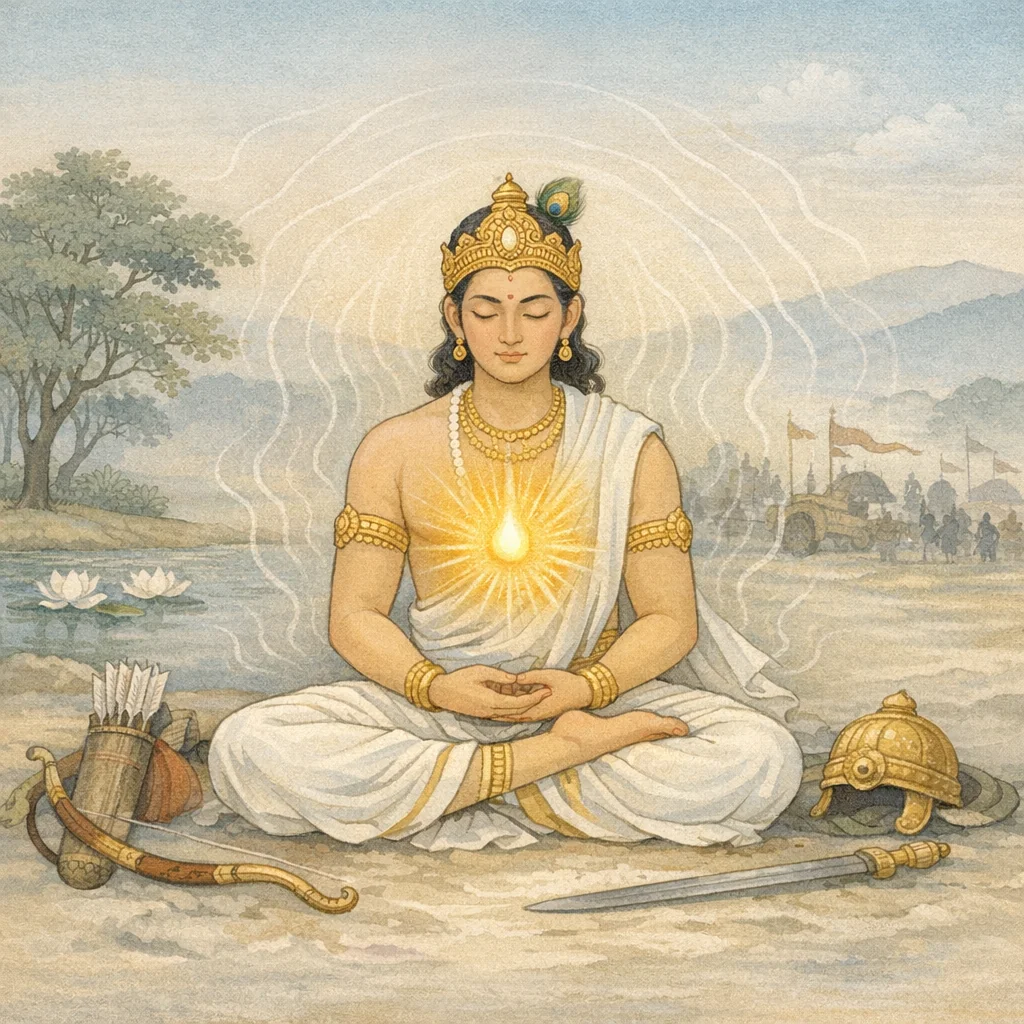
सुखमात्यन्तिकं यत्तद् बुद्धिग्राह्यमतीन्द्रियम् । वेत्ति यत्र न चैवायं स्थितश्चलति तत्त्वतः ॥ ६.२१ ॥
sukham ātyantikaṁ yat tad buddhigrāhyam atīndriyam | vetti yatra na caivāyaṁ sthitaś calati tattvataḥ || 6.21 ||

That supreme bliss which is grasped by the intellect and is beyond the senses—knowing which, one established therein does not swerve from the Reality.
जो सुख अत्यन्त (निरतिशय) है, जो बुद्धि द्वारा ग्रहण करने योग्य है और इन्द्रियों से परे है—जिसमें (योगी) जानता है; और जिसमें स्थित होकर यह (योगी) तत्त्व से कभी विचलित नहीं होता।
That ultimate happiness which is grasped by the intellect and is beyond the senses—there one knows (it); and established there, one does not depart from reality (tattvataḥ).
Some translations take ‘बुद्धिग्राह्यम्’ as ‘known by discriminative insight’ rather than discursive reasoning. ‘न ... चलति तत्त्वतः’ is read either as ‘does not swerve from the truth’ or ‘does not waver in essence,’ both emphasizing stability in realized understanding.
FAQs
The verse distinguishes durable well-being from sensory pleasure: it is not dependent on stimulation, and thus is less vulnerable to mood swings and circumstances.
‘Beyond the senses’ signals a level of experience tied to insight into reality (tattva), implying that the deepest fulfillment is connected with knowledge of the Self/ultimate principle.
It elaborates the experiential outcome of meditation described in 6.20: a stable, non-sensory happiness recognized through refined discernment.
Use it as a diagnostic: notice whether happiness is stimulus-dependent. Practices that cultivate clarity (reflection, meditation, ethical steadiness) support more stable well-being.