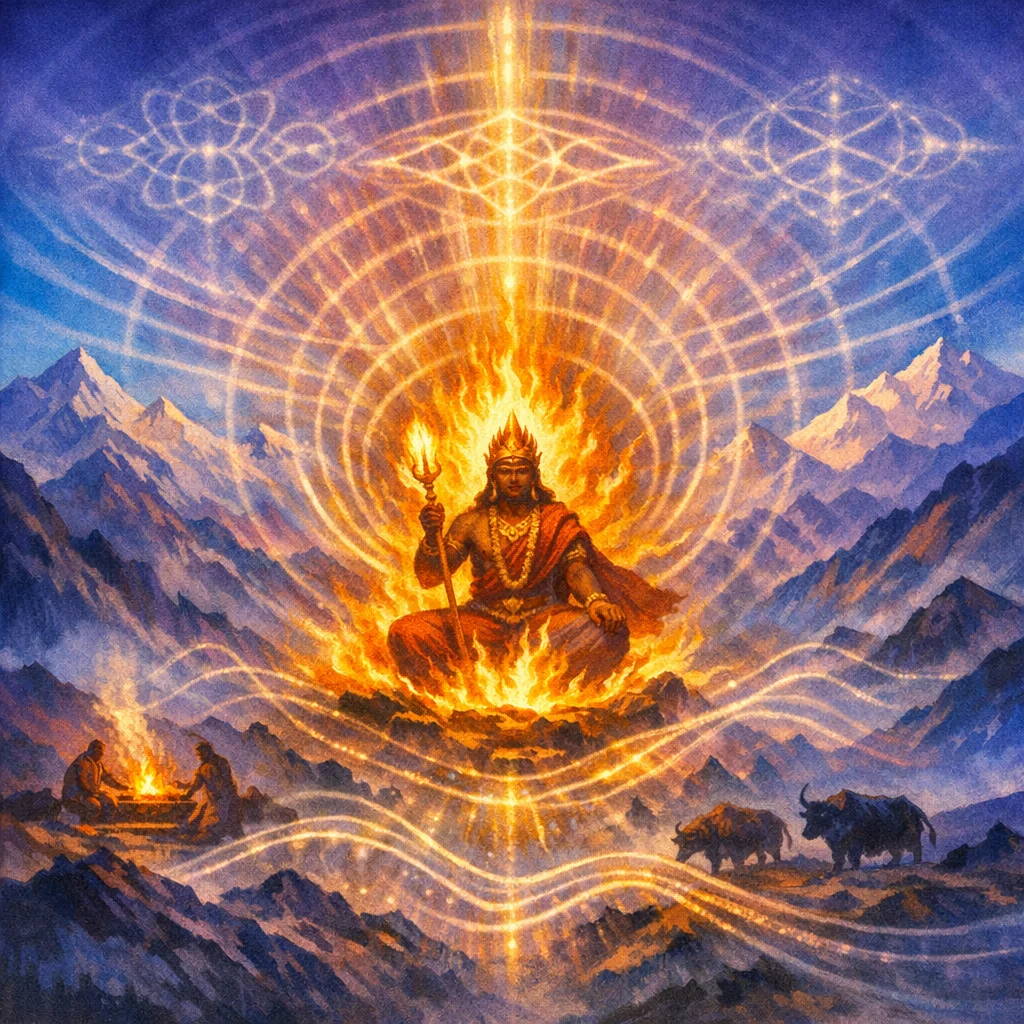
Dashati 9
Agni as the powerful guide of the sacrifice who grants safe passage to wealth, strength, and divine order (ṛta)
Agni
Invocatory and energizing—bright forceful praise aimed at stirring Agni’s beneficence
The dashati blends common Agni-hymn diction with a lineage/ordo statement (Śraddhā–Manu–Kaśyapa motif). Rṣi attributions can shift between Ṛgvedic source and Sāmavedic arrangement; confirm by śākhā-specific anukramaṇī.
Applicable in Soma liturgy where Agni is praised as the enabling power of the rite and the opener of the ‘path’ to the sacrificial reward; also suitable in Agni-oriented recitations preceding or supporting Soma pressing sequences.
Mantras
Mantra 1
अग्न ओजिष्ठमा भर द्युम्नमस्मभ्यमध्रिगो प्र नो राये पनीयसे रत्सि वाजाय पन्थाम्
Agni, bring unto us the strongest (succour), glory (and prosperity), that we may be uninjured; do thou grant us a path to excellent wealth, a path to the prize of strength.
Mantra 2
यदि वीरो अनु ष्यादग्निमिन्धीत मर्त्यः आजुह्वद्धव्यमानुषक्शर्म भक्षीत दैव्यम्
If a vigorous mortal be duly disposed, and kindle Agni, offering the oblation, then may he enjoy divine protection (though the act be) human.
Mantra 3
त्वेषस्ते धूम ऋण्वति दिवि सं च्छुक्र आततः सूरो न हि द्युता त्वं कृपा पावक रोचसे
Thy smoke, blazing, rises and spreads bright in the sky; for thou, O purifier, shinest in thy form with radiance like the sun.
Mantra 4
त्वं हि क्षैतवद्यशो ऽग्ने मित्रो न पत्यसे त्वं विचर्षणे श्रवो वसो पुष्टिं न पुष्यसि
For thou, Agni, rulest over earthly glory like Mitra; thou, O Vasu, among men increasest renown, and fosterest prosperity as (one fosters) nourishment.
Mantra 5
प्रातरग्निः पुरुप्रियो विष स्तवेतातिथिः विश्वे यस्मिन्नमर्त्ये हव्यं मर्तास इन्धते
In the morning let the people praise Agni, beloved of many, the guest; in whom, the immortal, mortals kindle the oblation.
Mantra 6
यद्वाहिष्ठं तदग्नये बृहदर्च विभावसो महिषीव त्वद्रयिस्त्वद्वाजा उदीरते
Chant thou, O radiant Agni, a great hymn unto him; for whatsoever is most desirable is for Agni: from thee, as from a mighty (bestower), wealth and invigorating prizes are elicited.
Mantra 7
विशोविशो वो अतिथिं वाजयन्तः पुरुप्रियम् अग्निं वो दुर्यं वचः स्तुषे शूषस्य मन्मभिः
Clan after clan, desiring to obtain the prize, (invite) for you Agni, the guest, beloved of many; him, your household (fire), I praise with words, with hymns (celebrating) his vigorous might.
Mantra 8
बृहद्वयो हि भानवे ऽर्चा देवायाग्नये यं मित्रं न प्रशस्तये मर्तासो दधिरे पुरः
Sing a lofty hymn to the shining god Agni, whose great vigour (is renowned); whom mortals have set foremost for praise, as (they would) a friend, even as Mitra.
Mantra 9
अगन्म वृत्रहन्तमं ज्येष्ठमग्निमानवम् य स्म श्रुतर्वन्नार्क्षे बृहदनीक इध्यते
We have approached Agni, the most potent slayer of the obstructer, the eldest, the beneficent; he who, renowned, of vast splendour, is kindled in the Nārkṣa (solemnity/rite).
Mantra 10
जातः परेण धर्मणा यत्सवृद्भिः सहाभुवः पिता यत्कश्यपस्याग्निः श्रद्धा माता मनुः कविः
Born by the higher ordinance, when he came into being together with his associates; Agni is the father of Kaśyapa; Faith is his mother; Manu is the sage (who institutes him).
Frequently Asked Questions
It asks Agni to bring the strongest help and glory, keep the sacrificer unharmed, and provide the effective ‘path’—right ritual means—leading to wealth (rāyas) and strength/prize (vāja).
The verse frames Agni’s role within higher ordinance (dharma/ṛta): faith is presented as the generative power of sacrifice, and Manu as the wise institutor who establishes the ritual order in which Agni functions.
They are sung by the Udgātṛ group in an Agni-focused stotra setting, with śākhā-specific melodic treatment (sāman) and typical Sāmavedic elongations/stobhas to fit the verses into the chant form.