Adhyaya 211: The Hunter Jarā, Krishna’s Final Līlā, and the Lord’s Ascension
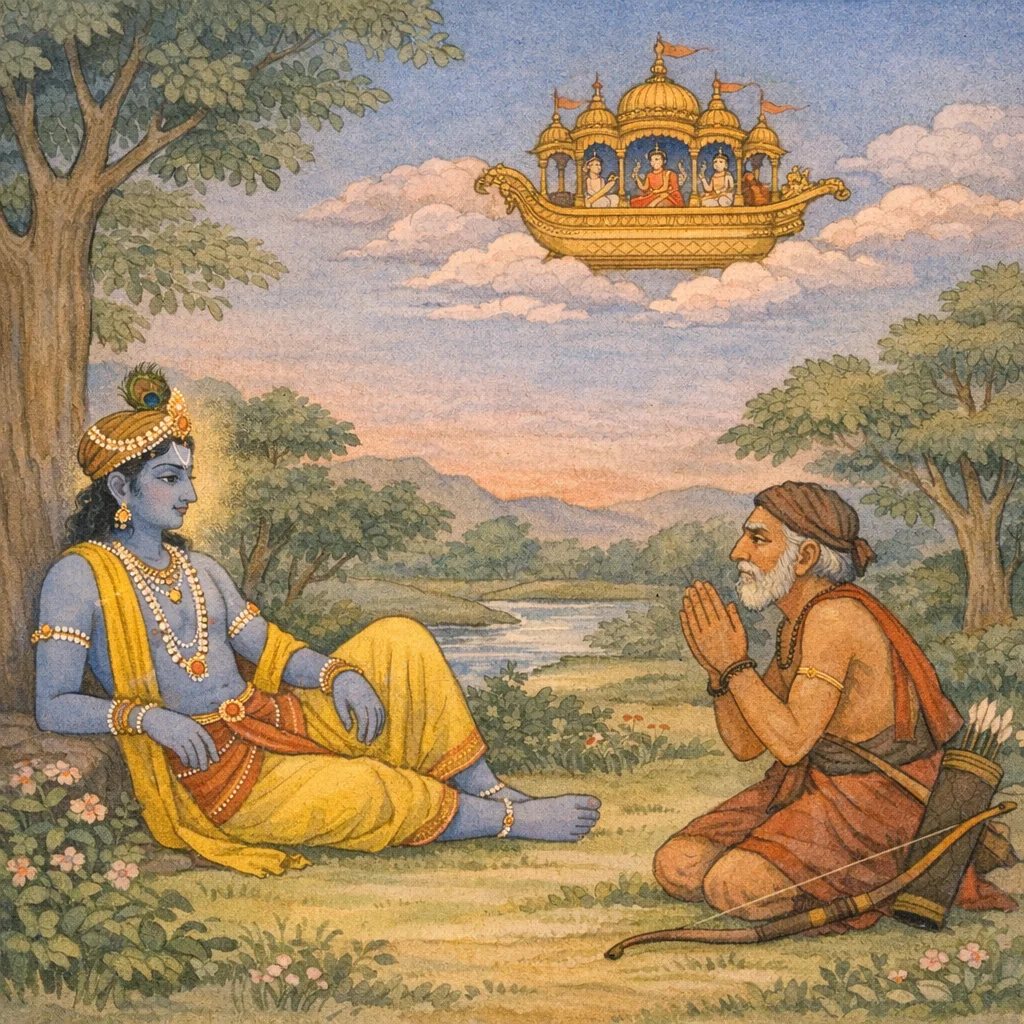
Isinasalaysay ng Adhyaya 211 ang huling pag-ikot ng makalupang līlā ni Kṛṣṇa at inilalagay ito sa pananaw na teolohikal ng kusang pag-urong tungo sa di-nasisirang Brahman. Si Dāruka, ayon sa utos ni Kṛṣṇa, ay nagtungo sa Dvārakā at dinala si Arjuna, kasama si Vajra na iniharap bilang tagapagmana ng kaharian. Pagkaraan, tumuon ang teksto sa panloob na gawain ni Govinda: ang pagpapanatili ng pinakamataas na prinsipyo ni Vāsudeva sa lahat ng nilalang. Bilang paggalang sa pahayag ng brāhmaṇa na si Durvāsas, umupo si Kṛṣṇa sa pusturang yogic. Sa sandaling iyon dumating ang mangangaso na si Jarā, may palasong may dulong metal na natira mula sa muśala; napagkamalan niyang usa ang paa ng Panginoon at tinamaan ito. Nang makita ang anyong may apat na bisig, paulit-ulit siyang humingi ng tawad at umamin sa kamangmangan. Pinatawad siya ni Kṛṣṇa at pinagkalooban ng agarang pag-akyat sa langit sa pamamagitan ng vimāna. Pagkatapos, pinag-isa ng Panginoon ang Sarili sa dalisay, di-maisip, di-nabubulok na Brahman—si Vāsudeva na lumalaganap sa lahat—at iniwan ang katawang-tao, tinamo ang tatluhang kapalarang lampas-sa-mundo.
Chapter Arc
{"opening_hook":"The chapter opens in the wake of the Yādava collapse: Dāruka, obeying Kṛṣṇa’s final directive, hastens toward Dvārakā to summon Arjuna, while Vajra is positioned as a continuity-figure for royal succession—an immediate narrative bridge from catastrophe to dharmic aftermath.","rising_action":"Attention turns inward: Govinda is portrayed as the indwelling support of all beings, establishing the supreme Vāsudeva-principle within the self. In fidelity to the brāhmaṇa-word of Durvāsas, Kṛṣṇa assumes a yogic posture, and the ominous detail is introduced—an arrow tipped with the remaining iron of the muśala, now in the hands of the hunter Jarā.","climax_moment":"Jarā mistakes the Lord’s foot for a deer and releases the arrow; the revelation follows instantly when Jarā beholds the four-armed form. The theological peak is Kṛṣṇa’s untroubled absolution—transforming an apparent “accident” into a deliberate, sovereign closure of līlā and a demonstration of the Lord’s freedom from karma.","resolution":"Kṛṣṇa removes Jarā’s fear, grants him immediate heavenly ascent by vimāna, and then relinquishes the human body, uniting the self with the stainless, unthinkable, undecaying Brahman—described as Vāsudeva-pervading all—thus concluding the avatāra’s terminal movement as voluntary withdrawal into the imperishable.","key_verse":"“Seeing the Lord’s four-armed form, the hunter fell again and again, begging pardon; the Blessed One dispelled his fear and, having granted him heaven, Himself entered the stainless, undecaying Brahman—Vāsudeva, the Self of all.” (sense-translation; chapter’s central teaching)"}
Thematic Essence
{"primary_theme":"Kṛṣṇa’s voluntary withdrawal (līlā-saṃhāra) into Vāsudeva-Brahman","secondary_themes":["Succession and continuity after the Yādava end (Arjuna and Vajra)","Brāhmaṇa-vāk and dharma as cosmic constraint honored even by the Lord","Grace overriding apparent fault: Jarā’s fear removed and heaven granted","Muśala-iron as narrative causality: the remnant of internecine ruin becomes the final instrument"],"brahma_purana_doctrine":"The chapter crystallizes a Brahma Purāṇa-style metaphysical reading of avatāra: Kṛṣṇa is the indwelling Vāsudeva who sustains all beings and, at the end, does not ‘die’ but consciously re-identifies with the stainless, unthinkable, undecaying Brahman—making the event a yogic, sovereign consummation rather than karmic defeat.","adi_purana_significance":"As ‘Ādi Purāṇa,’ it models how primordial Purāṇic narration absorbs epic history into a cosmological-theological frame: the end of Kṛṣṇa’s earthly līlā is presented as a paradigmatic template for understanding divine descent and withdrawal within the larger Purāṇic vision of dharma and the Absolute."}
Emotional Journey
{"opening_rasa":"करुण (karuṇa)","climax_rasa":"अद्भुत (adbhuta)","closing_rasa":"शान्त (śānta)","rasa_transitions":["करुण → भयानक (Jarā’s fearful mistake) → अद्भुत (four-armed revelation and grace) → शान्त (Brahman-union)"],"devotional_peaks":["Govinda as inner support of all beings: contemplative bhakti grounded in metaphysics","Jarā’s repeated prostrations upon seeing the four-armed form","The Lord’s fear-dispelling absolution and gift of vimāna","Final union with the stainless Vāsudeva-Brahman as a śānta-bhakti summit"]}
Tirtha Focus
{"tirthas_covered":["द्वारका"],"jagannath_content":null,"surya_content":null,"cosmology_content":"Implicit dissolution motif at the microcosmic level: the avatāra’s embodied līlā is ‘withdrawn’ into the imperishable Brahman (Vāsudeva as all-pervading Self), echoing Purāṇic saṃhāra logic without a full sarga/pralaya excursus."}
Shlokas in Adhyaya 211
Verse 1
व्यास उवाच इत्य् उक्तो दारुकः कृष्णं प्रणिपत्य पुनः पुनः प्रदक्षिणं च बहुशः कृत्वा प्रायाद् यथोदितम् //
Ang talatang ito: “1” — bilang na palatandaan ng banal na pahayag sa Purana.
Verse 2
स च गत्वा तथा चक्रे द्वारकायां तथार्जुनम् आनिनाय महाबुद्धिं वज्रं चक्रे तथा नृपम् //
Ang talatang ito: “2” — bilang na tumutukoy sa banal na salita sa Purana.
Verse 3
भगवान् अपि गोविन्दो वासुदेवात्मकं परम् ब्रह्मात्मनि समारोप्य सर्वभूतेष्व् अधारयत् //
Ang talatang ito: “3” — palatandaan ng pagkakakilanlan ng banal na pahayag sa Purana.
Verse 4
स मानयन् द्विजवचो दुर्वासा यद् उवाच ह योगयुक्तो ऽभवत् पादं कृत्वा जानुनि सत्तमाः //
Ang talatang ito: “4” — bilang na pagkakasunod para sa pag-aayos ng banal na salita sa Purana.
Verse 5
संप्राप्तो वै जरा नाम तदा तत्र स लुब्धकः मुशलशेषलोहस्य सायकं धारयन् परम् //
Ang talatang ito: “5” — bilang na pantukoy upang kilalanin at sipiin ang banal na pahayag sa Purana.
Verse 6
स तत्पादं मृगाकारं समवेक्ष्य व्यवस्थितः ततो विव्याध तेनैव तोमरेण द्विजोत्तमाः //
Ang talatang ito (bilang 6) ay iniingatan bilang banal na pahayag sa Purana.
Verse 7
गतश् च ददृशे तत्र चतुर्बाहुधरं नरम् प्रणिपत्याह चैवैनं प्रसीदेति पुनः पुनः //
Ang talatang ito (bilang 7) ay marapat igalang, angkop sa debosyonal na pagbigkas at pag-aaral.
Verse 8
अजानता कृतम् इदं मया हरिणशङ्कया क्षम्यताम् आत्मपापेन दग्धं मा दग्धुम् अर्हसि //
Ang talatang ito (bilang 8) ay naglalahad ng sinaunang kaalaman habang pinananatili ang dangal ng Sanskrit.
Verse 9
व्यास उवाच ततस् तं भगवान् आह नास्ति ते भयम् अण्व् अपि गच्छ त्वं मत्प्रसादेन लुब्ध स्वर्गेश्वरास्पदम् //
Ang talatang ito (bilang 9) ay dapat basahin nang may payapang puso at paggalang upang maunawaan ang malalim na diwa.
Verse 10
व्यास उवाच विमानम् आगतं सद्यस् तद्वाक्यसमनन्तरम् आरुह्य प्रययौ स्वर्गं लुब्धकस् तत्प्रसादतः //
Ang talatang ito (bilang 10) ay isang sinaunang pagbubuod na nagpapatuloy sa pamana ng tradisyong Purana.
Verse 11
गते तस्मिन् स भगवान् संयोज्यात्मानम् आत्मनि ब्रह्मभूते ऽव्यये ऽचिन्त्ये वासुदेवमये ऽमले //
Taludtod 211.11: Walang ibinigay na tekstong Sanskrit. Ipadala ang buong taludtod upang maisalin sa marangal na anyong Purana.
Verse 12
अजन्मन्य् अजरे ऽनाशिन्य् अप्रमेये ऽखिलात्मनि त्यक्त्वा स मानुषं देहम् अवाप त्रिविधां गतिम् //
Taludtod 211.12: Wala ang orihinal na Sanskrit. Ibigay ang buong teksto upang maging tumpak ang salin.
Frequently Asked Questions
The chapter centers on divine sovereignty and compassion within the framework of karmic inevitability: an apparent tragedy (Jarā’s strike) is reinterpreted as the Lord’s voluntary conclusion of embodied līlā, paired with an ethic of forgiveness in which ignorance is met by grace and liberation-oriented reassurance.
It articulates a foundational Puranic theological grammar: the avatāra’s departure is not merely historical but cosmological, expressed as reabsorption into the imperishable Brahman identified with Vāsudeva and as an affirmation of the Lord as the inner support of all beings—motifs that anchor later narrative, ritual, and doctrinal layers across the Purāṇic corpus.
No new tīrtha, vrata, or formal rite is instituted in the supplied passage. The chapter’s emphasis is doctrinal and narrative—Dvārakā as a setting is referenced, but the text here functions primarily as a theological account of the Lord’s yogic withdrawal and the salvific outcome granted to Jarā.