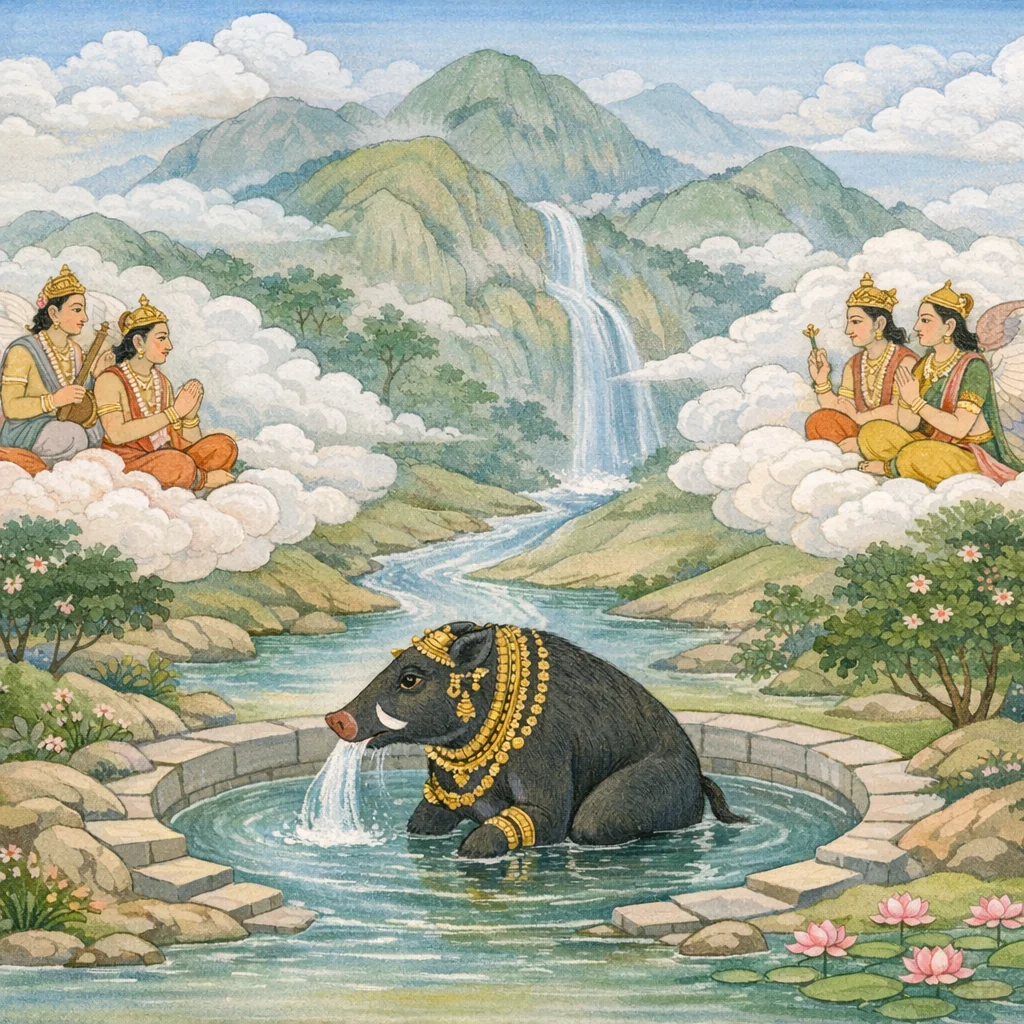
Adhyaya 79: Nārada Requests the Sequential Fruits of Tīrthas; The Origins of Tryambaka and Vārāha Tīrthas
Binubuksan ng Adhyaya 79 ang masidhing pagnanais ni Nārada na marinig, nang sunod-sunod, ang mga tiyak na gantimpala (tīrthaphala) ng mga banal na tawiran, lalo na ang landas na nagpapabanal ng Ilog Gaṅgā at ang mga kuwentong pinagmulan ng mga pook na ito. Sumagot si Brahmā na hindi kayang isa-isahin nang lubos ang lahat ng pagkakaiba-iba ng tīrtha at ang kanilang buong māhātmya, at hindi rin ito ganap na mabibigat ng karaniwang pakikinig; gayunman, nagbigay siya ng maikli ngunit may awtoridad na buod na nakabatay sa mga pahayag na tulad-śruti at sa kinikilalang banal na heograpiya. Itinatampok ng kabanata ang dalawang tīrtha: ang Tryambaka, na pinupuri dahil nagbibigay ng kapakinabangan sa daigdig at ng kalayaan (mokṣa), at ang Vārāha, na bantog sa tatlong daigdig. Nakaugat ang Vārāha tīrtha sa isang alamat: inagaw ng rākṣasa na si Sindhusena ang yajña at bumaba sa Rasātala, kaya nagulo ang kaayusan ng kosmikong ritwal. Nang hindi magtagumpay ang mga deva, lumapit sila kay Viṣṇu; nag-anyong Vārāha ang Panginoon, bumaba, nilipol ang mga kaaway, ibinalik ang yajña, at umahon sa parehong daanang dinaanan ng pagbaba ng Gaṅgā. Sa lugar ng pag-ahon, hinugasan ng tubig ng Gaṅgā ang dugong dumikit sa katawan at nabuo ang Vārāha-kuṇḍa. Ipinapahayag na sa tīrthang ito, ang banal na pagligo at pagbibigay-dāna ay nagbubunga ng gantimpala ng lahat ng sakripisyo, at maging ang pag-alaala sa mga ninuno ay nagdudulot ng kanilang paglilinis at pag-akyat sa langit.
Chapter Arc
{"opening_hook":"Nārada, marked by sustained curiosity (jijñāsā), presses Brahmā to enumerate—“in proper sequence” (krameṇa)—the distinct fruits of tīrthas, beginning with Gaṅgā and the itihāsa that makes her course intelligible as sacred geography.","rising_action":"Brahmā first places an epistemic boundary: tīrtha-māhātmya is effectively immeasurable, and ordinary hearing cannot bear the whole; yet he agrees to give a condensed, śruti-like précis, then narrows the focus to two named loci whose merits are both practical (snāna/dāna) and soteriological (bhukti/mukti).","climax_moment":"The etiological myth of Vārāha tīrtha: Sindhusena drags the yajña down to Rasātala, the devas fail to recover it, and Viṣṇu—becoming Vārāha—descends, slays the hostile beings, restores the sacrifice, and re-emerges along Gaṅgā’s own descent-path; Gaṅgā washes the blood from his body, and that purificatory contact crystallizes as Vārāha-kuṇḍa.","resolution":"Brahmā codifies the ritual consequences: bathing and gifting at Vārāha tīrtha yield the fruit of all kratus; even pitṛ-smaraṇa there purifies ancestors and leads them heavenward—closing the chapter by converting myth into repeatable pilgrimage practice.","key_verse":"Teaching (translation): “At Vārāha-tīrtha, by bathing and by gifting, one attains the fruit of all sacrifices; and by remembering one’s ancestors there, the pitṛs are purified of sin and ascend to heaven.”"}
Thematic Essence
{"primary_theme":"Tīrtha-māhātmya as ordered sacred geography: how specific sites (Tryambaka, Vārāha) yield defined fruits through myth-grounded practice.","secondary_themes":["Epistemic restraint in purāṇic discourse (the immeasurable totality of tīrthas vs. a usable précis)","Bhukti–mukti synthesis: pilgrimage as both worldly welfare and liberation","Yajña as cosmic infrastructure; avatāra as ritual-restoration","Gaṅgā as purifying medium that sacralizes landscape through contact with the divine"],"brahma_purana_doctrine":"Tīrtha is not merely a place but a repeatable interface between mythic event and present practice: snāna/dāna/pitṛ-smaraṇa at a site created by avatāric action is declared equivalent to comprehensive sacrificial merit (sarva-kratu-phala).","adi_purana_significance":"As an ‘Ādi’ purāṇa-style chapter, it demonstrates the template by which primordial narrative (avatāra restoring yajña) is converted into dharma for later ages—mapping cosmic history onto a pilgrim’s itinerary and daily ritual acts."}
Emotional Journey
{"opening_rasa":"adbhuta","climax_rasa":"vīra","closing_rasa":"śānta","rasa_transitions":["adbhuta → śānta","śānta → raudra","raudra → vīra","vīra → adbhuta","adbhuta → śānta"],"devotional_peaks":["Brahmā’s ‘immeasurable yet mercifully condensed’ authorization of tīrtha-knowledge","Viṣṇu’s descent as Vārāha to restore the yajña (dharma re-established)","Gaṅgā cleansing the blood-stained Vārāha body—tīrtha born from purification","Promise that pitṛ-smaraṇa at Vārāha tīrtha uplifts ancestors to heaven"]}
Tirtha Focus
{"tirthas_covered":["Gaṅgā","Brahmagiri","Gaṅgāsravaṇa","Tryambaka tīrtha","Vārāha tīrtha","Vārāha-kuṇḍa"],"jagannath_content":null,"surya_content":null,"cosmology_content":"Rasātala is invoked as the netherworld arena where ritual order is disrupted and restored; the chapter links cosmic stability to the continuity of yajña and to avatāric intervention."}
Shlokas in Adhyaya 79
Verse 1
नारद उवाच न मनस् तृप्तिम् आधत्ते कथाः शृण्वत् त्वयेरिताः पृथक् तीर्थफलं श्रोतुं प्रवृत्तं मम मानसम् //
Sa pasimula (79.1), sinisimulan ng Purana ang susunod na paksa sa pamamagitan ng banal at marangal na pananalita.
Verse 2
क्रमशो ब्राह्मणानीतां गङ्गां मे प्रथमं वद पृथक् तीर्थफलं पुण्यं सेतिहासं यथाक्रमम् //
Ang talata (79.2) ay nagpapatuloy sa pagpapalawig ng aral, inaakay ang puso sa Dharma at kapayapaan.
Verse 3
ब्रह्मोवाच तीर्थानां च पृथग् भावं फलं माहात्म्यम् एव च सर्वं वक्तुं न शक्नोमि न च त्वं श्रवणे क्षमः //
Ang talatang ito (bilang 3) sa Brahma Purana ay naglalahad ng banal na Dharma at sinaunang kaalaman.
Verse 4
तथापि किंचिद् वक्ष्यामि शृणु नारद यत्नतः यान्य् उक्तानि च तीर्थानि श्रुतिवाक्यानि यानि च //
Ang talatang ito (bilang 4) ay nagpapatuloy sa pagpapaliwanag ng kahulugan ng Dharma at sinaunang tradisyon nang may paggalang.
Verse 5
तानि वक्ष्यामि संक्षेपान् नमस्कृत्वा त्रिलोचनम् यत्रासौ भगवान् आसीत् प्रत्यक्षस् त्र्यम्बको मुने //
Ang talatang ito (bilang 5) ay pumupuri sa Dharma at naglalahad ng kaalamang panrelihiyon na dapat igalang.
Verse 6
त्र्यम्बकं नाम तत् तीर्थं भुक्तिमुक्तिप्रदायकम् वाराहम् अपरं तीर्थं त्रिषु लोकेषु विश्रुतम् //
Ang talatang ito (bilang 6) ay maringal na nagsasalaysay tungkol sa Dharma at sa pamamaraang gumabay sa buhay ayon sa sinaunang kaugalian.
Verse 7
तस्य रूपं प्रवक्ष्यामि नाम विष्णोर् यथाभवत् पुरा देवान् पराभूय यज्ञम् आदाय राक्षसः //
Ang talatang ito (bilang 7) ay nagtatapos sa pagpapatibay ng katotohanan at ng mga birtud na dapat isagawa.
Verse 8
रसातलम् अनुप्राप्तः सिन्धुसेन इति श्रुतः यज्ञे तलम् अनुप्राप्ते निर्यज्ञा ह्य् अभवन् मही //
Taludtod 8: Ipinapahayag ng Purana ang banal na katotohanan at kaayusang Dharma ayon sa Veda.
Verse 9
नायं लोको ऽस्ति न परो यज्ञे नष्ट इतीत्वराः सुरास् तम् एव विविशू रसातलम् अनुद्विषम् //
Taludtod 9: Dapat pakinggan ng mga pantas nang may paggalang upang luminaw ang karunungan at mapayapa ang isip.
Verse 10
नाशक्नुवंस् तु तं जेतुं देवा इन्द्रपुरोगमाः विष्णुं पुराणपुरुषं गत्वा तस्मै न्यवेदयन् //
Taludtod 10: Ang pag-alaala sa banal na Pangalan at pagsunod sa Dharma ay nagdudulot ng punya at nag-iingat sa kapahamakan.
Verse 11
राक्षसस्य तु तत् कर्म यज्ञभ्रंशम् अशेषतः ततः प्रोवाच भगवान् वाराहं वपुर् आस्थितः //
Taludtod 11: Ang tapat na nag-aaral ng Purana ay magkakamit ng kaalaman at kapayapaan sa buhay na ito at sa susunod.
Verse 12
शङ्खचक्रगदापाणिर् गत्वा चैव रसातलम् आनयिष्ये मखं पुण्यं हत्वा राक्षसपुंगवान् //
Taludtod 12: Kaya nga, igalang ang Dharma at ipagpatuloy ang pakikinig at pagbasa upang laging lumago ang biyaya at punya.
Verse 13
स्वः प्रयान्तु सुराः सर्वे व्येतु वो मानसो ज्वरः येन गङ्गा तलं प्राप्ता पथा तेनैव चक्रधृक् //
Ang talatang ito (Brahma Purana, kabanata 79, berso 13) ay iginagalang bilang banal na pahayag sa tradisyong Purana.
Verse 14
जगाम तरसा पुत्र भुवं भित्त्वा रसातलम् स वराहवपुः श्रीमान् रसातलनिवासिनः //
Ang bersong ito (kabanata 79, berso 14) ay nagpapatuloy sa paglalahad ng banal na diwa ayon sa anyong Purana.
Verse 15
राक्षसान् दानवान् हत्वा मुखे धृत्वा महाध्वरम् वाराहरूपी भगवान् मखम् आदाय यज्ञभुक् //
Ang talatang ito (79.15) ay dapat basahin nang may paggalang upang maunawaan ang Dharma at ang sinaunang salaysay ng Purana.
Verse 16
येन प्राप तलं विष्णुः पथा तेनैव शत्रुजित् मुखे न्यस्य महायज्ञं निश्चक्राम रसातलात् //
Sinasabi ng bersong ito (79.16) na ang pakikinig at pag-alaala sa banal na salita ay nagdudulot ng biyaya at karunungan.
Verse 17
तत्र ब्रह्मगिरौ देवाः प्रतीक्षां चक्रिरे हरेः पथस् तस्माद् विनिःसृत्य गङ्गास्रवणम् अभ्यगात् //
Ang bersong ito (79.17) ay nagwawakas sa pagpupuri sa kapangyarihan ng Dharma at sa matuwid na pagsasagawa.
Verse 18
प्राक्षालयच् च स्वाङ्गानि असृग्लिप्तानि नारद गङ्गाम्भसा तत्र कुण्डं वाराहम् अभवत् ततः //
Ang talatang ito (bilang 18) ay itinuturing na banal na pahayag sa «Brahma Purana», upang ipagpatuloy ang pagkakasunod ng salaysay at aral.
Verse 19
मुखे न्यस्तं महायज्ञं देवानां पुरतो हरिः दत्तवांस् त्रिदशश्रेष्ठो मुखाद् यज्ञो ऽभ्यजायत //
Ang talatang ito (bilang 19) ay bahagi ng banal na wika sa «Brahma Purana», na nagpapatuloy sa pagpapaliwanag ng kahulugan ayon sa ayos.
Verse 20
ततः प्रभृति यज्ञाङ्गं प्रधानं स्रुव उच्यते वाराहरूपम् अभवद् एवं वै कारणान्तरात् //
Ang talatang ito (bilang 20) ay isinama sa «Brahma Purana» upang mapanatili ang ugnayan ng salaysay at banal na pagtuturo.
Verse 21
तस्मात् पुण्यतमं तीर्थं वाराहं सर्वकामदम् तत्र स्नानं च दानं च सर्वक्रतुफलप्रदम् //
Ang talatang ito (bilang 21) ay pagpapatuloy ng banal na pahayag, inayos sa pagkakasunod upang malinaw na maunawaan at mapukaw ang debosyon.
Verse 22
तत्र स्थितो ऽपि यः कश्चित् पितॄन् स्मरति पुण्यकृत् विमुक्ताः सर्वपापेभ्यः पितरः स्वर्गम् आप्नुयुः //
Ang talatang ito (bilang 22) ang nagwawakas sa bahaging ito, na pinananatili ang sinaunang anyo at kabanalan ng «Brahma Purana».
Frequently Asked Questions
The chapter centers on sacred topography as a vehicle for dharma: tīrthas are presented as concentrated sites of ritual efficacy where purification, restoration of cosmic order (through the recovery of the yajña), and soteriological benefit (bhukti and mukti) become accessible through disciplined acts such as snāna, dāna, and pitṛ-smaraṇa.
Vārāha tīrtha is explicitly framed as a practice-site where bathing and charitable gifting yield the fruit of all sacrifices (sarvakratu-phala). The chapter also emphasizes ancestor-remembrance at the tīrtha as an efficacious rite for the liberation and heavenly ascent of pitṛs.
The sanctity is grounded in a mythic restoration: when the yajña is seized by Sindhusena and taken to Rasātala, Viṣṇu assumes the Vārāha form, defeats the hostile beings, and retrieves the rite. The emergence along the same route associated with Gaṅgā’s descent, and the subsequent cleansing in Gaṅgā’s waters that forms Vārāha-kuṇḍa, sacralize the location as a permanent pilgrimage locus.